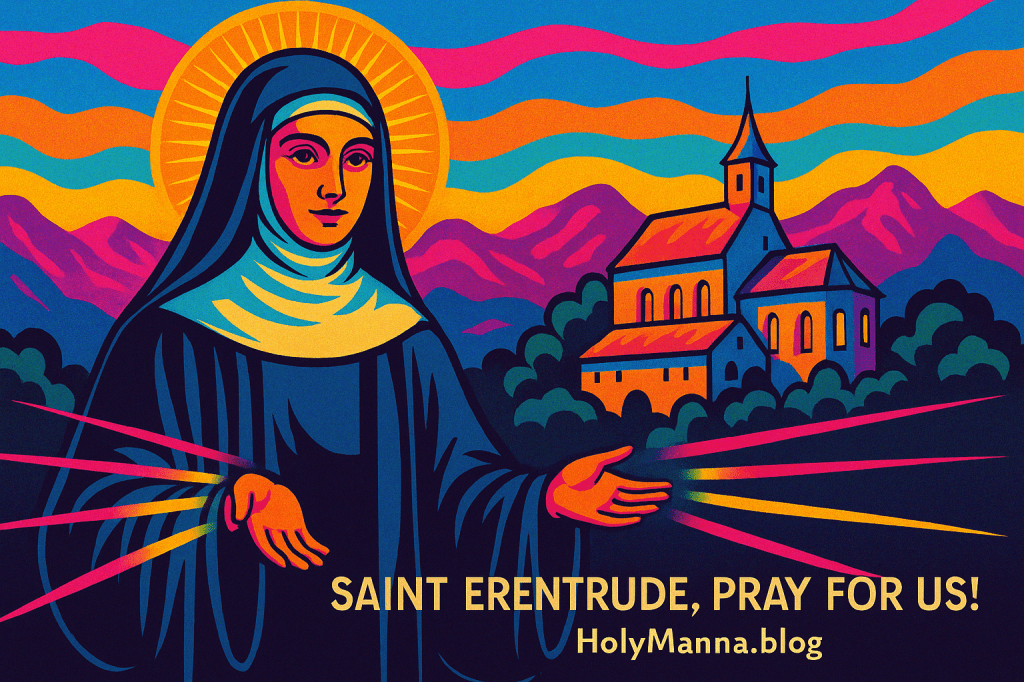
The Cloistered Star of Salzburg
While many saints dazzled the world with missionary zeal or dramatic martyrdoms, Saint Erentrude revealed her sanctity in the hidden, cloistered life. She is remembered as a spiritual mother, a pillar of monastic life, and a woman whose quiet strength helped shape the Christian roots of Austria. As the first abbess of Nonnberg Abbey—the oldest continuously operating women’s monastery in the German-speaking world—Saint Erentrude built not just walls of stone, but a community of prayer and sisterhood that endures to this day.
Though her name may not be widely known, the grace that flowed from her life continues to inspire generations. She did not seek the world’s applause but lived with eyes fixed on Christ and hands outstretched in service to others. The power of her example lies in the fact that she was not a fiery preacher or martyr in the traditional sense, but a woman who made her whole life a living sacrifice of love. She embraced poverty over privilege, prayer over prestige, and community over comfort—all for the glory of God. Her story is a precious reminder that holiness thrives in quiet soil, watered by fidelity and humility.
From Noble Blood to a Monastic Bride
Saint Erentrude was born in the late 7th century into a distinguished Frankish family. Though little is preserved about her early life, we know that she was the niece of Saint Rupert of Salzburg, the apostle of Bavaria and Austria. Her connection to Rupert is more than familial—it is spiritual. From him, she received not only the call to holiness but also the invitation to join him in his missionary work to the eastern frontiers of Christendom.
This noblewoman had all the privileges of wealth, education, and high status, yet her heart longed for something more eternal. Rather than marry into worldly power, Erentrude chose to become a bride of Christ, embracing the monastic life. When Rupert founded the city of Salzburg and built a church on the ruins of a Roman settlement, he knew that the evangelization of the people could not be complete without the presence of holy women. And so he called upon Erentrude to found a convent nearby. With courage and conviction, she responded.
She became the founding abbess of Nonnberg Abbey, and under her leadership, it flourished. The community she formed was rooted in the Rule of Saint Benedict, emphasizing prayer, work, stability, and obedience. She shaped the souls of women who would go on to shape the faith of an entire region. Erentrude was not merely an administrator; she was a mother in the fullest Christian sense—guiding, correcting, consoling, and sanctifying through her wisdom and example.
Hands that Healed, a Heart that Prayed
The sanctity of Saint Erentrude was not only seen in her leadership, but also in the miracles and spiritual gifts that marked her life. Though cloistered behind the walls of her abbey, her prayers reached into the hearts and bodies of those who sought her intercession. Stories were told of the sick who were healed, of the sorrowful who were consoled, and of the lost who were guided by her prophetic insight.
One tradition recounts a grieving mother who brought her lifeless child to the abbey, desperate for a sign of hope. Moved by compassion, Erentrude took the child into her arms and prayed fervently. The child began to stir and opened his eyes, breathing again—a miracle attributed to her pure and steadfast faith. This was not an isolated occurrence. Those who lived under her care witnessed time and again how her intercessory prayer brought about divine intervention.
She also had the gift of discerning the interior struggles of her fellow nuns. Without judgment, she would speak words of truth and healing to their hearts, calling them to greater virtue and intimacy with the Lord. These were not public miracles, but quiet ones—acts of grace that knit together the souls entrusted to her, creating a haven of holiness behind monastic walls.
Trials of a Hidden Martyrdom
Saint Erentrude did not shed her blood for Christ, but she endured a martyrdom of the heart—a continual offering of herself through sacrifice, perseverance, and spiritual warfare. Founding a monastic community in a predominantly pagan territory came with enormous challenges. Resources were scarce, and the new Christian community was often met with suspicion or hostility.
She bore the weight of her sisters’ needs, the uncertainty of a new mission field, and the loneliness of the cloistered life with patience and hope. Her days were marked by austerity and fasting, not out of self-punishment, but out of a desire to be wholly united with Christ’s suffering. Her nights were spent in prolonged vigils, offering up her prayers for the salvation of souls.
This was her cross: to suffer without recognition, to labor without applause, to love without demand. And she bore it with grace. As The Catechism reminds us, “By her fidelity and love, the Church is the bride of Christ who daily brings forth children to the Kingdom” (CCC 796). Erentrude embodied this spiritual motherhood, bearing not physical children, but a spiritual lineage that continues to flourish centuries later.
The Saint Whose Light Did Not Go Out
Saint Erentrude died around the year 718, but in many ways, her mission had only begun. Her tomb at Nonnberg Abbey became a place of pilgrimage, healing, and veneration, and the miracles attributed to her after death only magnified her reputation for holiness. Pilgrims from nearby villages came to pray at her resting place, often leaving cured of illnesses or touched by deep interior conversions.
There are accounts of plagues being halted after invoking her intercession, of dreams in which she appeared to offer guidance or comfort, and of individuals who found strength in her story when facing their own hidden sufferings. Her relics became precious to the faithful, not because they were magical, but because they were signs of a life entirely conformed to Christ.
To this day, Nonnberg Abbey continues to be a living testimony to her legacy. While Salzburg has become known for its music and art, it is in the silent halls of Erentrude’s abbey where the eternal song of prayer and devotion has never ceased. Hers is a light that continues to shine—unseen by many, but unfailing in its warmth.
Living the Hidden Fire
The life of Saint Erentrude offers a powerful invitation in our busy, noisy age: return to the silence where God speaks. Her holiness was not flashy, but it was fruitful. She teaches us that faithfulness in the hidden places bears more fruit than we may ever see. Her maternal heart, contemplative spirit, and unwavering trust in God challenge us to consider where we are being called to live more deeply for Christ.
What quiet act of service can I offer today for the love of God?
Who in my life needs spiritual guidance or a prayerful presence like Saint Erentrude offered?
Am I willing to embrace a vocation of hidden holiness, knowing that God sees what the world does not?
Let us ask for her intercession as we strive to love, to serve, and to suffer well—for in these things, the Kingdom of Heaven is revealed.
Engage with Us!
We’d love to hear your thoughts and reflections on the life of Saint Erentrude!
Share your insights in the comments below—your words may be the light someone else needs today.
Reflection Questions:
- How can you imitate Saint Erentrude’s quiet humility and spiritual leadership in your own life?
- What role does hidden prayer and sacrifice play in your faith journey?
- Have you ever experienced or witnessed the power of intercessory prayer like that of Saint Erentrude?
Let’s support one another on the path to holiness and remember:
Do everything with love—just as our Lord Jesus did.
Saint Erentrude, pray for us! 🏰
Follow us on Instagram and Facebook for more insights and reflections on living a faith-filled life.

 Holy Manna!
Leave a comment