The Relentless Flame of Evangelization
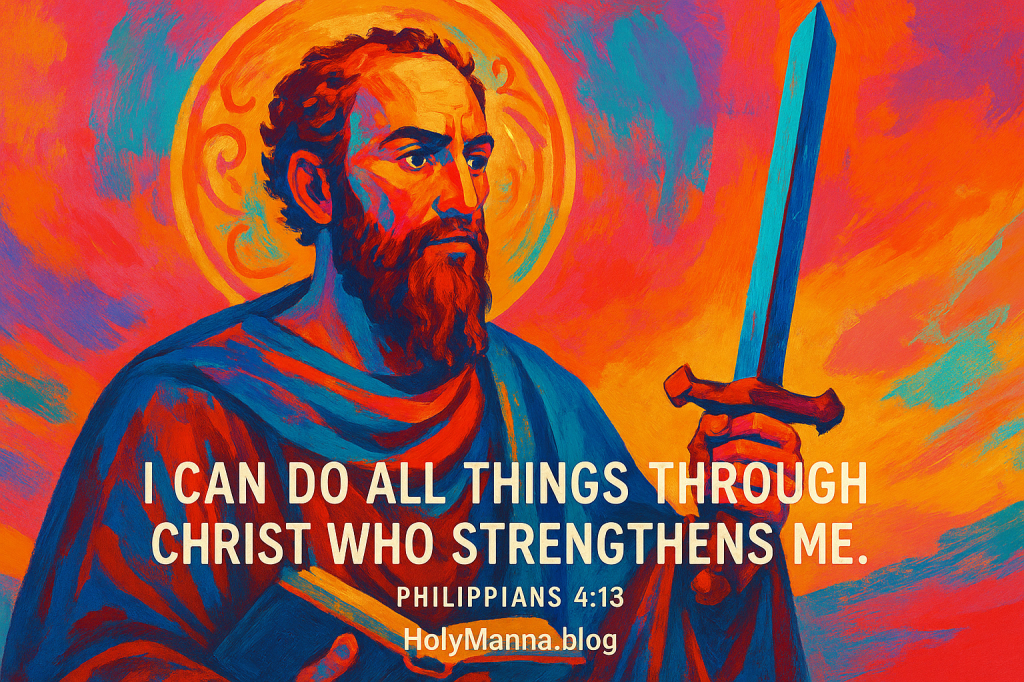
Saint Paul the Apostle is not merely one of the most recognizable figures in Christianity—he is its most fiery missionary, its most eloquent theologian, and its most radical convert. Once a feared persecutor of the Church, Paul became the Church’s greatest champion, offering his intellect, energy, and very life to the mission of spreading the Gospel. Revered as the Apostle to the Gentiles, his letters to the early Christian communities form a cornerstone of the New Testament, reflecting a man consumed by the love of Christ and utterly transformed by grace. He is often depicted in art holding a sword, representing both the Word of God (cf. Ephesians 6:17) and the means of his martyrdom, and a scroll or book—symbols of the inspired epistles he authored. Paul’s relentless missionary spirit, profound theological insights, and unwavering fidelity to Christ through suffering have inspired generations of Christians to walk boldly in faith, trusting in the God who makes all things new.
A Hunter of Christians Becomes a Herald of Christ
Born as Saul of Tarsus, this fierce young Pharisee entered the world in the vibrant city of Tarsus, located in present-day Turkey. He was a Jew of the tribe of Benjamin, raised according to the strictest traditions of the Law. A Roman citizen by birth and a pupil of the esteemed rabbi Gamaliel (cf. Acts 22:3), Saul possessed a unique blend of Jewish devotion and Greco-Roman cultural fluency, which would later serve him in his mission. But at the outset, this sharp-minded zealot became a threat to the fledgling Church. He watched approvingly as Saint Stephen was stoned to death, making him complicit in the blood of the Church’s first martyr. Saul then took up the cause of persecution with great fervor, “breathing threats and murder against the disciples of the Lord” (Acts 9:1).
Everything changed on the road to Damascus. As Saul journeyed to arrest followers of the Way, a brilliant light from heaven flashed around him. Falling to the ground, he heard the voice of Jesus say: “Saul, Saul, why are you persecuting me?” (Acts 9:4). That question shattered Saul’s world. Struck blind, he was led into Damascus, where he fasted and prayed for three days. Then came Ananias, a disciple sent by the Lord, who laid hands on him saying: “Brother Saul, the Lord Jesus… has sent me so that you may regain your sight and be filled with the Holy Spirit” (Acts 9:17). Saul was baptized, and scales fell from his eyes—both literally and spiritually. From that moment on, he became Paul, a servant of Jesus Christ, called to be an apostle and set apart for the Gospel (cf. Romans 1:1).
Paul’s conversion is not just a moment of personal transformation—it is a testimony to the overwhelming mercy of God. The man who once hunted down Christians became their greatest advocate. He journeyed across the ancient world—through Asia Minor, Greece, and Rome—preaching, debating, founding communities, and writing letters that pulsate with theological depth and pastoral love. His words continue to stir hearts today: “It is no longer I who live, but Christ who lives in me” (Galatians 2:20). Paul’s life reminds us that no one is beyond the reach of God’s mercy and that every sinner can become a saint.
Healed Hearts and Raised Lives
While Saint Paul is most celebrated for his preaching and writing, the Acts of the Apostles reveals that the Holy Spirit worked powerfully through him to perform miracles that confirmed his divine mission. These were not mere spectacles—they were manifestations of Christ’s compassion and authority operating through His servant. In Lystra, Paul encountered a man crippled from birth. Seeing that he had faith to be healed, Paul called out: “Stand upright on your feet!” The man sprang up and began to walk (Acts 14:8–10). The people were so astounded they thought Paul was a god.
In Philippi, Paul cast out a spirit of divination from a slave girl who was being exploited by her masters (Acts 16:16–18). Her liberation led to Paul and Silas being beaten and imprisoned, but even in chains, Paul’s voice rang with praise. In Troas, during one of his long teachings, a young man named Eutychus fell from a third-story window and died. Paul rushed down, embraced him, and declared: “Do not be alarmed, for his life is in him” (Acts 20:10). The boy came back to life—a sign of God’s dominion over death and a foreshadowing of the resurrection.
Later, on the island of Malta, Paul was bitten by a deadly viper but suffered no harm. The islanders, astonished, watched as Paul healed the father of the chief official and many others who were sick (Acts 28:1–9). In all these acts, Paul did not seek glory for himself but pointed all praise to the risen Christ. His miracles were not ends in themselves, but signs that the Kingdom of God had broken into the world and was being proclaimed through the very man who once tried to destroy it.
The Road of Suffering and Glory
Paul’s journey with Christ was marked not by ease or comfort but by an unrelenting stream of trials. From the moment he became a disciple, Paul was hunted, mocked, beaten, imprisoned, stoned, and shipwrecked. He catalogs his sufferings in 2 Corinthians 11:23–28—a staggering list of afflictions that would break even the strongest soul. Yet, Paul wore these scars as badges of love, proclaiming: “I bear on my body the marks of Jesus” (Galatians 6:17). For him, to suffer for Christ was to be united with Him in His Passion (cf. CCC 618).
Despite being rejected by both Jews and Gentiles, Paul never wavered. He continued preaching the Gospel with boldness, even when it meant imprisonment in Caesarea and Rome. Tradition holds that Paul was eventually sentenced to death under Emperor Nero, during a brutal wave of persecution against Christians. As a Roman citizen, he was spared crucifixion and instead beheaded—a martyrdom that took place around 67 A.D. near the Ostian Way. In laying down his life, Paul fulfilled the words he had written: “For to me, to live is Christ, and to die is gain” (Philippians 1:21). His blood became seed for the Church, and his courage continues to embolden those who suffer for their faith.
The Apostle Who Still Speaks
Though his earthly life ended in martyrdom, Saint Paul’s spiritual influence did not. His tomb became a site of pilgrimage, especially at the Basilica of Saint Paul Outside the Walls in Rome, where many have reported healings and conversions after praying near his relics. But even more profound than physical miracles are the spiritual transformations wrought through his writings. His epistles to the Romans, Corinthians, Galatians, Ephesians, Philippians, Colossians, and others have brought countless souls to Christ—forming the minds of theologians, inspiring the hearts of mystics, and guiding the feet of ordinary believers.
Saint Augustine was converted after hearing a child chant “Take and read”, prompting him to open the Scriptures to Paul’s letter to the Romans—an act that changed the course of history. Saint Ignatius of Loyola, too, was deeply influenced by Paul’s call to spiritual warfare and abandonment to divine providence. Paul’s teachings on justification, grace, suffering, and the mystical body of Christ continue to animate the Church’s mission and inform her doctrine (cf. CCC 1987–2029). In this way, Paul still speaks, still heals, still converts—his voice echoing through the ages as a thunderclap of mercy and truth.
Letting Grace Rewrite Your Story
Saint Paul’s life confronts us with the uncomfortable and glorious truth: no one is beyond redemption. His story shows that God does not merely patch up brokenness—He makes all things new (cf. Revelation 21:5). If the Lord could take a violent persecutor and make him the greatest preacher of the Gospel, then there is no limit to what He can do in your life and mine.
Have you allowed Jesus to confront you on your road to Damascus? Are you resisting His voice out of fear, shame, or pride? Paul’s encounter with Christ was both painful and liberating. He lost everything, but he gained everything that mattered. His words remind us: “I count everything as loss because of the surpassing worth of knowing Christ Jesus my Lord” (Philippians 3:8).
Let us take practical steps to follow in his footsteps. Begin by meditating on one of his epistles each week—let his words seep into your soul. Speak of Christ with conviction, especially when it’s uncomfortable. Don’t run from suffering, but see in it an opportunity to grow in love and humility. And most of all, let grace be the rhythm of your life. For as Paul reminds us, “My grace is sufficient for you, for power is made perfect in weakness” (2 Corinthians 12:9).
What story might God be writing through your weakness? Will you let Him turn your trials into testimonies, just as He did with Saint Paul?
Engage with Us!
We’d love to hear from you. How has Saint Paul’s life inspired your walk with Christ? Have his letters spoken to your heart in a particular way?
Here are a few questions to spark your reflection:
- What part of Saint Paul’s conversion resonates most with your personal faith journey?
- How can you be more courageous in living out your faith, like Saint Paul?
- What is one area in your life where you need to experience the transforming power of Christ’s mercy?
Share your thoughts below, and let’s lift each other up in prayer.
Let us always remember to walk in faith, endure with love, and proclaim the Gospel—just as Saint Paul did.
“I have fought the good fight, I have finished the race, I have kept the faith.”
(2 Timothy 4:7)
Saint Paul, pray for us! 🔥
Follow us on Instagram and Facebook for more insights and reflections on living a faith-filled life.

 Holy Manna!
Leave a comment