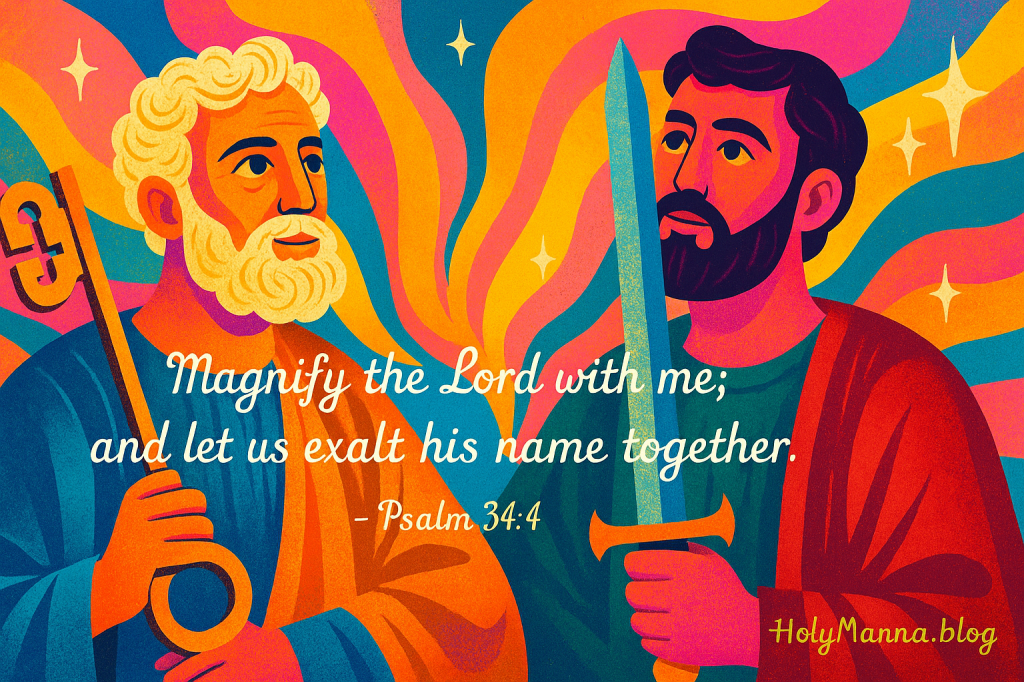
Built on the Rock, Poured Out in Love
Have you ever stood between freedom and fear, knowing that only God could make a way forward? Today, as the Church celebrates the Solemnity of Saints Peter and Paul, we’re invited to marvel at how God chooses and sustains those He calls—transforming weakness into strength, fear into boldness, and persecution into a powerful testimony. These two towering pillars of the Church were not always saints. Peter denied. Paul persecuted. And yet through grace, both became fearless witnesses—one the rock on which Christ built His Church, the other a tireless herald of the Gospel to the nations.
The readings chosen for this feast are charged with urgency, intimacy, and divine intervention. In Acts 12, we see Peter miraculously delivered from prison—a scene that shows God’s providential care for His Church even under violent persecution. Psalm 34 bursts with the grateful praise of one who has been rescued: “I sought the Lord, and he answered me, delivered me from all my fears” (Psalm 34:5). Meanwhile, Paul’s words in 2 Timothy read like a final letter from a warrior of faith: “I have competed well; I have finished the race; I have kept the faith” (2 Timothy 4:7). Finally, The Gospel of Matthew brings us to Caesarea Philippi, where Peter’s confession—“You are the Messiah, the Son of the living God”—leads Christ to entrust him with the keys to the Kingdom (Matthew 16:16).
The common thread through all of today’s passages is faithful witness and divine deliverance through apostolic authority. Peter and Paul, though very different in personality and mission, were united by their radical encounter with Christ and their total surrender to His will. Their lives remind us that God does not call the qualified; He qualifies the called. As we reflect on these readings, we’re invited to ask: How is Christ calling me to deeper trust, greater courage, and bolder witness in the face of fear or unworthiness?
First Reading – Acts 12:1–11
Chains Broken by Faithful Prayer
The Acts of the Apostles is often called the “Gospel of the Holy Spirit,” as it records the birth and expansion of the early Church after Pentecost, highlighting how the Spirit empowers ordinary men and women to carry out extraordinary missions. Today’s first reading brings us into the heart of a violent persecution under Herod Agrippa I, the grandson of Herod the Great. This Herod ruled Judea from AD 41–44 and sought to gain political favor by cracking down on the early Christian movement, which many devout Jews viewed with suspicion or outright hostility. Within this tense environment, Saint Peter—the leader of the apostles—is arrested after James the brother of John is martyred. Yet rather than despair, the Church turns to its most powerful weapon: prayer. What unfolds is a profound demonstration of God’s sovereign protection over His chosen ones, aligning with today’s feast honoring Saints Peter and Paul as faithful and fearless witnesses, even amid deadly opposition.
Acts 12:1-11
New American Bible (Revised Edition)
Herod’s Persecution of the Christians. 1 About that time King Herod laid hands upon some members of the church to harm them. 2 He had James, the brother of John, killed by the sword, 3 and when he saw that this was pleasing to the Jews he proceeded to arrest Peter also. (It was [the] feast of Unleavened Bread.) 4 He had him taken into custody and put in prison under the guard of four squads of four soldiers each. He intended to bring him before the people after Passover. 5 Peter thus was being kept in prison, but prayer by the church was fervently being made to God on his behalf.
6 On the very night before Herod was to bring him to trial, Peter, secured by double chains, was sleeping between two soldiers, while outside the door guards kept watch on the prison. 7 Suddenly the angel of the Lord stood by him and a light shone in the cell. He tapped Peter on the side and awakened him, saying, “Get up quickly.” The chains fell from his wrists. 8 The angel said to him, “Put on your belt and your sandals.” He did so. Then he said to him, “Put on your cloak and follow me.” 9 So he followed him out, not realizing that what was happening through the angel was real; he thought he was seeing a vision. 10 They passed the first guard, then the second, and came to the iron gate leading out to the city, which opened for them by itself. They emerged and made their way down an alley, and suddenly the angel left him. 11 Then Peter recovered his senses and said, “Now I know for certain that [the] Lord sent his angel and rescued me from the hand of Herod and from all that the Jewish people had been expecting.”
Detailed Exegesis
Verse 1 – “About that time King Herod laid hands upon some members of the church to harm them.”
Herod Agrippa I, a politically shrewd ruler, targets the fledgling Church not simply out of malice, but to win public approval from Jewish authorities. His attack underscores the vulnerability of the early Christian community—still small, still figuring out how to be the Body of Christ in a hostile world. It’s a reminder that persecution has been woven into the Church’s story from the beginning.
Verse 2 – “He had James, the brother of John, killed by the sword.”
James becomes the first of the apostles to be martyred, fulfilling Christ’s words in Mark 10:39: “You will drink the cup that I drink.” His execution, done by the sword, signified Roman capital punishment and a clear warning to the Church. But James’ death, like that of Stephen before him, becomes a seed planted in blood that will yield abundant fruit.
Verse 3 – “And when he saw that this was pleasing to the Jews he proceeded to arrest Peter also. (It was the feast of Unleavened Bread.)”
Peter’s arrest during the Passover season echoes Christ’s own Passion. Just as Jesus was imprisoned during Passover and brought before the people, Peter too faces the threat of death during this holy time, underlining the Paschal mystery being lived out in the Church.
Verse 4 – “He had him taken into custody and put in prison under the guard of four squads of four soldiers each. He intended to bring him before the people after Passover.”
This over-the-top security—a full 16 guards—signals Herod’s fear of Peter’s influence and perhaps even of miraculous escape, as had occurred previously in Acts 5:19. The detail foreshadows God’s intention to act yet again.
Verse 5 – “Peter thus was being kept in prison, but prayer by the church was fervently being made to God on his behalf.”
This verse captures the essence of Christian solidarity and spiritual power: while one is in chains, the rest are on their knees. The word “fervently” (ektenos in Greek) implies a deep, stretching prayer—an intense spiritual labor on behalf of their shepherd.
Verse 6 – “On the very night before Herod was to bring him to trial, Peter, secured by double chains, was sleeping between two soldiers, while outside the door guards kept watch on the prison.”
Peter sleeps in perfect trust, like Christ in the boat during the storm (Mark 4:38). His peace, despite impending execution, testifies to a deep confidence in God’s will. The double chains and constant surveillance show that from a human standpoint, escape is impossible.
Verse 7 – “Suddenly the angel of the Lord stood by him and a light shone in the cell. He tapped Peter on the side and awakened him, saying, ‘Get up quickly.’ The chains fell from his wrists.”
Divine intervention explodes into the darkness. The “angel of the Lord” and the light evoke Old Testament scenes of deliverance, especially the Exodus. The chains falling are not merely physical—they symbolize the spiritual power of God to free His people from any bondage.
Verse 8 – “The angel said to him, ‘Put on your belt and your sandals.’ He did so. Then he said to him, ‘Put on your cloak and follow me.’”
The angel’s instructions are almost liturgical, recalling the Israelites being told to dress in haste for the Exodus (Exodus 12:11). There is order and purpose in divine deliverance—it requires obedience and readiness to move when God says go.
Verse 9 – “So he followed him out, not realizing that what was happening through the angel was real; he thought he was seeing a vision.”
This surreal moment emphasizes that God’s work often surpasses what we think is possible. Even Peter—witness to so many miracles—is caught off guard by this act of divine power.
Verse 10 – “They passed the first guard, then the second, and came to the iron gate leading out to the city, which opened for them by itself. They emerged and made their way down an alley, and suddenly the angel left him.”
The detail of the iron gate opening on its own is a powerful image: when God opens a door, no man can shut it (Revelation 3:7). The Church, still in its infancy, is being shown that divine deliverance is not the exception but the norm for those in God’s hands.
Verse 11 – “Then Peter recovered his senses and said, ‘Now I know for certain that the Lord sent his angel and rescued me from the hand of Herod and from all that the Jewish people had been expecting.’”
Peter’s declaration echoes the Exodus again: God delivers His people from slavery and death, not for their own sake alone, but to proclaim His glory. Peter is spared not just to live, but to lead—to be the rock strengthened through fire.
Teachings
The Catechism of the Catholic Church teaches that “prayer attends to the grace we need for meritorious actions” (CCC 2010), and today’s reading reveals this truth powerfully. The Church’s ektenos prayer did not merely comfort Peter—it unleashed heaven’s intervention. Saint John Chrysostom once proclaimed, “The fervent prayer of the Church is more powerful than all human guards and prison doors.” What is striking is not only Peter’s rescue but the communal faith that activated it. This is a direct reflection of CCC 2635, which emphasizes intercessory prayer as a “prayer of petition which leads us to pray as Jesus did.”
Peter’s deliverance is more than a dramatic rescue; it is a sign of God’s covenant faithfulness and His intention to preserve the mission of His Church. Saint Bede the Venerable reflects that “Peter’s chains fell off at the word of the angel, just as the bonds of sin fall away from those who obey the voice of divine command.” This aligns with the Paschal mystery itself: the movement from death to life, captivity to freedom, fear to mission. The Church, even in its infancy, was being shown that neither kings nor prisons could thwart the will of God.
Historically, this episode gave courage to the early Christians who faced opposition. Though James was martyred and Peter was freed, both bore witness to the same Lord with equal fidelity. Their lives, especially when remembered together in this solemnity, echo what CCC 2473 teaches: “Martyrdom is the supreme witness given to the truth of the faith: it means bearing witness even unto death.” God’s deliverance does not always mean rescue from suffering—but it always means victory in the end.
Reflection
How many times have we found ourselves in chains—whether emotional, spiritual, or situational—and doubted that God could set us free? This reading reminds us that prayer is not our last resort; it is our first line of defense. Are we praying for one another with the same fervor the early Church showed for Peter? Are we sleeping in trust even when surrounded by what looks like failure or doom? God still sends angels, still opens iron gates, and still breaks chains. But often, it begins with the Church on its knees. In your life today, who needs your intercession? And are you willing to believe that God still works miracles in response to faithful prayer?
Responsorial Psalm – Psalm 34:2–9
The Song of the Delivered Soul
Psalm 34 is a hymn of thanksgiving traditionally attributed to King David, written after a dramatic escape from danger, as recorded in 1 Samuel 21. David, feigning madness before the Philistine king, was spared his life—an event that inspired this outpouring of praise. This psalm, then, is the voice of one who has been rescued, who knows what it means to be cornered and then saved by the Lord. In the context of today’s solemnity honoring Saints Peter and Paul, this psalm takes on new resonance: both apostles were repeatedly delivered from danger, and both lived lives of deep, personal trust in God’s providence. The Church places this psalm after Acts 12 to echo Peter’s miraculous escape from prison, amplifying the communal gratitude and awe at what God has done.
Psalm 34:2-9
New American Bible (Revised Edition)
2 I will bless the Lord at all times;
his praise shall be always in my mouth.
3 My soul will glory in the Lord;
let the poor hear and be glad.
4 Magnify the Lord with me;
and let us exalt his name together.
5 I sought the Lord, and he answered me,
delivered me from all my fears.
6 Look to him and be radiant,
and your faces may not blush for shame.
7 This poor one cried out and the Lord heard,
and from all his distress he saved him.
8 The angel of the Lord encamps
around those who fear him, and he saves them.
9 Taste and see that the Lord is good;
blessed is the stalwart one who takes refuge in him.
Detailed Exegesis
Verse 2 – “I will bless the Lord at all times; his praise shall be always in my mouth.”
The psalmist declares a continual attitude of worship. Praise is not reserved for moments of triumph—it becomes a lifestyle. This aligns with the apostles’ witness, especially Peter and Paul, who blessed God even while imprisoned, beaten, or on the brink of death. Their lives show that authentic praise isn’t based on circumstances but on God’s unchanging goodness.
Verse 3 – “My soul will glory in the Lord; let the poor hear and be glad.”
To “glory in the Lord” is to root our identity not in wealth, power, or status, but in God’s faithfulness. The “poor” here refers not only to the materially poor but also to the spiritually humble—those who recognize their dependence on God. Saints Peter and Paul both exemplified this radical humility, boasting not in themselves but in Christ crucified (1 Corinthians 2:2).
Verse 4 – “Magnify the Lord with me; and let us exalt his name together.”
This verse moves from individual praise to communal worship. The Church, just like the early Christian community praying for Peter, finds strength when it gathers in unity to honor the Lord. This verse mirrors the power of collective prayer in Acts 12:5, where the Church’s intercession led to divine intervention.
Verse 5 – “I sought the Lord, and he answered me, delivered me from all my fears.”
Here we hear the testimony of someone who actively turned to God in distress and found Him faithful. Fear is not denied—it is transformed. Peter, facing martyrdom, was at peace. Paul, nearing the end of his life, spoke with confidence, not fear. Their deliverance, whether from prison or through death into eternal life, flows from seeking the Lord first.
Verse 6 – “Look to him and be radiant, and your faces may not blush for shame.”
This verse reveals the transforming power of divine intimacy. To “look to Him” is to fix our gaze on the Lord—especially in suffering—and become radiant with His light. Saints reflect the glory of God not because of their own brilliance, but because they behold the One who is Light (John 8:12).
Verse 7 – “This poor one cried out and the Lord heard, and from all his distress he saved him.”
The singular voice becomes universal: anyone who cries out with sincerity is heard. Peter in chains, Paul in danger, and the Church in prayer—each experienced this truth. God is not distant; He is moved by our cries. As CCC 2639 teaches, “Praise embraces the other forms of prayer and carries them toward him who is its source and goal: the ‘one God, the Father, from whom are all things and for whom we exist.’”
Verse 8 – “The angel of the Lord encamps around those who fear him, and he saves them.”
This verse directly connects to the first reading, where an angel leads Peter out of prison. The angel’s presence is not symbolic—it is real. Scripture reveals again and again that God sends His angels to defend the faithful (Psalm 91:11). The “fear” of the Lord here implies reverence, obedience, and trust—qualities lived out by Peter and Paul.
Verse 9 – “Taste and see that the Lord is good; blessed is the stalwart one who takes refuge in him.”
This is not an invitation to intellectual assent but to spiritual experience. To “taste and see” is to encounter God personally, as the saints did. The “stalwart” one—literally “strong” or “resilient” in Hebrew—is not self-made, but rooted in God. Refuge in the Lord is what made Peter sleep peacefully in chains and Paul face death with joy.
Teachings
The Catechism of the Catholic Church emphasizes that praise, such as found in Psalm 34, is “the form of prayer which recognizes most immediately that God is God” (CCC 2639). Praise is not merely a response to blessings; it is an act of spiritual warfare, declaring that God is sovereign even when life is uncertain. Saints Peter and Paul modeled this kind of praise: Peter sang hymns in jail (Acts 16:25), and Paul wrote letters of encouragement from prison. They lived Psalm 34 with every breath.
Saint Augustine teaches that this psalm “was not sung by David alone, but by Christ, and through Christ, by the whole Church.” In this light, Psalm 34 becomes the cry of every soul that has been rescued, every heart that has known the terror of distress and the sweetness of deliverance. The Church Fathers saw in this psalm a call to contemplative vision: to “look to Him and be radiant” is to behold Christ crucified and risen, and to be transformed by His gaze.
Historically, this psalm became part of the Church’s liturgical and monastic tradition, often prayed by early Christians undergoing persecution. The phrase “Taste and see that the Lord is good” became associated with the Eucharist, the supreme place where we encounter God’s goodness not just spiritually, but sacramentally. As CCC 1391 teaches: “The Eucharist augments our union with Christ. The principal fruit of receiving the Eucharist in Holy Communion is an intimate union with Christ Jesus.”
Reflection
How often do we praise God only after the storm has passed? Psalm 34 invites us to praise Him in the storm, trusting that He delivers, even when we don’t yet see how. Do we glorify in the Lord, or do we still seek the world’s applause? Do we exalt His name together with others, or isolate ourselves in times of fear? This psalm calls us into a lifestyle of trust and gratitude—a willingness to cry out, wait for God’s response, and rejoice when He comes through. Like Peter and Paul, we are not called to comfortable lives, but to lives of courageous faith that glorify God in every trial. Today, take a moment to praise Him—out loud, from the heart. Let praise be always in your mouth, even before the chains fall off.
Second Reading – 2 Timothy 4:6–8
The Crown That Never Fades
The Second Letter to Timothy is widely regarded as Saint Paul’s final epistle, written from prison in Rome shortly before his martyrdom under Emperor Nero. This letter is deeply personal, filled with emotion, urgency, and fatherly instruction. It reflects Paul’s awareness that his earthly mission is coming to an end, and yet his tone is not one of despair but of triumph. Writing to Timothy—his beloved spiritual son—Paul offers a testimony of a life poured out in faithful service, a race run to completion. Today’s passage is a fitting selection for the Solemnity of Saints Peter and Paul, showing us Paul’s inner peace as he faces death, rooted in hope of the eternal reward promised to those who remain steadfast. His words are both legacy and invitation: a call to every disciple to live with eyes fixed not on this world, but on the crown that lasts forever.
2 Timothy 4:6-8
New American Bible (Revised Edition)
Reward for Fidelity. 6 For I am already being poured out like a libation, and the time of my departure is at hand. 7 I have competed well; I have finished the race; I have kept the faith. 8 From now on the crown of righteousness awaits me, which the Lord, the just judge, will award to me on that day, and not only to me, but to all who have longed for his appearance.
Detailed Exegesis
Verse 6 – “For I am already being poured out like a libation, and the time of my departure is at hand.”
Paul draws on the Old Testament imagery of a drink offering (libation), where wine was poured out at the altar in worship (Numbers 28:7). He sees his life as a sacrifice, completely offered to God. This metaphor expresses his acceptance of martyrdom—not with fear, but as a final act of worship. The word “departure” in Greek (analusis) also suggests a ship being loosed from its moorings—a gentle, dignified transition into eternal life. Paul is not clinging to this world; he is ready to go home.
Verse 7 – “I have competed well; I have finished the race; I have kept the faith.”
This verse is a powerful summation of the Christian life as one of struggle, endurance, and loyalty. The “competition” or “fight” evokes the image of an athlete or soldier—Paul’s life has not been easy, but it has been intentional and focused. He has “kept the faith,” meaning he has remained true to the Gospel, even when it cost him everything. These words are not self-congratulatory but serve as a model of what it looks like to persevere in Christ.
Verse 8 – “From now on the crown of righteousness awaits me, which the Lord, the just judge, will award to me on that day, and not only to me, but to all who have longed for his appearance.”
Paul now turns to the reward: not worldly glory, but the “crown of righteousness,” a symbol of eternal communion with God. This is not a crown he has earned, but one that will be “awarded” by the Lord—the righteous Judge who sees the heart. Importantly, Paul universalizes the promise: this crown is available to all who “long for His appearance.” The Christian life is not just about enduring suffering, but about longing for Christ, watching for Him with hopeful expectation.
Teachings
The Catechism of the Catholic Church affirms this very idea of a life offered in sacrificial love: “The Christian who unites his own death to that of Jesus views it as a step towards him and an entrance into everlasting life” (CCC 1020). Paul’s imagery of being poured out like a libation is not unique to him; it is echoed at every Mass. In the Eucharistic liturgy, Christ’s sacrifice is re-presented, and the faithful are called to unite their own sufferings, labors, and deaths to His. Paul’s life becomes Eucharistic—a total gift, broken and shared.
Saint Ignatius of Antioch, writing not long after Paul, uses similar language before his own martyrdom: “Permit me to be an imitator of the Passion of my God… let me be food for the wild beasts, through whom I can reach God” (Letter to the Romans). This profound desire to be conformed to Christ in life and in death reflects a spirituality of martyrdom rooted in love. Saints Peter and Paul, though different in temperament and mission, both gave everything for the sake of Christ—and did so joyfully.
The Church also teaches that heaven is not a reward for good behavior, but the fulfillment of God’s promise to those who are faithful. As CCC 1821 beautifully states: “We can therefore hope in the glory of heaven promised by God to those who love him and do his will… hoping for the ‘crown of righteousness,’ we are sustained by hope during our earthly pilgrimage.” Paul’s hope was not vague optimism; it was grounded in a Person—Jesus Christ—and in the certainty of the Resurrection. This is why he could face execution not with dread, but with anticipation.
Reflection
Have you ever considered what you would say if you knew your time on earth was ending? Would your words echo Paul’s—words of peace, fulfillment, and hope? What race are you running? What crown are you chasing? Today’s reading challenges us to live each day with the end in mind—not in fear, but with purpose. It is not enough to start the race well; we must finish it. That means fighting the good fight daily through prayer, charity, integrity, and endurance. Like Paul, we are called to keep the faith—not just privately, but publicly, courageously, and sacrificially. Do you long for His appearance? If not, ask Him to stir that longing in you, so that when the day of your own departure comes, your life, too, will have been a living libation poured out for love.
Holy Gospel – Matthew 16:13–19
The Rock and the Keys
The Gospel of Matthew is uniquely structured to reveal Jesus as the long-awaited Messiah and authoritative Teacher, the New Moses who fulfills the Law and the Prophets. In chapter 16, Jesus and His disciples have entered the region of Caesarea Philippi, a pagan stronghold known for its worship of many gods, including a prominent shrine to the emperor. It is in this setting—surrounded by false idols and imperial power—that Jesus asks the defining question of His ministry: “Who do you say that I am?” Peter’s response becomes the foundation of the Church, and Jesus’ declaration about Peter’s role is the basis of the papacy. For this Solemnity of Saints Peter and Paul, this Gospel passage reveals Peter’s divine appointment as the rock upon which Christ builds His Church, echoing the power of faithful witness, divine revelation, and spiritual authority at the heart of the apostolic mission.
Matthew 16:13-19
New American Bible (Revised Edition)
13 When Jesus went into the region of Caesarea Philippi he asked his disciples, “Who do people say that the Son of Man is?” 14 They replied, “Some say John the Baptist, others Elijah, still others Jeremiah or one of the prophets.” 15 He said to them, “But who do you say that I am?” 16 Simon Peter said in reply, “You are the Messiah, the Son of the living God.” 17 Jesus said to him in reply, “Blessed are you, Simon son of Jonah. For flesh and blood has not revealed this to you, but my heavenly Father. 18 And so I say to you, you are Peter, and upon this rock I will build my church, and the gates of the netherworld shall not prevail against it. 19 I will give you the keys to the kingdom of heaven. Whatever you bind on earth shall be bound in heaven; and whatever you loose on earth shall be loosed in heaven.”
Detailed Exegesis
Verse 13 – “When Jesus went into the region of Caesarea Philippi he asked his disciples, ‘Who do people say that the Son of Man is?’”
Caesarea Philippi was a striking location for this moment—known for its pagan temples and emperor worship, it symbolized the competing claims for allegiance. Jesus begins with a public question about popular opinion, referring to Himself as “Son of Man,” a messianic title from Daniel 7:13. The setting contrasts earthly kingdoms with the coming Kingdom of God.
Verse 14 – “They replied, ‘Some say John the Baptist, others Elijah, still others Jeremiah or one of the prophets.’”
The people recognize something prophetic about Jesus, but they fall short of the truth. Each figure mentioned—John, Elijah, Jeremiah—represents a fragment of the messianic expectation, but none capture the fullness. This reveals the limits of human speculation and sets the stage for divine revelation.
Verse 15 – “He said to them, ‘But who do you say that I am?’”
This is the heart of the Gospel—the question every believer must answer. It’s not enough to rely on cultural or secondhand ideas about Jesus. This direct question forces the disciples, and us, into a personal response. Peter’s answer will not only identify Jesus rightly but also reveal his own vocation.
Verse 16 – “Simon Peter said in reply, ‘You are the Messiah, the Son of the living God.’”
Peter’s confession is bold, clear, and divinely inspired. In contrast to the dead idols of Caesarea Philippi, Peter proclaims Jesus as the Son of the living God. His use of “Messiah” acknowledges Jesus as the anointed One, the fulfillment of Israel’s hopes. This moment marks a decisive turning point in Peter’s role among the Twelve.
Verse 17 – “Jesus said to him in reply, ‘Blessed are you, Simon son of Jonah. For flesh and blood has not revealed this to you, but my heavenly Father.’”
Jesus affirms that Peter’s insight is not human guesswork but a gift of divine revelation. The name “Simon son of Jonah” recalls his earthly lineage, but Jesus is about to elevate him beyond natural identity. This verse underscores that faith is not merely intellectual; it is a supernatural grace.
Verse 18 – “And so I say to you, you are Peter, and upon this rock I will build my church, and the gates of the netherworld shall not prevail against it.”
This is the cornerstone of Catholic teaching on the papacy. Jesus gives Simon a new name—Peter, Petros, meaning “rock.” In Scripture, a name change signals a new divine mission, as with Abram becoming Abraham. Christ promises that His Church, built on this rock, will never be overcome by death, sin, or hell. This is not just a compliment—it’s a commissioning.
Verse 19 – “I will give you the keys to the kingdom of heaven. Whatever you bind on earth shall be bound in heaven; and whatever you loose on earth shall be loosed in heaven.”
The keys represent authority, echoing Isaiah 22:22, where the steward of David’s house receives the keys to act in the king’s name. Jesus entrusts Peter with real spiritual governance: the power to bind and loose, to govern and absolve, to teach and discipline. This authority, handed on through apostolic succession, is what anchors the unity and authority of the Catholic Church.
Teachings
The Catechism of the Catholic Church speaks directly to this passage: “The Lord made Simon alone, whom he named Peter, the ‘rock’ of his Church. He gave him the keys of his Church and instituted him shepherd of the whole flock. The office of binding and loosing which was given to Peter was also assigned to the college of apostles united to its head” (CCC 881). This foundational moment at Caesarea Philippi marks the birth of the Petrine ministry, a role that continues in the papacy to this day.
Furthermore, CCC 424 teaches that Peter’s confession is the heart of our own faith: “Moved by grace, man turns toward God and away from sin, thus accepting forgiveness and righteousness from on high.” Peter’s ability to proclaim Jesus as the Christ was not his own doing—it was a response to grace. This teaches us that all authentic confession of faith is born from an encounter with the living God.
The Church Fathers also saw this passage as a confirmation of the visible unity of the Church. Saint Augustine wrote: “Peter, who for the sake of representing the Church had received the keys of the Kingdom of Heaven… represented the whole Church” (Sermon 295). What began with Peter becomes the structure of communion and governance for the Body of Christ. Saints Peter and Paul, though different in mission, were united in this singular purpose: to preach Christ crucified and to establish His Church as a light to the nations.
Reflection
Who do you say that He is? This is not merely a question for Peter or the first disciples—it is a question that echoes in every heart. The world offers many answers: a good teacher, a prophet, a moral example. But only one answer has the power to save: “You are the Messiah, the Son of the living God.” Have you made that confession with your life? Do your choices, relationships, and priorities proclaim Christ’s lordship? Today’s Gospel challenges us to live not just as believers but as witnesses—those who not only confess Christ but live as members of His Church, built on the rock and sustained by His promise. Do you trust in the Church He founded? Do you see the pope as the successor of Peter, and the teachings of the Church as the keys that open heaven? If we, like Peter, can say yes—then we, too, become rocks on which the Lord can build.
Unshakable Witnesses, Unbreakable Church
Today’s readings form a mosaic of courage, grace, and divine mission, all centered on the towering lives of Saints Peter and Paul. From Peter’s miraculous escape in Acts 12, to Paul’s moving farewell in 2 Timothy 4, to the joyful thanksgiving of Psalm 34, and finally to the foundational moment in Matthew 16 when Peter is named the rock—the Church invites us to contemplate what faithful witness looks like. Peter shows us that even the one who once denied Christ can become the rock of the Church when renewed by grace. Paul reminds us that the race is worth running, even when the road leads through chains and suffering. Together, these apostles did not just preach the Gospel—they lived and died for it.
The central theme of faithful witness and divine deliverance through apostolic authority resounds in every passage. Peter is protected so that he might lead. Paul is poured out so that he might inspire. Both point us to Jesus—the true foundation, the faithful judge, the Savior whose power is made perfect in weakness. Their lives are not museum pieces of ancient heroism; they are blueprints for the Church today. Through their witness, we learn that suffering does not destroy the mission—it often fuels it. And that divine authority, given by Christ to the apostles, still guides and protects the Church He founded.
What is God asking of you today? Are you willing to let Him build something unshakable in your heart? Like Peter, you may feel unworthy. Like Paul, you may feel spent. But the Lord specializes in transforming the ordinary into the extraordinary. On this solemn feast, let us ask for the intercession of Saints Peter and Paul, that we too may boldly proclaim Christ with our lives. Let us trust in the Church they helped build, knowing that the gates of hell shall not prevail against it. And let us run the race before us, not with fear, but with faith—toward the crown that awaits all who long for His glorious appearing.
Engage with Us!
We’d love to hear how the Lord spoke to your heart through today’s readings and the witness of Saints Peter and Paul. Share your thoughts, prayers, or personal reflections in the comments below—your voice might be the encouragement someone else needs today!
Reflection Questions:
First Reading – Acts 12:1–11
When have you experienced God’s deliverance from a situation that felt impossible? Are you interceding fervently for others in your community like the early Church did for Peter?
Responsorial Psalm – Psalm 34:2–9
How can you praise God even in the midst of fear or uncertainty? What does it mean for you to “taste and see that the Lord is good”?
Second Reading – 2 Timothy 4:6–8
What race are you running right now in your spiritual life? Are you living each day in a way that keeps your eyes on the eternal crown?
Holy Gospel – Matthew 16:13–19
Who do you say that Jesus is—not just with your words, but with your life? Do you truly trust the Church that Christ built upon the rock of Peter?
As you go forward today, may you walk with boldness, humility, and unwavering faith. Let every word, every step, and every struggle be an offering to God. Live the Gospel with the courage of Peter and the fire of Paul—and do all things with the love and mercy that Jesus taught us.
Follow us on Instagram and Facebook for more insights and reflections on living a faith-filled life.

 Holy Manna!
Leave a comment