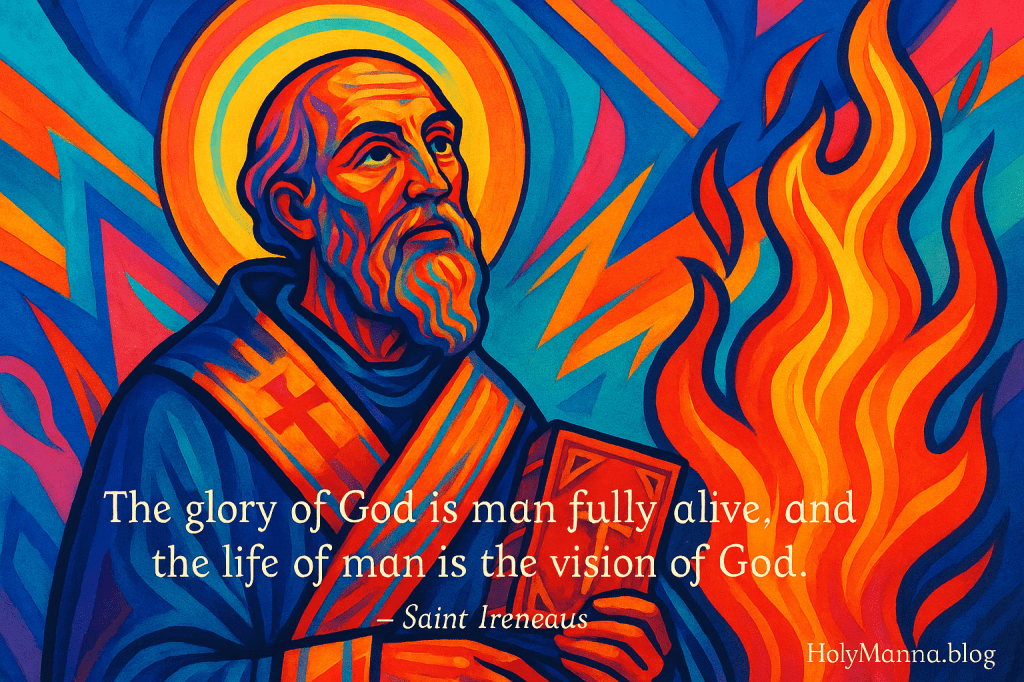
The Torchbearer of Truth
When confusion threatened to eclipse the light of the Gospel in the second century, Saint Irenaeus emerged as a radiant torchbearer of apostolic truth. Revered as one of the first great theologians of the Church, Irenaeus was a man of peace and conviction, a bishop who carried the flame of the Apostles into the heart of Europe. He stood boldly against the heresies of his time—especially the complex and dangerous errors of Gnosticism—offering a clear, faithful, and Spirit-filled vision of Christian doctrine. His most enduring contribution was his defense of the Incarnation: that Jesus Christ, both fully God and fully man, entered the world to redeem it entirely—not partially, not symbolically, but fully and lovingly. This profound truth was not just theological for Irenaeus—it was deeply personal and pastoral. He knew that when people believe false things about God, they begin to live false lives. Thus, he worked tirelessly to lead his flock—and future generations—into the fullness of divine truth. Canonized for both his writings and his martyrdom, and named a Doctor of the Church by Pope Francis in 2022 with the unique title Doctor of Unity, Saint Irenaeus remains a timeless model of fidelity, courage, and Christian wisdom.
Apostolic Echoes
Irenaeus was born around the year 130 A.D. in Smyrna, a prominent city in Asia Minor, in what is now modern-day Turkey. He grew up in a region rich with apostolic presence, and his spiritual formation was nothing short of extraordinary. As a youth, he was a student of Saint Polycarp, the venerable bishop of Smyrna who had been personally discipled by Saint John the Apostle. This lineage is not merely historical trivia—it forms the backbone of Irenaeus’ credibility and authority. He was a living link in the sacred chain of apostolic succession. His memories of Polycarp’s preaching and witness shaped his understanding of Jesus and the Church for the rest of his life. “What I heard from him,” Irenaeus wrote later, “I committed not to paper but to my heart.”
Sometime in his adult years, Irenaeus journeyed west to Gaul, settling in Lugdunum (modern-day Lyon, France), a burgeoning Christian community in a pagan land. There, he was ordained a priest under the bishop Saint Pothinus. In 177 A.D., while violent persecution broke out under the Roman emperor Marcus Aurelius, Irenaeus was sent to Rome with an urgent letter. When he returned, many of the faithful had been martyred, including Bishop Pothinus. Irenaeus was then appointed bishop of Lyon and began the work of rebuilding and strengthening a deeply wounded Church.
As bishop, Irenaeus became most famous for his work Adversus Haereses (Against Heresies), a five-book theological masterpiece that systematically dismantled Gnostic teachings and upheld the truth of the Gospel as taught by the Apostles. Gnosticism, with its elitist doctrine of secret knowledge and rejection of the material world, threatened the very foundation of the Christian faith. In response, Irenaeus declared that the fullness of revelation is found in the Church and that salvation is open to all through Christ. He emphasized that Scripture and Tradition, passed down through the bishops in communion with Rome, are the authentic sources of truth. His defense of the Incarnation, the Resurrection, and the sacramental life of the Church would become cornerstones of Catholic theology for centuries to come.
The Quiet Wonderworker
While Saint Irenaeus is best remembered for his theological brilliance, there are also traditions that speak to the spiritual authority and healing grace he carried in life. One early account tells of a man afflicted by an evil spirit who was healed when Irenaeus prayed over him and laid hands upon him. The man was freed, not just from torment, but from a life of sin and despair. This simple story, though not recorded in grand volumes of miracles, reflects the deep pastoral heart of a bishop whose hands were anointed for more than writing—they were instruments of Christ’s healing power.
What made Irenaeus’ ministry miraculous was the way he brought people from darkness to light, from falsehood to truth, from death to life. Through preaching, prayer, and theological instruction, he rescued countless souls from the clutches of Gnosticism and led them to the heart of Christ. “God has no need of man,” he once wrote, “but man has need of God.” That radical humility shaped his every action, every counsel, every correction. Even those he disagreed with, he treated with charity, always hoping to convert rather than condemn. In this, his life mirrored the miracles of Jesus Himself—touching minds and hearts, healing the whole person, body and soul.
Faith in the Furnace
The world Irenaeus lived in was not safe for Christians. Roman authorities viewed the faith as subversive, and internal heresies often fractured the fragile unity of believers. As a bishop, Irenaeus faced threats from all sides. Yet he stood firm, undeterred by persecution, false teachings, or political manipulation. He did not wield power with force but with the serene authority of truth. His courage was not boastful but quiet—rooted in prayer, fasting, study, and the unshakable conviction that Jesus Christ is Lord.
According to tradition, Irenaeus was martyred around the year 202 A.D., during the reign of Emperor Septimius Severus. It is believed he was beheaded, though some accounts are sparse. What matters more than the method of death is the spirit in which he died. Like Saint Polycarp, his teacher, and Saint John, the beloved disciple, he offered his life in faithful witness to the Gospel. His martyrdom was the final punctuation mark on a life wholly given to God. In giving his blood, he sealed every word he had ever written about the love, mercy, and power of Christ.
Echoes Beyond the Tomb
After his death, Saint Irenaeus was buried in Lyon, and his tomb became a site of veneration for centuries. Pilgrims came to pray, to seek healing, and to draw inspiration from the bishop who had shown them the face of Christ. Testimonies from the early Church speak of spiritual and even physical healings at his tomb. Though the site was tragically destroyed during the Protestant Reformation, the memory of his sanctity remained indelible.
But the miracles did not stop. Irenaeus’ writings continued to convert hearts, clarify doctrine, and strengthen believers through the centuries. His defense of apostolic succession was key at the Council of Nicaea. His theology would inspire saints like Augustine, Athanasius, and John Henry Newman. Even in the 21st century, his voice echoes in the halls of the Vatican and the homes of the faithful. When Pope Francis named him Doctor of the Church in 2022, he emphasized Irenaeus’ role as a bridge between East and West, calling him the Doctor of Unity—a title that honors not only his intellect but his burning desire for a united body of Christ.
Living the Light
Saint Irenaeus invites us into a Christianity that is deeply rooted, intellectually vibrant, and joyfully embodied. His central teaching—that the glory of God is man fully alive—reminds us that holiness is not about escaping the world but transforming it through grace. The Incarnation reveals our own dignity and vocation: to be images of Christ in the world.
Are we, like Irenaeus, students of the Apostles? Do we allow the Catechism, the Scriptures, and the Eucharist to shape our minds and hearts? In a culture that often preaches relativism and confusion, Irenaeus teaches us to speak truth clearly, but with love. He shows us that unity matters, that doctrine matters, and that compassion must always be the face of orthodoxy.
Let us learn from him. Let us study the Gospel of John, meditate on the Catechism of the Catholic Church (especially paragraphs like CCC 80–83 on the transmission of Divine Revelation), and ask for the intercession of this great saint. He will help us defend our faith—not with anger, but with wisdom. Not with pride, but with the joy of knowing Christ.
Engage with Us!
What stands out to you about the life of Saint Irenaeus? Have you encountered modern-day “heresies” or confusion that challenge your faith? Let’s support one another in staying grounded in the truth that comes from Christ and His Church.
Reflection Questions:
- Do I take time to learn and understand my Catholic faith deeply, as Saint Irenaeus did?
- How do I respond when I encounter false teachings or confusion—on social media, in conversations, or in secular culture?
- Am I striving to be a person of unity in my family, parish, and community, as Saint Irenaeus was for the early Church?
We invite you to share your thoughts in the comments, and let’s encourage each other to keep growing in love and truth. Let everything we do be done with love, as our Lord Jesus did.
Saint Irenaeus, pray for us! 🔥
Follow us on Instagram and Facebook for more insights and reflections on living a faith-filled life.

 Holy Manna!
Leave a comment