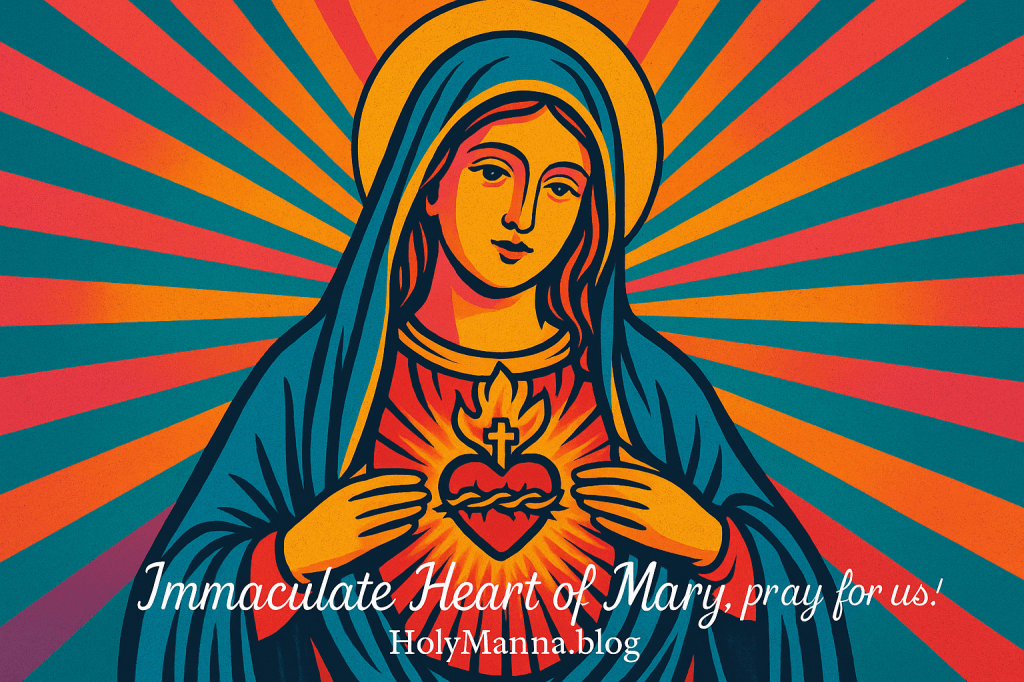
A Heart That Leads Us Home
On the Saturday after the Solemnity of the Sacred Heart of Jesus, the Church, like a child turning toward the gentle gaze of its mother, celebrates the Memorial of the Immaculate Heart of the Blessed Virgin Mary. This feast is far more than an emotional response to the suffering of a mother; it is a theological invitation into the very mystery of redemption, reflected and lived out in Mary’s own heart.
What makes this memorial so profoundly important is its placement—intentionally paired with the feast of her Son’s Heart, it reveals their perfect union. Where the Sacred Heart of Jesus overflows with divine love for humanity, the Immaculate Heart of Mary receives and mirrors that love in her own unique, maternal way. Her heart is the garden where the Word took root, where grace was never rejected, and where pain was transfigured into prayer. Celebrating this feast is not only about honoring Mary—it’s about learning from her how to love Jesus more deeply, with purity, courage, and unwavering trust.
From Hidden Sorrows to Global Devotion
The foundation of this feast lies deep in Scripture and Church tradition. From the moment the angel Gabriel greets Mary in The Gospel of Luke, we are given glimpses into the interior life of this young woman who was destined to become the Mother of God. Luke 2:19 tells us: “But Mary kept all these things, pondering them in her heart.” And later, at the presentation in the Temple, Simeon prophesies that “a sword will pierce your own soul also” (Luke 2:35), marking the beginning of Mary’s lifelong participation in the sufferings of her Son.
Centuries later, in a time when Europe was marked by war, disease, and religious upheaval, St. John Eudes (1601–1680) began promoting a public devotion to the Hearts of Jesus and Mary. He composed liturgical texts in their honor and emphasized their unity in God’s plan of salvation. But the devotion remained relatively localized until the 20th century, when it would gain universal attention through a series of supernatural events in rural Portugal.
In Fatima, 1917, the Blessed Virgin appeared to three shepherd children—Lucia dos Santos and her cousins, Jacinta and Francisco Marto. These apparitions came at a time of great uncertainty: World War I raged across Europe, and secularism and atheistic communism were spreading rapidly. Mary’s message to the children was both maternal and urgent: “Jesus wants to use you to make me known and loved. He wants to establish in the world devotion to my Immaculate Heart.” In the July 13 apparition, she showed the children a vision of hell and explained that the salvation of many souls depended on reparation made to her Heart.
It was this event that sparked the global expansion of the devotion. In 1942, as World War II tore through humanity, Pope Pius XII, responding to Our Lady of Fatima’s requests, consecrated the world to her Immaculate Heart. The feast was later made official in 1944 and eventually moved to its present date by Pope Paul VI in 1969, highlighting its intimate connection with the Sacred Heart of Jesus.
The Furnace of Grace and Sorrow
What makes the Immaculate Heart of Mary so unique in the economy of salvation is not merely her purity, but her complete and active cooperation with God’s plan. The Church teaches that Mary, though human like us, was preserved from the stain of original sin through the singular grace of the Immaculate Conception. Her heart was never tainted by disobedience or rebellion; instead, it remained a constant yes—a fiat—to the will of God.
According to the Catechism of the Catholic Church, “By her complete adherence to the Father’s will, to his Son’s redemptive work, and to every prompting of the Holy Spirit, the Virgin Mary is the Church’s model of faith and charity” (CCC 967). Her Immaculate Heart, then, is not only a symbol of maternal affection but a theological model of the fully redeemed human response to God’s love. It is a heart formed by grace, but also one tested in fire—a heart that has pondered joy and wept beneath the Cross.
The popes have long echoed this reality. In Haurietis Aquas (1956), Pope Pius XII wrote that “the most pure heart of the Virgin… was so inflamed with love for God and for Jesus that she could not but be consumed with sorrow for the sufferings of her Son.” Likewise, St. John Paul II, who famously survived an assassination attempt on May 13—the Feast of Our Lady of Fatima—attributed his survival to Mary’s intercession. In his homily at Fatima in 1982, he declared: “In the light of the Immaculate Heart of Mary, we understand the meaning of the sacrifice of Christ.”
To venerate her Heart is to draw near to the very fire of divine love—received, reflected, and returned.
Sacred Pathways to a Mother’s Heart
Devotion to the Immaculate Heart of Mary is not merely emotional or symbolic; it is deeply sacramental and practical. One of the most powerful practices associated with this feast is the Five First Saturdays Devotion, given by Our Lady to Sister Lucia in 1925. She asked for five consecutive Saturdays of reparation: going to Confession, receiving Holy Communion, praying the Rosary, and meditating for fifteen minutes on the mysteries—all with the intention of making reparation to her Immaculate Heart.
Why five Saturdays? Mary explained that they correspond to the five principal ways she is offended: blasphemies against her Immaculate Conception, her virginity, her divine maternity, those who implant hatred in children’s hearts against her, and the desecration of her images.
Countless faithful around the world have consecrated themselves to the Immaculate Heart of Mary, following in the footsteps of saints like St. Louis de Montfort, St. Maximilian Kolbe, and St. Teresa of Calcutta. Through consecration, one entrusts all that one is—mind, body, heart, and soul—into the maternal arms of Mary, who never leads us anywhere but to Jesus.
Among the holiest destinations for this devotion is the Sanctuary of Our Lady of Fatima in Portugal. Pilgrims travel from all corners of the globe to pray the Rosary, walk the candlelit processions, and offer penance, all under the maternal gaze of the Virgin who once stood there to call the world to repentance and peace.
These practices are not outdated rituals; they are living pathways of grace. When we meditate on her sorrows, entrust our hearts to hers, and walk the road of penance and prayer, we are not simply honoring her—we are being formed by her, into saints.
A Celebration That Echoes Across the Earth
Though the feast originated in Europe, the celebration of the Immaculate Heart now echoes across continents and cultures, finding expression in rich and varied traditions. In the Philippines, for example, the entire month of May is dedicated to Mary through Flores de Mayo, culminating in elaborate processions where children offer flowers to Marian statues, and public Rosaries fill the air with song.
In Latin America, the devotion is often woven into vibrant community life. On the feast day, families may gather to pray novenas, decorate home altars with fresh flowers, and participate in dawn Masses followed by joyful meals shared among neighbors. In countries like Mexico and Colombia, parishes hold Marian parades with statues of the Immaculate Heart carried through the streets, followed by fireworks and folk music.
In Portugal, especially in Fatima, the faithful gather by the thousands to light candles, pray the Rosary in procession, and renew their consecrations. The atmosphere is reverent yet joyful—a communal return to the arms of a Mother who promised to never abandon her children.
In Europe and North America, churches often hold special votive Masses, organize Rosary rallies, and offer opportunities for communal consecration. Hymns like “Immaculate Mary” and “O Purest of Creatures” fill the liturgies, expressing the longing of souls to find refuge and renewal in the maternal love of Mary.
These cultural expressions of faith are not mere tradition for tradition’s sake—they are manifestations of how the Holy Spirit inculturates love for Mary in every heart, from every nation, drawing all people toward her Son.
Hearts Made New in Her Image
If the Sacred Heart of Jesus is the blazing center of divine love, then the Immaculate Heart of Mary is the mirror that reflects it perfectly into the world. Her heart teaches us how to receive, how to keep silence, how to suffer redemptively, and how to love with purity and depth.
What does it mean to live in the school of Mary’s heart? It means cultivating a life of meditative prayer, where we ponder rather than react. It means trusting God’s will, even when it leads us through trials and losses. It means choosing mercy over resentment, silence over vengeance, and hope over despair.
In a culture dominated by noise, pride, and impulsivity, Mary offers us a different path—one of contemplation, humility, and enduring love. Her Immaculate Heart is not just an object of devotion; it is an invitation to interior transformation. How is God asking you to let Mary mother you into holiness today?
Immaculate Heart of Mary, make our hearts like yours—pure, faithful, and aflame with love for Jesus.
Engage with Us!
We’d love to hear how this beautiful feast touches your heart.
Reflection Questions:
- What part of Mary’s interior life do you feel called to imitate most right now—her silence, her obedience, or her love?
- Have you ever considered consecrating yourself to the Immaculate Heart of Mary? Why or why not?
- How can the Immaculate Heart help you find peace in a world so often torn by conflict and noise?
Let’s grow together in love for Jesus and Mary. Leave your reflections in the comments and tag us on Instagram @HolyManna.blog with your Marian devotionals and prayer spaces. Let’s fill the world with images of hearts that beat for Heaven!
Immaculate Heart of Mary, pray for us! ❤️🔥
Sacred Heart of Jesus, have mercy on us! ❤️🔥
Follow us on Instagram and Facebook for more insights and reflections on living a faith-filled life.

 Holy Manna!
Leave a comment