Nothing Is Too Marvelous for the Lord
Have you ever laughed at the idea that something could actually change? That a situation too far gone, too broken, or too improbable could somehow be transformed? Today’s readings invite us to reconsider what’s possible when God steps into the story. From the desert tent of Abraham to the home of a Roman centurion, from the song of Mary to the healings in Capernaum, one truth resounds: nothing is too marvelous for the Lord. These passages echo across generations, affirming that God’s mercy transcends our limitations and His promises never fail.
In Genesis 18, we encounter Abraham and Sarah at a moment of quiet hospitality disrupted by divine mystery. Sarah’s disbelief, marked by laughter at the absurdity of bearing a child in old age, mirrors our own tendency to doubt when God’s promises stretch beyond human logic. Yet the Lord responds with a powerful question: “Is anything too marvelous for the Lord to do?” This question becomes the thread weaving through today’s Gospel in Matthew 8, where a Roman centurion believes in Jesus’ authority to heal with just a word. His faith is radical, unexpected, and deeply pleasing to Christ, who proclaims, “In no one in Israel have I found such faith”.
Between these two scenes of miraculous intervention stands Mary’s Magnificat in Luke 1, a song of praise from a young woman who also received a promise that defied nature: the Incarnation. Her words celebrate a God who lifts the lowly, fills the hungry, and remembers His covenant with Abraham. This covenantal thread ties all the readings together, reminding us that the God of Sarah, Mary, and the centurion is still at work—healing, fulfilling promises, and calling us to trust. What if the very situation you’ve written off is the one God plans to redeem?
First Reading – Genesis 18:1–15
When God Shows Up at Your Door
The Book of Genesis is not only the origin story of creation—it’s the unfolding of the divine relationship between God and humanity, particularly through the covenant with Abraham. In today’s passage, we are drawn into a sacred encounter beneath the oak of Mamre, where heaven meets earth in the form of three mysterious visitors. This moment comes after God has already promised Abraham a son (Genesis 17), and here, He confirms the promise again in person. The setting—a desert tent in the heat of the day—emphasizes the vulnerability, hospitality, and intimacy that make this the perfect scene for divine revelation. This passage reveals not only God’s fidelity but also the human tendency to doubt when God’s promises clash with the boundaries of reason. Today’s theme—nothing is too marvelous for the Lord—is introduced in this text with both tenderness and truth. It is also deeply Eucharistic: a meal, divine presence, hospitality, and a transformative promise.
Genesis 18:1-15
New American Bible (Revised Edition)
Abraham’s Visitors. 1 The Lord appeared to Abraham by the oak of Mamre, as he sat in the entrance of his tent, while the day was growing hot. 2 Looking up, he saw three men standing near him. When he saw them, he ran from the entrance of the tent to greet them; and bowing to the ground, 3 he said: “Sir, if it please you, do not go on past your servant. 4 Let some water be brought, that you may bathe your feet, and then rest under the tree. 5 Now that you have come to your servant, let me bring you a little food, that you may refresh yourselves; and afterward you may go on your way.” “Very well,” they replied, “do as you have said.”
6 Abraham hurried into the tent to Sarah and said, “Quick, three measures of bran flour! Knead it and make bread.” 7 He ran to the herd, picked out a tender, choice calf, and gave it to a servant, who quickly prepared it. 8 Then he got some curds and milk, as well as the calf that had been prepared, and set these before them, waiting on them under the tree while they ate.
9 “Where is your wife Sarah?” they asked him. “There in the tent,” he replied. 10 One of them said, “I will return to you about this time next year, and Sarah will then have a son.” Sarah was listening at the entrance of the tent, just behind him. 11 Now Abraham and Sarah were old, advanced in years, and Sarah had stopped having her menstrual periods. 12 So Sarah laughed to herself and said, “Now that I am worn out and my husband is old, am I still to have sexual pleasure?” 13 But the Lord said to Abraham: “Why did Sarah laugh and say, ‘Will I really bear a child, old as I am?’ 14 Is anything too marvelous for the Lord to do? At the appointed time, about this time next year, I will return to you, and Sarah will have a son.” 15 Sarah lied, saying, “I did not laugh,” because she was afraid. But he said, “Yes, you did.”
Detailed Exegesis
Verse 1 – “The Lord appeared to Abraham by the oak of Mamre, as he sat in the entrance of his tent, while the day was growing hot.”
This verse immediately situates the divine in the midst of the ordinary. God chooses to appear during the midday heat, a time when desert dwellers rest. This reflects God’s initiative—He comes to us not when we’re most alert or deserving, but often in the quiet, hidden hours. The “oak of Mamre” is associated with Abraham’s dwelling place and thus represents constancy and faithfulness in the journey of faith.
Verse 2 – “Looking up, he saw three men standing near him. When he saw them, he ran from the entrance of the tent to greet them; and bowing to the ground…”
Abraham’s immediate, reverent hospitality reveals his openness to the divine. The three men are later revealed to be a manifestation of the Lord Himself, traditionally interpreted in Christian theology as a prefiguration of the Holy Trinity. Abraham’s instinct to serve, to bow, to welcome—this is the posture of the faithful heart.
Verse 3 – “Sir, if it please you, do not go on past your servant.”
This appeal is more than cultural politeness; it reflects Abraham’s desire for communion with the divine. The language of servanthood foreshadows Mary’s own response in Luke 1:38: “Behold, I am the handmaid of the Lord.” In both figures, we see the openness and humility that welcome God’s miraculous action.
Verse 4 – “Let some water be brought, that you may bathe your feet, and then rest under the tree.”
In the ancient Near East, foot-washing was a sacred act of hospitality. Abraham’s offer of water and shade speaks to his deep generosity, but also reflects liturgical echoes—cleansing, resting, and being refreshed in the presence of God.
Verse 5 – “Now that you have come to your servant, let me bring you a little food, that you may refresh yourselves; and afterward you may go on your way.” “Very well,” they replied, “do as you have said.”
Abraham’s eagerness to provide refreshment becomes a vehicle for blessing. The simple act of offering food is elevated when it is done in service of God. Here we see how human hospitality becomes sacred when it welcomes divine grace.
Verse 6 – “Abraham hurried into the tent to Sarah and said, ‘Quick, three measures of bran flour! Knead it and make bread.’”
The urgency with which Abraham and Sarah prepare the meal shows the depth of their reverence. “Three measures” of flour is not a small amount—it’s an extravagant offering. This echoes the Eucharistic offering of bread, and the image of leavened hospitality foreshadows Christ’s multiplication of loaves and institution of the Eucharist.
Verse 7 – “He ran to the herd, picked out a tender, choice calf, and gave it to a servant, who quickly prepared it.”
Again, Abraham’s generous haste is highlighted. The calf represents the best of what he has—just as we are called to give God our best. This verse reminds us that generosity is not an afterthought; it is at the heart of divine encounter.
Verse 8 – “Then he got some curds and milk, as well as the calf that had been prepared, and set these before them, waiting on them under the tree while they ate.”
This simple act of table fellowship foreshadows the many meals Jesus will share in the Gospels, culminating in the Last Supper. Abraham does not eat with them—he serves. In his service, we see the prototype of Christian discipleship: to serve Christ present in others.
Verse 9 – “Where is your wife Sarah?” they asked him. “There in the tent,” he replied.
The question may seem casual, but it reveals divine omniscience. God does not forget Sarah. Her absence from the earlier hospitality hints at her inner distance or weariness. But God draws her into the conversation, into the promise.
Verse 10 – “One of them said, ‘I will return to you about this time next year, and Sarah will then have a son.’ Sarah was listening at the entrance of the tent, just behind him.”
This is the pivotal promise, and Sarah’s silent listening signifies both curiosity and disbelief. Her location—at the entrance—symbolizes the threshold between doubt and belief, barrenness and fruitfulness, the human and the divine.
Verse 11 – “Now Abraham and Sarah were old, advanced in years, and Sarah had stopped having her menstrual periods.”
This verse underscores the impossibility of the promise by human standards. The Scriptures are making it clear: this child will not be the result of human effort but of divine intervention. God’s plan unfolds not through strength but through surrender.
Verse 12 – “So Sarah laughed to herself and said, ‘Now that I am worn out and my husband is old, am I still to have sexual pleasure?’”
Sarah’s laugh is more bitter than joyful—a response we might recognize in ourselves when we have prayed for something for so long that we can no longer imagine it coming true. Her question reveals both physical and emotional exhaustion.
Verse 13 – “But the Lord said to Abraham: ‘Why did Sarah laugh and say, “Will I really bear a child, old as I am?”’”
God addresses the doubt head-on—not with condemnation, but with clarity. He calls Sarah out of the shadows of disbelief and into the light of trust. This is the moment when divine promise confronts human skepticism.
Verse 14 – “Is anything too marvelous for the Lord to do? At the appointed time, about this time next year, I will return to you, and Sarah will have a son.”
This is the heart of the reading. God’s rhetorical question is a declaration of His power. “Appointed time” echoes the liturgical rhythm of divine intervention—God is never early or late. He acts in perfect kairos, sacred time.
Verse 15 – “Sarah lied, saying, ‘I did not laugh,’ because she was afraid. But he said, ‘Yes, you did.’”
The final verse reminds us that God sees the truth of our hearts. Even when we try to mask our disbelief, He gently exposes it—not to shame us, but to draw us into deeper faith. Sarah’s story doesn’t end in her fear, but in the fulfillment of God’s word.
Teachings
The Catechism of the Catholic Church teaches us that faith is first and foremost a grace: “Faith is a gift of God, a supernatural virtue infused by him” (CCC 153). But it is also a human act: “Believing is possible only by grace and the interior helps of the Holy Spirit. But it is no less true that believing is an authentically human act” (CCC 154). Sarah’s journey from laughter to belief mirrors our own struggle to accept the marvels God wants to work in us. Even in her doubt, the Lord draws her deeper into trust and ultimately fulfills His word.
Saint John Chrysostom reflects on this very passage, teaching that Abraham’s hospitality was not simply an act of kindness but a spiritual openness that welcomed God Himself. He wrote, “Abraham thought he was giving a little, but in fact he received more than he offered” (Homily on Genesis 48). This echoes the deeper truth that in giving to God, we receive abundantly—just as Abraham and Sarah received the gift of a son, Isaac, whose name means “laughter.”
The Church has always seen this event as a foreshadowing of the Incarnation. Just as Sarah receives a child through divine promise, so Mary receives the Son of God through the overshadowing of the Holy Spirit. The Catechism confirms this parallel: “The Virgin Mary is the supreme model of this faith, for she believed that ‘nothing will be impossible with God’ and was enabled to carry in her womb the Son of the eternal Father” (CCC 273). Sarah’s journey prepares the way for Mary’s fiat, and both reveal the miracle-working mercy of God.
Reflection
God doesn’t wait until we feel strong, holy, or prepared to speak His promises over us. He comes into our ordinary spaces—our homes, our doubts, even our fears—and asks us to believe again. What if the moment you’ve given up on is the very doorway to grace? Abraham teaches us how to welcome God with generosity, and Sarah shows us how God meets us in our weakness and still fulfills His word.
Have you laughed in disbelief at what God might do in your life? Have you stopped expecting the miraculous because the wait has been too long? Let Sarah’s story be a gentle but firm reminder: God’s power is not limited by our biology, our logic, or our timelines. He comes in His own time, bringing life where there once was barrenness. Listen closely, and you’ll hear Him ask: “Is anything too marvelous for the Lord to do?”
Responsorial Psalm – Luke 1:46–50, 53–55
A Song for the God Who Keeps His Promises
Today’s responsorial psalm is not drawn from the Book of Psalms, but from the Gospel of Luke. It is the Magnificat, the canticle of Mary, sung in response to her cousin Elizabeth’s joyful recognition of the Lord in her womb. Set within the narrative of the Visitation, this hymn bursts forth as a spontaneous act of praise and prophecy. Culturally and religiously, the Magnificat echoes the song of Hannah in 1 Samuel 2—a woman who, like Sarah, conceived after barrenness through divine intervention. Mary’s voice is that of Israel rejoicing in the long-awaited Messiah, but it is also the voice of every soul who recognizes that God’s mercy is not a vague abstraction—it is concrete, personal, and everlasting. In the context of today’s readings, this psalm fits perfectly: Mary stands in the tradition of Sarah and Abraham, praising a God who makes the impossible happen. Her song proclaims that the God who spoke a child into Sarah’s womb is now placing His own Son in hers.
Luke 1:46-50, 53-55
New American Bible (Revised Edition)
The Canticle of Mary. 46 And Mary said:
“My soul proclaims the greatness of the Lord;
47 my spirit rejoices in God my savior.
48 For he has looked upon his handmaid’s lowliness;
behold, from now on will all ages call me blessed.
49 The Mighty One has done great things for me,
and holy is his name.
50 His mercy is from age to age
to those who fear him.
53 The hungry he has filled with good things;
the rich he has sent away empty.
54 He has helped Israel his servant,
remembering his mercy,
55 according to his promise to our fathers,
to Abraham and to his descendants forever.”
Detailed Exegesis
Verse 46 – “My soul proclaims the greatness of the Lord;”
Mary’s proclamation is not simply personal but liturgical. She becomes a vessel through which God’s glory is made known. The word “proclaims” implies an outward declaration, not just quiet belief. Her soul magnifies—not her own merit—but God’s greatness, emphasizing humility as the proper response to grace.
Verse 47 – “my spirit rejoices in God my savior.”
Mary rejoices not in a vague hope, but in the concrete salvation that God brings. She recognizes God as her Savior—highlighting that even the Immaculate Virgin saw herself in need of redemption, though preserved from sin in anticipation of Christ’s merits. Her joy stems from this saving love, echoing the joyful faith of those who dare to believe in the impossible.
Verse 48 – “For he has looked upon his handmaid’s lowliness; behold, from now on will all ages call me blessed.”
This verse connects intimately to the theme of divine reversal—God sees the lowly and lifts them up. Mary’s self-identification as “handmaid” reflects her humility and her total receptivity to God’s will. The prophecy that “all ages will call me blessed” has been fulfilled throughout Church history in Marian devotion, confirming her unique role in salvation history.
Verse 49 – “The Mighty One has done great things for me, and holy is his name.”
The focus shifts to the deeds of God, not the worthiness of the recipient. Holiness belongs to God alone, and His works in Mary reflect His nature. Just as He worked wonders for Abraham and Sarah, the “Mighty One” is now working an even greater marvel—the Incarnation of His Son.
Verse 50 – “His mercy is from age to age to those who fear him.”
This mercy is not new; it is eternal. “From age to age” links Mary’s song with God’s covenant with Abraham, Isaac, and Jacob. The fear of the Lord—reverent awe—is the gateway to this mercy. Mary recognizes that God’s fidelity spans generations and is always directed toward those who trust Him.
Verse 53 – “The hungry he has filled with good things; the rich he has sent away empty.”
This dramatic reversal of social order reveals God’s heart for the poor and lowly. The “hungry” are not only physically needy but spiritually open. The “rich” symbolize those self-sufficient and blind to their need. This echoes the Beatitudes: “Blessed are the poor in spirit” (Matthew 5:3), for they will be filled.
Verse 54 – “He has helped Israel his servant, remembering his mercy,”
God’s help is not a new development—it is a continuation of His covenantal love. To “remember” in biblical terms is not passive but active. God’s remembrance brings intervention, salvation, and fulfillment. Israel is still His servant, still beloved, and still part of His saving plan.
Verse 55 – “according to his promise to our fathers, to Abraham and to his descendants forever.”
Mary anchors her experience in the unbreakable promise made to Abraham. She sees herself not as the beginning of something new, but as the flowering of something ancient and enduring. In her womb, the covenant is not only remembered—it is fulfilled.
Teachings
The Catechism of the Catholic Church affirms Mary’s song as a model of prayer and faith. It teaches: “The Magnificat… is the song both of the Mother of God and of the Church; it celebrates the marvels God has done in her and through her for the salvation of men” (CCC 2619). Mary’s canticle is not private piety—it is ecclesial. It reveals the pattern of God’s mercy that continues in every soul that opens itself in humility and awe. Just as Sarah laughed and then received, Mary believed and rejoiced—both responses show different shades of the journey of faith.
Saint Ambrose saw Mary’s words as the new psalm of the New Covenant: “Mary’s soul magnifies the Lord; her spirit rejoices in God because, consecrated to God with soul and spirit, she gives herself wholly to God” (Expositio Evangelii secundum Lucam). Her total self-gift is what every Christian is called to imitate. Her lowliness becomes the throne upon which God is exalted. Her faith becomes the foundation for the Church’s belief in God’s saving power.
Historically, the Church has placed the Magnificat at the heart of the Liturgy of the Hours in Evening Prayer (Vespers). It is not only Mary’s prayer—it is the Church’s daily declaration that God is still doing great things. The repetition of these verses each evening forms our hearts to praise Him even in spiritual darkness. In a world that prizes strength, the Magnificat teaches us that God’s mercy is for the small, the surrendered, and the hungry.
Reflection
Mary’s song reminds us that the proper response to God’s impossible promises is not skepticism, but praise. Her heart didn’t argue with God—it sang. Do you allow yourself to rejoice when God breaks into your life in ways you don’t expect? Or do you dismiss the moment because it doesn’t fit your logic? The Magnificat invites us to see our lives as part of a larger story—a story rooted in Abraham’s faith and fulfilled in Mary’s fiat.
What would it look like to proclaim God’s greatness in your own soul today? Where is He inviting you to rejoice, even if you don’t yet see the full picture? Mary teaches us that even before the miracle is fully visible, we can magnify the Lord for what He has already begun. Let your spirit rejoice with hers—and you will find that His mercy still reaches from age to age.
Holy Gospel – Matthew 8:5–17
Faith That Amazes God
In this portion of The Gospel of Matthew, we find Jesus performing a series of healings that reveal His authority, compassion, and divine identity. Written to a predominantly Jewish audience, Matthew continually emphasizes how Jesus fulfills the prophecies and longings of Israel, often referencing the Old Testament directly. In today’s passage, however, it is not a Jew but a Roman centurion—a Gentile and military occupier—who models a faith so profound that Jesus marvels at it. This interaction flips expectations, challenging cultural, ethnic, and religious assumptions about who can receive God’s mercy. The scene continues with the healing of Peter’s mother-in-law and many others, underscoring that Jesus’ mission is not limited by social status, race, or ritual purity. Within the broader theme of nothing is too marvelous for the Lord, this Gospel passage proclaims that miracles are possible where there is faith, and that God’s healing grace reaches beyond boundaries we often assume are fixed.
Matthew 8:5-17
New American Bible (Revised Edition)
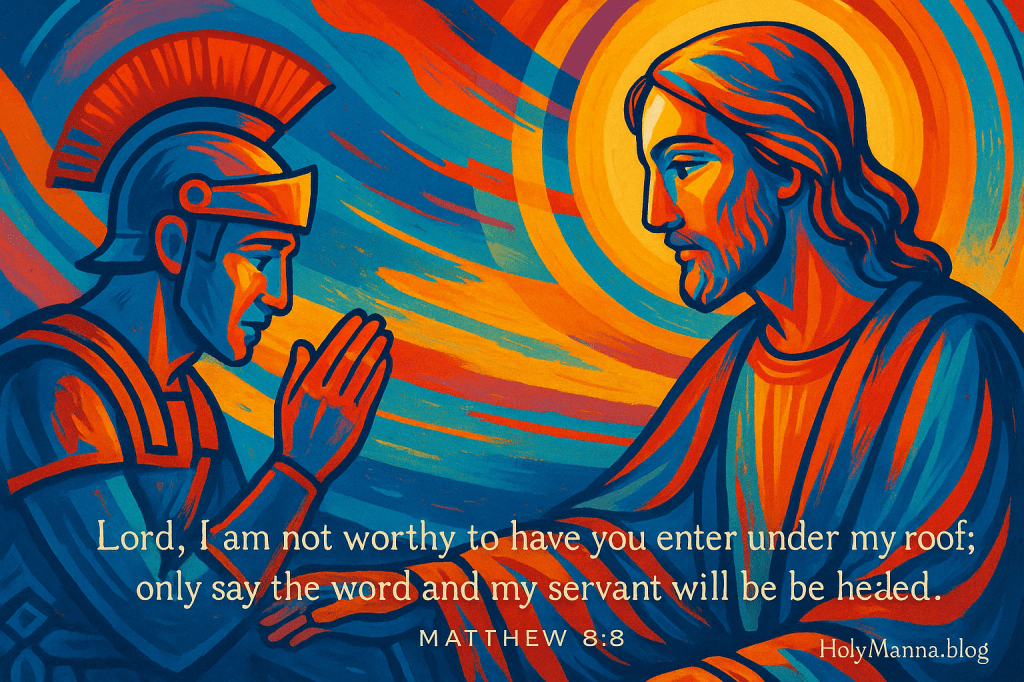
5 When he entered Capernaum, a centurion approached him and appealed to him, 6 saying, “Lord, my servant is lying at home paralyzed, suffering dreadfully.” 7 He said to him, “I will come and cure him.” 8 The centurion said in reply, “Lord, I am not worthy to have you enter under my roof; only say the word and my servant will be healed. 9 For I too am a person subject to authority, with soldiers subject to me. And I say to one, ‘Go,’ and he goes; and to another, ‘Come here,’ and he comes; and to my slave, ‘Do this,’ and he does it.” 10 When Jesus heard this, he was amazed and said to those following him, “Amen, I say to you, in no one in Israel have I found such faith. 11 I say to you, many will come from the east and the west, and will recline with Abraham, Isaac, and Jacob at the banquet in the kingdom of heaven, 12 but the children of the kingdom will be driven out into the outer darkness, where there will be wailing and grinding of teeth.” 13 And Jesus said to the centurion, “You may go; as you have believed, let it be done for you.” And at that very hour [his] servant was healed.
The Cure of Peter’s Mother-in-Law. 14 Jesus entered the house of Peter, and saw his mother-in-law lying in bed with a fever. 15 He touched her hand, the fever left her, and she rose and waited on him.
Other Healings. 16 When it was evening, they brought him many who were possessed by demons, and he drove out the spirits by a word and cured all the sick, 17 to fulfill what had been said by Isaiah the prophet:
“He took away our infirmities
and bore our diseases.”
Detailed Exegesis
Verse 5 – “When he entered Capernaum, a centurion approached him and appealed to him,”
Capernaum, a small town by the Sea of Galilee, becomes a hub for Jesus’ early ministry. The centurion, a Roman officer in charge of about 100 soldiers, represents the very power that oppressed the Jewish people. Yet he approaches Jesus—not with arrogance, but with humility and intercession. His appeal demonstrates both concern for his servant and recognition of Jesus’ authority.
Verse 6 – “saying, ‘Lord, my servant is lying at home paralyzed, suffering dreadfully.’”
In calling Jesus “Lord,” the centurion uses a term of respect that also hints at deeper spiritual insight. He doesn’t ask for healing outright—he simply states the situation. This shows a reverent surrender, entrusting the outcome to Jesus’ will rather than demanding a specific action.
Verse 7 – “He said to him, ‘I will come and cure him.’”
Jesus responds immediately with a willingness to go—crossing cultural and religious lines. Jews at the time would typically avoid entering a Gentile home to maintain ritual purity. Yet Jesus is not bound by those customs. His words reveal divine availability and readiness to heal.
Verse 8 – “The centurion said in reply, ‘Lord, I am not worthy to have you enter under my roof; only say the word and my servant will be healed.’”
This verse forms the heart of today’s Gospel and is so powerful that the Church places it on the lips of every Catholic before receiving the Eucharist: “Lord, I am not worthy that you should enter under my roof, but only say the word and my soul shall be healed.” The centurion acknowledges both his unworthiness and his deep faith in Jesus’ authority—believing Jesus can act without physical proximity.
Verse 9 – “For I too am a person subject to authority, with soldiers subject to me. And I say to one, ‘Go,’ and he goes; and to another, ‘Come here,’ and he comes; and to my slave, ‘Do this,’ and he does it.”
The centurion uses his own experience of command to express confidence in Jesus’ spiritual authority. He recognizes that Jesus doesn’t need to perform elaborate rituals—His word alone is enough. This practical, soldierly logic transforms into profound spiritual insight.
Verse 10 – “When Jesus heard this, he was amazed and said to those following him, ‘Amen, I say to you, in no one in Israel have I found such faith.’”
The word “amazed” is used sparingly in the Gospels in reference to Jesus. That the Son of God is astonished tells us something critical: faith moves the heart of God. This Gentile’s trust surpasses that of the covenant people. It’s a shocking and powerful declaration that faith—not heritage—draws down divine grace.
Verse 11 – “I say to you, many will come from the east and the west, and will recline with Abraham, Isaac, and Jacob at the banquet in the kingdom of heaven,”
Jesus opens the door wide to the nations, signaling that the kingdom is not limited to the biological descendants of Abraham. The image of reclining at table with the patriarchs conveys communion, fulfillment, and joy in God’s eternal kingdom—a feast that includes outsiders who believe.
Verse 12 – “but the children of the kingdom will be driven out into the outer darkness, where there will be wailing and grinding of teeth.”
This is a sobering warning: mere identity or heritage does not guarantee salvation. Those who presume upon their status without faith may find themselves excluded. Jesus teaches that access to the kingdom comes through humble trust, not entitlement.
Verse 13 – “And Jesus said to the centurion, ‘You may go; as you have believed, let it be done for you.’ And at that very hour [his] servant was healed.”
The healing takes place instantly and remotely, fulfilling the centurion’s expectation. Jesus honors the man’s faith and acts according to it. The miracle serves as both physical healing and a validation of Gentile inclusion in the kingdom.
Verse 14 – “Jesus entered the house of Peter, and saw his mother-in-law lying in bed with a fever.”
Now within a Jewish home, Jesus continues His healing ministry. The juxtaposition of Gentile and Jew underscores that His mercy is for all. This verse also reveals Peter’s family life, reminding us that the apostles had real, personal responsibilities.
Verse 15 – “He touched her hand, the fever left her, and she rose and waited on him.”
Jesus’ touch brings immediate restoration, and Peter’s mother-in-law responds with service. Her healing leads to action—a reminder that grace received is meant to be shared through loving acts of discipleship.
Verse 16 – “When it was evening, they brought him many who were possessed by demons, and he drove out the spirits by a word and cured all the sick,”
As the Sabbath ends at sunset, people are free to bring the sick without violating the law. Jesus heals not just some but all, reinforcing the boundless nature of His mercy. With just a word, He exerts total authority over spiritual and physical affliction.
Verse 17 – “to fulfill what had been said by Isaiah the prophet: ‘He took away our infirmities and bore our diseases.’”
Matthew ties Jesus’ ministry to the prophecy of Isaiah 53, the Suffering Servant. Jesus’ healings are not random acts—they fulfill the divine mission of redemption. He takes our suffering upon Himself, both on the Cross and throughout His earthly ministry.
Teachings
The Catechism of the Catholic Church upholds the healing ministry of Jesus as a sign of the Kingdom of God breaking into our world. It teaches: “The compassion of Christ toward the sick and his many healings… are a resplendent sign that ‘God has visited his people’ and that the Kingdom of God is close at hand” (CCC 1503). The Gospel shows us a Messiah who brings not just spiritual salvation, but physical and emotional healing as part of the integral restoration of the human person.
Furthermore, the Catechism reflects on the faith of the centurion with admiration: “Moved by so much suffering Christ not only allows himself to be touched by the sick, but he makes their miseries his own… He took our infirmities and bore our diseases” (CCC 1505). This is not just symbolic—it is incarnational. Jesus enters our suffering to transform it from within, revealing the depth of His love and the cost of our redemption.
Saint Augustine commented on this Gospel with deep insight, saying, “The centurion was not proud of his power, but confessed his weakness. He recognized the Word and knew its strength; he did not need Christ to walk, only to speak” (Sermon 62). In a world that values control and prestige, the centurion models humble confidence—a faith that trusts in the power of Christ’s word more than in human effort. This kind of faith is what amazes even God.
Reflection
Jesus continues to walk into our lives with healing power, yet His miracles are often limited not by His will, but by our lack of faith. Do you trust that He can heal you with just a word? Or do you put conditions on His power—waiting for the “right moment” or needing to “feel” something to believe? The centurion invites us into a radical trust that doesn’t rely on signs, only on the authority of Christ’s voice.
What wounds in your life have you not brought before the Lord? What parts of your heart remain paralyzed by fear, bitterness, or pride? Like the centurion, we can stand before Jesus and say: “Only say the word, and I shall be healed.” And we can believe that it is enough. Because it is. Let your faith be bold, humble, and expectant—this is the kind of faith that moves the heart of God.
Faith That Laughs, Sings, and Believes
From the quiet tent of Abraham to the humble home in Capernaum, today’s readings show us a God who steps into human stories with promises that seem laughable, invitations that sound impossible, and healings that happen with just a word. Sarah laughed because she couldn’t imagine such joy in her barrenness. Mary sang because she believed that God was doing something marvelous in her lowliness. And a Roman centurion—unexpected and uninvited by religious standards—trusted that Jesus could heal from a distance. Each of these moments reflects one divine truth: “Is anything too marvelous for the Lord?”
We are reminded that God doesn’t ask us for perfection, but for faith—faith that welcomes, that rejoices, that risks believing again when hope seems lost. Like Sarah, we may have buried our desires under layers of realism and disappointment. Like Mary, we may feel unworthy and overwhelmed. Like the centurion, we may not be “insiders” by religious or cultural standards. But each of these figures encountered the living God and were transformed because they responded, however imperfectly, with trust.
So today, what would it look like to believe again? To laugh with holy wonder at the thought that God hasn’t forgotten you? To sing like Mary in the middle of uncertainty? To pray with the confidence of the centurion: “Only say the word.” Let these Scriptures stir your heart. Let them invite you to trust that your story, too, is a place where the marvelous mercy of God wants to break in. Believe it. Proclaim it. And like those who have gone before us, receive the miracle that only faith makes room for.
Engage with Us!
We’d love to hear how today’s readings spoke to your heart. The Word of God is living and active, and your insights might bless someone else on their journey. Share your reflections in the comments below and join us in building a community rooted in faith, hope, and love.
Reflection Questions
First Reading – Genesis 18:1–15
What promises have you struggled to believe because they seem too late or too impossible? How is God inviting you to move from skepticism to faith, like Sarah? In what ways can you practice Abraham’s spirit of generous hospitality in your daily life?
Responsorial Psalm – Luke 1:46–50, 53–55
What blessings in your life can you proclaim today as the “great things” God has done for you? How do Mary’s words challenge you to trust in God’s mercy, even when circumstances seem bleak? Where is God calling you to sing instead of doubt?
Holy Gospel – Matthew 8:5–17
Do you truly believe Jesus can heal you or someone you love with just a word? What does the centurion’s humility teach you about approaching God in prayer? How can you better serve Jesus like Peter’s mother-in-law—responding to grace with action?
Let today’s Word take root in your heart. Live with the faith of Abraham, the joy of Mary, and the bold trust of the centurion. May every step you take be guided by the love and mercy Jesus taught us—and may your life be a reflection of the God who still does marvelous things.
Follow us on Instagram and Facebook for more insights and reflections on living a faith-filled life.

 Holy Manna!
Leave a comment