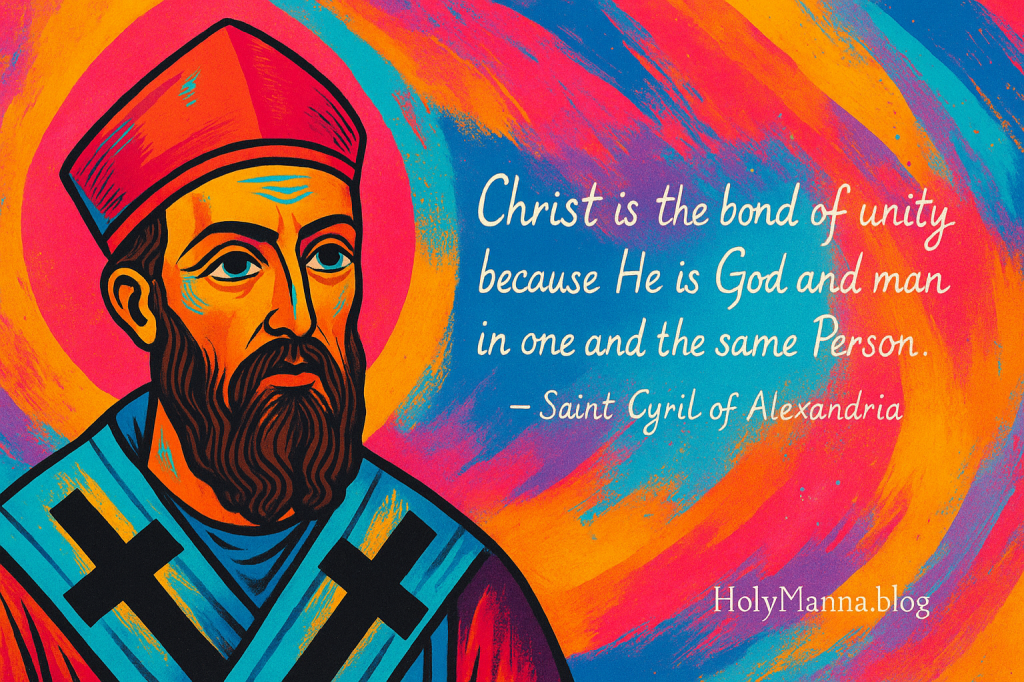
The Lion of Orthodoxy
Few saints roared with such theological might and pastoral conviction as Saint Cyril of Alexandria. Revered as both a Bishop and a Doctor of the Church, Cyril occupies a place of honor in the treasury of Christian memory. His name is etched into the heart of Catholic tradition because of his courageous stand for truth during one of the most critical theological crises in the early Church. He is perhaps best known for his leadership at the Council of Ephesus in 431 AD, where he defended the divinity of Christ and the rightful title of the Virgin Mary as Theotokos, meaning “God-bearer” or “Mother of God.”
This title for Mary, so foundational to Catholic Mariology, was under fierce attack by Nestorius, the Patriarch of Constantinople, who taught that Mary gave birth only to Christ’s human nature and not to God the Son. Saint Cyril’s defense of the unity of Christ’s divine and human natures laid the groundwork for orthodox Christology and preserved the integrity of our faith in the Incarnation. His courage, brilliance, and holiness make him a towering figure among the early Church Fathers. He was not only a theologian of exceptional depth but also a pastor who suffered greatly to safeguard the Church’s teaching. Canonized and later declared a Doctor of the Church, Cyril’s life is a powerful testament to what it means to be a faithful servant of Christ, no matter the cost.
From Alexandria with Fire
Born around 376 AD in Alexandria, Egypt, one of the intellectual capitals of the ancient world, Cyril came from a devout Christian family. His uncle, Theophilus, was the powerful Patriarch of Alexandria and ensured that Cyril received an outstanding education in biblical studies, theology, Greek philosophy, and rhetoric. Immersed in the Church’s teachings from an early age, Cyril entered monastic life for some time before being ordained to the priesthood and eventually ascending to the patriarchal seat of Alexandria upon his uncle’s death in 412 AD.
Cyril’s appointment was not without turbulence. The see of Alexandria was a politically charged post, often at odds with other ecclesiastical centers, especially Constantinople. Despite the power struggles, Cyril quickly established himself as a devoted shepherd of his flock. He began expelling heretical sects, enforcing Church discipline, and affirming orthodoxy in his diocese. But his defining moment came with the rise of Nestorianism, a heresy that divided Christ into two persons—one human and one divine—thus denying the full mystery of the Incarnation. Cyril responded with spiritual intensity and scholarly precision, writing extensively to defend the truth of the hypostatic union: that Jesus Christ is one divine person with two natures, human and divine, united without confusion or separation.
His theological insights were not abstract but deeply pastoral. He saw that if Christ were not truly God and truly man, then our salvation was in jeopardy. He wrote, “The Word, by having united to Himself hypostatically flesh animated with a rational soul, became man” (Third Letter to Nestorius), grounding his entire ministry in the person of Christ as revealed in Scripture and taught by the Apostolic Church.
Miracles Cloaked in Wisdom
Though Saint Cyril is celebrated more for his theological might than wonder-working, testimonies from his life reveal a man so united to God that divine power occasionally manifested in his ministry. Known for his sanctity and asceticism, he was often called upon to heal the sick and console the afflicted, especially during periods of intense conflict and spiritual warfare.
One early account speaks of Cyril curing a boy possessed by a demon through nothing but a fervent prayer and the sign of the Cross. The child, tormented day and night, was brought to the bishop after other remedies had failed. Cyril knelt in prayer, invoked the name of Christ, and the demon fled, leaving the child in peace. Such miracles were never performed for spectacle but were always signs pointing to the power of Christ and the truth of the Gospel.
Even more remarkable was the way Cyril’s very presence brought clarity to theological confusion. His words were often described as fire that burned away falsehood. Many of the faithful viewed his writings and sermons as instruments of healing—not only for the body but for the soul. His treatises clarified dogmas, strengthened bishops, and healed the wounds of ecclesial division. In this way, Saint Cyril’s greatest miracles were intellectual and spiritual—healing the Church from heresy and binding her again in truth.
Chains for the Truth
The life of Saint Cyril was not one of peace and comfort but of constant battle. He faced immense opposition from political leaders, fellow bishops, and even emperors. His unwavering stand for orthodoxy—especially in opposition to Nestorius—brought him into conflict with the Eastern Roman Emperor Theodosius II and powerful factions in Constantinople.
When the Council of Ephesus convened in 431, it did so under a cloud of tension. Nestorius had many supporters among the imperial court, and some bishops tried to delay the council to sabotage Cyril’s efforts. But with the backing of Pope Celestine I, Cyril began the council and presided over its deliberations. He issued twelve anathemas against Nestorius’ teachings and affirmed that the Virgin Mary should rightly be called Theotokos, for she bore God in the flesh.
For this, Cyril was arrested and briefly imprisoned. His name was slandered, his motives questioned, and his diocese thrown into turmoil. But he bore it all with patience, trusting in God’s providence. “Blessed are those who are persecuted for righteousness’ sake, for theirs is the kingdom of heaven” (Matthew 5:10). Cyril’s suffering was not physical martyrdom, but it was a white martyrdom—painfully real, spiritually harrowing, and marked by deep personal sacrifice for the sake of the Gospel.
The Saint Whose Words Still Heal
Saint Cyril died in 444 AD, but his legacy lived on with stunning vitality. After his death, his relics became sources of devotion and intercession. Pilgrims flocked to Alexandria to pray at his tomb. Many spoke of miraculous healings and conversions attributed to his intercession. His reputation as a defender of truth made him a patron for theologians, bishops, and all who suffer for speaking the truth in love.
His writings continued to shape the theological consciousness of the Church. Among his most cherished works are his Commentary on the Gospel of John, his letters to Nestorius, and his defenses of the Nicene Creed. These texts are considered masterpieces of patristic theology, illuminating the profound mystery of Christ and His redeeming mission. Many conversions and returns to the faith have been attributed to people reading his works and discovering the fullness of Catholic teaching.
Throughout the centuries, theologians such as Saint Thomas Aquinas and Saint John Henry Newman praised Cyril’s intellect and holiness. He was formally declared a Doctor of the Church in 1882 by Pope Leo XIII. Today, his name is still invoked in liturgies, seminaries, and spiritual reflections by those seeking clarity in a confused world. His feast day, June 27, offers all the faithful an opportunity to renew their commitment to Christ, who is “the way, and the truth, and the life” (John 14:6).
A Heart on Fire for Truth and Love
Saint Cyril’s life poses a deep challenge to our modern hearts: Are we willing to stand for truth even when it costs us? He reminds us that theology is not dry academic exercise but a matter of eternal salvation. If Christ is not fully God and fully man, then we are still in our sins. If Mary is not the Mother of God, then the Incarnation is fractured and incomplete.
In a time when faith is often reduced to feelings or dismissed as irrelevant, Cyril’s example calls us to study the faith seriously, to proclaim it boldly, and to live it with compassion and courage. He shows us that doctrine is not an obstacle to love but the pathway to its fullness. “The truth will set you free” (John 8:32)—and Cyril lived and died in that freedom.
Each of us can carry Cyril’s torch. You don’t need a bishop’s mitre or theological degree. You need a heart formed by Scripture, nourished by the Catechism, and on fire with the Holy Spirit. Read CCC 464–469 this week. Meditate on The Gospel of John. Pray the Hail Mary with renewed understanding. And when opportunities come to defend the Church—at work, with family, online—speak with love and clarity, as Cyril did.
Let us live like Saint Cyril: on fire for truth, grounded in charity, and fearless in faith.
Engage with Us!
What does Saint Cyril of Alexandria teach you about the value of truth and fidelity to Christ? How are you called to stand firm in your faith today?
- How does this saint’s life challenge your current understanding of Jesus?
- What can you do this week to defend the truth of the Gospel with greater love?
- Do you turn to the Blessed Virgin Mary for guidance when your beliefs are tested?
Let us know in the comments! Support one another in the journey of faith—and strive to do everything with love, just as our Lord Jesus did.
Saint Cyril of Alexandria, pray for us! 🔥
Follow us on Instagram and Facebook for more insights and reflections on living a faith-filled life.

 Holy Manna!
Leave a comment