The Foundation Beneath Our Feet
Have you ever felt the urge to take control when God seems silent? When prayers go unanswered or promises feel delayed, we often grasp for quick fixes or human solutions. Today’s readings speak directly into this universal struggle — the tension between doing things our way and trusting God’s way. They invite us to examine whether the spiritual foundations of our lives are built on shifting sands of self-will or on the solid rock of divine obedience.
In Genesis 16, we witness Sarai and Abram wrestling with infertility — a deeply painful and shame-filled reality in ancient Near Eastern culture, where bearing children was seen as a sign of divine favor. Sarai, desperate and weary of waiting on God’s promise, urges Abram to conceive a child with her maidservant, Hagar. This decision, made outside of God’s will, leads to division, jealousy, and pain. Yet even in this brokenness, God reveals His mercy. He hears Hagar’s cry and names her son Ishmael — “God has heard” — reminding us that no one is forgotten in His eyes, not even the rejected or displaced. This moment echoes Israel’s future history: when they would stray from God’s commands yet find Him merciful when they return, as expressed in Psalm 106: “Give thanks to the Lord, who is good, whose mercy endures forever” (Psalm 106:1).
Finally, in The Gospel of Matthew, Jesus delivers a sobering call to authenticity: “Not everyone who says to me, ‘Lord, Lord,’ will enter the kingdom of heaven, but only the one who does the will of my Father in heaven” (Matthew 7:21). It’s not enough to speak God’s name — we must live in obedience to Him, especially when His will contradicts our preferences. Like a house built on rock, a life rooted in God’s Word can withstand the storms of trial, waiting, and uncertainty. Together, these readings offer us a spiritual mirror: Are we surrendering to God’s timing, or constructing our own plans out of impatience? Do we trust Him enough to obey even when it’s hard? This is the question that prepares us to dive deeper into today’s sacred texts.
First Reading – Genesis 16:1–12, 15–16
When God’s Promise Feels Delayed
The Book of Genesis is the story of beginnings — not only the origins of the universe, but of humanity’s covenantal relationship with God. By the time we reach chapter 16, Abram and Sarai have already received a stunning promise: their descendants would be as numerous as the stars. Yet years have passed in Canaan, and Sarai remains barren — a condition considered both socially humiliating and spiritually troubling in the ancient Near East. In a world where lineage was everything, and barrenness was seen as a curse, Sarai’s desperation gives way to human reasoning. This chapter introduces us to Hagar, the Egyptian maidservant, and the birth of Ishmael — a pivotal moment in salvation history that underscores the spiritual consequences of impatience and the far-reaching effects of choices made outside God’s will. Yet even in the mess, God speaks. He sees. He blesses. And through it all, He teaches us that obedience, not expediency, builds the house that stands.
Genesis 16:1-12, 15-16
New American Bible (Revised Edition)
Birth of Ishmael. 1 Abram’s wife Sarai had borne him no children. Now she had an Egyptian maidservant named Hagar. 2 Sarai said to Abram: “The Lord has kept me from bearing children. Have intercourse with my maid; perhaps I will have sons through her.” Abram obeyed Sarai. 3 Thus, after Abram had lived ten years in the land of Canaan, his wife Sarai took her maid, Hagar the Egyptian, and gave her to her husband Abram to be his wife. 4 He had intercourse with her, and she became pregnant. As soon as Hagar knew she was pregnant, her mistress lost stature in her eyes. 5 So Sarai said to Abram: “This outrage against me is your fault. I myself gave my maid to your embrace; but ever since she knew she was pregnant, I have lost stature in her eyes. May the Lord decide between you and me!” 6 Abram told Sarai: “Your maid is in your power. Do to her what you regard as right.” Sarai then mistreated her so much that Hagar ran away from her.
7 The Lord’s angel found her by a spring in the wilderness, the spring on the road to Shur, 8 and he asked, “Hagar, maid of Sarai, where have you come from and where are you going?” She answered, “I am running away from my mistress, Sarai.” 9 But the Lord’s angel told her: “Go back to your mistress and submit to her authority. 10 I will make your descendants so numerous,” added the Lord’s angel, “that they will be too many to count.” 11 Then the Lord’s angel said to her:
“You are now pregnant and shall bear a son;
you shall name him Ishmael,
For the Lord has heeded your affliction.
12 He shall be a wild ass of a man,
his hand against everyone,
and everyone’s hand against him;
Alongside all his kindred
shall he encamp.”
15 Hagar bore Abram a son, and Abram named the son whom Hagar bore him Ishmael. 16 Abram was eighty-six years old when Hagar bore him Ishmael.
Detailed Exegesis
Verse 1 – “Abram’s wife Sarai had borne him no children. Now she had an Egyptian maidservant named Hagar.”
This verse sets the scene of both longing and limitation. Sarai’s infertility is not just a personal sorrow but a theological tension — how can God’s promise be fulfilled if she cannot conceive? The introduction of Hagar, an Egyptian slave, foreshadows the complex dynamics that will unfold: power, culture, and vulnerability colliding within the covenantal family.
Verse 2 – “Sarai said to Abram: ‘The Lord has kept me from bearing children. Have intercourse with my maid; perhaps I will have sons through her.’ Abram obeyed Sarai.”
Here we see Sarai’s struggle with waiting. Rather than trusting in the Lord’s timing, she blames Him for her barrenness and takes control of the situation. Her proposal reflects a common practice in ancient Mesopotamia — surrogacy through maidservants — but what is culturally accepted is not necessarily God’s will. Abram’s passive agreement also reveals a lapse in leadership and trust.
Verse 3 – “Thus, after Abram had lived ten years in the land of Canaan, his wife Sarai took her maid, Hagar the Egyptian, and gave her to her husband Abram to be his wife.”
Ten years is a long time to wait. This detail emphasizes the intensity of the test of faith. The phrase “to be his wife” signals a secondary marital status — not equal to Sarai, but recognized as a bearer of heirs. The tension is rising.
Verse 4 – “He had intercourse with her, and she became pregnant. As soon as Hagar knew she was pregnant, her mistress lost stature in her eyes.”
Hagar’s pregnancy flips the social order: the servant now carries what the mistress could not. Her sense of superiority causes contempt, which Sarai immediately resents. The sin of pride is not limited to those in power — even the vulnerable, when exalted, can look down on others.
Verse 5 – “So Sarai said to Abram: ‘This outrage against me is your fault. I myself gave my maid to your embrace; but ever since she knew she was pregnant, I have lost stature in her eyes. May the Lord decide between you and me!’”
Sarai’s bitterness reveals the inner cost of acting apart from God. Her complaint against Abram reveals the blame-shifting that sin often produces. Her final appeal to the Lord — “May the Lord decide” — shows she still acknowledges divine authority, even in her anger.
Verse 6 – “Abram told Sarai: ‘Your maid is in your power. Do to her what you regard as right.’ Sarai then mistreated her so much that Hagar ran away from her.”
Abram abdicates his responsibility, washing his hands of the situation. Sarai’s mistreatment leads Hagar to flee — an act of desperation for a vulnerable woman. The abuse of power and neglect of duty by both husband and wife lead to the exile of the innocent.
Verse 7 – “The Lord’s angel found her by a spring in the wilderness, the spring on the road to Shur.”
This is the first appearance of “the Lord’s angel” in Scripture. God seeks out the outcast — a revolutionary truth in ancient times. He meets Hagar in her distress, showing that divine mercy is not bound by human privilege or covenantal status.
Verse 8 – “He asked, ‘Hagar, maid of Sarai, where have you come from and where are you going?’ She answered, ‘I am running away from my mistress, Sarai.’”
God’s messenger addresses her by name and role — affirming both her identity and situation. His question invites reflection, as all divine questions do. Hagar responds honestly, revealing her pain and flight.
Verse 9 – “But the Lord’s angel told her: ‘Go back to your mistress and submit to her authority.’”
This directive may sound harsh, but it is not abandonment. God is asking Hagar to endure suffering for the sake of a future blessing. Her return will secure protection for her child, and this obedience mirrors the later call of many prophets and saints who were sent into hardship for a greater purpose.
Verse 10 – “I will make your descendants so numerous,” added the Lord’s angel, “that they will be too many to count.”
This promise mirrors God’s covenant with Abram — underscoring that Hagar’s son, too, will be the father of a great nation. God’s mercy extends beyond the boundaries we draw.
Verse 11 – “Then the Lord’s angel said to her: ‘You are now pregnant and shall bear a son; you shall name him Ishmael, for the Lord has heeded your affliction.’”
Ishmael means “God hears.” This naming reveals the Lord’s intimate awareness of suffering. Hagar is not invisible. Her affliction has been heard — a powerful reminder that no cry of the oppressed goes unnoticed.
Verse 12 – “He shall be a wild ass of a man, his hand against everyone, and everyone’s hand against him; alongside all his kindred shall he encamp.”
This prophecy foreshadows the difficult and independent life Ishmael’s descendants will live — yet also affirms his identity and strength. It reflects both a natural and spiritual reality: that what is born of human striving may lead to struggle.
Verse 15 – “Hagar bore Abram a son, and Abram named the son whom Hagar bore him Ishmael.”
Despite the conflict, Abram honors the divine message and accepts the child as his own, naming him according to God’s instruction. This act brings legitimacy to Ishmael and underscores God’s hand in the situation.
Verse 16 – “Abram was eighty-six years old when Hagar bore him Ishmael.”
This detail anchors the story in time, reminding us again of the long wait — and the cost of acting outside of God’s timing. Ishmael’s birth marks a turning point, but not the fulfillment of God’s ultimate promise.
Teachings
The Catechism of the Catholic Church speaks powerfully about the virtue of obedience and trust in God’s providence. “The obedience of faith (cf. Rom 1:5; 16:26) is to submit freely to the word that has been heard, because its truth is guaranteed by God, who is Truth itself” (CCC 144). Sarai and Abram’s failure to wait is not just an emotional reaction — it is a moment of weakened faith, one that carries consequences for generations. Yet God’s mercy shows us that even when we fail, He does not abandon His plan.
St. Augustine commented on this passage with pastoral insight, writing, “Hagar represents the earthly Jerusalem… her son, the one born according to the flesh, persecutes the one born according to the Spirit” (cf. Galatians 4:29). This patristic interpretation reminds us that Ishmael’s story prefigures spiritual dynamics within salvation history: the tension between works of the flesh and the fruit of the Spirit.
Historically, the story of Ishmael has been seen as a root of the Arab peoples, with Christian tradition often focusing on Isaac as the child of promise. However, the Church calls us to read these texts with a view toward reconciliation and mercy. God’s intervention in Hagar’s life is not a secondary story — it is part of the grand narrative of how He hears the afflicted and exalts the humble. “He raises the needy from the dust; from the ash heap he lifts up the poor” (Psalm 113:7).
Reflection
How often do we take matters into our own hands when God seems slow to act? Sarai’s story is painfully relatable — a reminder that impatience can lead us into decisions that sow division and regret. Yet through Hagar, God reveals that He remains faithful even in our failures. He meets us at the spring in the wilderness, asking us not just where we are going, but who we are becoming.
This reading invites us to reflect on the foundations we are building our lives upon. Are we motivated by fear or faith? Do we manipulate outcomes, or do we surrender to divine timing? Like Abram and Sarai, we may face long seasons of waiting, but God’s promises are not void. And like Hagar, we may find ourselves running, mistreated, or lost — yet the God who sees us is already drawing near.
Today, ask yourself: Where in my life am I growing impatient with God’s plan? Am I trying to force results instead of trusting in His promise? What would it look like to surrender control and walk in obedience, even when the outcome is uncertain? In that surrender, we may just hear what Hagar heard: “The Lord has heeded your affliction”.
Responsorial Psalm – Psalm 106:1–5
Mercy in the Midst of Memory
The Book of Psalms is the prayerbook of the people of Israel, a collection of inspired songs that express every human emotion — joy, anguish, gratitude, repentance, and longing for God. Psalm 106 is a communal confession of sin, recited during liturgies to recall Israel’s failures and God’s enduring mercy. Positioned near the end of Book IV of the Psalms, this psalm stands as a historical reflection: it recounts how Israel repeatedly fell into rebellion, and yet God continually delivered them. Today’s selected verses (1–5) serve as the opening invocation to that larger psalm of repentance and remembrance. They form a perfect bridge between the First Reading — where Sarai and Abram act outside God’s will — and the Gospel, which calls us to build our lives on obedience rather than empty words. This psalm reminds us that even when we fall, we can always turn back and cry out to the Lord who is “good, whose mercy endures forever”.
Psalm 106:1-5
New American Bible (Revised Edition)
Israel’s Confession of Sin
1 Hallelujah!
Give thanks to the Lord, who is good,
whose mercy endures forever.
2 Who can recount the mighty deeds of the Lord,
proclaim in full God’s praise?
3 Blessed those who do what is right,
whose deeds are always just.
4 Remember me, Lord, as you favor your people;
come to me with your saving help,
5 That I may see the prosperity of your chosen ones,
rejoice in the joy of your people,
and glory with your heritage.
Detailed Exegesis
Verse 1 – “Hallelujah! Give thanks to the Lord, who is good, whose mercy endures forever.”
The psalm begins with a resounding “hallelujah”, meaning “praise the Lord”. This immediate call to praise is not based on circumstance, but on God’s nature: He is “good”. The enduring mercy of the Lord is a central theme throughout Scripture — a mercy not earned, but freely given. This verse frames the entire psalm as an act of trust in divine mercy, even before confession begins.
Verse 2 – “Who can recount the mighty deeds of the Lord, proclaim in full God’s praise?”
This rhetorical question reveals the immeasurable greatness of God. No one can fully recount all He has done — yet we are still called to try. This verse echoes the invitation to reflect deeply on salvation history, both personal and communal. The psalmist invites us into awe: to remember, to proclaim, and to never grow numb to grace.
Verse 3 – “Blessed those who do what is right, whose deeds are always just.”
Here the psalm makes a connection between worship and action. It’s not enough to speak God’s name; true blessing lies in “righteousness and justice”. This verse prepares us for the Gospel’s message — that only those who “do” the Father’s will shall enter the Kingdom. Holiness is not abstract but lived.
Verse 4 – “Remember me, Lord, as you favor your people; come to me with your saving help,”
The psalm shifts to a personal plea. The speaker, likely representing all Israel, begs to be remembered. In biblical language, for God to “remember” is to act decisively in mercy and favor. This verse highlights a yearning not only for forgiveness but for restoration. The soul longs to be counted among the chosen.
Verse 5 – “That I may see the prosperity of your chosen ones, rejoice in the joy of your people, and glory with your heritage.”
The prayer culminates in a vision of communal joy. The psalmist desires not material gain, but spiritual communion — to “see”, “rejoice”, and “glory with your heritage”. This is not a self-centered request but a desire to be part of the faithful remnant, united in the covenant and in joy.
Teachings
The Catechism of the Catholic Church teaches that “the Psalms both nourished and expressed the prayer of the People of God assembled during the great feasts at Jerusalem” and that they “remain essential to the prayer of the Church” (CCC 2586). Psalm 106 exemplifies this liturgical power — it leads the faithful in repentance while anchoring them in hope. The Church continues this tradition through the Liturgy of the Hours and the Responsorial Psalm at Mass, allowing every generation to cry out, “Remember me, Lord”.
St. John Paul II taught that remembrance is a sacred act in the spiritual life. In his General Audience on Psalm 106 (Nov 12, 2003), he said, “In the mirror of this Psalm, the faithful of every age can recognize their own failures and sins, but also the greatness of divine mercy.” This psalm, therefore, is not just history; it is a mirror into our souls. It reveals the pattern of human weakness and God’s persistent, saving love.
Historically, Psalm 106 would have been sung by a people returning from exile — a people who knew both shame and deliverance. It calls us today to do the same. In our personal exiles — our doubts, our sins, our moments of impatience like Sarai’s — we are invited to remember God’s faithfulness. We do not stand before Him because we are blameless, but because “His mercy endures forever”.
Reflection
How often do we begin our prayers with thanksgiving rather than complaints? This psalm challenges us to praise God not for what He’s done lately, but for who He always is. It reminds us that praise is not based on our mood or situation, but on the unchanging character of the Lord.
Psalm 106 also invites us to confession and reflection. Like Sarai, we often act rashly when waiting on God. Like Israel, we forget His deeds and stray from His ways. But here is the good news: we can always return. Do I ask God to “remember me” as one of His own, even when I’ve failed? This psalm teaches us how to pray from the depths — with honesty, humility, and hope.
Today, take time to recount God’s mighty deeds in your life. Where has He been faithful? Where do you need His saving help now? How can you make justice and righteousness the foundation of your daily decisions? In doing so, we step into the heritage of His people — a people who fall, but rise again through mercy.
Holy Gospel – Matthew 7:21–29
Foundations That Withstand the Storm
The Gospel of Matthew was written primarily for a Jewish-Christian audience and seeks to present Jesus as the new Moses — the fulfillment of the Law and the Prophets. Today’s passage concludes the famous Sermon on the Mount (chapters 5–7), where Jesus outlines the radical demands of the Kingdom of Heaven. This portion serves as both a warning and a call to action: discipleship cannot be based on appearances or empty religious language. Jesus, speaking with divine authority, separates true obedience from mere performance. His words echo the struggles we saw in Genesis 16 and Psalm 106: people who act according to their own will suffer consequences, while those who trust and obey receive mercy and stability. Jesus challenges His listeners to build their lives not on superficial faith but on obedience to His Word — a house built on rock.
Matthew 7:21-29
New American Bible (Revised Edition)
The True Disciple. 21 “Not everyone who says to me, ‘Lord, Lord,’ will enter the kingdom of heaven, but only the one who does the will of my Father in heaven. 22 Many will say to me on that day, ‘Lord, Lord, did we not prophesy in your name? Did we not drive out demons in your name? Did we not do mighty deeds in your name?’ 23 Then I will declare to them solemnly, ‘I never knew you. Depart from me, you evildoers.’
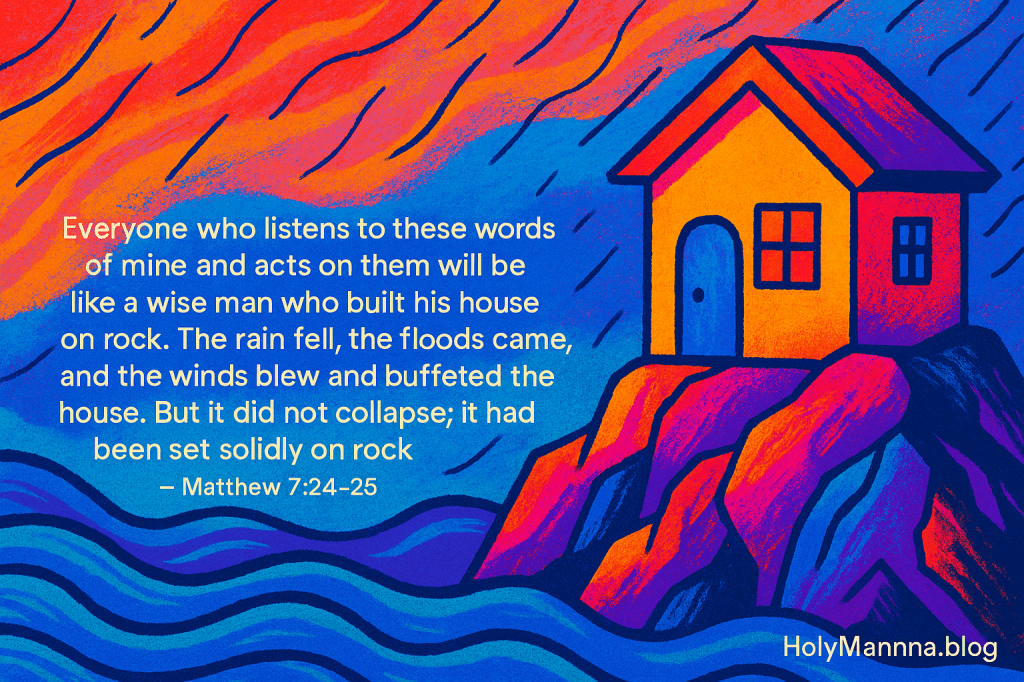
The Two Foundations. 24 “Everyone who listens to these words of mine and acts on them will be like a wise man who built his house on rock. 25 The rain fell, the floods came, and the winds blew and buffeted the house. But it did not collapse; it had been set solidly on rock. 26 And everyone who listens to these words of mine but does not act on them will be like a fool who built his house on sand. 27 The rain fell, the floods came, and the winds blew and buffeted the house. And it collapsed and was completely ruined.”
28 When Jesus finished these words, the crowds were astonished at his teaching, 29 for he taught them as one having authority, and not as their scribes.
Detailed Exegesis
Verse 21 – “Not everyone who says to me, ‘Lord, Lord,’ will enter the kingdom of heaven, but only the one who does the will of my Father in heaven.”
This striking verse teaches that lip service to God is not enough. The repetition “Lord, Lord” implies enthusiasm or even desperation — but without obedience, it is hollow. Entrance into the Kingdom is granted to those who conform their lives to God’s will, not merely those who use religious language. This confronts the illusion of external religiosity.
Verse 22 – “Many will say to me on that day, ‘Lord, Lord, did we not prophesy in your name? Did we not drive out demons in your name? Did we not do mighty deeds in your name?’”
Jesus anticipates the objection of those who believed their actions proved their righteousness. The emphasis on doing things “in your name” highlights the possibility of exploiting God’s name for personal gain or prestige. The key problem is not the actions themselves, but the absence of real relationship and submission to God’s will.
Verse 23 – “Then I will declare to them solemnly, ‘I never knew you. Depart from me, you evildoers.’”
This is among the most sobering verses in the New Testament. Jesus’ declaration, “I never knew you”, reveals that what matters most is intimate, obedient communion with Him. Knowledge here implies covenantal relationship — the kind found in genuine discipleship. Without it, even dramatic religious acts are deemed “evil”.
Verse 24 – “Everyone who listens to these words of mine and acts on them will be like a wise man who built his house on rock.”
Now Jesus offers a metaphor. The wise man not only hears but acts. The “rock” is the Word of God lived out. This image recalls God as the Rock in the Old Testament (Psalm 18:2), and foreshadows Christ as the cornerstone. A solid foundation implies discipline, patience, and trust.
Verse 25 – “The rain fell, the floods came, and the winds blew and buffeted the house. But it did not collapse; it had been set solidly on rock.”
Here Jesus describes the inevitable trials of life. The storm tests the structure, revealing its foundation. The house that stands symbolizes the soul grounded in faith and obedience. The strength is not in the materials, but in what lies beneath.
Verse 26 – “And everyone who listens to these words of mine but does not act on them will be like a fool who built his house on sand.”
The contrast is clear: hearing without obedience is foolishness. Sand is easier, quicker, and more convenient — but unstable. Jesus’ use of “fool” ties to the wisdom literature of the Old Testament, where folly is the refusal to fear the Lord (Proverbs 1:7).
Verse 27 – “The rain fell, the floods came, and the winds blew and buffeted the house. And it collapsed and was completely ruined.”
The identical storm comes — showing that trials are not avoidable. The difference is in the foundation. A life built on disobedience, no matter how impressive outwardly, will not endure. Complete ruin represents not just earthly collapse but eternal consequence.
Verse 28 – “When Jesus finished these words, the crowds were astonished at his teaching,”
The crowd’s astonishment shows that Jesus taught with a weight and clarity that differed from their religious leaders. He was not quoting others; He was speaking as one with inherent authority — as the Son of God.
Verse 29 – “for he taught them as one having authority, and not as their scribes.”
Unlike the scribes who relied on tradition and interpretation, Jesus’ authority was original and divine. His teaching demands a decision: will we follow or ignore? This final verse sets the stage for the crowds to respond, and for us to examine the structure of our own lives.
Teachings
The Catechism of the Catholic Church emphasizes that “Faith is a personal act — the free response of the human person to the initiative of God who reveals himself” (CCC 166). This Gospel challenges us to move beyond external piety toward interior conversion. Jesus is not impressed by performance; He desires a heart that listens and obeys.
St. Teresa of Ávila warned against spiritual self-deception, writing: “What matters is not to think much but to love much, and so to do what best awakens us to love.” Love for God is shown not by lofty religious acts but by humble, consistent obedience. This is the house built on rock: a life of love expressed in action.
During the early Church, especially amidst persecution, this Gospel held critical meaning. Many claimed Christ with their lips, but those who lived His words became martyrs and saints. The Church has always honored those who “do the will of the Father” as the true disciples, for their witness endures. Jesus’ words remain a litmus test for all Christians: “Do I merely call Him Lord, or do I live as though He is?”
Reflection
What is the foundation of your spiritual life? In a world of quick fixes and surface-level faith, Jesus invites us to dig deep. Obedience isn’t glamorous, but it is powerful. It gives our lives resilience. Like Hagar in the wilderness and the psalmist crying for mercy, we need to root ourselves in the voice and will of God.
This Gospel also invites us to examine the gap between what we say and how we live. Am I building on rock or sand? Do I take Jesus’ words seriously, or do I only echo them when convenient? Jesus reminds us that storms will come — not if, but when. What we’ve built will be revealed in the flood.
Today, choose one teaching of Jesus that you’ve heard but not yet lived. Ask the Holy Spirit for the grace to act on it. Replace good intentions with holy decisions. In that obedience, you are laying a foundation that no storm can shake — because it rests on the Rock Himself.
A Faith That Endures the Storm
Today’s readings weave a powerful tapestry of trust, obedience, and divine mercy. In Genesis 16, we saw the consequences of stepping ahead of God’s plan — and yet, we also witnessed His compassionate response to the vulnerable. Psalm 106 called us to remember our history, to confess our shortcomings, and to trust in the Lord’s enduring mercy. And in Matthew 7, Jesus brings it all together by reminding us that only those who hear His words and act on them will stand firm when the storms of life come.
This is not a message of fear, but of invitation. God is not looking for perfection — He is looking for trust. He desires our hearts, not just our words. Whether you relate to Sarai’s impatience, Hagar’s suffering, the psalmist’s yearning, or the crowd’s astonishment at Jesus’ teaching, you are being invited today to take one step deeper. One act of obedience. One moment of surrender. One choice to build not on sand, but on the Rock.
Where is God asking you to wait, to trust, to act in faith? Whatever your answer, know this: “The Lord has heeded your affliction”, “His mercy endures forever”, and “Everyone who listens to these words of mine and acts on them will be like a wise man who built his house on rock”. Let us be that wise builder today. Let us live a faith that endures the storm — not because we are strong, but because He is faithful.
Engage with Us!
We’d love to hear how these Scriptures spoke to your heart today. Share your reflections, prayers, or personal stories in the comments. Let’s grow together as a community rooted in the Word of God. Here are a few questions to guide your reflection:
First Reading – Genesis 16:1–12, 15–16
Have you ever tried to take control when you felt God was delaying? What were the consequences? How might you surrender more fully to His timing today?
Responsorial Psalm – Psalm 106:1–5
What moments in your life call for repentance and remembrance? How can you cultivate a deeper spirit of thanksgiving, even in difficult seasons?
Holy Gospel – Matthew 7:21–29
What part of your life feels like it’s built on sand? What’s one way you can begin building on the rock of Christ today?
Let’s encourage one another to live a life of faith — a life anchored in God’s will, shaped by His mercy, and fueled by the love Jesus teaches us every day. May everything we do begin and end with that love.
Follow us on Instagram and Facebook for more insights and reflections on living a faith-filled life.

 Holy Manna!
Leave a comment