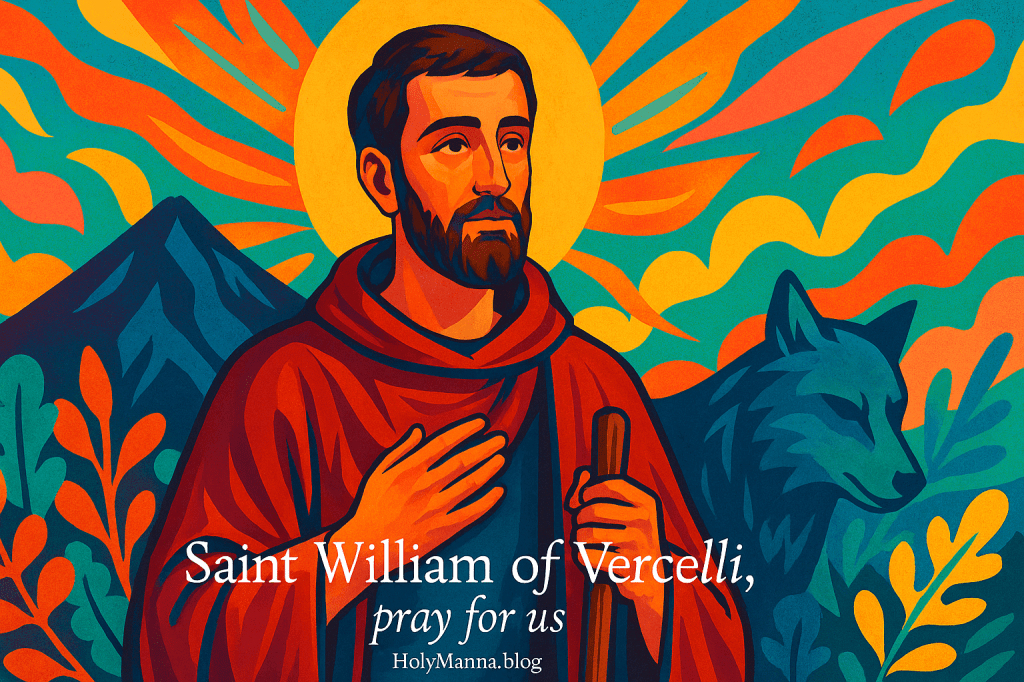
A Life That Roared in Silence
Saint William of Vercelli, also known as Saint William of Montevergine, stands as a remarkable figure of heroic sanctity and hidden glory. In an age dominated by monarchical power, urban renewal, and ecclesiastical reform, William chose the forgotten places of the world—mountaintops and forests—as the stages of his divine drama. Yet despite his solitude, the light of his holiness could not remain concealed. He is remembered not only as a hermit and founder but also as a man aflame with mystical love for Christ and the Virgin Mary. His life bore fruit in the establishment of the Congregation of Montevergine, a monastic community that blended the rigors of eremitical living with the warmth of Marian devotion. In a noisy world, Saint William’s voice still echoes through time—not in shouts, but in silence, inviting us to climb the mountain of God.
Chains of Fire
Born around 1085 in the Italian town of Vercelli, young William entered a world of privilege. Orphaned in early childhood, he was raised by relatives who gave him every advantage in education and status. Yet from the beginning, something burned within him—a yearning that could not be satisfied by comfort or ambition. At the age of fourteen, he made a radical decision that would set the course of his entire life. With nothing but iron chains around his waist and a heart ablaze for Christ, William embarked on a barefoot pilgrimage to the famed shrine of Santiago de Compostela in Spain. This was no ordinary teenage rebellion; it was a complete surrender to divine calling.
Upon returning to Italy, he withdrew from the world entirely, choosing the life of a hermit on the remote mountain of Solicoli. But as is often the case with the truly holy, solitude attracted seekers. His sanctity, penitential lifestyle, and devotion to the Blessed Virgin Mary drew disciples to his side. Eventually, he settled on Monte Vergine, a wild and wooded peak whose very name means “Mount of the Virgin.” There, he built a chapel in Our Lady’s honor and laid the foundation of a religious community that would later become the Congregation of Montevergine. William is remembered most vividly for his fierce commitment to asceticism, his obedience to the promptings of the Holy Spirit, and his ability to form others in the way of holiness without compromising the demands of the Gospel. His life was a continuous ascent—not merely of mountains, but of the soul.
When Nature Obeys
God often chooses the humble and hidden through whom to reveal His glory, and Saint William was no exception. The miracles attributed to him during his life are many, but they all radiate the same message: when a soul is totally surrendered to God, even creation bends to serve that soul’s mission. One of the most beloved miracles occurred when a wild wolf devoured the donkey William used to carry wood and supplies. Rather than lament his loss, the saint simply turned to the wolf and commanded it to take the donkey’s place. The beast obeyed, tamely submitting itself to the will of the saint and serving him faithfully thereafter. This miracle has become emblematic of Saint William’s authority over creation—not a dominion of power, but of holiness.
Saint William also healed the sick with astonishing frequency. People traveled long distances to seek his intercession for afflictions of the body and the soul. The blind received sight, the lame walked, and many tormented by spiritual oppression were liberated through his prayers. His insight into the human heart was also considered miraculous. He could read souls and often revealed to people the hidden sins or wounds they were too ashamed to confess. But always, his words were not to condemn, but to heal. “Blessed are the pure in heart, for they shall see God” (Matthew 5:8)—William embodied this Beatitude with every step of his holy journey.
A Crown of Thorns on the Mountaintop
Though not a martyr in the traditional sense, Saint William lived a martyrdom of spirit and will. His whole life was one of self-denial, misunderstanding, and rejection. His refusal to bend to worldly expectations often placed him at odds with both civil and ecclesiastical leaders. Many could not understand his extreme asceticism or his insistence on silence, solitude, and detachment. Some of the monks who joined him eventually rebelled against the strictness of his rule and abandoned the community. Others tried to discredit him, spreading false rumors and questioning his motives.
Despite these trials, William never defended himself. Instead, he clung to the Cross, accepting humiliation as a gift. He once said, “He who seeks glory from men will never find peace in God.” In the later years of his life, William was invited by King Roger II of Sicily to help reform monasteries in the southern regions of the kingdom. The royal court, fascinated by the holiness of this wild mountain man, sought his blessing and advice. Yet even in the halls of earthly power, William maintained his poverty and simplicity. He lived as he always had—close to God, removed from vanity, and eager to serve.
When he founded the double monastery of Goleto—housing both monks and nuns—he did so to foster a community of mutual sanctification. His leadership there was marked by deep humility and a clear sense of mission. He died in 1142, worn out by prayer, fasting, and love.
From the Grave, He Still Heals
Saints never stop working. Even after his death, Saint William’s intercession brought healing, protection, and peace to thousands. His tomb at Goleto became a destination for pilgrims who sought healing from every kind of affliction. The blind, the lame, the incurably ill—all came hoping for a miracle, and many left rejoicing. Reports of instantaneous healings and answered prayers poured in from across Italy.
Montevergine, the mountain he once sanctified with his solitude, became a place of public grace. The monastery and sanctuary that grew there attracted pilgrims from all social classes, especially those devoted to the Blessed Virgin Mary. Through the centuries, Montevergine has been spared from natural disasters and enemy invasions after the faithful invoked Saint William’s intercession. In these acts, God confirmed His servant’s sanctity.
The enduring popularity of the pilgrimage site at Montevergine is a testament to the ongoing legacy of Saint William’s life. Pilgrims still climb that sacred mountain seeking not just physical healing, but the strength to surrender their own lives to God as William did. In 1785, Pope Pius VI formally confirmed the widespread veneration of Saint William, declaring him a model of monastic and Marian devotion for the entire Church.
The Ascent of the Heart
Saint William challenges us to look beyond comfort and worldly success. His life is a living sermon on detachment, discipline, and divine intimacy. In a world addicted to noise and instant gratification, William invites us to seek solitude—not as an escape, but as a gateway to transformation. His radical rejection of luxury and praise reminds us that true peace can only be found when we empty ourselves of everything but Christ.
But perhaps most moving is his absolute trust in God. Whether it was setting out on a barefoot pilgrimage, founding a monastery in the wilderness, or confronting betrayal from those closest to him, William never doubted that God was guiding his every step. He teaches us that the path to holiness is not always bright and beautiful. Sometimes, it is rough, steep, and lonely. But it is on those spiritual mountaintops—far from the comforts of the world—that God reveals Himself most intimately.
How can we create “little mountains” in our lives—spaces of solitude and intimacy with God?
What comforts might the Lord be inviting us to surrender, even temporarily, for a deeper union with Him?
Are we willing to follow Jesus wherever He leads—even if it means carrying a cross up a spiritual mountain?
Engage with Us!
We’d love to hear how Saint William’s story touches your heart.
🌿 Have you experienced moments when God called you to spiritual solitude?
🌿 What does “radical trust” look like in your daily life?
🌿 How do you balance action and contemplation in your walk with Jesus?
Share your thoughts in the comments below! Let us support one another in striving for holiness. May we, like Saint William of Vercelli, do all things with love, humility, and unwavering trust in our Lord Jesus Christ.
“Blessed are those who hunger and thirst for righteousness, for they shall be satisfied.” (Matthew 5:6)
Saint William of Vercelli, pray for us! ⛰️
Follow us on Instagram and Facebook for more insights and reflections on living a faith-filled life.

 Holy Manna!
Leave a comment