By Their Faith You Shall Know Them
What does it mean to trust God when His promises feel impossible? When the evidence of our eyes contradicts the hope in our hearts, how do we keep walking forward in faith? Today’s readings draw us into the deep mystery of faith that bears fruit—not because of what we see, but because of Who we believe. We are invited to reflect on what it truly means to take God at His word, to walk in covenant fidelity, and to discern the difference between what merely appears good and what is truly good in God’s sight.
In Genesis 15, we enter the story of Abram, a man advanced in years with no children, who is nonetheless promised descendants as numerous as the stars. This covenant moment is one of the most pivotal in salvation history—God binds Himself to Abram through an ancient ritual of sacrifice, symbolizing a sacred oath. This kind of covenant would have been well understood in Abram’s world: two parties would walk between severed animals to say, in essence, “May I become like these if I break my word.” But in Abram’s vision, only God passes through—declaring that the burden of fulfillment rests on His divine fidelity. This extraordinary act foreshadows the irrevocable love revealed in Christ, who fulfills the covenant not by our merit, but through His own sacrifice.
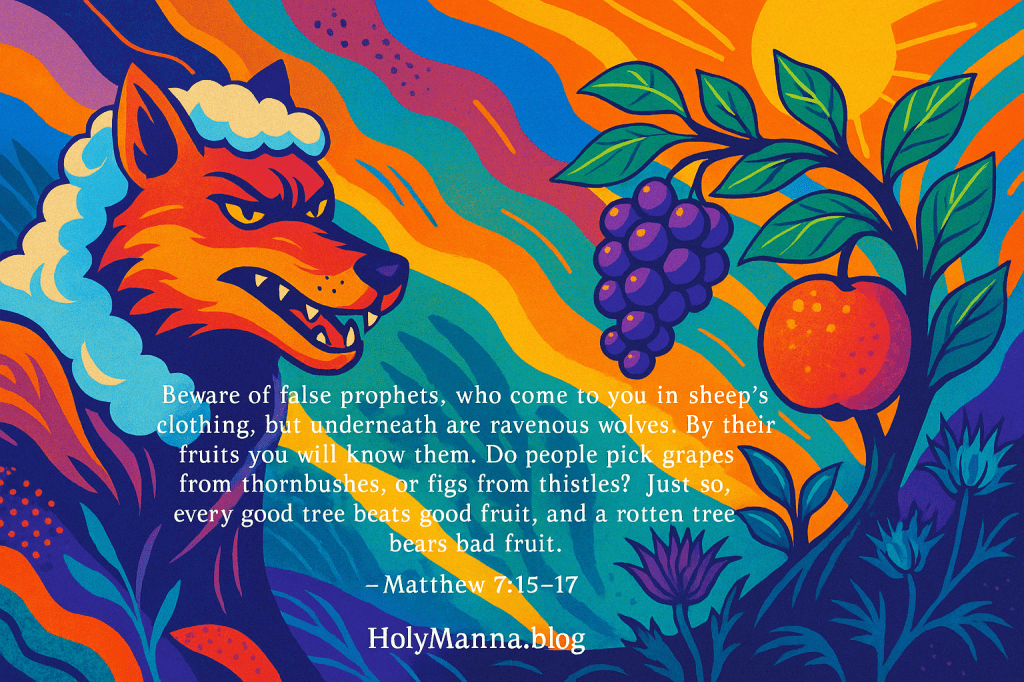
Fast forward to The Gospel of Matthew, where Jesus warns of false prophets, teaching us that “by their fruits you will know them”. It’s a message of discernment that brings us full circle: authentic faith isn’t proven by lofty words or outward appearances—it is proven by fruit. Like Abram, we are called to trust deeply, to listen for the voice of the true Shepherd, and to bear fruit through that faith. And in Psalm 105, we are reminded that God “remembers His covenant forever”, and that we, the spiritual descendants of Abraham, are invited into this eternal promise. Today, we are challenged to ask ourselves: Is my faith rooted in trust like Abram’s? Does my life bear fruit that reveals it?
First Reading – Genesis 15:1–12, 17–18
When Promises Burn Like Fire
What does it mean to trust God when His promises seem distant, or even impossible? When the waiting stretches on and all you see is barrenness, how do you remain faithful? Abram’s encounter with God in Genesis 15 marks one of the most profound turning points in the history of salvation. The Book of Genesis, the first book of the Bible, is foundational not just for understanding Israel’s identity, but for understanding the origins of the covenantal relationship between God and humanity. In today’s reading, we are brought into an intimate, mystical encounter where God initiates a formal covenant with Abram—who will soon be renamed Abraham—sealing divine promises with symbols both mysterious and sacred. This chapter is often considered a precursor to all later covenantal theology, echoed in the Mosaic, Davidic, and New Covenants. It ties perfectly into today’s theme: faith that bears fruit. Abram’s belief is counted as righteousness—not because he earned it, but because he trusted. His story calls us to mirror that trust in a world of uncertainty and delay.
Genesis 15:1-12, 17-18
New American Bible (Revised Edition)
The Covenant with Abram. 1 Some time afterward, the word of the Lord came to Abram in a vision: Do not fear, Abram! I am your shield; I will make your reward very great.
2 But Abram said, “Lord God, what can you give me, if I die childless and have only a servant of my household, Eliezer of Damascus?” 3 Abram continued, “Look, you have given me no offspring, so a servant of my household will be my heir.” 4 Then the word of the Lord came to him: No, that one will not be your heir; your own offspring will be your heir. 5 He took him outside and said: Look up at the sky and count the stars, if you can. Just so, he added, will your descendants be. 6 Abram put his faith in the Lord, who attributed it to him as an act of righteousness.
7 He then said to him: I am the Lord who brought you from Ur of the Chaldeans to give you this land as a possession. 8 “Lord God,” he asked, “how will I know that I will possess it?” 9 He answered him: Bring me a three-year-old heifer, a three-year-old female goat, a three-year-old ram, a turtledove, and a young pigeon. 10 He brought him all these, split them in two, and placed each half opposite the other; but the birds he did not cut up. 11 Birds of prey swooped down on the carcasses, but Abram scared them away. 12 As the sun was about to set, a deep sleep fell upon Abram, and a great, dark dread descended upon him.
17 When the sun had set and it was dark, there appeared a smoking fire pot and a flaming torch, which passed between those pieces. 18 On that day the Lord made a covenant with Abram, saying: To your descendants I give this land, from the Wadi of Egypt to the Great River, the Euphrates,
Detailed Exegesis
Verse 1 – “Some time afterward, the word of the Lord came to Abram in a vision: ‘Do not fear, Abram! I am your shield; I will make your reward very great.’”
This verse opens with reassurance. God speaks directly into Abram’s anxiety and uncertainty. The phrase “Do not fear” signals a divine call to courage, a frequent theme throughout Scripture when God prepares someone for a great task. Calling Himself Abram’s “shield” evokes both protection and divine patronage. The “reward” refers not only to material blessing, but to legacy, fruitfulness, and participation in God’s salvific plan.
Verse 2 – “But Abram said, ‘Lord God, what can you give me, if I die childless and have only a servant of my household, Eliezer of Damascus?’”
Here, Abram expresses raw vulnerability. Despite all the blessings he’s received, he remains without an heir. This introduces a major theme: the tension between God’s promise and human barrenness. Abram’s naming of Eliezer also suggests that, by custom, his estate would go to his chief servant—a common Near Eastern practice.
Verse 3 – “Abram continued, ‘Look, you have given me no offspring, so a servant of my household will be my heir.’”
Abram’s lament is not a lack of faith, but a cry for clarity. He acknowledges God’s sovereignty—“you have given me”—while wrestling with unfulfilled expectations. This models a form of prayer that is honest and trusting, even when confused.
Verse 4 – “Then the word of the Lord came to him: ‘No, that one will not be your heir; your own offspring will be your heir.’”
God’s response is definitive. The covenant will not be fulfilled through a workaround or human convention but through God’s direct intervention. This moment foreshadows the miraculous birth of Isaac and the unfolding of salvation history through divine initiative.
Verse 5 – “He took him outside and said: ‘Look up at the sky and count the stars, if you can. Just so,’ he added, ‘will your descendants be.’”
This is one of the most iconic images in all of Scripture. The night sky becomes a sacramental symbol of God’s promise—immense, uncountable, and cosmic in scope. The “stars” represent the future People of God, both physical descendants and spiritual heirs through faith.
Verse 6 – “Abram put his faith in the Lord, who attributed it to him as an act of righteousness.”
This verse is foundational for both Jewish and Christian theology. Cited by St. Paul in Romans 4 and Galatians 3, it shows that righteousness is not first about law or sacrifice, but about trust. Faith is the beginning of justification—trusting in God’s promise even when fulfillment seems impossible.
Verse 7 – “He then said to him: ‘I am the Lord who brought you from Ur of the Chaldeans to give you this land as a possession.’”
God recalls His past faithfulness to affirm His future promises. Naming “Ur of the Chaldeans” situates Abram’s story in a historical context and reminds us that God calls people out of their familiar surroundings to journey toward His purposes.
Verse 8 – “‘Lord God,’ he asked, ‘how will I know that I will possess it?’”
Abram’s question is not a challenge, but a request for assurance. This shows the human side of faith—longing for signs, for visible anchors to invisible truths.
Verse 9 – “He answered him: ‘Bring me a three-year-old heifer, a three-year-old female goat, a three-year-old ram, a turtledove, and a young pigeon.’”
These animals were customary offerings in ancient covenant ceremonies. Their age and diversity reflect both completeness and sacred value. This is not random ritual but divine liturgy.
Verse 10 – “He brought him all these, split them in two, and placed each half opposite the other; but the birds he did not cut up.”
This ritual of splitting animals was typical of covenant-making, symbolizing the seriousness of the agreement: a curse upon oneself if the terms were broken. The uncut birds may represent that not all offerings required severance—perhaps symbolizing purity or peace.
Verse 11 – “Birds of prey swooped down on the carcasses, but Abram scared them away.”
Symbolically, these predators may represent threats to the covenant—chaos, evil, or spiritual attack. Abram’s action shows vigilance in preserving the sanctity of the offering.
Verse 12 – “As the sun was about to set, a deep sleep fell upon Abram, and a great, dark dread descended upon him.”
This sleep parallels Adam’s in Genesis 2, signaling a deep spiritual event. The dread could reflect the weight of the covenant’s gravity or foreshadow Israel’s future suffering in Egypt (explained in later verses not read today).
Verse 17 – “When the sun had set and it was dark, there appeared a smoking fire pot and a flaming torch, which passed between those pieces.”
Fire and smoke are classic symbols of God’s presence, later seen in the burning bush and Mount Sinai. God alone walks through the sacrifice—unilateral grace, unconditional faithfulness.
Verse 18 – “On that day the Lord made a covenant with Abram, saying: ‘To your descendants I give this land, from the Wadi of Egypt to the Great River, the Euphrates.’”
God’s covenant is sealed with a specific promise of land, marking the beginning of the territorial identity of Israel. It is not just about land, but about a people consecrated to God’s purpose.
Teachings
This moment in Genesis lays the foundation for the Church’s understanding of covenant theology. The Catechism of the Catholic Church teaches that “the economy of the Old Covenant was to prepare the way for the Gospel” (CCC 122), and that “the patriarchs, prophets, and certain other Old Testament figures have been and always will be honored as saints in all the Church’s liturgical traditions” (CCC 61). Abram’s righteousness through faith prefigures the righteousness given to all who believe in Christ. His trust becomes the model of obedience that flows not from the Law but from belief in God’s promises.
St. Paul builds on this when he writes, “Abraham believed God, and it was credited to him as righteousness… so understand that it is those who have faith who are children of Abraham” (Galatians 3:6–7). In the New Covenant, all who believe in Jesus are spiritual heirs of Abram’s faith. The covenant of Genesis is thus not abolished but fulfilled—Jesus becomes the true “fire pot and torch”, walking between sacrifice and sealing us in His own blood on the Cross.
St. Augustine reflects on this event, noting: “The Lord, wishing to show that His promise to Abraham was certain, not only declared it with His word but confirmed it with a sacrament” (City of God, Book XVI). The ritual is a divine oath—a sacrament in sign if not yet in the formal system of the Church—and reveals God’s desire to condescend to human understanding. Historically, this scene also foreshadows the Passover and all subsequent covenant renewals, climaxing in the Eucharist, the “new and eternal covenant.”
Reflection
Abram’s journey is our journey. We are all called to trust in promises we do not yet see—promises of transformation, healing, resurrection, and divine purpose. Yet how often do we find ourselves like Abram, asking: “Lord, how will I know?” God doesn’t chastise that question—He answers it with signs, sacraments, and above all, His presence. Like Abram chasing away the birds of prey, we too must protect our faith from discouragement, doubt, and spiritual attack. What “birds of prey” try to settle on your heart today?
We live in a world of competing voices and counterfeit assurances. But God’s voice remains faithful. His covenant is not merely a transaction—it is a relationship, initiated by grace and sealed in love. What would it look like for you to step out into the unknown, as Abram did, and believe again? What land—literal or spiritual—is God promising to you, waiting for you to trust Him enough to walk toward it?
The fruit of faith is not always immediate, but it is always real. Trust, like Abram’s, is the seed that will grow into legacy. If we truly desire to be counted among the righteous, today’s reading shows us the way: to believe God, to wait on His promises, and to allow His covenant to shape our lives.
Responsorial Psalm – Psalm 105:1–4, 6–9
Echoes of a Faithful Covenant
Psalm 105 is a sacred hymn of thanksgiving and remembrance, celebrating God’s enduring fidelity to His covenant with Abraham. Rooted in Israel’s collective memory, this psalm was likely sung during major liturgical celebrations to recall the mighty deeds of the Lord and to reawaken the people’s identity as heirs to the divine promise. Historically, it serves as both a prayer and a lesson—an invitation to remember, to rejoice, and to remain faithful. The psalm was composed in a post-Exilic context or adapted for temple use during times of national reflection, especially as the people of Israel confronted trials and longed for the full realization of God’s promises. In today’s readings, Psalm 105 connects beautifully with Genesis 15 by emphasizing God’s unbreakable covenant and with The Gospel of Matthew by highlighting the importance of bearing witness to God’s works—evidence of good fruit.
Psalm 105:1-4, 6-9
New American Bible (Revised Edition)
God’s Fidelity to the Promise
1 Give thanks to the Lord, invoke his name;
make known among the peoples his deeds!
2 Sing praise to him, play music;
proclaim all his wondrous deeds!
3 Glory in his holy name;
let hearts that seek the Lord rejoice!
4 Seek out the Lord and his might;
constantly seek his face.
6 You descendants of Abraham his servant,
offspring of Jacob the chosen one!
7 He the Lord, is our God
whose judgments reach through all the earth.
8 He remembers forever his covenant,
the word he commanded for a thousand generations,
9 Which he made with Abraham,
and swore to Isaac,
Detailed Exegesis
Verse 1 – “Give thanks to the Lord, invoke his name; make known among the peoples his deeds!”
This opening line is a triple call to action: gratitude, invocation, and proclamation. The psalmist urges Israel to begin not with complaint or fear, but with praise. To “invoke his name” means to call upon the Lord in covenantal intimacy. The command to “make known among the peoples” transforms praise into mission—revealing that Israel’s experience of God is meant to bless the nations, echoing Genesis 12:3.
Verse 2 – “Sing praise to him, play music; proclaim all his wondrous deeds!”
This verse deepens the call to worship. Singing and music are more than art—they are acts of sacred remembrance. To “proclaim all his wondrous deeds” is to rehearse salvation history. This kind of proclamation cultivates hope and roots the community in identity and gratitude.
Verse 3 – “Glory in his holy name; let hearts that seek the Lord rejoice!”
To “glory” in God’s name is to find one’s boast and joy in His presence and character. The phrase “hearts that seek the Lord” suggests intentional pursuit, not passive religion. Rejoicing springs from authentic desire for God—a theme echoed in Psalm 37:4, “Delight in the Lord, and he will give you the desires of your heart.”
Verse 4 – “Seek out the Lord and his might; constantly seek his face.”
This verse uses repetition to emphasize persistence. To “seek his face” is to desire personal encounter—an intimate knowledge of God, not just His blessings. The Hebrew idiom behind this phrase suggests presence, relationship, and reverence. It aligns with Matthew 7, where Jesus calls us to discern God’s true presence by the fruit of righteousness.
Verse 6 – “You descendants of Abraham his servant, offspring of Jacob the chosen one!”
The psalmist addresses the faithful directly, connecting them to the covenant lineage. This reminder of heritage is both honor and responsibility. As “descendants of Abraham”, the people are called to live by faith and reflect their identity as God’s chosen.
Verse 7 – “He, the Lord, is our God whose judgments reach through all the earth.”
This affirms God’s universal reign. His “judgments” are not limited to Israel but are sovereign over the entire world. This reinforces the theme that God’s promises and justice extend beyond borders, and that His covenant with Abraham is for the blessing of all peoples.
Verse 8 – “He remembers forever his covenant, the word he commanded for a thousand generations,”
Here, divine memory is not passive recollection but active faithfulness. God’s remembrance is not like ours—it is a promise kept in motion. “A thousand generations” implies eternity. God’s word, once spoken, sustains generations even through seasons of silence.
Verse 9 – “Which he made with Abraham, and swore to Isaac,”
The psalmist anchors everything in the covenant with Abraham and Isaac. This verse forms a liturgical bridge between past and present, reminding the people—and us—that the God we worship is bound by love to fulfill His word. Even when we falter, He remains steadfast.
Teachings
The Catechism of the Catholic Church teaches that “The remembrance of the marvelous works of God… forms the heart of the celebration of the liturgy” (CCC 1363). This psalm, which remembers and proclaims God’s faithfulness, is a liturgical act in itself. As we recall the covenant with Abraham, we participate in the memory that nourishes faith. Worship, in Catholic understanding, is not a break from life—it is the re-anchoring of our life in God’s saving acts.
Saint Irenaeus, reflecting on salvation history, wrote: “God does not forget His promises. Rather, He fulfills them at the right time, for the good of all creation” (Against Heresies, Book 4). Psalm 105 embodies this theological truth. While Abram had to wait for the birth of Isaac, and Israel waited centuries to see the Promised Land, and all creation waited for the Incarnation, God’s timing is always perfect. His “judgments reach through all the earth”, and His faithfulness is the true compass of history.
The Church Fathers also saw in this psalm the mission of the Church. As descendants of Abraham by faith (cf. Galatians 3:29), we are called to “make known among the peoples His deeds”—to evangelize through memory. Saint John Paul II once said: “To be Christian is to be a keeper of memory.” This is not nostalgia but covenantal responsibility: to remember God’s wonders and let them shape our witness to the world.
Reflection
Psalm 105 reminds us that remembering is a sacred act. In a world saturated with distraction and spiritual amnesia, we are called to pause and recall what God has done—not just for Israel, but for each of us. Do I regularly rehearse the works of the Lord in my life? Do I give thanks, invoke His name, and make His deeds known among those around me?
This psalm also challenges us to rejoice in seeking the Lord. In times of dryness or doubt, it may feel difficult to rejoice or sing praises. Yet joy often follows the act of seeking—not the other way around. What small act of praise or remembrance can you offer today, even before the fruit of the promise arrives? Can you name and share one way God has been faithful to you this week?
Finally, we are invited to see ourselves as part of an unbroken story—a chosen lineage not by blood, but by faith. To live as heirs of the covenant is to bear fruit in love, memory, and trust. Let us glorify in His holy name, seek His face constantly, and join in the great echo of faith sung by Abraham, Isaac, and every heart that has ever hoped in the Lord.
Holy Gospel – Matthew 7:15–20
Fruit That Cannot Lie
As Jesus nears the end of His Sermon on the Mount in The Gospel of Matthew, He shifts from the Beatitudes and spiritual disciplines to sharp warnings and discernment. Matthew 7 is set within a deeply Jewish context, where prophets were known and revered, yet where false prophets were also a dangerous reality. Jesus speaks into a religious culture where external piety could mask interior corruption—where wolves could wear wool. This Gospel is deeply significant for Christian moral teaching because it shows how inner transformation must bear outer fruit. It ties directly into today’s theme: faith that bears fruit. In Abram we saw a faith counted as righteousness; in Psalm 105 we saw a people called to proclaim God’s faithfulness. Now Jesus gives us the litmus test: “By their fruits you will know them.”
Matthew 7:15-20
New American Bible (Revised Edition)
15 “Beware of false prophets, who come to you in sheep’s clothing, but underneath are ravenous wolves. 16 By their fruits you will know them. Do people pick grapes from thornbushes, or figs from thistles? 17 Just so, every good tree bears good fruit, and a rotten tree bears bad fruit. 18 A good tree cannot bear bad fruit, nor can a rotten tree bear good fruit. 19 Every tree that does not bear good fruit will be cut down and thrown into the fire. 20 So by their fruits you will know them.
Detailed Exegesis
Verse 15 – “Beware of false prophets, who come to you in sheep’s clothing, but underneath are ravenous wolves.”
Jesus begins with a warning, not a suggestion. The word “beware” implies active vigilance. The imagery of “sheep’s clothing” draws on pastoral symbolism familiar to His audience—sheep being the image of God’s people. To be “ravenous wolves” is to be predatory, consuming others rather than feeding them. This verse reminds us that not all who appear religious or kind-hearted are trustworthy.
Verse 16 – “By their fruits you will know them. Do people pick grapes from thornbushes, or figs from thistles?”
This central principle is repeated twice for emphasis. Fruit in Scripture refers to visible moral and spiritual outcomes. Jesus uses common agricultural knowledge—grapes don’t grow on thornbushes—to illustrate a deeper truth: the interior reality of a person will eventually show itself. Disciples must judge teachings and lives not by charm or novelty but by fruit.
Verse 17 – “Just so, every good tree bears good fruit, and a rotten tree bears bad fruit.”
This analogy pushes the metaphor further. There is no ambiguity—trees are either healthy or diseased. In biblical thought, fruit is not about perfection, but consistency in righteousness, love, humility, and truth. A good tree can struggle, but it cannot perpetually produce rotten fruit.
Verse 18 – “A good tree cannot bear bad fruit, nor can a rotten tree bear good fruit.”
Here, Jesus speaks of spiritual integrity. While we may stumble, we cannot live in contradiction forever. The Gospel calls for coherence between belief and behavior. This statement challenges a culture that separates words from witness, intentions from impact.
Verse 19 – “Every tree that does not bear good fruit will be cut down and thrown into the fire.”
This is a stark warning of divine judgment. It echoes John the Baptist’s words in Matthew 3:10. The imagery of fire often symbolizes purification or judgment. Trees that do not bear fruit are not just ignored—they are cut down. This reinforces the urgency of conversion and authentic discipleship.
Verse 20 – “So by their fruits you will know them.”
The passage ends where it began, bookending the teaching. This repetition is classic rabbinic pedagogy—truth must be driven home. Discernment is not optional. The visible fruit of a person’s life is the clearest indicator of their closeness to God.
Teachings
The Catechism of the Catholic Church teaches that “By charity, we love God above all things and our neighbor as ourselves for love of God. Charity, the form of all the virtues, binds everything together in perfect harmony” (CCC 1822). Fruit, in Gospel terms, is most perfectly seen in charity. A person’s inner life with God must be revealed through their outward actions of love, justice, and mercy. If we want to examine our fruit, we must begin with love.
St. John Chrysostom, commenting on this passage, writes: “It is not the outward appearance of things that must guide us, but their results and works. This is how one discerns the false from the true.” In other words, orthodoxy must be accompanied by orthopraxy. This wisdom remains urgent today, in a digital world of spiritual influencers and self-proclaimed prophets. The fruit test is timeless: it is Christ’s safeguard for His Church.
St. Ignatius of Loyola also offers practical wisdom in the Spiritual Exercises regarding discernment of spirits: “The good spirit gives strength, consolation, and peace. The evil spirit disturbs, brings anxiety, and leads to desolation.” These interior fruits mirror the external ones Jesus points to. A false prophet may wear a smile but sow confusion. The Spirit of God, by contrast, yields clarity, joy, and good works. Jesus’ teaching in Matthew 7 invites us to sharpen our discernment—not with suspicion, but with spiritual sobriety.
Reflection
Jesus doesn’t call us to judge harshly, but to discern wisely. In our relationships, our faith communities, even our own hearts, we must ask: What kind of fruit is being produced here? Does this person, this teaching, or this habit lead me closer to the Father or away from Him?
This Gospel calls for courageous honesty. It challenges us to look not just at what we say or believe, but at what flows from our lives. Are my words kind, but my actions selfish? Do I bear the fruits of the Spirit: love, joy, peace, patience, kindness, faithfulness? (cf. Galatians 5:22–23) Jesus offers this teaching not to shame us but to prune us—to help us flourish.
Finally, this passage is a call to integrity. If we are grafted into the Vine that is Christ, we cannot help but bear good fruit over time. And when we fall short, we turn to Him who is both the Gardener and the Redeemer. Lord, make me a good tree. Let my roots go deep in You, so that the fruit of my life may reveal not my glory, but Yours.
Faith That Grows Roots and Bears Fruit
Today’s readings carry us through the entire arc of the spiritual life: from the moment of promise in Genesis 15, through the memory of covenant in Psalm 105, to the test of authenticity in Matthew 7. We begin with Abram, standing beneath the stars, daring to believe the impossible. His faith is not proven by success, but by trust—and God counts that trust as righteousness. In the psalm, we are invited to remember, rejoice, and respond. God’s faithfulness is not locked in the past; it is alive in every generation. He remembers His covenant forever—and so must we. Then, in the Gospel, Jesus brings everything into focus: “By their fruits you will know them.” Faith must not only believe—it must live, it must grow, it must bear fruit that nourishes others and glorifies God.
All three readings speak of legacy: Abram’s descendants, the thousand generations of the faithful, the lasting fruit of a life rooted in Christ. But this legacy does not begin in grand acts—it begins in secret trust, in daily surrender, in honest discernment. Where in your life is God inviting you to deeper trust? What kind of fruit are you cultivating in the hidden soil of your soul?
Let this day be a call not just to admire the saints and prophets of the past, but to join them. Like Abram, step into God’s promises—even when they seem distant. Like the psalmist, remember and proclaim the wonders of the Lord. Like the disciples in the Gospel, seek not appearances but fruit, not noise but truth. May our faith take root in trust and bloom in love, until the harvest reveals hearts that are truly His.
Engage with Us!
We’d love to hear how today’s readings speak to your heart. Share your reflections, prayers, or insights in the comments below—your words may be the encouragement someone else needs today! Whether it’s a moment of trust like Abram’s, a verse from the psalm that stirred your memory, or a line from the Gospel that challenged your walk, don’t keep it to yourself. Let’s grow together in faith and bear fruit that glorifies God.
Reflection Questions:
First Reading – Genesis 15:1–12, 17–18
When have you had to trust God despite not seeing immediate results? Are there areas in your life where God is asking you to believe in His promise before it’s fulfilled? How do you protect your heart from the “birds of prey” that threaten your trust in God’s word?
Responsorial Psalm – Psalm 105:1–4, 6–9
What are some of the “wondrous deeds” God has done in your life that you need to remember today? Do you take time to “seek His face constantly” in prayer and worship? How can you make His deeds known among the people in your family, workplace, or community?
Holy Gospel – Matthew 7:15–20
What kind of fruit is your life bearing right now—at home, in your thoughts, and in your relationships? Are there “trees” in your life that may appear good but are not bearing the fruit of the Spirit? How can you grow in spiritual discernment without becoming judgmental?
As you go about your day, remember that faith isn’t a feeling—it’s a relationship. Trust in God’s promises, seek His face daily, and let your life be a testimony to His goodness. Do everything with the love and mercy Jesus taught us, and let the world know you belong to Him—by your fruits.
Follow us on Instagram and Facebook for more insights and reflections on living a faith-filled life.

 Holy Manna!
Leave a comment