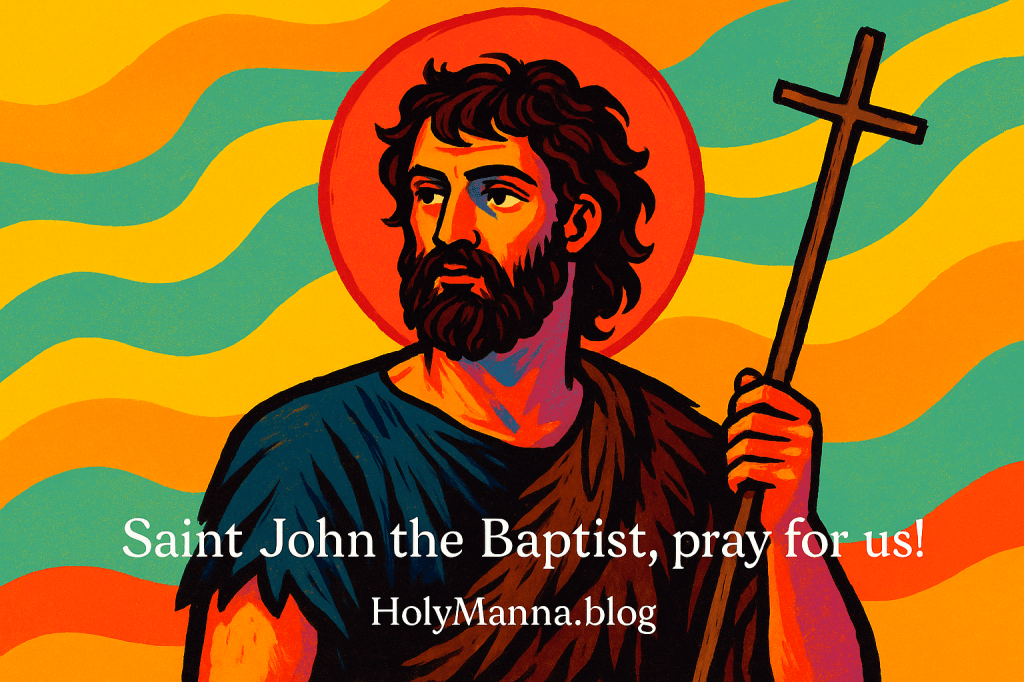
The Voice in the Wilderness
Saint John the Baptist stands like a blazing torch on the threshold between the Old and New Covenants. His role in salvation history is both unique and profound: he was the last and greatest of the prophets who prepared the people for the coming of Christ, and he was the first to recognize and proclaim Jesus as the Messiah. “Among those born of women, there has risen no one greater than John the Baptist” (The Gospel of Matthew 11:11). His mission, given before his birth, was to make straight the way of the Lord, and he carried it out with fearless dedication, uncompromising truth, and radical humility. His voice cried out not only in the literal wilderness of Judea but in the spiritual wilderness of human hearts. The Church venerates him with exceptional honor—his birth is one of only three celebrated in the liturgical calendar (alongside Jesus and Mary)—a sign of his extraordinary role in God’s plan.
A Child of Prophecy and Desert Fire
The birth of John the Baptist is a story saturated in divine promise. His parents, Zechariah and Elizabeth, were advanced in age and had no children, a situation seen as shameful in their time. But “nothing will be impossible with God” (The Gospel of Luke 1:37). When Zechariah was serving in the Temple, the angel Gabriel appeared and declared that Elizabeth would bear a son, and that this child would be “great before the Lord” (The Gospel of Luke 1:15). His name, John—meaning “God is gracious”—was divinely given. Even before his birth, John was chosen and consecrated for his prophetic mission. When Mary, bearing Jesus in her womb, visited Elizabeth, the unborn John leapt in the womb in recognition of the Savior’s presence, a moment that the Church understands as John being filled with the Holy Spirit.
As he grew, John withdrew into the desert, choosing a life of poverty, solitude, and communion with God. He became the very image of prophetic fervor, wearing camel’s hair, eating locusts and honey, and preaching repentance to all who came to him by the Jordan River. His baptism was not yet the sacramental baptism we know, but a symbolic call to conversion of heart. Still, when Jesus approached him to be baptized, John recognized the moment’s sacredness and hesitated: “I need to be baptized by you, and do you come to me?” (The Gospel of Matthew 3:14). Yet he obeyed, and in that moment, the heavens opened, the Holy Spirit descended, and the Father’s voice was heard: “This is my beloved Son, with whom I am well pleased” (The Gospel of Matthew 3:17). John’s entire life and ministry pointed to Jesus. His greatest joy was not in his own following, but in stepping aside: “He must increase, but I must decrease” (The Gospel of John 3:30).
The Miracle Hidden in the Womb
While John the Baptist is not typically listed among the miracle-working saints, his entire existence is a testament to the miraculous. His conception to an aged, barren couple is reminiscent of the births of Isaac and Samuel, placing John in the line of great prophetic births that revealed God’s intervention in human barrenness. His very presence in the womb became a channel of grace: when the Virgin Mary greeted Elizabeth during the Visitation, John leapt with joy—a sign that he recognized Christ even from the womb. “The infant leaped in her womb, and Elizabeth was filled with the Holy Spirit” (The Gospel of Luke 1:41). This event, understood by the Church as John’s sanctification before birth, is unparalleled in the history of the saints.
John’s life itself was a miracle of unwavering faith. He drew entire crowds into the wilderness, not through wealth or worldly power, but by the strength of his prophetic voice. His words pierced the hearts of tax collectors, soldiers, and Pharisees alike. Even King Herod, who would later order his execution, was at first fascinated and troubled by John’s preaching. Saint John’s authority came from his deep union with God, and though he performed no dramatic wonders like healing the sick or raising the dead, he turned the hearts of many back to righteousness through the miracle of repentance.
The Fire That Cost Him His Head
Courage has always carried a cost, and for John the Baptist, that cost was his life. His message was clear, uncompromising, and confrontational. He called out the sins of the people, but also those in high places. When King Herod Antipas entered into an unlawful and scandalous marriage with Herodias, his brother’s wife, John publicly rebuked him: “It is not lawful for you to have her” (The Gospel of Mark 6:18). Herodias burned with resentment and sought revenge, but Herod, though disturbed, feared and respected John, “knowing that he was a righteous and holy man” (The Gospel of Mark 6:20).
John was arrested and imprisoned, yet his spirit was not broken. He continued to be a beacon of integrity behind bars. Eventually, Herodias seized her chance. During a banquet, her daughter Salome danced for Herod and his guests. Delighted, Herod rashly promised her anything she desired. Coached by her mother, she demanded the unthinkable: “I want you to give me at once the head of John the Baptist on a platter” (The Gospel of Mark 6:25). Bound by his own oath and fear of losing face, Herod ordered the execution. John died a martyr’s death—a prophet silenced by pride, lust, and political cowardice.
Yet in this martyrdom, John’s witness became immortal. He became the patron of those who stand for truth regardless of the consequences. His blood cried out, not for vengeance, but for preparation—for the Lamb of God to be known, loved, and followed.
A Prophet Remembered by Heaven and Earth
Though John the Baptist performed few miracles during his life, his veneration has been accompanied by signs of grace throughout the centuries. His relics have long been objects of pilgrimage and reverence. In the ancient Christian world, devotion to Saint John was widespread. Churches were erected in his honor in Jerusalem, Constantinople, and throughout Europe. The Umayyad Mosque in Damascus—originally a Christian basilica—was said to house his head. In Amiens Cathedral, a relic believed to be his skull drew thousands of medieval pilgrims.
The Church celebrates his birth on June 24 and his martyrdom on August 29, both days honored with liturgical solemnity. The Catechism reminds us of John’s exceptional place in salvation history: “John surpasses all the prophets, of whom he is the last… he inaugurates the Gospel… he is more than a prophet” (CCC 523). His life, death, and legacy remain a source of strength for those who seek to speak the truth, even when the world does not want to hear it.
In art and iconography, John is often shown with a lamb or pointing to Christ, symbolizing his role as herald of the Messiah. His spirit lives on in every preacher who calls for repentance, every voice that dares to cry out in the wilderness of modern moral confusion. His life was one long preparation—and his death, the final seal of fidelity.
The Desert Still Speaks
The story of Saint John the Baptist is not just ancient history—it’s a living call to conversion, humility, and courage. His life challenges each of us to examine our hearts: Are we preparing the way for the Lord in our families, our friendships, our workplaces? Do we have the courage to speak the truth in love, even when it costs us comfort or status? Are we willing to step into the wilderness if that’s where God is calling us?
Saint John teaches us that greatness in God’s eyes is not found in popularity or possessions, but in obedience. His message was never his own—it was always a finger pointing toward Christ. “Behold, the Lamb of God, who takes away the sin of the world” (The Gospel of John 1:29). That same Lamb calls us now to a deeper conversion.
Let us strive to embody John’s virtues: his passionate commitment to truth, his radical humility, and his fearless proclamation of God’s kingdom. Like John, we are called to prepare the way of the Lord—not just in our words, but in the way we live, love, and serve.
How will you prepare the way of the Lord today? Are you willing to decrease, so Christ may increase in your life?
Engage with Us!
We’d love to hear your thoughts! How does Saint John the Baptist’s example speak to your life today? Share your reflections in the comments and let’s encourage one another in our walk with Christ.
Reflection Questions:
- In what areas of your life do you feel called to speak truth boldly, like John the Baptist?
- How can you practice humility this week and “decrease” so that Christ may increase?
- Are there any “deserts” in your life where God may be calling you to deeper intimacy with Him?
Let us pray for one another, that we may be courageous like John, compassionate like Jesus, and faithful to the very end. Let everything we do be done in love (1 Corinthians 16:14).
Saint John the Baptist, pray for us! 🕊️
Follow us on Instagram and Facebook for more insights and reflections on living a faith-filled life.

 Holy Manna!
Leave a comment