Known, Named, and Sent
There is something profoundly mysterious about the moment we realize our life is not random—that we were seen, formed, and called even before our first breath. Today’s Solemnity of the Nativity of Saint John the Baptist invites us into that mystery with awe and gratitude. We celebrate not just John’s miraculous birth, but the truth it reveals about God’s divine initiative: He names us, claims us, and sets us apart for a purpose far greater than we could imagine. What if your life was written into God’s plan from the very beginning? Today’s readings challenge us to look back to the womb and forward to our mission.
Each reading echoes this theme of being chosen and formed from before birth. In Isaiah 49, we hear the Servant of the Lord proclaim, “From my mother’s womb he gave me my name”, a prophetic declaration fulfilled in the life of John, who is named by God and not by man. Psalm 139 resounds with wonder at the God who “knit me in my mother’s womb”, revealing a Creator who fashions every person with intimate care. In Acts 13, Saint Paul reminds us how John’s role was to prepare the way for Jesus, not to glorify himself, but to announce the One to come. Finally, The Gospel of Luke recounts John’s nativity—his birth marked by joy, his naming by obedience, and his growth in the silence of the desert until the day of his prophetic emergence. These are not isolated stories—they are threads woven into one magnificent tapestry of divine calling.
The Church’s celebration of John’s birth is one of only three nativities honored in the liturgical calendar—the others being Jesus and the Blessed Virgin Mary. This alone signals John’s exceptional role in salvation history. His life, from conception to martyrdom, is a mirror held up to our own: we are called not to be the Messiah, but to make room for Him. John’s cry in the wilderness is the same one we’re invited to echo in our homes, workplaces, and culture: “Prepare the way of the Lord”. As we journey through today’s readings, may we rediscover that we, too, are wonderfully made, called by name, and sent forth to shine His light to the ends of the earth.
First Reading – Isaiah 49:1–6
Conceived in Secret, Chosen for the World
The Book of Isaiah is a towering prophetic text that bridges judgment and hope, exile and restoration. Written over multiple generations, today’s passage comes from what scholars often call Second Isaiah (chapters 40–55), believed to be written during the Babylonian Exile—a period of immense suffering and identity crisis for Israel. Chapter 49 introduces us to the mysterious “Servant of the Lord,” whose mission will eventually encompass not only Israel but the entire world. This Servant, both an individual and a symbol of faithful Israel, speaks of a divine call that began before birth. On this Solemnity of the Nativity of Saint John the Baptist, the reading draws a profound connection between John and the Servant: both are chosen from the womb, both speak words that pierce hearts, and both prepare the way for God’s greater plan. John’s mission, like the Servant’s, is to gather, illuminate, and glorify God.
Isaiah 49:1-6
New American Bible (Revised Edition)
The Servant of the Lord
1 Hear me, coastlands,
listen, distant peoples.
Before birth the Lord called me,
from my mother’s womb he gave me my name.
2 He made my mouth like a sharp-edged sword,
concealed me, shielded by his hand.
He made me a sharpened arrow,
in his quiver he hid me.
3 He said to me, You are my servant,
in you, Israel, I show my glory.
4 Though I thought I had toiled in vain,
for nothing and for naught spent my strength,
Yet my right is with the Lord,
my recompense is with my God.
5 For now the Lord has spoken
who formed me as his servant from the womb,
That Jacob may be brought back to him
and Israel gathered to him;
I am honored in the sight of the Lord,
and my God is now my strength!
6 It is too little, he says, for you to be my servant,
to raise up the tribes of Jacob,
and restore the survivors of Israel;
I will make you a light to the nations,
that my salvation may reach to the ends of the earth.
Detailed Exegesis
Verse 1 – “Hear me, coastlands, listen, distant peoples. Before birth the Lord called me, from my mother’s womb he gave me my name.”
The Servant begins by calling the nations—“coastlands” and “distant peoples”—into the conversation, signaling a mission that is global in scope. His calling is not self-generated; it is divine and prenatal. This verse directly parallels the story of John the Baptist, whose name was given by God through the angel Gabriel (Luke 1:13). In Jewish tradition, naming signifies identity and mission. That God gives the Servant his name while still in the womb affirms His sovereign authorship of every life and vocation.
Verse 2 – “He made my mouth like a sharp-edged sword, concealed me, shielded by his hand. He made me a sharpened arrow, in his quiver he hid me.”
The Servant’s words are likened to weapons—not of violence, but of truth. His mouth is a “sharp-edged sword,” reminiscent of Hebrews 4:12, which declares, “The word of God is living and effective, sharper than any two-edged sword.” Hidden in God’s “quiver,” the Servant is a prepared instrument, waiting for the right moment. This is John in the desert—being strengthened by God in secret until his appointed time (Luke 1:80).
Verse 3 – “He said to me, You are my servant, in you, Israel, I show my glory.”
Here we see the Servant addressed as both an individual and as “Israel,” indicating a double meaning. He is one person but also represents the faithful remnant of the people of God. The mission is clear: to be a reflection of God’s glory. John the Baptist’s life, rooted in simplicity and radical obedience, glorified God not by drawing attention to himself, but by pointing entirely to Jesus: “Behold, the Lamb of God” (John 1:29).
Verse 4 – “Though I thought I had toiled in vain, for nothing and for naught spent my strength, Yet my right is with the Lord, my recompense is with my God.”
Even the Servant experiences discouragement. His feelings of futility are deeply human, but his confidence remains in God’s justice. John’s death in Herod’s prison could seem like a tragic end—but from the perspective of eternity, his “toil” prepared Israel for Christ. God sees and rewards every hidden labor of love.
Verse 5 – “For now the Lord has spoken who formed me as his servant from the womb, That Jacob may be brought back to him and Israel gathered to him; I am honored in the sight of the Lord, and my God is now my strength!”
The mission of the Servant is reconfirmed: to bring back Jacob and gather Israel. This is exactly what John’s ministry of repentance accomplished—he turned hearts back to God in preparation for Jesus. His honor is not in status but in obedience. His strength, like ours, is not self-made, but rooted in God’s grace.
Verse 6 – “It is too little, he says, for you to be my servant, to raise up the tribes of Jacob, and restore the survivors of Israel; I will make you a light to the nations, that my salvation may reach to the ends of the earth.”
This verse expands the vision. The Servant is not only for Israel but for all nations. This anticipates the universal mission of Christ and, through Him, the Church. John the Baptist inaugurates this global vision by preparing the hearts of Israel for the One whose light is meant for everyone—Jews and Gentiles alike.
Teachings from the Church
The Catechism of the Catholic Church reaffirms that every human life is willed and known by God before birth. CCC 2270 proclaims: “Human life must be respected and protected absolutely from the moment of conception. From the first moment of his existence, a human being must be recognized as having the rights of a person.” This is not merely a teaching on morality but a declaration of divine intentionality. We are not accidents—we are creations of love and mission.
The figure of the Servant in Isaiah 49 finds fulfillment in both John the Baptist and ultimately in Christ Himself. As CCC 523 states: “St. John the Baptist is the Lord’s immediate precursor or forerunner, sent to prepare his way… he inaugurates the Gospel, already from his mother’s womb welcomes the coming of Christ.” John leaps in Elizabeth’s womb as Mary, bearing Jesus, greets her—a moment of prenatal prophecy that embodies this reading in flesh and spirit.
Saint Augustine once preached: “John is the voice, but the Lord is the Word who was in the beginning. John is a temporary sound; Christ is the eternal meaning.” This captures the humility and power of John’s mission. He did not seek glory but embraced his role as herald. In history, as in Scripture, the faithful often serve in obscurity, yet the Church teaches that it is precisely in that humble service that God is glorified and the world is prepared for His salvation.
Reflection
This reading challenges each of us to believe that we, too, were formed by God with purpose. Do you believe that your life was crafted with intention—even your wounds, your seasons of silence, your hidden struggles? Like the Servant—and like John—you are not forgotten. God may be preparing you in secret to shine His light in places no one else can reach. Are you willing to speak truth even when you feel ineffective? Are you trusting in God’s timing when the fruit is not yet visible? This reading reminds us that God is the Author, the Potter, and the Sender. Our role is not to measure success, but to say yes. Let us embrace our divine calling with courage and joy.
Responsorial Psalm – Psalm 139:1–3, 13–15
Wonderfully Made, Eternally Known
Few passages in all of Scripture express the intimate nearness of God quite like Psalm 139. Attributed to King David, this psalm reflects a deeply personal, even poetic awareness of God’s omniscience and omnipresence. Written in a time when neighboring nations worshipped distant, impersonal gods, Psalm 139 stands apart as a declaration of God’s tender, ever-present attention to every detail of human life. It portrays not a cold divine surveillance, but the loving gaze of a Creator who sees, knows, and cherishes every one of His children. On this Solemnity of the Nativity of Saint John the Baptist, the psalm resonates powerfully with the day’s theme: called from the womb, seen in secret, and sent with purpose. Just as John was known by God before he was formed, so too are we. And not just known—loved into being.
Psalm 139:1-3, 13-15
New American Bible (Revised Edition)
The All-knowing and Ever-present God
1 For the leader. A psalm of David.
Lord, you have probed me, you know me:
2 you know when I sit and stand;
you understand my thoughts from afar.
3 You sift through my travels and my rest;
with all my ways you are familiar.
13 You formed my inmost being;
you knit me in my mother’s womb.
14 I praise you, because I am wonderfully made;
wonderful are your works!
My very self you know.
15 My bones are not hidden from you,
When I was being made in secret,
fashioned in the depths of the earth.
Detailed Exegesis
Verse 1 – “Lord, you have probed me, you know me.”
This opening verse sets the tone for the entire psalm. God’s knowledge of us is not superficial—it is probing, penetrating, complete. The Hebrew word used here implies an intimate searching, like the way a priest would examine an offering. We are known through and through by God—not just our actions, but our motivations, fears, and longings. This is a cause not for dread, but for awe.
Verse 2 – “You know when I sit and stand; you understand my thoughts from afar.”
Even the most mundane details of our lives are seen by God. The image of sitting and standing expresses our everyday routines. More than observing our behavior, God “understands” our thoughts—our mental processes, hopes, and inner dialogues. God is not distant; He draws near to know us better than we know ourselves.
Verse 3 – “You sift through my travels and my rest; with all my ways you are familiar.”
“Sift” is an image of refinement, like wheat separated from chaff. God examines our coming and going, our work and our rest. The phrase “all my ways” affirms that there is no hidden path from God. In the context of John the Baptist, who lived a life of radical detachment and desert wandering, this verse reminds us that even the wildest terrain is known to the Lord.
Verse 13 – “You formed my inmost being; you knit me in my mother’s womb.”
This verse is the heartbeat of today’s theme. “Formed” and “knit” are verbs of care and craftsmanship, suggesting a Creator who is both Artist and Father. Our “inmost being” includes not just our body, but our soul—our spiritual core. This verse aligns perfectly with Isaiah 49 and Luke 1, affirming that our lives begin not at birth, but at God’s eternal initiative.
Verse 14 – “I praise you, because I am wonderfully made; wonderful are your works! My very self you know.”
David breaks into praise, not for his own sake, but for the marvel of God’s creative love. To declare, “I am wonderfully made”, is not self-centered—it is an act of worship. It acknowledges that we are each a masterpiece of divine intention. This verse teaches us to reclaim reverence for the body, soul, and the entire human person.
Verse 15 – “My bones are not hidden from you, when I was being made in secret, fashioned in the depths of the earth.”
Here David draws from the imagery of a potter’s workshop, hidden from view, deep in the earth. This “secret place” is the womb—hidden from human eyes but known by God. It’s a poetic mirror of the reading from Isaiah 49, where the Servant is “concealed” and “hidden in God’s quiver.” John the Baptist, too, was formed in secret, yet destined to echo across the ages.
Teachings from the Church
The Catechism of the Catholic Church consistently affirms the sacredness of every human life, from conception to natural death. CCC 364 reminds us that “the human body shares in the dignity of ‘the image of God’: it is a human body precisely because it is animated by a spiritual soul, and it is the whole human person that is intended to become, in the body of Christ, a temple of the Spirit.” Psalm 139 reflects this mystery by showing us that our physical formation is deeply spiritual—it is not merely biological, but theological.
Saint John Paul II often referenced Psalm 139 in his writings on the dignity of life, particularly in his encyclical Evangelium Vitae. He wrote: “Even before being born, indeed from the moment of conception, the life of every individual—inside and outside the womb—is marked by the creative action of God and is part of his plan.” This psalm, then, is not just personal poetry; it is a foundation for the Church’s unwavering defense of life and human dignity. In the life of John the Baptist, we see that divine initiative unfold dramatically.
Saint Teresa of Calcutta embodied this psalm in her mission. She often reminded others that “Each one of them is Jesus in disguise”, referring to the poor and abandoned. But she also recognized that each life, no matter how small or hidden, is a work of God’s own hands. Historically, this psalm has been prayed by expectant mothers, pro-life advocates, and those searching for identity and purpose. In a world that prizes external achievement, Psalm 139 calls us back to the truth that our value lies in simply being known and loved by God.
Reflection
Do you live as though you are wonderfully made? Do you truly believe that your life, even in its hiddenness or hardship, is known and loved by God? Today’s psalm invites us to see ourselves—and others—through heaven’s eyes. We are not the sum of our failures or accomplishments. We are not forgotten. We are formed, known, and held. In a world driven by comparison and performance, this is liberating. Consider spending time today in silence, letting God “probe” your heart, not to shame you, but to remind you: “My very self you know.” Let that be the place where praise begins. And like John the Baptist, may we grow strong in spirit, rooted in the truth that before we ever spoke a word, God spoke our name.
Second Reading – Acts 13:22–26
The Voice That Prepared the Promise
The Acts of the Apostles is often described as the “Gospel of the Holy Spirit,” chronicling the explosive birth and growth of the early Church after Christ’s Ascension. Written by Saint Luke, Acts bridges the life of Jesus and the missionary journey of the Apostles—especially Saints Peter and Paul. Today’s passage comes from one of Paul’s sermons, delivered in the synagogue at Antioch in Pisidia. Here, Paul is connecting the Old Testament promises to their New Testament fulfillment in Jesus. He traces salvation history from King David to Jesus Christ, and introduces John the Baptist as the final preparatory figure—the hinge between the old covenant and the new. On this Solemnity of the Nativity of Saint John the Baptist, Paul’s words show us how John’s voice didn’t just echo in the desert—it reverberated through the very structure of salvation history.
Acts 13:22-26
New American Bible (Revised Edition)
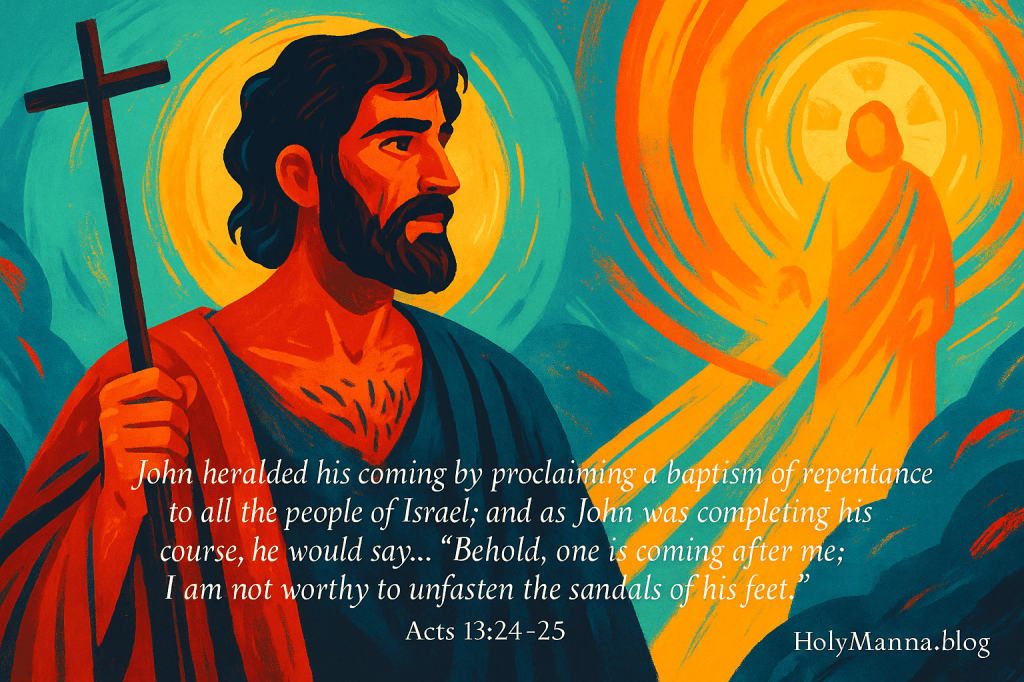
22 Then he removed him and raised up David as their king; of him he testified, ‘I have found David, son of Jesse, a man after my own heart; he will carry out my every wish.’ 23 From this man’s descendants God, according to his promise, has brought to Israel a savior, Jesus. 24 John heralded his coming by proclaiming a baptism of repentance to all the people of Israel; 25 and as John was completing his course, he would say, ‘What do you suppose that I am? I am not he. Behold, one is coming after me; I am not worthy to unfasten the sandals of his feet.’
26 “My brothers, children of the family of Abraham, and those others among you who are God-fearing, to us this word of salvation has been sent.
Detailed Exegesis
Verse 22 – “Then he removed him and raised up David as their king; of him he testified, ‘I have found David, son of Jesse, a man after my own heart; he will carry out my every wish.’”
Paul recounts how God replaced King Saul with David, calling him a man after His own heart. David is the model of a repentant and faithful servant, despite his flaws. This sets the stage for Jesus, the Son of David, who fulfills the kingship perfectly. The mention of David reminds listeners that God works through chosen individuals, formed and anointed, just as John was chosen from the womb.
Verse 23 – “From this man’s descendants God, according to his promise, has brought to Israel a savior, Jesus.”
God’s promise to David in 2 Samuel 7:12–13—that his lineage would produce a king whose reign would never end—is fulfilled in Jesus. Paul is proclaiming that the long-awaited Savior has come, not by human design, but through divine fidelity. John’s role in heralding this Savior is inseparable from this fulfillment.
Verse 24 – “John heralded his coming by proclaiming a baptism of repentance to all the people of Israel.”
John’s identity is clear: he is the forerunner. His baptism of repentance was not salvific, but preparatory—an outward sign of interior readiness for the One who was to come. John’s mission was rooted in urgency and humility. He knew he was not the Messiah, yet his ministry was essential to prepare Israel’s heart to receive Him.
Verse 25 – “And as John was completing his course, he would say, ‘What do you suppose that I am? I am not he. Behold, one is coming after me; I am not worthy to unfasten the sandals of his feet.’”
This powerful verse reveals the depth of John’s humility. In the ancient world, unfastening sandals was the task of the lowliest servant. John refuses even that role, showing total deference to Christ. His mission, like the Servant in Isaiah 49, is not self-promotion, but self-emptying. His “course” wasn’t a sprint but a life of discipline, clarity, and obedience.
Verse 26 – “My brothers, children of the family of Abraham, and those others among you who are God-fearing, to us this word of salvation has been sent.”
Paul includes both Jews and Gentile “God-fearers” in his message, extending the Gospel’s reach. He affirms that the “word of salvation” is not a concept or philosophy—it is Jesus Himself. And John the Baptist prepared the soil for this Word to take root in the hearts of all who would listen.
Teachings from the Church
The Church reveres John the Baptist as the final prophet of the Old Covenant and the bridge into the New. CCC 719 states: “John is ‘Elijah [who] must come.’ The fire of the Spirit dwells in him and makes him the forerunner of the coming Lord. In John, the precursor, the Holy Spirit completes the work of ‘making ready a people prepared for the Lord.’” John’s mission is not secondary or symbolic—it is the direct fulfillment of prophecy and the Holy Spirit’s preparation for Christ’s public ministry.
Saint Thomas Aquinas emphasized that John’s role was both preparatory and testimonial. In his Catena Aurea on the Gospels, Aquinas compiles the wisdom of the Fathers to show that John “illuminates Christ to Israel, as the morning star heralds the rising sun.” His baptism, then, was not a mere ritual, but a call to conversion—a prophetic sign that something—and Someone—was about to change everything.
Historically, John’s birth has been celebrated by the Church as a solemnity, not simply because of its miraculous nature, but because of its theological significance. His birth is like a spiritual dawn, six months before the birth of Christ, aligning with the summer solstice, after which the days begin to shorten. Saint Augustine remarked, “John was born when the days begin to grow shorter; Jesus when they begin to grow longer. He must decrease, but Christ must increase.” This rhythm of light and darkness reflects John’s very vocation: to step aside so that the Light of the World could shine.
Reflection
John the Baptist’s life is a lesson in joyful surrender. Are we willing to point others to Christ, even if it means stepping into the background? Do we recognize the moments in our own life when God is calling us to prepare the way for someone else’s encounter with Jesus? Paul’s proclamation in Acts 13 reminds us that the Gospel is not a disconnected ideology—it’s the fulfillment of promises spoken over centuries. And those promises included John. They include us, too. What if your voice—your daily witness—is meant to prepare someone else to hear the Word of salvation? Let us echo John’s humility and courage, confident that our mission—however hidden—is part of God’s plan to redeem the world.
Holy Gospel – Luke 1:57–66, 80
Named by God, Set Apart for Glory
The Gospel of Luke is the most detailed and orderly of the four Gospels, offering a deeply theological and historical narrative of Jesus’ life and the events that prepared the way for Him. Luke begins with parallel birth narratives—John the Baptist and Jesus—showing how their lives are divinely intertwined. Today’s Gospel reading takes us to the climactic moment of John’s nativity, an event steeped in divine mystery, joy, and fulfillment. The cultural and religious context of this passage cannot be overstated: in first-century Jewish society, naming a child was a sacred act, tied to identity, family heritage, and divine destiny. By naming him “John,” Elizabeth and Zechariah reject convention and obey heaven’s command. This act becomes a declaration that this child’s life does not belong to tradition, but to the mission of God. On this Solemnity, we are reminded that God names, calls, and empowers each of us for a purpose beyond comprehension.
Luke 1:57-66
New American Bible (Revised Edition)
57 When the time arrived for Elizabeth to have her child she gave birth to a son. 58 Her neighbors and relatives heard that the Lord had shown his great mercy toward her, and they rejoiced with her. 59 When they came on the eighth day to circumcise the child, they were going to call him Zechariah after his father, 60 but his mother said in reply, “No. He will be called John.” 61 But they answered her, “There is no one among your relatives who has this name.” 62 So they made signs, asking his father what he wished him to be called. 63 He asked for a tablet and wrote, “John is his name,” and all were amazed. 64 Immediately his mouth was opened, his tongue freed, and he spoke blessing God. 65 Then fear came upon all their neighbors, and all these matters were discussed throughout the hill country of Judea. 66 All who heard these things took them to heart, saying, “What, then, will this child be?” For surely the hand of the Lord was with him.
Detailed Exegesis
Verse 57 – “When the time arrived for Elizabeth to have her child she gave birth to a son.”
This verse signals the long-awaited fulfillment of the angel Gabriel’s message in Luke 1:13. Elizabeth’s barrenness had marked her with shame in the eyes of her community, but now, in God’s timing, she gives birth—not just to a child, but to the prophet who would prepare the way for the Messiah. It is a moment of divine vindication.
Verse 58 – “Her neighbors and relatives heard that the Lord had shown his great mercy toward her, and they rejoiced with her.”
The community rejoices not only in the birth of the child but in the visible mercy of God. In biblical culture, children were seen as signs of God’s blessing, and this miraculous birth stirs public awe and praise. The rejoicing of others echoes the joy of heaven over every act of divine intervention.
Verse 59 – “When they came on the eighth day to circumcise the child, they were going to call him Zechariah after his father.”
Circumcision on the eighth day was required by the Law of Moses (Leviticus 12:3), marking the child’s entrance into the covenant community. The family and neighbors assume the child will carry on the father’s name—a tradition deeply rooted in Jewish identity. This moment sets the stage for a divine interruption of human expectations.
Verse 60 – “But his mother said in reply, ‘No. He will be called John.’”
Elizabeth’s decisive rejection of convention in favor of divine command is an act of radical obedience. “John” (Yohanan in Hebrew) means “God is gracious”, a name given not by family but by God through the angel (Luke 1:13). Her courage affirms that her son’s identity is rooted in God’s will, not human custom.
Verse 61 – “But they answered her, ‘There is no one among your relatives who has this name.’”
This verse reflects the cultural weight of naming within family lines. The community’s resistance reveals how unusual and controversial this act of obedience is. God’s work often looks disruptive through human eyes.
Verse 62 – “So they made signs, asking his father what he wished him to be called.”
The crowd turns to Zechariah, still mute since his disbelief at the angel’s message (Luke 1:20). Their use of signs implies that Zechariah may also have been deaf—a deeper silence enveloping him. Now, he must confirm his faith through obedient action.
Verse 63 – “He asked for a tablet and wrote, ‘John is his name,’ and all were amazed.”
By writing “John is his name”, Zechariah doesn’t merely agree with Elizabeth—he affirms the angelic decree. His obedience unlocks the next moment of grace. The crowd’s amazement mirrors the awe we should feel when people step boldly into God’s will.
Verse 64 – “Immediately his mouth was opened, his tongue freed, and he spoke blessing God.”
Zechariah’s tongue is loosed the moment he acts in faith. The physical healing reflects a spiritual restoration. His first words are praise—blessing God for His mercy, power, and faithfulness. This verse fulfills Luke 1:20 and shows that true speech is born from trust.
Verse 65 – “Then fear came upon all their neighbors, and all these matters were discussed throughout the hill country of Judea.”
“Fear” in the biblical sense means awe-filled reverence. The people recognize that this child is marked by the hand of God. The birth of John becomes a communal sign, stirring holy wonder and expectation.
Verse 66 – “All who heard these things took them to heart, saying, ‘What, then, will this child be?’ For surely the hand of the Lord was with him.”
This question—“What, then, will this child be?”—echoes beyond John to every child of God. The recognition that “the hand of the Lord” is with him affirms a prophetic identity. John’s life will not follow a normal path; it will blaze like a torch in the wilderness.
Verse 80 – “The child grew and became strong in spirit, and he was in the desert until the day of his manifestation to Israel.”
Like the Servant in Isaiah 49, John is formed in hiddenness. The desert is a place of testing, silence, and communion with God. His strength is spiritual, not worldly. His “manifestation” points to the future moment when he will emerge and cry out, “Prepare the way of the Lord!”
Teachings from the Church
The Catechism of the Catholic Church emphasizes the special role of John the Baptist in salvation history. CCC 717 teaches: “There was a man sent from God, whose name was John. John was ‘filled with the Holy Spirit even from his mother’s womb’ by Christ himself… John is ‘Elijah [who] must come.’” This affirms the Gospel’s portrayal of John as uniquely consecrated and filled with the Spirit from before birth. His life was never his own—it was a vessel of divine purpose.
Saint Bede the Venerable, reflecting on this Gospel, writes: “The tongue is loosed that it may bless, the mouth opened that it may sing praise. He who did not believe is now compelled to confess.” Zechariah’s restored speech is not just a physical healing, but a spiritual lesson: faith unleashes praise, and obedience restores communion. This aligns with CCC 720, which explains: “In him, the Holy Spirit begins to ‘prepare a people fit for the Lord.’”
The Church honors the Nativity of Saint John the Baptist as a Solemnity—one of only three birthdays celebrated liturgically (Jesus and Mary being the others). This rare distinction highlights his prophetic importance. Saint Augustine beautifully said: “John is born when the days begin to grow shorter, Christ when they begin to grow longer. He must decrease, but Christ must increase.” The calendar itself becomes a theological sign, mirroring the Baptist’s call to humble service and Jesus’ rise as the Light of the world.
Reflection
What would it look like to let God name your life—to define your purpose not by cultural expectations but by divine identity? This Gospel invites us to consider the power of obedience. Elizabeth and Zechariah were not merely passive recipients of a miracle; they actively cooperated with God’s will. Are there areas in your life where you’ve been tempted to follow tradition or opinion rather than God’s voice? John’s birth reminds us that our vocation may not always make sense to others—but when we live it faithfully, God moves in powerful ways. Have you embraced the desert seasons in your life as times of spiritual strengthening? Like John, you may be growing in hiddenness now for a future moment of “manifestation.” Trust that the hand of the Lord is with you. Let your life become a question mark for the world: What, then, will this child be? And may your answer be nothing less than: a servant, a light, a voice crying out for God’s glory.
Woven in the Womb, Sent into the World
Today’s celebration of the Nativity of Saint John the Baptist unveils a breathtaking truth that runs through every reading: our lives are not accidents—they are part of a divine design that begins in the womb and stretches into eternity. From the Servant in Isaiah 49 who is called before birth, to the psalmist who proclaims, “You knit me in my mother’s womb”, to Paul’s testimony of John’s role in salvation history, to the Gospel’s account of a child named by God and destined for greatness—each passage reminds us that we are wonderfully made and deliberately sent. John the Baptist stands as a living bridge between prophecy and fulfillment, silence and voice, preparation and proclamation. His life models what it means to be formed in hiddenness and revealed in holiness.
But John’s story isn’t just a historical wonder—it’s a personal invitation. Like John, you have been chosen, formed, and named by the Father. Your mission may not be public or prophetic in the same way, but it is no less sacred. Are you living from the truth that your identity is rooted in God’s love, not in the world’s expectations? Have you embraced the silence, the waiting, the obedience that forms saints in the shadows before they are revealed in the light? Today, you are invited to respond with the same courage that Elizabeth and Zechariah showed—trusting God’s voice over all others and proclaiming with your life: “His name is John”, or in your case, “His plan is good, and I am His.”
Let this Solemnity awaken something in you. Let it stir reverence for your own story, confidence in your calling, and urgency in your witness. Like John, be the voice that points to the Light. Be the one who prepares the way in your home, workplace, parish, and heart. For surely, the hand of the Lord is with you.
Engage with Us!
We would love to hear how today’s readings spoke to your heart. What moved you, challenged you, or gave you hope? Share your thoughts, prayers, or personal stories in the comments below. Your voice may be the encouragement someone else needs today. Reflect on the questions below, and let’s grow in faith together as a community seeking the Lord with sincerity and joy.
First Reading – Isaiah 49:1–6
Do you believe that you were called by God even before you were born? How might God be using your life—even your hidden seasons—to be a light to others?
Responsorial Psalm – Psalm 139:1–3, 13–15
What does it mean to you to be “wonderfully made”? How can resting in God’s intimate knowledge of you change the way you live each day?
Second Reading – Acts 13:22–26
Are there people in your life you are called to help “prepare the way” for? How can you imitate John’s humility and courage in pointing others to Christ?
Holy Gospel – Luke 1:57–66, 80
Have you allowed God to “name” your life—to give you identity and mission beyond human expectations? In what areas of your life is God inviting you to trust Him more deeply, even when it goes against the norm?
As we honor the birth of Saint John the Baptist, may we remember that we too are part of God’s saving story. Let us live with the faith of Elizabeth, the obedience of Zechariah, and the bold spirit of John. Whatever your vocation, do it with the love and mercy Jesus taught us—always preparing the way for His presence in the world.
Follow us on Instagram and Facebook for more insights and reflections on living a faith-filled life.

 Holy Manna!
Leave a comment