A Journey Anchored in Mercy
Have you ever felt the tug in your soul to step into unfamiliar territory—something uncertain, yet deeply right? That quiet yet unmistakable call that asks for more than comfort, more than control? Today’s readings speak to the heart of that holy restlessness. They beckon us to a faith that moves—not only across land, as in the case of Abram, but inward, toward humility, surrender, and a deep reliance on God’s mercy. This spiritual migration isn’t only about where we’re going, but about who we’re becoming on the way.
In Genesis 12, we meet Abram at a pivotal moment—called to leave his homeland, his kin, and all that is familiar. At seventy-five years old, this isn’t a youthful leap of ambition—it’s a mature act of trust. God doesn’t hand him a blueprint; He gives a promise: “I will make of you a great nation… and you will be a blessing” (Gen 12:2). This invitation to become a vessel of blessing requires profound faith in the unseen. And it’s not only Abram’s journey—it’s ours too. Every day, we’re called to leave behind what is safe and familiar in order to trust in a God who sees far beyond what we can. The Responsorial Psalm echoes this truth with assurance: “Our soul waits for the Lord, he is our help and shield” (Ps 33:20), reminding us that waiting and trusting are acts of strength, not passivity.
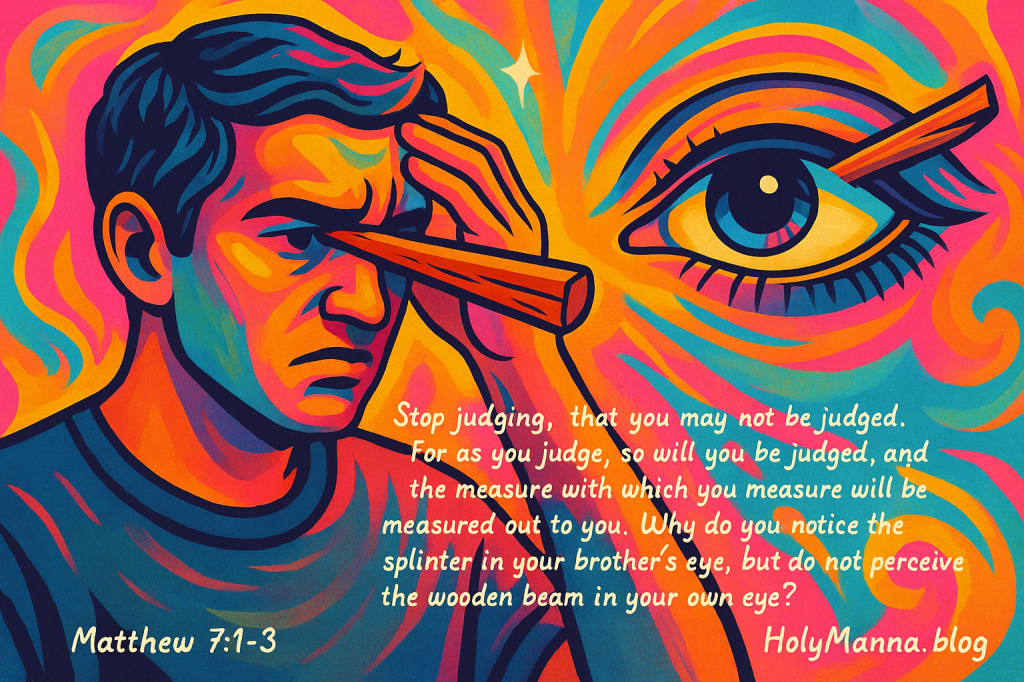
Then in The Gospel of Matthew, Jesus shifts our focus from the external to the internal. It’s easy to critique the world around us, to spot flaws in others—but He cautions: “Remove the wooden beam from your eye first” (Mt 7:5). This inner honesty is part of the same spiritual journey begun with Abram. It takes courage to look within, to allow God’s mercy to refine us, and only then to gently help others. Together, these readings invite us to walk forward in faith, to lean wholly on divine mercy, and to embrace humility as the lens through which we see ourselves and the world. Are you willing to take that first step today—even if you don’t know where it will lead?
First Reading – Genesis 12:1–9
Leaving All Behind
The story of Abram’s call marks a seismic shift in salvation history. With Genesis 12, we move from the universal scope of the early chapters—creation, fall, flood, and tower—to the particular story of one man, one family, one promise. Abram, later renamed Abraham, is often called our “father in faith” because this moment sets into motion the covenantal relationship between God and His people. This passage is foundational not only for Jews, who see Abram as the patriarch of Israel, but also for Christians, who view him as a model of obedience and trust. In the time of Abram, tribal identity, land, and lineage were everything. To be asked to leave one’s homeland and kin was a call to complete vulnerability. Yet, Abram responds in faith—a faith echoed throughout Scripture and praised in The Catechism and the Letter to the Hebrews. Today’s reading situates us at the beginning of a journey that requires not certainty, but surrender—just like the theme binding all of today’s readings.
Genesis 12:1-9
New American Bible (Revised Edition)
Abram’s Call and Migration. 1 The Lord said to Abram: Go forth from your land, your relatives, and from your father’s house to a land that I will show you. 2 I will make of you a great nation, and I will bless you; I will make your name great, so that you will be a blessing. 3 I will bless those who bless you and curse those who curse you. All the families of the earth will find blessing in you.
4 Abram went as the Lord directed him, and Lot went with him. Abram was seventy-five years old when he left Haran. 5 Abram took his wife Sarai, his brother’s son Lot, all the possessions that they had accumulated, and the persons they had acquired in Haran, and they set out for the land of Canaan. When they came to the land of Canaan, 6 Abram passed through the land as far as the sacred place at Shechem, by the oak of Moreh. The Canaanites were then in the land.
7 The Lord appeared to Abram and said: To your descendants I will give this land. So Abram built an altar there to the Lord who had appeared to him. 8 From there he moved on to the hill country east of Bethel, pitching his tent with Bethel to the west and Ai to the east. He built an altar there to the Lord and invoked the Lord by name. 9 Then Abram journeyed on by stages to the Negeb.
Detailed Exegesis
Verse 1 – “The Lord said to Abram: Go forth from your land, your relatives, and from your father’s house to a land that I will show you.”
This is a radical command. The Hebrew verb lech-lecha conveys not only “go forth” but “go to yourself”—a spiritual as well as physical journey. God is not revealing the destination yet, which makes Abram’s obedience an act of pure trust. This is the beginning of covenant—God initiates, Abram responds.
Verse 2 – “I will make of you a great nation, and I will bless you; I will make your name great, so that you will be a blessing.”
Here, the promise unfolds. God offers three things: nationhood, blessing, and renown. But these are not for Abram’s sake alone. His greatness is tied to being a blessing for others. This reveals God’s missionary plan: salvation through one family for all families.
Verse 3 – “I will bless those who bless you and curse those who curse you. All the families of the earth will find blessing in you.”
This is a universal mission. God’s covenant with Abram is not exclusive but inclusive—meant to extend to all the families of the earth. Saint Paul will later refer to this in Galatians 3:8, calling it a foreshadowing of the Gospel.
Verse 4 – “Abram went as the Lord directed him, and Lot went with him. Abram was seventy-five years old when he left Haran.”
Obedience in old age. Abram’s age is no small detail; it underscores that God’s call is not limited by human expectations. Even when it seems “too late,” God calls—and faith responds.
Verse 5 – “Abram took his wife Sarai, his brother’s son Lot, all the possessions that they had accumulated, and the persons they had acquired in Haran, and they set out for the land of Canaan. When they came to the land of Canaan…”
This is the beginning of the promised land journey. The text also highlights Abram’s household, showing that his faith affected those around him. Canaan, a region filled with rival cultures and religions, becomes the stage where divine promise confronts human reality.
Verse 6 – “Abram passed through the land as far as the sacred place at Shechem, by the oak of Moreh. The Canaanites were then in the land.”
Shechem was a place of historical significance and worship. The oak of Moreh may have been a site of pagan rituals. Abram enters a land occupied by others, yet God leads him there—foreshadowing the later conquest under Joshua and the full realization of the promise.
Verse 7 – “The Lord appeared to Abram and said: To your descendants I will give this land. So Abram built an altar there to the Lord who had appeared to him.”
This is the first theophany—the Lord appears. Abram’s response is to build an altar, which marks both thanksgiving and presence. Worship becomes a physical expression of trust.
Verse 8 – “From there he moved on to the hill country east of Bethel, pitching his tent with Bethel to the west and Ai to the east. He built an altar there to the Lord and invoked the Lord by name.”
Again, Abram builds an altar. The mention of pitching his tent reveals his nomadic, temporary existence. Despite receiving a promise of land, he dwells in tents—faith waits patiently. Invoking the Lord’s name signifies growing intimacy and covenantal fidelity.
Verse 9 – “Then Abram journeyed on by stages to the Negeb.”
The journey continues in stages—a powerful metaphor for the life of faith. There are no shortcuts. God doesn’t rush transformation; He guides it, step by step.
Teachings of the Church
Abram’s journey embodies the very essence of the theological virtue of faith, as described in The Catechism of the Catholic Church: “Faith is first of all a personal adherence of man to God. At the same time, and inseparably, it is a free assent to the whole truth that God has revealed” (CCC 150). Abram’s faith is not static; it is active, moving, and open to mystery. As Saint John Paul II once reflected, “Abraham, our father in faith, accepted God’s invitation and set out on a journey to an unknown land… faith was born from listening and matured through obedience” (Homily, October 26, 1997).
The early Church Fathers also saw Abram as a prototype of Christian discipleship. Origen writes, “When Abraham is ordered to leave his land and go to the land God will show him, it is a sign of the soul leaving the bodily things of the world to attain spiritual knowledge” (Homilies on Genesis). This spiritual exodus mirrors our own call to conversion and sanctification. It is no coincidence that Abram builds altars as he journeys—worship and movement go hand-in-hand.
Historically, Abram’s obedience sets the stage for the entire salvation narrative. His “yes” opens the path for Israel, for the coming of Christ, and for the Church. In this sense, his story is not just a beginning—it is a blueprint. As the Catechism affirms, “The Christian vocation is, of its nature, a vocation to the apostolate as well” (CCC 863). Abram was called not just to receive, but to bless; not just to move, but to carry others into God’s promise.
Reflection
What in your life is God asking you to leave behind—not necessarily physically, but spiritually or emotionally? Like Abram, we are each called to trust God beyond what we can see. That might mean letting go of pride, comfort, or control. It may require us to walk into new roles, responsibilities, or relationships that stretch us. But if God calls, He also equips. Are you willing to begin your journey in faith, without all the answers? And as you journey, how can you make altars in your daily life—moments of prayer, surrender, and worship—to mark where God has revealed Himself to you? Trust that your “yes,” however small, participates in a much larger story of redemption.
Responsorial Psalm – Psalm 33:12–13, 18–20, 22
Eyes on the Journey
The Book of Psalms, the prayerbook of Israel and the Church, speaks directly to the human heart in all its moods—joy, sorrow, fear, awe, and hope. Psalm 33 is a hymn of praise that celebrates God’s providence, justice, and unfailing love. Composed in a context where kings and armies often relied on military might and political alliances, this psalm boldly proclaims that the strength of a nation lies not in power, but in fidelity to the Lord. This is a fitting complement to the call of Abram in Genesis 12, who left everything behind to follow God into uncertainty. Just as Abram trusted in God’s unseen plan, Psalm 33 invites us to trust in the ever-watchful eye and steadfast mercy of the Lord. In today’s theme of radical trust, this psalm becomes the soul’s response—an anthem of faith, humility, and surrender.
Psalm 33:12-13, 18-20, 22
New American Bible (Revised Edition)
12 Blessed is the nation whose God is the Lord,
the people chosen as his inheritance.
13 From heaven the Lord looks down
and observes the children of Adam,
18 Behold, the eye of the Lord is upon those who fear him,
upon those who count on his mercy,
19 To deliver their soul from death,
and to keep them alive through famine.
20 Our soul waits for the Lord,
he is our help and shield.
22 May your mercy, Lord, be upon us;
as we put our hope in you.
Detailed Exegesis
Verse 12 – “Blessed is the nation whose God is the Lord, the people chosen as his inheritance.”
This verse reminds us that true blessing comes not from earthly wealth or national power but from a relationship with God. To be chosen by Him is not a privilege of pride but a call to holiness. The phrase “inheritance” reflects covenantal language; it echoes God’s promise to Abram to make of him a great nation and implies that God’s favor rests on those who belong to Him in trust and obedience.
Verse 13 – “From heaven the Lord looks down and observes the children of Adam.”
God is not distant or indifferent. His gaze is watchful, active, and deeply personal. “Children of Adam” universalizes the message—God sees all of humanity. This reinforces that His providence is not limited to the chosen people but extends to all, setting the stage for the universal blessing promised in Abram’s call.
Verse 18 – “Behold, the eye of the Lord is upon those who fear him, upon those who count on his mercy.”
Here we see a beautiful paradox: those who “fear” God—meaning reverent awe and submission—are the very ones who also “count on his mercy.” Fear and trust are not opposites in Scripture; they are complementary. God’s loving gaze rests on those who remain humble and reliant on His goodness, not on their own merit or strength.
Verse 19 – “To deliver their soul from death, and to keep them alive through famine.”
God’s mercy is not abstract—it is deeply practical and protective. Deliverance from death and survival during famine are signs of God’s saving action. These images resonate with the journey of Abram, who would face famine in the very land he was promised (Genesis 12:10), reminding us that trust in God doesn’t exempt us from hardship but carries us through it.
Verse 20 – “Our soul waits for the Lord, he is our help and shield.”
This is a declaration of complete dependence. To “wait” is an act of spiritual discipline, not passive inactivity. In Hebrew spirituality, waiting on God implies hope, expectancy, and surrender. God is both help—the one who acts—and shield—the one who protects. It is a confession that we are not our own saviors.
Verse 22 – “May your mercy, Lord, be upon us; as we put our hope in you.”
The psalm ends with a plea rooted in covenant: because we hope in you, let your mercy rest upon us. This reciprocal dynamic—hope drawing mercy, mercy strengthening hope—captures the rhythm of the spiritual life. It is the posture of the faithful soul walking in the dark, trusting in the Lord’s light.
Teachings of the Church
The Church has always taught that divine providence is not random or detached but deeply loving and attentive. As The Catechism of the Catholic Church explains, “Divine providence consists of the dispositions by which God guides all his creatures with wisdom and love to their ultimate end” (CCC 321). This psalm beautifully reflects that guidance. God’s gaze is not surveillance but shepherding—watching over His people with care and mercy.
Saint Augustine reflects on the “eye of the Lord” not as one of judgment alone, but of delight and fatherly concern: “He sees us not to condemn, but to illuminate and heal. His eye brings mercy when our eyes are lifted to Him in reverent fear” (Expositions on the Psalms). This helps us understand why the psalmist connects fear of the Lord with trust in His mercy—two spiritual attitudes that flourish together in the heart of the humble.
Historically, the Church has turned to this psalm in times of uncertainty, famine, and war. In monastic tradition, Psalm 33 is prayed in community, reinforcing that God watches not only over individuals but over peoples, nations, and the Church as a whole. In times of persecution or need, this psalm becomes a lifeline of hope. As the Second Vatican Council reminds us, “In the face of any fear or threat, the Christian places his hope not in earthly securities, but in the mercy and power of God” (Gaudium et Spes, 48).
Reflection
When was the last time you truly felt seen by God—not just known about, but watched over in love? Today’s psalm is an invitation to surrender the illusion of control and step more deeply into trust. The world tempts us to look for security in financial stability, personal performance, or social status, but the psalm redirects our gaze: Are we placing our hope in the Lord’s mercy, or in ourselves? Waiting on God, especially in seasons of confusion or delay, requires patience and humility. But it is also the ground in which deep peace takes root. How can you wait on the Lord this week—with hope, reverence, and quiet joy? Let His mercy be your shield, and His gaze your guiding light.
Holy Gospel – Matthew 7:1–5
Clarity Before Correction
In the heart of the Sermon on the Mount, The Gospel of Matthew presents one of Christ’s most piercing teachings on interpersonal relationships and spiritual integrity. In a time and culture where external religious observance—ritual purity, Sabbath laws, tithing—often defined righteousness, Jesus draws attention to the interior life. His audience, largely made up of Jews living under the Law of Moses and Roman occupation, would have been accustomed to clear moral lines and strict legal observance. Yet here, Jesus challenges not just how we behave but how we see—ourselves and others. His teaching on judgment is not a call to moral relativism but an invitation to humble honesty, beginning with our own hearts. This fits seamlessly into today’s theme: a radical trust in God’s mercy must begin with an internal journey, a willingness to let divine light expose and heal our own blindness before we presume to lead others.
Matthew 7:1-5
New American Bible (Revised Edition)
Judging Others. 1 “Stop judging, that you may not be judged. 2 For as you judge, so will you be judged, and the measure with which you measure will be measured out to you. 3 Why do you notice the splinter in your brother’s eye, but do not perceive the wooden beam in your own eye? 4 How can you say to your brother, ‘Let me remove that splinter from your eye,’ while the wooden beam is in your eye? 5 You hypocrite, remove the wooden beam from your eye first; then you will see clearly to remove the splinter from your brother’s eye.
Detailed Exegesis
Verse 1 – “Stop judging, that you may not be judged.”
Jesus begins with a direct command. “Judging” here refers not to discernment, which is necessary, but to a spirit of condemnation. He warns us against taking the place of God, the true Judge. This verse invites restraint and humility, recognizing our limited vision and the danger of self-righteousness.
Verse 2 – “For as you judge, so will you be judged, and the measure with which you measure will be measured out to you.”
This echoes the biblical principle of reciprocal justice. God, in His mercy, chooses to judge us by the standard we apply to others. This is not a threat but a spiritual law: our hearts will be held to the same openness or harshness we offer. It invites us to approach others with the same mercy we hope to receive.
Verse 3 – “Why do you notice the splinter in your brother’s eye, but do not perceive the wooden beam in your own eye?”
Jesus uses humor and exaggeration to make a profound point. The “splinter” and “beam” both represent sin or faults, but the image makes clear that we often obsess over small faults in others while being blind to our own much larger issues. This blindness is not accidental—it is a spiritual defense mechanism to avoid self-confrontation.
Verse 4 – “How can you say to your brother, ‘Let me remove that splinter from your eye,’ while the wooden beam is in your eye?”
Jesus challenges the hypocrisy of correction without conversion. The implication is clear: we are unfit to help others until we ourselves have gone through the humbling process of self-examination. Spiritual guidance requires credibility, which begins with integrity.
Verse 5 – “You hypocrite, remove the wooden beam from your eye first; then you will see clearly to remove the splinter from your brother’s eye.”
This verse is both a rebuke and a hope. Jesus does not say we must never help others with their faults—on the contrary, He calls us to that responsibility—but only after we ourselves have been purified. The path of healing begins with personal transformation, which leads to clearer vision, and from that, compassionate service to others.
Teachings of the Church
The Church teaches that judging others rashly and without charity is a violation of justice and truth. The Catechism of the Catholic Church states: “To avoid rash judgment, everyone should be careful to interpret insofar as possible his neighbor’s thoughts, words, and deeds in a favorable way” (CCC 2478). This is a call to assume the best in others, to resist jumping to conclusions, and to imitate the patience of God, who sees the full picture. True spiritual maturity involves giving others the same benefit of the doubt we long for ourselves.
Saint Teresa of Ávila, a master of the interior life, warned frequently against focusing too much on others’ faults. She once wrote, “Let each one examine his own faults and not those of others. We always have enough to do ourselves” (The Way of Perfection, Ch. 10). Her wisdom reflects the same invitation Jesus gives in today’s Gospel: the work of inner purification is lifelong and necessary if we are to love rightly. It is through that difficult but grace-filled process that our judgment softens into mercy, and our words gain healing power.
In the tradition of the Desert Fathers, early Christian hermits and monks often emphasized the importance of recognizing one’s own sins first. Abba Poemen said, “Teach your mouth to say what is in your heart. If a man does not admit his faults, he will never be free from them”. This radical honesty was not self-deprecation but the foundation for real holiness. Jesus’s teaching today builds on that same spirit: honest self-awareness is the beginning of healing and the heart of mercy.
Reflection
Are you more aware of the faults in others than the faults within yourself? Today’s Gospel is a spiritual mirror. It invites us to stop, look inward, and allow the Lord to heal what clouds our vision. This isn’t easy—it demands humility, silence, and grace. But it is freeing. Once we’ve allowed God to remove our “wooden beams,” we can truly love others, not as judges, but as brothers and sisters. How might you practice this today? Begin by asking the Holy Spirit to reveal one area of blindness in your life. Then bring it to prayer, to Confession if needed, and let healing begin. What would change in your relationships if you judged less and listened more? The Lord’s mercy begins not at the edge of our vision but at the center of our hearts. Let it start there.
Into the Unknown, With Eyes Wide Open
Today’s readings draw us into a sacred tension between movement and stillness, between leaving behind and waiting upon, between looking outward and turning inward. In Genesis 12, Abram sets forth in radical obedience, not because he knows the plan, but because he trusts the Promise-Giver. In Psalm 33, the faithful are reminded that God’s eye is upon those who revere Him—not in judgment, but in mercy. And in The Gospel of Matthew, Jesus calls us to look honestly at our own hearts before we dare to point out the flaws in others. Together, these Scriptures form a powerful invitation to the spiritual journey—a journey not of perfection, but of humility, surrender, and hope.
What does it mean to trust God when the destination is unclear? What would it look like to wait with confidence, to see with compassion, and to walk by faith? These readings challenge us to embrace both the outward call of discipleship and the inward work of purification. The God who called Abram is the same God who watches us with mercy and invites us to remove the beams from our vision—not to shame us, but to heal us. He wants us to become blessings to others, not through our superiority, but through our vulnerability and love.
Are you willing to take that first step today—to go forth like Abram, to wait like the psalmist, to see like Jesus? The journey may not come with maps or guarantees, but it comes with a promise: “I will bless you… and you will be a blessing” (Gen 12:2). Let today be a new stage in your walk with God. Trust His call. Wait on His mercy. Open your eyes to your own heart. And then, go be a blessing in the lives of others.
Engage with Us!
We’d love to hear how God is speaking to you through today’s readings. What moved your heart? What challenged you? Share your thoughts in the comments below—your insights may be the blessing someone else needs today. Let’s walk this journey of faith together, encouraging one another with hope and humility.
Reflection Questions:
First Reading – Genesis 12:1–9
What is God asking you to leave behind so you can follow Him more freely? Have you ever experienced a moment when you had to trust God without knowing the outcome? What happened?
Responsorial Psalm – Psalm 33:12–13, 18–20, 22
Where do you turn when you feel uncertain or afraid? What does it mean for you personally to “wait for the Lord”?
Holy Gospel – Matthew 7:1–5
Are there any “wooden beams” in your life that the Lord is asking you to remove? How can you approach others today with the same mercy and patience that you desire from God?
Go forth today with courage, humility, and love. Walk in trust like Abram, hope like the psalmist, and mercy like Jesus. Let your every word and action be guided by the love and mercy our Savior has shown us.
Follow us on Instagram and Facebook for more insights and reflections on living a faith-filled life.

 Holy Manna!
Leave a comment