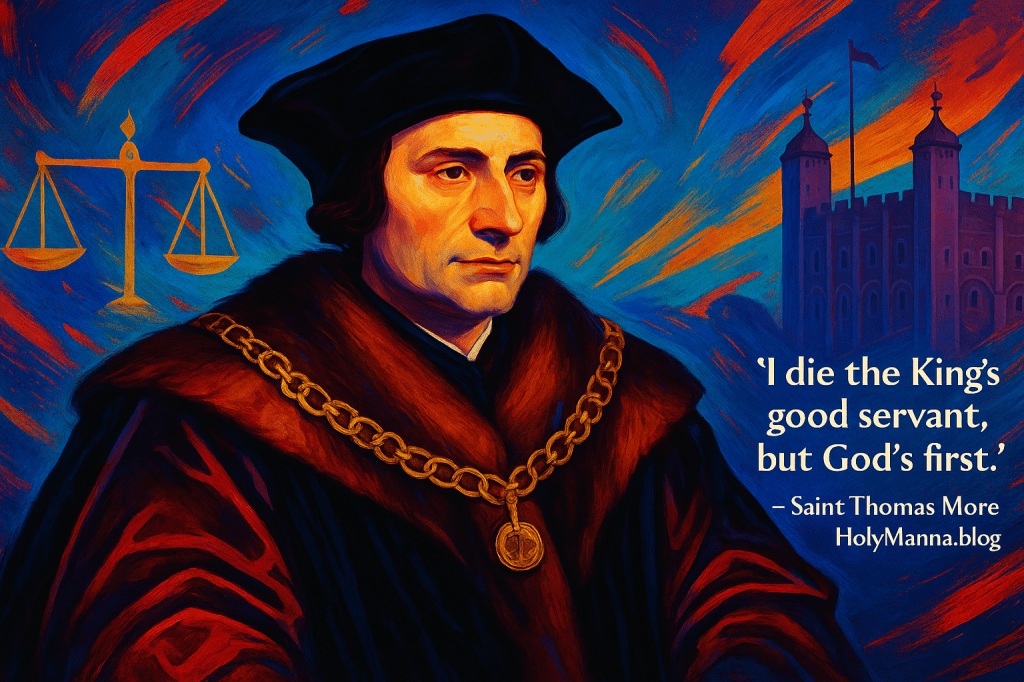
A Crown of Integrity
Saint Thomas More is a name that resounds with dignity, courage, and unwavering faith. In an age when loyalty to the truth could cost a man everything—his reputation, his freedom, his family, even his life—More stood firm, preferring death to dishonor, martyrdom to moral compromise. He is one of the most honored martyrs of the English Reformation and remains a powerful example of conscience formed by truth and grace. Revered as the patron saint of lawyers, judges, statesmen, and politicians, Thomas More is a figure whose relevance never fades. His life testifies to the beauty of Catholic humanism, the possibility of sanctity in public life, and the supreme value of fidelity to Christ above all. Declared a saint in 1935 by Pope Pius XI and later honored by Saint John Paul II as the heavenly patron of political leaders, More’s example is as urgent today as it was in the turbulent 16th century.
From Courtrooms to the Church
Born on February 7, 1478, in bustling London, Thomas More was the eldest son of Sir John More, a prominent judge. From the start, Thomas was immersed in a world of law, discipline, and education. Yet his early years weren’t consumed solely by ambition—he also showed a deep fascination with prayer and asceticism. He was educated first at St. Anthony’s School and then at Oxford, where he excelled in the classics and became fluent in Latin and Greek. Even in his youth, he displayed a precocious blend of intellect and humility.
After Oxford, Thomas studied law at Lincoln’s Inn and eventually entered public service. Yet, amid this upward trajectory, he seriously considered a monastic vocation. He lived for a time near the Carthusian monks and adopted many of their practices: early rising, silence, prayer, fasting, and wearing a hair shirt. Though he ultimately discerned that he was called to marriage and family life, the seeds of a deep spiritual foundation were planted and bore fruit for the rest of his life.
His first marriage to Jane Colt was deeply loving, and together they had four children. After her untimely death, he married Alice Middleton, a widow with a daughter of her own. Thomas was a tender and attentive father, unusually committed to the education of his children—especially his daughters. He encouraged his daughter Margaret to pursue rigorous studies, going so far as to correspond with Erasmus about the virtues of educated women. His household was a haven of learning, laughter, and prayer.
But Thomas More’s fame came largely through his career in law and politics. As Lord Chancellor of England, he was second only to the king in power. Yet he carried out his responsibilities with grace and fidelity to Catholic teaching. In his landmark work Utopia, he imagined a society guided by reason and justice, even as he grappled with the political realities of his day. Still, his ultimate loyalty was never to political expediency—it was to Christ and His Church. That fidelity would one day cost him everything.
Silent Signs of Sanctity
Though Saint Thomas More is not associated with public miracles like healings or visions during his lifetime, the miraculous nature of his holiness lies in the extraordinary consistency of his virtue. In a world of shifting alliances, rampant ambition, and political betrayal, More remained untouched by corruption. That in itself is a wonder.
He lived simply, prayed constantly, and practiced secret acts of penance. Beneath his rich robes of office, he wore a hair shirt as a constant reminder of humility and penance. He frequently attended Mass and made spiritual reading a daily habit. His conversations with friends and family were filled with joy, wit, and wisdom. Those who knew him said he was a man full of laughter, yet never flippant; firm in judgment, yet never harsh. His was the kind of holiness that sanctifies the ordinary—the courtroom, the dinner table, the corridors of political power.
In his friendship with Erasmus of Rotterdam, More cultivated a vision of Christianity that was both intellectually vibrant and spiritually grounded. Their correspondence reveals a man deeply engaged with Scripture and the teachings of the Church, particularly those found in The Catechism. While others looked for loopholes, More looked for truth. His virtue, though hidden from the headlines of history, was heroic in its perseverance.
The Tower and the Sword
The final years of Saint Thomas More’s life unfolded like a Passion narrative. When King Henry VIII sought to annul his marriage to Queen Catherine and establish himself as the Supreme Head of the Church in England, More could not comply. His conscience, formed by the truths of The Catechism—especially its teachings on the unity and indissolubility of marriage (cf. CCC 1644–1650) and the primacy of the Pope (cf. CCC 882)—would not allow him to affirm a lie.
More resigned as Chancellor and hoped that silence would protect him. But silence, in this case, spoke volumes. He refused to sign the Oath of Supremacy and was imprisoned in the Tower of London. For over a year, he suffered the loss of freedom, separation from his family, and increasing pressure to recant. Yet he remained serene, writing beautiful reflections from his cell—letters to his daughter Margaret, meditations on Christ’s Passion, and even a dialogue on the soul’s final judgment.
The courage with which he faced death was astonishing. On July 6, 1535, he was brought to Tower Hill. He joked with the executioner and forgave him. His final words have become immortal:
“I die the King’s good servant, but God’s first.”
Like the martyrs of old, Thomas More shed his blood in witness to the truth. His death confirmed what his life had already proven—that God’s law is written on the heart, and no earthly power can erase it.
The Echo of Conscience
After his death, Saint Thomas More’s memory did not fade. Though initially buried without honor, his legacy only grew. His head, displayed on London Bridge as a warning, was rescued by his devoted daughter Margaret and enshrined as a relic. His writings—especially those from the Tower—became spiritual treasures for Catholics throughout the world.
While no specific physical miracles are commonly associated with him after death, the miracle of his enduring influence cannot be overstated. He has inspired conversions, shaped the consciences of judges and statesmen, and renewed in many a desire for integrity. Pilgrims still visit his cell in the Tower of London, now a shrine of conscience and courage. His relics are venerated in several locations, and his feast day—celebrated on June 22 alongside Saint John Fisher—is a solemn reminder that truth and holiness are worth dying for.
His canonization was a beacon of hope in the early 20th century, when ideologies and dictatorships once again threatened the soul of humanity. In Veritatis Splendor, Saint John Paul II would later speak of the indispensable role of conscience, echoing the witness of More. In 2000, the pope formally declared him the patron of all those who serve in public life, reminding Catholics that even in the realm of politics, we are called to be saints.
Conscience Over Comfort
What does the life of Saint Thomas More mean for us today? How do we remain faithful in a world that so often tempts us to compromise our values? More’s example is an invitation to re-center our lives around what is eternal, not what is expedient.
He reminds us that our daily decisions—at work, at home, in society—matter deeply. Every time we tell the truth when it would be easier to lie, every time we uphold virtue when others mock it, we are walking the same path of fidelity. We may not wear robes of office or face royal courts, but we do face moral crossroads every day.
Are we willing to put God first? Are we cultivating our consciences with prayer, Scripture, and the teachings of the Church, as found in The Catechism? Do we surround ourselves with friendships that nourish our souls, as More did with Erasmus and his family? Do we allow our faith to inform our politics, our professions, our parenting?
The world does not need more clever leaders. It needs holy ones. People of joy, wisdom, and unshakable integrity. That is what Thomas More offers us: a model not only of martyrdom but of daily moral heroism. He teaches us how to laugh with our children, think with clarity, speak with love, and, when the moment comes, stand with Christ.
“Blessed are those who are persecuted for righteousness’ sake, for theirs is the kingdom of heaven.” (Matthew 5:10)
Engage with Us!
What about Saint Thomas More’s story touches your heart the most? We’d love to hear your thoughts and reflections.
Reflection Questions:
- When have you had to make a difficult decision because of your faith? How did you respond?
- Do you feel pressure to compromise your beliefs in your workplace or social life? How can Saint Thomas More inspire your response?
- What does being “God’s servant first” mean in your daily life?
Let’s walk together in courage and love—strengthened by the witness of the saints, and united in our desire to follow Christ at all costs. May we, like Saint Thomas More, be faithful until the end.
Saint Thomas More, pray for us! ⚔️
Follow us on Instagram and Facebook for more insights and reflections on living a faith-filled life.

 Holy Manna!
Leave a comment