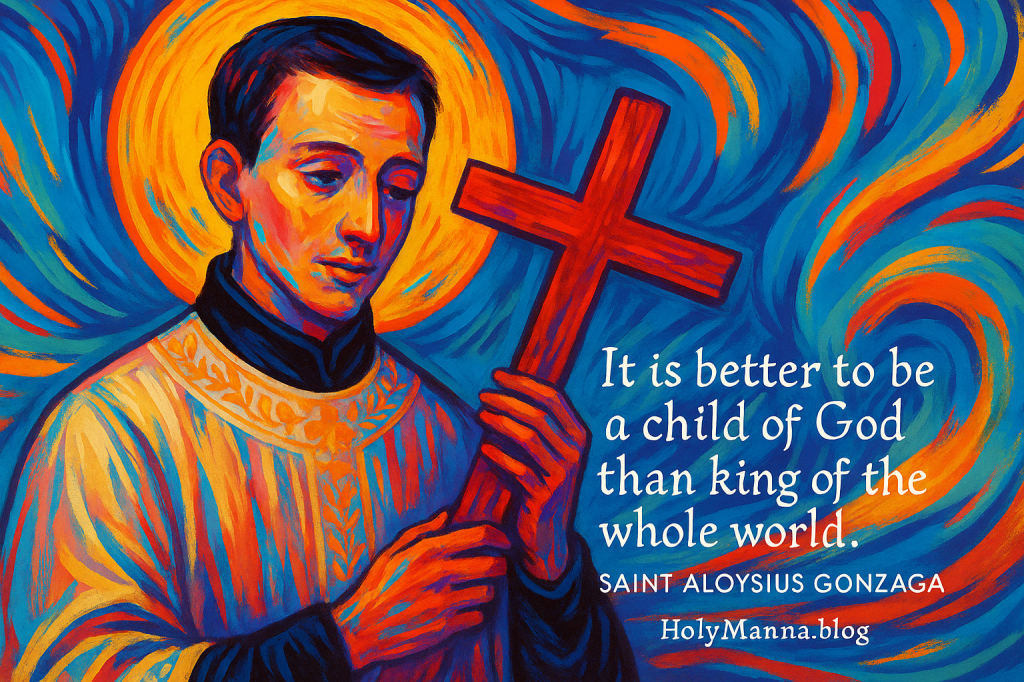
A Soul Radiant with Purity and Purpose
From the very beginning of his life, Saint Aloysius Gonzaga seemed destined to stand apart—not through earthly greatness, but through a profound surrender to God. In an era marked by political intrigue and noble ambition, Aloysius emerged like a lily among thorns, a striking symbol of purity, humility, and sacrificial love. The Church rightly celebrates him as the patron saint of youth, not because of his age alone, but because of the heroic way he embraced a life totally dedicated to Christ. His life challenges modern Christians—especially the young—to rise above the noise of the world and live for something eternal. Aloysius didn’t just believe in the Gospel; he embodied it, caring for plague victims, renouncing riches, and living a life of radical prayer and penance, all by the age of twenty-three. In doing so, he shone with a holiness that continues to illumine the path of sanctity for generations to come.
From Courtly Vanity to Celestial Vows
Born on March 9, 1568, in the grand castle of Castiglione delle Stiviere in Northern Italy, Aloysius was the eldest son of Ferrante Gonzaga, a Marquis deeply entrenched in the political and military currents of the time. As heir to his family’s titles and lands, Aloysius was raised amidst opulence, trained in diplomacy, and groomed for war. By the age of four, he was already playing with miniature weapons and donning soldier’s attire. His father delighted in the idea of a son who would bring military prestige to the Gonzaga name. Yet beneath the silk and swords, God was planting seeds of something far more glorious.
At the tender age of seven, Aloysius shocked those around him by privately vowing chastity, a decision fueled by an interior grace and an unusual depth of piety. He taught himself to pray the Divine Office and was inspired by the missionary exploits of the Jesuits. By age nine, while ill and confined to bed, he experienced a conversion of heart so profound that he renounced all worldly pursuits. From then on, he practiced extreme asceticism: fasting, night vigils, and meditating for hours on the Passion of Christ. His father was horrified by what he considered an unmanly and wasteful use of his son’s potential. But Aloysius was resolute.
Despite fierce resistance from his family—particularly his father, who used every tactic from bribery to social humiliation—Aloysius petitioned to join the Society of Jesus. After years of struggle, he renounced his title and inheritance, handing over the family legacy to his younger brother. At just seventeen, Aloysius entered the Jesuit novitiate in Rome, where he immersed himself in theological studies and the interior life. His superiors marveled at his angelic demeanor and his devotion to the Eucharist, which he received daily with trembling love. If ever a soul longed for heaven more than earth, it was Aloysius Gonzaga.
The Hidden Miracle of Selfless Love
Unlike some saints who are remembered for dramatic supernatural events during their lives, Saint Aloysius Gonzaga revealed his holiness through the quiet, radiant miracle of self-emptying love. His life was a continuous offering, a burning candle lit for others. When plague swept through Rome in 1591, bringing unimaginable suffering and death, the Jesuits opened a hospital to tend to the sick. While many of his brothers hesitated to take part directly in patient care due to the high risk of infection, Aloysius begged for the opportunity to serve.
He was granted permission under strict orders to avoid the most contagious tasks. But love knows no boundaries. Aloysius embraced every duty: he carried plague victims from the streets, bathed their wounds, fed them, and even held them as they died. Those who witnessed his work reported a supernatural peace around him. One brother spoke of seeing a mysterious light surrounding Aloysius as he prayed over a dying man. To those who knew him, his very presence became a kind of healing balm.
Every action he performed, no matter how menial or dangerous, was done as though for Christ Himself. He once confided to his confessor that he could barely contain his joy after returning from the hospital, even when his body was weakened to the point of collapse. It was the miracle of divine charity flowing through a young man so empty of self, and so full of God, that even amidst plague and death, heaven’s light shone through him.
A Martyrdom Not of Blood, But of Charity
Though not martyred by sword or flame, Aloysius Gonzaga lived—and died—a true martyr of love. In his final months, he bore suffering with a serenity that was otherworldly. After contracting the plague from one of the men he carried in his arms, he lingered in agony. His body, already weakened from years of penance, could not withstand the disease. Yet in his final illness, Aloysius never complained. He continued to speak only of heaven and offered all his pain for the glory of God and the salvation of souls.
Aloysius had a profound sense that he would die on the Octave of Corpus Christi. He told his confessor, Saint Robert Bellarmine, that he would pass into eternal life on that exact date. As that night arrived—June 20, 1591—he received viaticum, the last Eucharist, and spent the evening in contemplative prayer. Just after midnight, in the early hours of June 21, he spoke the Holy Name of Jesus and passed peacefully into eternity at the age of twenty-three. His death was not marked by dramatic miracles, but by the quiet majesty of a soul wholly united to Christ, going home.
Miracles That Echo Through Time
In the years following his death, the memory of Saint Aloysius Gonzaga became a beacon of hope, especially for the young and the sick. His intercession was sought widely, and numerous miracles began to be reported—especially healings involving children, students, and seminarians. Devotees began attributing physical and spiritual healings to his intercession. One story from the 19th century tells of a young boy suffering from a terminal illness who was miraculously cured after his mother prayed to Aloysius and placed one of his relics on her son’s chest.
The Church, careful and thorough in its discernment of miracles, eventually recognized the widespread and enduring devotion to Aloysius. In 1726, Pope Benedict XIII canonized him, and later, Pope Pius XI named him the Patron Saint of all Christian Youth. His body now rests in the Church of Saint Ignatius of Loyola in Rome, in a side chapel that continues to attract pilgrims from across the world. Young people especially flock to this site, praying for purity, strength, and vocational clarity through his intercession.
Even today, youth ministries, Catholic schools, and seminaries often turn to Saint Aloysius as a model and heavenly friend. His life reminds us that sainthood is not reserved for the old or the scholarly. It is a call for everyone—young and old—to give themselves fully to God, to love without counting the cost, and to keep their eyes fixed on the eternal crown.
Living the Fire of Love
What does Saint Aloysius Gonzaga have to say to us today, especially in a world obsessed with fame, comfort, and self-expression? He reminds us that purity is not weakness but power, that self-denial is not deprivation but freedom, and that love—true love—always looks like sacrifice. His example is especially vital for young people navigating a culture of moral confusion and spiritual apathy. He challenges us to reject what is shallow and embrace what is eternal.
The Catechism of the Catholic Church teaches us in CCC 2348 that “All the baptized are called to chastity.” Aloysius proves that this call is not a burden but a beautiful invitation to intimacy with God. Likewise, his acts of mercy fulfill CCC 2447, which reminds us that “The works of mercy are charitable actions by which we come to the aid of our neighbor in his spiritual and bodily necessities.” Aloysius didn’t perform these acts out of obligation—he did them with joy, because he saw Christ in every suffering soul.
In our daily lives, we can imitate his spirit by embracing silence, detaching from vanity, serving the poor, and nurturing a deep life of prayer. We can begin with simple steps: a heartfelt confession, an extra hour in adoration, an act of kindness for someone forgotten. Are we willing to make time for the things of God, even when the world tells us we’re wasting it? Are we ready to be fools for Christ like Aloysius was?
If we are, we will discover what Aloysius discovered: that to be a child of God is greater than to be king of the world.
Engage with Us!
What aspect of Saint Aloysius’ life inspires you most? How can his example speak into the temptations and distractions of today’s world?
Reflection Questions:
- How can I grow in the virtue of purity in thought, word, and deed like Saint Aloysius?
- Am I willing to sacrifice comfort to serve those who suffer around me?
- What does “being a child of God” mean to me personally, and how does it affect my daily choices?
Let us encourage one another on this journey toward holiness. May we, like Saint Aloysius Gonzaga, do everything for the glory of God and the salvation of souls. “Ad Majorem Dei Gloriam!” (To the greater glory of God.)
Saint Aloysius Gonzaga, pray for us! ✝️
Follow us on Instagram and Facebook for more insights and reflections on living a faith-filled life.

 Holy Manna!
Leave a comment