Grace in the Thorn, Peace in the Providence
Have you ever felt like your weakness disqualified you from God’s plans? Or that your anxiety over life’s demands was somehow a failure of faith? Today’s readings gently but powerfully remind us that it’s precisely in our limits, our longings, and even our lowliness that the Lord reveals His strength and His care. The Church invites us to meditate on a divine paradox: that when we are weak, then we are strong—not by worldly standards, but by the mysterious logic of grace. These scriptures call us to a radical reorientation: from control to surrender, from boasting in success to boasting in Christ, and from worry to worship.
St. Paul’s letter in 2 Corinthians 12 offers us an intimate window into the spiritual battle of a great apostle. Despite extraordinary revelations—being “caught up into Paradise”—Paul confesses a persistent “thorn in the flesh,” a suffering allowed not to shame him, but to humble him. And what does the Lord say in reply to Paul’s pleading? “My grace is sufficient for you, for power is made perfect in weakness” (2 Corinthians 12:9). This sets the tone for the whole day: divine strength is not found in escaping pain or eliminating lack, but in learning to lean wholly on God.
Psalm 34 and The Gospel of Matthew both echo this invitation to rest in God’s sufficiency. The psalmist urges us to “taste and see that the Lord is good”, promising that those who seek the Lord lack no good thing. Jesus in Matthew 6 goes even further, calling us away from the slavery of worry and the idolatry of wealth: “You cannot serve God and mammon… seek first the kingdom of God and his righteousness, and all these things will be given you besides” (Matthew 6:24, 33). In a world that prizes control and self-promotion, today’s readings declare a countercultural truth: grace meets us not in our power, but in our poverty. Are you willing to trust that God’s love is enough for you—today, as you are?
First Reading – 2 Corinthians 12:1–10
The Strength of Christ in the Thorn of Weakness
The Second Letter to the Corinthians is among the most emotionally raw and theologically rich writings of St. Paul. Composed around 55–57 A.D., this epistle was written in the face of severe criticism and division within the Corinthian Church. Paul was defending not only his apostolic authority but also the authenticity of his ministry—one marked not by signs of worldly power, but by affliction, persecution, and humility. This particular passage, 2 Corinthians 12:1–10, is part of what’s often referred to as Paul’s “Fool’s Speech,” where he contrasts false apostles’ prideful boasting with his own boast in weakness. What makes this reading so profound is that it reveals Paul’s mystical experience of the “third heaven” while simultaneously rooting him in a daily struggle with a mysterious “thorn in the flesh.” It beautifully complements today’s theme: God’s grace is sufficient, even when—especially when—we feel weakest.
2 Corinthians 12:1-10
New American Bible (Revised Edition)
1 I must boast; not that it is profitable, but I will go on to visions and revelations of the Lord. 2 I know someone in Christ who, fourteen years ago (whether in the body or out of the body I do not know, God knows), was caught up to the third heaven. 3 And I know that this person (whether in the body or out of the body I do not know, God knows) 4 was caught up into Paradise and heard ineffable things, which no one may utter. 5 About this person I will boast, but about myself I will not boast, except about my weaknesses. 6 Although if I should wish to boast, I would not be foolish, for I would be telling the truth. But I refrain, so that no one may think more of me than what he sees in me or hears from me 7 because of the abundance of the revelations. Therefore, that I might not become too elated, a thorn in the flesh was given to me, an angel of Satan, to beat me, to keep me from being too elated. 8 Three times I begged the Lord about this, that it might leave me, 9 but he said to me, “My grace is sufficient for you, for power is made perfect in weakness.” I will rather boast most gladly of my weaknesses, in order that the power of Christ may dwell with me. 10 Therefore, I am content with weaknesses, insults, hardships, persecutions, and constraints, for the sake of Christ; for when I am weak, then I am strong.
Detailed Exegesis
Verse 1 – “I must boast; not that it is profitable, but I will go on to visions and revelations of the Lord.”
Paul begins with reluctant boasting—not to elevate himself, but to emphasize that any spiritual gifts or mystical experiences come from God. He sets the tone that human pride has no place in ministry; what matters is divine revelation and obedience to the Lord’s will.
Verse 2 – “I know someone in Christ who, fourteen years ago (whether in the body or out of the body I do not know, God knows), was caught up to the third heaven.”
Here, Paul speaks in the third person out of humility. The “third heaven” in Jewish cosmology is the realm of God’s full presence, beyond the visible sky and the stars. This reference underscores the reality and mystery of mystical union with God—a grace that remains beyond full human comprehension.
Verse 3 – “And I know that this person (whether in the body or out of the body I do not know, God knows)”
Paul reiterates the mystical nature of this experience. The repetition emphasizes that God alone knows the truth of the soul’s journey in moments of supernatural revelation. It’s a humble admission of his own limitations even in the face of divine intimacy.
Verse 4 – “Was caught up into Paradise and heard ineffable things, which no one may utter.”
“Paradise” here refers to the direct presence of God, and the “ineffable things” allude to sacred mysteries too holy for human speech. This verse reflects what The Catechism teaches: “God can be known with certainty by natural light, but He also reveals Himself in surpassing ways through grace” (CCC 36–38). Paul witnesses to this supernatural disclosure without grasping at it for personal glory.
Verse 5 – “About this person I will boast, but about myself I will not boast, except about my weaknesses.”
Paul draws a line between what God has done and who he is. His only true boast is in weakness—not as a gimmick, but as a holy paradox. This upends human expectations and magnifies the divine reversal at the heart of the Gospel.
Verse 6 – “Although if I should wish to boast, I would not be foolish, for I would be telling the truth. But I refrain, so that no one may think more of me than what he sees in me or hears from me.”
Paul insists on integrity. He resists creating a cult of personality. He wants others to encounter Christ through his life, not be awed by spiritual spectacle.
Verse 7 – “Because of the abundance of the revelations. Therefore, that I might not become too elated, a thorn in the flesh was given to me, an angel of Satan, to beat me, to keep me from being too elated.”
This verse is one of the most discussed in all of Paul’s letters. The “thorn” remains intentionally vague—perhaps a physical ailment, spiritual struggle, or external persecution—but its purpose is clear: to humble him and keep him close to grace. The thorn is not a punishment, but a providential gift. God allows suffering not to torment but to sanctify.
Verse 8 – “Three times I begged the Lord about this, that it might leave me.”
Paul’s prayer is persistent, heartfelt, and unanswered in the way he desired. This echoes Christ in the Garden of Gethsemane. Not all prayers result in the removal of suffering—but always in the deepening of communion.
Verse 9 – “But he said to me, ‘My grace is sufficient for you, for power is made perfect in weakness.’ I will rather boast most gladly of my weaknesses, in order that the power of Christ may dwell with me.”
This is the heart of the reading. God’s answer flips human logic: “My grace is sufficient for you” is both comfort and commission. It doesn’t eliminate hardship, but transforms it. Paul’s “boast” is not masochism, but mission. It’s the acknowledgment that Christ dwells most powerfully in surrendered hearts.
Verse 10 – “Therefore, I am content with weaknesses, insults, hardships, persecutions, and constraints, for the sake of Christ; for when I am weak, then I am strong.”
Paul ends with a declaration of paradoxical joy. Strength is not self-generated but Christ-infused. Every trial becomes an opportunity for divine strength to radiate. This is the cruciform path of Christian maturity.
Teachings
St. John Chrysostom beautifully echoes Paul’s message when he writes, “It is not our infirmities that hinder the power of God, but our pride. Grace descends where there is humility.” The Catechism of the Catholic Church affirms this spiritual logic: “The grace of the Holy Spirit confers upon us the righteousness of God. Grace is favor, the free and undeserved help that God gives us to respond to his call” (CCC 1996). Paul’s embrace of weakness is not defeat—it is trust in the God who chooses the lowly to shame the proud.
The Catechism also reminds us that suffering is not meaningless: “By his passion and death on the Cross, Christ has given a new meaning to suffering: it can henceforth configure us to him and unite us with his redemptive Passion” (CCC 1505). Paul’s thorn is a participation in Christ’s own redemptive suffering. This theology of redemptive suffering is echoed in the lives of many saints. St. Teresa of Ávila once said, “Pain is never permanent, and God never abandons those who love Him.” Weakness becomes a vehicle for sanctification when it is handed over in faith.
Finally, we find in CCC 2001 the assurance that “The preparation of man for the reception of grace is already a work of grace. God’s free initiative demands man’s free response.” Paul’s readiness to accept the thorn in the flesh and boast in it is the fruit of a heart deeply converted to the mystery of divine providence. Rather than resisting his limitations, he rejoices in them, because they create space for Christ’s power to shine.
Reflection
How might we allow God’s grace to dwell more fully in the thorns we bear? In a culture obsessed with self-reliance and image, today’s reading calls us to a new way of living—one that exalts surrender over strength, and grace over grit. Perhaps the thorn in your life is not something to be despised, but the very place where Christ wants to meet you. Can you identify where you’ve been pleading with God for relief—and instead, begin to invite His strength to rest there? When we stop pretending to have it all together, we become holy ground for divine power. And that, dear brothers and sisters, is true strength.
Responsorial Psalm – Psalm 34:8–13
The Refuge of the Righteous
The Book of Psalms is the ancient prayerbook of the people of God, a sacred collection of hymns, laments, and praises that express the full range of human emotion in the presence of the divine. Psalm 34 is a thanksgiving psalm composed by David after a dramatic deliverance from danger (see 1 Samuel 21). It carries a tone of urgent encouragement: come, taste, see, listen, and fear the Lord! Written from the vantage point of a man who has seen the hand of God at work in his trials, the psalm offers a litany of promises for those who take refuge in the Lord. In the context of today’s theme, Psalm 34 invites us to do exactly what Paul models in 2 Corinthians: to rest in God’s sufficiency, to turn to Him in our weakness, and to live in reverent trust rather than anxious striving. This psalm also functions catechetically—it teaches us what it means to “fear the Lord” and to find life in His goodness.
Psalm 34:8-13
New American Bible (Revised Edition)
8 The angel of the Lord encamps
around those who fear him, and he saves them.
9 Taste and see that the Lord is good;
blessed is the stalwart one who takes refuge in him.
10 Fear the Lord, you his holy ones;
nothing is lacking to those who fear him.
11 The rich grow poor and go hungry,
but those who seek the Lord lack no good thing.
12 Come, children, listen to me;
I will teach you fear of the Lord.
13 Who is the man who delights in life,
who loves to see the good days?
Detailed Exegesis
Verse 8 – “The angel of the Lord encamps around those who fear him, and he saves them.”
This verse assures divine protection for those who “fear” the Lord—not in terror, but in awe-filled reverence. The “angel of the Lord” is often interpreted as a divine messenger or even a Christophany in early Christian tradition. God surrounds the humble, just as He surrounded Israel in the wilderness with a pillar of fire. His nearness is not just symbolic, but salvific.
Verse 9 – “Taste and see that the Lord is good; blessed is the stalwart one who takes refuge in him.”
This beloved invitation is both sensory and spiritual. “Taste and see” calls us into experiential knowledge of God’s goodness. This verse is often connected to the Eucharist in Catholic spirituality. St. Gregory of Nyssa wrote, “The soul that is united with God must taste Him in the intimacy of love.” The “stalwart one” is not necessarily mighty, but steadfast in trust.
Verse 10 – “Fear the Lord, you his holy ones; nothing is lacking to those who fear him.”
Here the psalm pivots from individual invitation to communal exhortation. All God’s “holy ones”—His faithful—are called to live in the fear of the Lord, which is the beginning of wisdom (cf. Proverbs 9:10). This fear is not paralyzing but liberating; it places everything in the light of God’s majesty and mercy.
Verse 11 – “The rich grow poor and go hungry, but those who seek the Lord lack no good thing.”
A powerful reversal is expressed here—material wealth and security cannot guarantee lasting satisfaction. This echoes Jesus’ teaching in Matthew 6 that God feeds the birds and clothes the fields, and that seeking Him first brings fullness. True provision comes from God, not from possessions.
Verse 12 – “Come, children, listen to me; I will teach you fear of the Lord.”
The psalmist shifts into a fatherly, didactic role. “Children” here refers to the community of faith—those being initiated into wisdom. This verse connects to Jewish rabbinic tradition and Christian catechesis, emphasizing that the fear of the Lord must be taught, practiced, and passed on.
Verse 13 – “Who is the man who delights in life, who loves to see the good days?”
This rhetorical question sets up a moral lesson. It appeals to our deepest longing: to live meaningfully, joyfully, and fully. It prepares the way for the ethical exhortations that follow in later verses (not included in today’s reading), which urge purity of speech, peace-seeking, and righteous living.
Teachings
The Catechism of the Catholic Church reinforces the psalm’s central insight: “Fear of the Lord is not a servile fear, but a filial respect. It is the beginning of wisdom and the source of inner conversion” (CCC 1831). This is one of the seven gifts of the Holy Spirit, and it leads us to a deeper trust in God’s goodness. When Psalm 34 says we will lack no good thing, it echoes Romans 8:32: “He who did not spare his own Son… how will he not also give us everything else along with him?” Trusting God leads to a life of spiritual abundance.
The invitation to “taste and see” also finds rich resonance in the Church’s liturgy. At every Mass, the faithful are called to communion with the words: “Taste and see the goodness of the Lord.” The Eucharist is the ultimate fulfillment of David’s cry. St. Thomas Aquinas taught that in the Eucharist we receive “the soul’s delight in the sweetness of the Lord’s presence” (cf. Summa Theologiae, III, q. 73). It is here that we learn, through sacred participation, that God satisfies more deeply than any worldly gift.
Church Fathers like St. Augustine read this psalm as both a literal praise of God’s deliverance and a prophecy of Christ, the one in whom all our fears are calmed. Augustine wrote: “He who tastes is not taught by words, but by experience.” The early Church saw the psalms not just as poetry, but as windows into the heart of Christ and the life of the believer. Psalm 34 reminds us that the promises of God are not abstract; they are to be lived, tasted, trusted, and shared.
Reflection
How often do we try to fill the hunger of our hearts with things that will never satisfy? The psalm invites us to reorient our desires and learn the “fear of the Lord”—a holy reverence that grounds us in God’s providence. When you feel anxious about what you lack, can you remember that those who seek the Lord “lack no good thing”? If you feel distant from God, are you willing to come near, to “taste and see” anew in prayer, Scripture, or the Eucharist? Today, let this psalm become your prayer: a song of trust when fear rises, a declaration of blessing when you choose refuge in Him. Let it form the rhythm of your heart.
Holy Gospel – Matthew 6:24–34
Freedom from Worry, Fulfillment in God
The Gospel of Matthew was written to a primarily Jewish-Christian audience, portraying Jesus as the New Moses who fulfills the Law and the Prophets. Chapter 6 is nestled within the Sermon on the Mount, Jesus’ most iconic teaching on the nature of the Kingdom of God. In this section, Jesus turns from how we pray and fast to how we trust and live. He exposes the spiritual tyranny of material anxiety and reorients His disciples toward a life of faith, simplicity, and surrender. His words echo the psalmist’s assurance that those who seek the Lord lack no good thing and deepen the Pauline mystery that God’s grace is sufficient in every need. In a culture—both ancient and modern—obsessed with provision, status, and security, Jesus invites us into childlike trust. This Gospel is the crown of today’s readings: an exhortation to live in the present moment with hearts anchored not in scarcity, but in divine sufficiency.
Matthew 6:24-34
New American Bible (Revised Edition)
God and Money. 24 “No one can serve two masters. He will either hate one and love the other, or be devoted to one and despise the other. You cannot serve God and mammon.
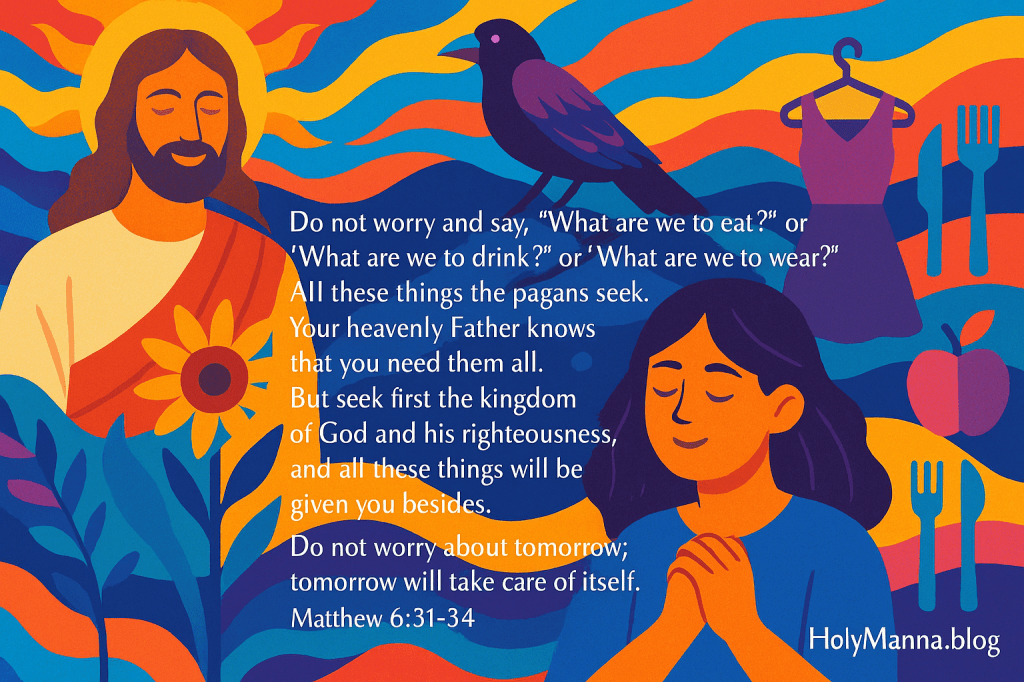
Dependence on God. 25 “Therefore I tell you, do not worry about your life, what you will eat [or drink], or about your body, what you will wear. Is not life more than food and the body more than clothing? 26 Look at the birds in the sky; they do not sow or reap, they gather nothing into barns, yet your heavenly Father feeds them. Are not you more important than they? 27 Can any of you by worrying add a single moment to your life-span? 28 Why are you anxious about clothes? Learn from the way the wild flowers grow. They do not work or spin. 29 But I tell you that not even Solomon in all his splendor was clothed like one of them. 30 If God so clothes the grass of the field, which grows today and is thrown into the oven tomorrow, will he not much more provide for you, O you of little faith? 31 So do not worry and say, ‘What are we to eat?’ or ‘What are we to drink?’ or ‘What are we to wear?’ 32 All these things the pagans seek. Your heavenly Father knows that you need them all. 33 But seek first the kingdom [of God] and his righteousness, and all these things will be given you besides. 34 Do not worry about tomorrow; tomorrow will take care of itself. Sufficient for a day is its own evil.
Detailed Exegesis
Verse 24 – “No one can serve two masters. He will either hate one and love the other, or be devoted to one and despise the other. You cannot serve God and mammon.”
Jesus begins with a non-negotiable truth: divided loyalty is spiritual slavery. “Mammon” refers not merely to money, but to materialism as a rival god. To serve mammon is to orient one’s entire life around acquisition and control. Jesus demands a radical reorientation—a total entrustment of our hearts to the Father alone.
Verse 25 – “Therefore I tell you, do not worry about your life, what you will eat or drink, or about your body, what you will wear. Is not life more than food and the body more than clothing?”
This verse is not a dismissal of responsibility, but a command to release anxiety. Jesus asks a piercing question: What is life really about? He invites us to step beyond mere survival and into a life defined by deeper meaning and trust in God’s provision.
Verse 26 – “Look at the birds in the sky; they do not sow or reap, they gather nothing into barns, yet your heavenly Father feeds them. Are not you more important than they?”
Using a gentle image from nature, Jesus offers a reflection on dignity and providence. Birds live freely under God’s care—how much more does He care for His children? This is not a call to idleness, but to confidence. The Father’s love is personal and precise.
Verse 27 – “Can any of you by worrying add a single moment to your life-span?”
This rhetorical question cuts deep. Worry, far from solving anything, steals our peace and shortens our joy. Jesus invites us to recognize the futility of anxiety—and the freedom of surrender.
Verse 28 – “Why are you anxious about clothes? Learn from the way the wild flowers grow. They do not work or spin.”
The image of wildflowers speaks to beauty without striving. Jesus uses creation to model Kingdom living: beauty emerges not from anxious toil, but from being rooted in God’s care.
Verse 29 – “But I tell you that not even Solomon in all his splendor was clothed like one of them.”
Solomon, the wealthiest and wisest of Israel’s kings, is surpassed by the effortless beauty of flowers. Jesus is flipping cultural expectations. Glory, in the Kingdom, is found not in accumulation, but in God-given grace.
Verse 30 – “If God so clothes the grass of the field, which grows today and is thrown into the oven tomorrow, will he not much more provide for you, O you of little faith?”
Jesus gently rebukes the tendency to doubt. If God lavishes such attention on perishable things, how much more will He care for us—eternal souls made in His image?
Verse 31 – “So do not worry and say, ‘What are we to eat?’ or ‘What are we to drink?’ or ‘What are we to wear?’”
Here Jesus names the core questions that haunt the human heart. These are real concerns, but He reminds us they need not dominate our spiritual horizon.
Verse 32 – “All these things the pagans seek. Your heavenly Father knows that you need them all.”
The contrast is stark: to chase after things as if we have no Father is to live like pagans. But we are not orphans. Our Father knows, sees, and cares. This line is one of the most consoling in all of Scripture.
Verse 33 – “But seek first the kingdom of God and his righteousness, and all these things will be given you besides.”
This is the hinge of the entire passage. Prioritize the Kingdom, and provision will follow. Righteousness here means right relationship with God—living in His grace. Jesus promises abundance, but only when God is first.
Verse 34 – “Do not worry about tomorrow; tomorrow will take care of itself. Sufficient for a day is its own evil.”
Jesus concludes with a liberating principle: live in the present. Trust God today. Each day will bring its own trials, but grace is always available in the now. This echoes the prayer: “Give us this day our daily bread.”
Teachings
The Catechism of the Catholic Church speaks directly to the spiritual disorder that comes from putting trust in wealth: “The desire for true happiness frees man from his immoderate attachment to the goods of this world so that he can find fulfillment in the vision and beatitude of God” (CCC 2548). Jesus is not teaching irresponsibility, but refocusing the eyes of our heart. When our gaze is fixed on the Kingdom, everything else falls into place.
St. Francis de Sales wrote, “Anxiety is the greatest evil that can befall a soul except sin… God commands you to work, but He forbids you to worry.” This echoes Jesus’ teaching here in Matthew 6. The spiritual tradition of the Church sees trust not as weakness, but as strength—the fruit of a mature soul. CCC 2830 affirms that “Jesus teaches us this petition [‘Give us this day…’] because it glorifies our Father by acknowledging how good He is, beyond all our deserts.” The command to trust is always rooted in the Father’s goodness.
Finally, CCC 2090 defines hope as the confident expectation of divine blessing. Jesus in this Gospel does not promise a life without hardship—but a life filled with providence. He shows us that faith and hope are the true antidotes to worry. And when we seek the Kingdom first, we become part of that Kingdom’s work in the world.
Reflection
What anxieties have been dominating your mind lately? Is it your future, your finances, your family, your appearance? Jesus gently, firmly invites you to let go. Are you willing to believe that your Father knows your needs? He is not distant. He is intimately concerned with your life, your struggles, your daily bread. What would change if, today, you chose to seek the Kingdom first? Let these words not just comfort you but challenge you—to pray more, hoard less, serve more, and worry less. The path to freedom is trust. And the God who clothes lilies and feeds birds is inviting you to live in the dignity of His care.
Grace Enough for Today
Today’s readings form a symphony of surrender—each voice, from St. Paul to the psalmist to Jesus Himself, invites us to exchange our burdens for grace, our striving for stillness, our anxiety for trust. In 2 Corinthians 12, Paul shows us that “power is made perfect in weakness”, a truth learned not in theory but through a thorn that kept him humble and dependent. In Psalm 34, we are reminded to “taste and see that the Lord is good”, that those who fear Him and seek Him will lack nothing. And in Matthew 6, Jesus gives us permission to stop worrying and begin trusting: “Seek first the kingdom of God and his righteousness, and all these things will be given you besides.”
This is not a passive message; it is an active call to live differently—to let go of the illusion of control and lean into the Father’s faithful providence. God does not ask us to be strong on our own, but to be open to His strength in our weakness. He does not demand perfection, but invites intimacy. He does not promise that all will go smoothly, but that we will never go alone.
So where do you need to surrender today? What thorn are you still begging to be removed instead of allowing it to become the dwelling place of grace? What worry is robbing you of your joy and distracting you from your call? Lay it all at His feet. Let His love be enough. Let His voice quiet your fears. Let His promise guide your steps. You don’t have to have it all figured out—you only need to be held by the One who does. And He is near. Always near. Will you trust Him with today?
Engage with Us!
We’d love to hear how today’s Scriptures are speaking to your heart. Share your thoughts, struggles, and inspirations in the comments below—your reflection could be just what someone else needs to read today. Let’s grow together in faith, rooted in God’s Word and in the love of Christ that unites us.
Reflection Questions:
First Reading – 2 Corinthians 12:1–10
Where do you feel weakest right now, and how might that be the very space God wants to fill with His power? Can you think of a time when a hardship led to unexpected spiritual growth? What does it mean for you personally to “boast of your weaknesses”?
Responsorial Psalm – Psalm 34:8–13
How have you recently “tasted and seen” the goodness of the Lord? What does the “fear of the Lord” look like in your everyday life? Where might God be calling you to greater trust in His provision?
Holy Gospel – Matthew 6:24–34
Which area of your life is most prone to worry—finances, future, relationships? What would it look like for you to truly “seek first the kingdom of God” today? How can you practice trusting the Father’s care in small, concrete ways this week?
May you walk today with peace in your heart, knowing that God’s grace is sufficient, His presence is near, and His love is steadfast. Whatever you do, let it be done with faith, courage, and the mercy of Christ. Let your life echo the words you have read—lived not in fear, but in freedom.
Follow us on Instagram and Facebook for more insights and reflections on living a faith-filled life.

 Holy Manna!
Leave a comment