Weakness, Worship, and the True Riches
What do you treasure most—success, comfort, strength, the admiration of others? Today’s Mass readings challenge us to examine the vaults of our hearts and ask: Are we storing our wealth in heaven or on earth? In a world that rewards power, beauty, and self-promotion, Scripture flips the script. We’re invited to see with new eyes—a light-filled gaze that discerns the eternal value of humility, suffering, and trust in God. The Apostle Paul, the psalmist, and Christ Himself each point to a deeper wisdom: that our true worth lies not in what we gain, but in how we love and what we’re willing to lose for the sake of the Kingdom.
In 2 Corinthians 11, Paul defends his apostolic ministry not by recounting glory but by listing his trials—beatings, shipwrecks, hunger, anxiety for the Church. He even says, “If I must boast, I will boast of the things that show my weakness”. This wasn’t mere rhetoric. In a Greco-Roman world that prized strength, honor, and eloquence, Paul’s words were scandalous. Yet they echo the very heart of the Gospel: the Cross. In parallel, Psalm 34 overflows with the song of a poor man who cries out and is saved—proof that God draws near not to the proud, but to those crushed in spirit. Both readings expose a spiritual paradox that lies at the core of our faith: it is in our littleness that God shows His greatness.
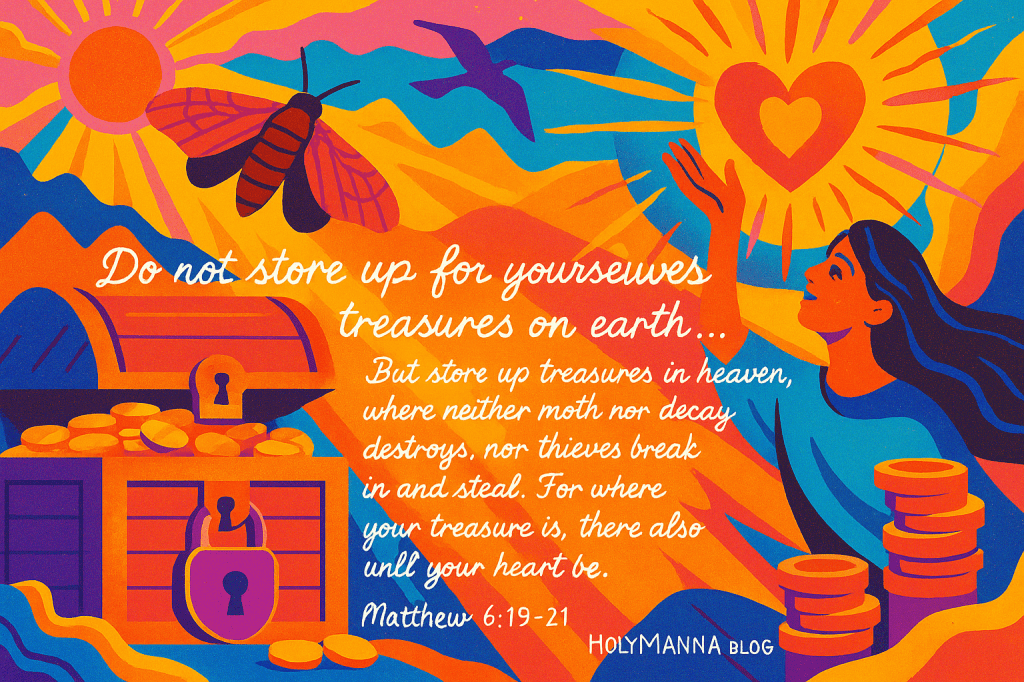
Then, in The Gospel of Matthew, Jesus speaks with piercing clarity: “Do not store up for yourselves treasures on earth” and “where your treasure is, there also will your heart be”. This teaching was as radical then as it is now. To the Jews living under Roman rule, wealth was often associated with divine favor; to Jesus’ followers, however, it becomes a test of attachment. Christ urges His disciples to pursue a luminous interior life—one in which the “eye” is clear, unclouded by greed or worldly obsession. Today’s readings, taken together, offer a roadmap to eternal riches: boast in your weakness, cry out to God in your poverty, and let your gaze be fixed on heaven, where the treasure never fades.
First Reading – 2 Corinthians 11:18, 21-30
Strength Revealed in Scars
Corinth was a bustling, cosmopolitan city—intellectually elite, economically wealthy, and spiritually chaotic. When St. Paul wrote his second letter to the Corinthians, he was addressing a Christian community vulnerable to division, seduced by charismatic “super-apostles” who boasted of their credentials, eloquence, and spiritual power. Paul, in contrast, presents a profile of a true apostle that is as shocking today as it was then: one marked by suffering, weakness, and daily anxiety for the Church. The Second Letter to the Corinthians is deeply personal—Paul strips himself bare to show that apostolic authority is not about dominance, but about sacrificial love. This passage prepares our hearts to rethink what it means to follow Christ faithfully: not by worldly success, but by sharing in His Cross.
2 Corinthians 11:18, 21-30
New American Bible (Revised Edition)
18 Since many boast according to the flesh, I too will boast.
21 To my shame I say that we were too weak!
But what anyone dares to boast of (I am speaking in foolishness) I also dare. 22 Are they Hebrews? So am I. Are they Israelites? So am I. Are they descendants of Abraham? So am I. 23 Are they ministers of Christ? (I am talking like an insane person.) I am still more, with far greater labors, far more imprisonments, far worse beatings, and numerous brushes with death. 24 Five times at the hands of the Jews I received forty lashes minus one. 25 Three times I was beaten with rods, once I was stoned, three times I was shipwrecked, I passed a night and a day on the deep; 26 on frequent journeys, in dangers from rivers, dangers from robbers, dangers from my own race, dangers from Gentiles, dangers in the city, dangers in the wilderness, dangers at sea, dangers among false brothers; 27 in toil and hardship, through many sleepless nights, through hunger and thirst, through frequent fastings, through cold and exposure. 28 And apart from these things, there is the daily pressure upon me of my anxiety for all the churches. 29 Who is weak, and I am not weak? Who is led to sin, and I am not indignant?
Paul’s Boast: His Weakness. 30 If I must boast, I will boast of the things that show my weakness.
Detailed Exegesis
Verse 18 – “Since many boast according to the flesh, I too will boast.”
Paul opens with biting irony. “Boasting according to the flesh” refers to worldly qualifications—lineage, power, accomplishments. Rather than dismiss this tactic outright, Paul temporarily plays along, not to exalt himself, but to contrast earthly boasting with the paradox of Christian humility. He is setting the stage for what seems like foolishness to the world but is in fact the wisdom of God.
Verse 21 – “To my shame I say that we were too weak!”
Here Paul mocks the standards of strength admired by his opponents. His self-deprecating remark underscores that his “weakness” was not moral or spiritual failure, but a refusal to dominate or manipulate. The Apostle’s ministry was marked by meekness and vulnerability—a mirror of Christ’s own humility.
Verse 22 – “Are they Hebrews? So am I. Are they Israelites? So am I. Are they descendants of Abraham? So am I.”
Paul now lays out his Jewish credentials to match those of the false teachers. He affirms his full participation in the covenantal heritage of Israel. This lineage matters because Paul is confronting those who claim authority based on their Jewish identity—yet he does so not to flaunt it, but to show that such boasts are ultimately insufficient.
Verse 23 – “Are they ministers of Christ? (I am talking like an insane person.) I am still more, with far greater labors, far more imprisonments, far worse beatings, and numerous brushes with death.”
Paul’s sarcasm intensifies. His “insanity” is pretending that one proves ministry by self-glory. Instead, he lists the marks of his apostleship: hardship, danger, and endurance. These are his credentials—signs that he has conformed his life to the crucified Christ.
Verse 24 – “Five times at the hands of the Jews I received forty lashes minus one.”
The “forty minus one” lashes were a legal punishment based on Deuteronomy 25:3, intended to avoid exceeding the maximum of forty. Enduring this repeatedly, Paul aligns himself with the Suffering Servant. The wounds of his body become a living Gospel.
Verse 25 – “Three times I was beaten with rods, once I was stoned, three times I was shipwrecked, I passed a night and a day on the deep.”
Roman beatings, stoning, and shipwrecks—these trials reveal Paul’s perseverance through physical danger and rejection. His journey of faith is not metaphorical. It involves real suffering that refines and authenticates his ministry.
Verse 26 – “On frequent journeys, in dangers from rivers, dangers from robbers, dangers from my own race, dangers from Gentiles, dangers in the city, dangers in the wilderness, dangers at sea, dangers among false brothers.”
This litany of danger emphasizes how following Christ exposed Paul to constant risk, from both Jews and Gentiles, friends and foes. His path was anything but safe. This verse echoes Psalm 23—walking through the “valley of the shadow of death,” yet fearing no evil.
Verse 27 – “In toil and hardship, through many sleepless nights, through hunger and thirst, through frequent fastings, through cold and exposure.”
Paul catalogs his ascetic life—not as self-imposed penance, but as the result of a mission that demanded total surrender. His body bore the weight of the Gospel. These sufferings mirror the fasting and trials of Christ in the desert (Matthew 4:1-11).
Verse 28 – “And apart from these things, there is the daily pressure upon me of my anxiety for all the churches.”
Even more painful than physical suffering was the emotional and spiritual burden of shepherding souls. Paul’s love for the Church is paternal, even Christ-like. This verse reminds us that true spiritual leadership always carries the cross of concern for others.
Verse 29 – “Who is weak, and I am not weak? Who is led to sin, and I am not indignant?”
Paul’s compassion is profound. He shares in the weakness of others—not from afar, but as one who enters into their pain. Like Christ, he bears the burdens of the flock. His indignation is not anger, but righteous grief over sin and its destructive power.
Verse 30 – “If I must boast, I will boast of the things that show my weakness.”
This is the climax: Paul glories not in strength but in weakness, because it is in weakness that Christ’s power is made perfect (cf. 2 Corinthians 12:9). His life is a living homily on the Cross—a paradox of love through sacrifice.
Teachings
Paul’s radical embrace of weakness is echoed in the Catechism of the Catholic Church: “By His glorious Cross Christ has won salvation for all men. He redeemed them from the sin that held them in bondage. ‘For freedom Christ has set us free’ (Gal 5:1). In Him we have communion with the truth that makes us free” (CCC 1741). Just as Jesus emptied Himself in obedience unto death (cf. Philippians 2:7-8), Paul’s own journey models this self-emptying, revealing that Christian power comes not from domination, but from participation in Christ’s redemptive love.
St. John Chrysostom praised Paul’s sufferings, saying: “He wore the marks of Christ, not only on his body but in his soul”. Paul’s spiritual strength resided not in eloquence or miracles but in his willingness to bear wounds for the sake of others. His “boasting” invites believers to measure greatness not by outward achievements but by fidelity to the Cross.
Historically, Paul’s suffering becomes a model for saints throughout the ages. From Ignatius of Antioch to Maximilian Kolbe, the Church has always recognized the value of redemptive suffering. Even in modern times, Pope St. John Paul II affirmed this mystery: “Suffering, more than anything else, makes present in the history of humanity the force of the Redemption” (Salvifici Doloris, 27). In a world that flees discomfort, the Church still proclaims that suffering united to Christ is a treasure.
Reflection
What if the things you try to avoid—fatigue, rejection, anxiety—are actually where Christ is waiting for you? This reading challenges us to redefine success, to boast in the moments we’ve carried our cross with trust, and to stop hiding our wounds. Are we willing to let Christ’s power shine through our weaknesses? Do we see spiritual worth in sacrificing comfort for others? And what would it look like to pray not just for strength, but for the courage to be weak? These verses invite us to take inventory of our lives—not our achievements, but our surrender—and ask: What treasure am I storing in heaven through my daily trials?
Responsorial Psalm – Psalm 34:2-7
The Song of the Poor and Radiant
Psalm 34 is a hymn of thanksgiving composed by David after a dramatic moment of deliverance—when he feigned madness before Abimelech to escape death (cf. 1 Samuel 21:10-15). Set against that backdrop of danger and humiliation, the psalm becomes a radiant declaration of God’s faithfulness to those who humble themselves and cry out. In Israelite tradition, psalms were more than prayers—they were communal memories set to music, guiding the heart of the people through praise, lament, and hope. Today’s verses serve as a spiritual anchor between Paul’s boasting in weakness and Jesus’ command to seek treasure in heaven. Here, the psalmist invites us to join in a celebration of divine rescue, where poverty of spirit becomes the door to joy, and God’s saving power is revealed not in might, but in mercy.
Psalm 34:2-7
New American Bible (Revised Edition)
2 I will bless the Lord at all times;
his praise shall be always in my mouth.
3 My soul will glory in the Lord;
let the poor hear and be glad.
4 Magnify the Lord with me;
and let us exalt his name together.
5 I sought the Lord, and he answered me,
delivered me from all my fears.
6 Look to him and be radiant,
and your faces may not blush for shame.
7 This poor one cried out and the Lord heard,
and from all his distress he saved him.
Detailed Exegesis
Verse 2 – “I will bless the Lord at all times; his praise shall be always in my mouth.”
David begins with a vow to perpetual praise—“at all times”—even in trial. This reflects a heart that has learned to worship not only in victory, but in weakness and need. For the Christian, this echoes 1 Thessalonians 5:18: “In all circumstances give thanks, for this is the will of God for you in Christ Jesus.”
Verse 3 – “My soul will glory in the Lord; let the poor hear and be glad.”
In contrast to glorying in self or strength, David’s soul “glories in the Lord”. This directly complements St. Paul’s message in 2 Corinthians 11, where true boasting comes from dependence on God. The poor—the anawim, the humble and afflicted—are lifted up in this shared song of gladness.
Verse 4 – “Magnify the Lord with me; and let us exalt his name together.”
This is an invitation to communal worship. David is not content to praise God alone; he desires the entire community to “magnify the Lord”. This reflects the Church’s liturgical heart—praise is most complete when shared. The Eucharistic celebration itself is a communal exalting of the divine name.
Verse 5 – “I sought the Lord, and he answered me, delivered me from all my fears.”
This personal testimony of deliverance reveals that God listens and responds to the cries of the faithful. Notably, David emphasizes being freed from “fears”, not necessarily from danger. God’s answer begins in the heart—He casts out fear with His love (cf. 1 John 4:18).
Verse 6 – “Look to him and be radiant, and your faces may not blush for shame.”
The image here is one of transfiguration—the one who gazes upon God becomes “radiant”, unashamed. In Hebrew thought, the face reflects the state of the soul. This verse prefigures the beatific vision and calls to mind Moses, whose face shone after speaking with God (Exodus 34:29).
Verse 7 – “This poor one cried out and the Lord heard, and from all his distress he saved him.”
David speaks in the third person to emphasize humility. He refers to himself as “this poor one”, embodying the spirit of poverty Jesus blesses in Matthew 5:3. God’s saving power is shown not through destruction of enemies, but through hearing and rescuing the lowly. This is the God who sees the afflicted and acts.
Teachings
The Catechism of the Catholic Church teaches that prayer of praise is a key dimension of our relationship with God: “Praise is the form of prayer which recognizes most immediately that God is God. It lauds God for His own sake and gives Him glory, quite beyond what He does, but simply because He IS” (CCC 2639). Psalm 34 exemplifies this pure praise. David’s heart rejoices not just in God’s deeds, but in His being—a God who sees, hears, and saves the humble.
St. Augustine, in his Confessions, reflected on the power of this psalm when he wrote: “My soul shall make her boast in the Lord, not in myself; for of myself I am nothing, but in Him I shall glory.” He goes on to say, “The poor shall hear of Him, and be glad”—not the proud, not the self-sufficient, but the broken-hearted who know they need salvation. This captures the essence of today’s responsorial: God does not hear us because we are impressive—He hears us because we are poor in spirit.
Historically, this psalm became a foundation for the spirituality of the Desert Fathers and monastic tradition. They sang it as a daily reminder that praise must rise not from success, but from surrender. Even in our liturgy, Psalm 34 appears regularly in the Liturgy of the Hours, especially in Morning Prayer, anchoring the Church in a daily rhythm of humble thanksgiving. The poor man’s voice becomes the Church’s voice, drawing all the faithful into the mystery of God’s protective love.
Reflection
Have you ever cried out from a place of real fear, poverty, or shame—and been met by God’s peace? This psalm reminds us that worship is not a performance but a lifeline. When we bless the Lord “at all times,” especially in distress, we open ourselves to receive His radiance. What are the fears you need deliverance from today? Are you willing to be seen as “poor” in the world’s eyes so that you might be rich in grace? Begin today by offering a prayer of praise, even if your heart is heavy. Sing with David, and let your soul glory not in your strength, but in the God who hears, answers, and saves.
Holy Gospel – Matthew 6:19-23
Eyes for Eternity
In the heart of the Sermon on the Mount, Jesus delivers this brief yet piercing teaching on true treasure and spiritual sight. The Gospel of Matthew, written primarily for a Jewish-Christian audience, consistently presents Jesus as the New Moses, the authoritative interpreter of the Law. Chapter 6 belongs to a section where Christ reorients the heart of religious practice—moving from external piety to internal disposition. These verses directly confront the human tendency to seek security in material things and to base one’s worth on visible accomplishments. In light of today’s theme, Jesus invites us to abandon false measures of strength and success and to let our hearts and eyes be fixed on the things of heaven, where light, not darkness, guides every choice.
Matthew 6:19-23
New American Bible (Revised Edition)
Treasure in Heaven. 19 “Do not store up for yourselves treasures on earth, where moth and decay destroy, and thieves break in and steal. 20 But store up treasures in heaven, where neither moth nor decay destroys, nor thieves break in and steal. 21 For where your treasure is, there also will your heart be.
The Light of the Body. 22 “The lamp of the body is the eye. If your eye is sound, your whole body will be filled with light; 23 but if your eye is bad, your whole body will be in darkness. And if the light in you is darkness, how great will the darkness be.
Detailed Exegesis
Verse 19 – “Do not store up for yourselves treasures on earth, where moth and decay destroy, and thieves break in and steal.”
Jesus begins with a prohibition that cuts to the core of worldly desire. Earthly treasures—wealth, reputation, power—are subject to rot, theft, and inevitable loss. His language is vivid: “moth and decay” conjure the fragility of possessions, while “thieves” speak to the insecurity of placing trust in anything temporal. This verse is not just about wealth, but about the human heart’s tendency to cling to what does not last.
Verse 20 – “But store up treasures in heaven, where neither moth nor decay destroys, nor thieves break in and steal.”
The contrast is sharp. Christ points to a kind of wealth that is beyond corruption: the treasure of grace, virtue, charity, and communion with God. This verse recalls Matthew 5:12, where Jesus says, “Rejoice and be glad, for your reward will be great in heaven”. True treasure is not stored in vaults or social media profiles, but in acts of love offered to the Father in secret.
Verse 21 – “For where your treasure is, there also will your heart be.”
Here Jesus names the central issue: our desires shape our destiny. The Greek word for “heart” (kardia) refers to the inner core of a person—the seat of thought, feeling, and will. What we love most determines the direction of our life. If we treasure comfort or praise, our heart will serve those things. If we treasure Christ, our heart will rise with Him.
Verse 22 – “The lamp of the body is the eye. If your eye is sound, your whole body will be filled with light.”
Jesus uses a powerful image: the eye as the lamp. In Jewish understanding, the eye represented not only sight but intention. A “sound” or “single” eye (from the Greek haplous) implies clarity, integrity, and focused devotion. A rightly ordered gaze leads to a body—and life—filled with light, echoing Psalm 119:105: “Your word is a lamp for my feet, a light for my path.”
Verse 23 – “But if your eye is bad, your whole body will be in darkness. And if the light in you is darkness, how great will the darkness be.”
Jesus warns that a distorted gaze—covetous, envious, prideful—leads to inner blindness. When the thing meant to bring light (our eye, our moral compass) becomes dark, the soul is plunged into confusion. This verse resonates with the tragedy of sin: it doesn’t merely lead us astray; it distorts how we see everything. The result is not just error, but profound inner darkness.
Teachings
The Catechism of the Catholic Church echoes the urgency of this Gospel in teaching that detachment from riches is essential for holiness: “The Lord grieves over the rich, because they find their consolation in the abundance of goods. ‘Let the proud seek and love earthly kingdoms, but blessed are the poor in spirit for theirs is the Kingdom of heaven.’ Abandonment to the providence of the Father in heaven frees us from anxiety about tomorrow” (CCC 2547). The treasure Christ speaks of is freedom—the ability to love without fear, to serve without calculating cost, to give without clinging.
St. Gregory of Nyssa, reflecting on the “eye as the lamp,” writes: “If the eye of the soul is clean and simple, its whole body—meaning its actions and life—will be full of the light of divine truth”. He saw spiritual clarity as the fruit of prayer and moral discipline. To have a “sound eye” is to possess spiritual discernment, to see everything in the light of eternity. This calls for a continual purification of our desires.
In the desert tradition, the early Christian monks understood this passage as foundational to the spiritual life. They spoke of the “logismoi”—inner thoughts that, if left unchecked, cloud the eye of the soul. Their response was silence, fasting, and prayer. In a modern world filled with noise and distraction, this wisdom speaks louder than ever. The treasures of heaven are accumulated not through ambition, but through hidden fidelity, purity of heart, and a clear gaze fixed on Christ.
Reflection
Where is your treasure really stored? Is your heart divided between the altar and the marketplace, between God and self? This Gospel invites us into a life of simplicity and singular focus. What fills your vision each day—screens, status, or the face of Christ? Begin by asking God to purify your gaze. Try fasting from distractions that feed greed or vanity, and seek out silence where your heart can rest in His presence. Are you willing to store treasure where only God sees? Today, let us allow the light of His truth to enter through the windows of our soul and illuminate the whole house. Only then will our heart truly belong where it was made to dwell—forever in heaven.
Heaven’s Treasury is Open—Come and Enter
Today’s readings shine a piercing yet beautiful light on a truth we often resist: the path to glory is paved with weakness, poverty, surrender, and trust. St. Paul boasts not in triumph but in trials—“If I must boast, I will boast of the things that show my weakness”—reminding us that God’s power is made perfect in those who dare to be small. Psalm 34 becomes our shared song of deliverance, as the poor one cries out and is heard, his face radiant and unashamed. And in The Gospel of Matthew, Jesus invites us to reorient our hearts: “Where your treasure is, there also will your heart be”. When we fix our eyes on heaven, our lives begin to glow with the light of eternity.
These Scriptures challenge the way we measure value and strength. They unmask the illusion of earthly treasures and redirect us to the imperishable riches of grace, mercy, and communion with God. True light floods the soul when we see the world through the lens of love, detachment, and trust. Like Paul, like David, like Christ, we are called to live not by appearances, but by eternal truth. This is a treasure no thief can steal and no moth can destroy.
What if your poverty—your weariness, your hidden sacrifice—isn’t a burden to hide but a jewel in the eyes of Heaven? What if the world’s rejection is your invitation to deeper intimacy with Christ? Today, let’s choose to store our treasures in heaven. Let’s bless the Lord at all times, even in our brokenness. Let’s fix our eyes on what truly matters. The treasury of heaven is open—and your heart is the key.
Engage with Us!
We would love to hear how today’s readings spoke to your heart. What line challenged you? What verse comforted you? Share your thoughts in the comments below—your reflections may be the light someone else needs today. Let’s grow together as a community rooted in the Word and walking in the Spirit.
Reflection Questions
First Reading – 2 Corinthians 11:18, 21-30
When have you experienced God’s strength through your weakness? Are there “boasts” in your life—achievements, comforts, appearances—that may be keeping you from deeper humility and dependence on Christ? How can you begin to see your wounds and trials as signs of love rather than failure?
Responsorial Psalm – Psalm 34:2-7
Do you believe that God hears you when you cry out? What fears or burdens do you need to surrender in order to praise Him more freely? How can you live today as someone whose face is “radiant” with trust in the Lord?
Holy Gospel – Matthew 6:19-23
What is one “earthly treasure” you feel overly attached to? Where do you direct most of your gaze—toward Christ or toward the things of the world? What practical steps can you take this week to store treasure in heaven and purify the eye of your soul?
May we go forth with hearts that are poor in spirit, eyes that are full of light, and lives that shine with the radiance of Christ’s mercy. Let every choice we make, every burden we bear, and every word we speak be done in faith, and with the love and compassion Jesus teaches us each day.
Follow us on Instagram and Facebook for more insights and reflections on living a faith-filled life.

 Holy Manna!
Leave a comment