A Saint Who Set the Desert on Fire
In the vast garden of Catholic saints, there are those whose holiness blooms in the streets, and others whose sanctity blossoms in the shadows. Saint Romuald belongs to the latter. Born into the luxury of nobility, he chose instead the ashes and embers of solitude. He became a flame in the wilderness—igniting renewal in the Church through monastic reform, spiritual discipline, and a radical embrace of divine silence. Revered as the founder of the Camaldolese Order, Romuald revived the ancient eremitic tradition at a time when monastic life had grown soft and comfortable. His sanctity, forged in long nights of prayer, penance, and communion with God, continues to burn brightly for those seeking God in the quiet places of the heart.
Saint Romuald’s impact cannot be overstated. He was not merely a reformer; he was a prophet of the interior life. In a time when wealth and corruption had infiltrated even monastic communities, he reminded the Church of the desert fathers, of the sacredness of asceticism, and of the furnace of love that silence can become. To study his life is to hear the whisper of the Holy Spirit, calling us too to deeper conversion, prayer, and holy solitude.
The Radical Detour of Grace
Saint Romuald was born around 951 AD in Ravenna, Italy, into the influential and noble Onesti family. His early years were shaped by wealth, privilege, and the expectations of a powerful lineage. Yet, even as he was surrounded by the pleasures of the world, there was a restlessness in his soul—a sense that something greater awaited him beyond the walls of luxury.
That call from heaven came through a terrible tragedy. When Romuald was in his early twenties, he witnessed his father kill a relative in a violent duel over a land dispute. Overcome with guilt and horror at the shedding of blood—blood he indirectly felt complicit in—Romuald fled to the monastery of Sant’Apollinare in Classe to do penance. What was meant to be a temporary retreat turned into the beginning of a lifelong transformation. The silence of the monastery echoed louder than the noise of his noble past. In those stone walls, through the chanting of the Psalms and the rhythm of prayer, Romuald encountered the living God.
He took the Benedictine habit and sought to live a holy life, but soon grew discontent with what he perceived as the spiritual mediocrity of his fellow monks. Seeking a more radical expression of holiness, he left the monastery and placed himself under the guidance of a hermit named Marinus, who taught him the harsh but fruitful life of solitude, fasting, and uninterrupted prayer.
From there, Romuald began a decades-long pilgrimage across Italy, founding hermitages and reforming monasteries. His most significant legacy was the founding of the Camaldolese Order around 1012. This community fused the solitude of hermits with the communal life of monks. In the remote forests of Tuscany, Romuald established Camaldoli, a place where souls could seek God in profound silence, away from the world’s distractions. His life became a beacon for others who hungered for holiness untainted by compromise. He had become the very opposite of what he was born to be—not a prince of this world, but a pilgrim of heaven.
A Light in the Stillness
While Saint Romuald is not remembered for an abundance of physical miracles like healing the sick or raising the dead, the supernatural fruits of his life were no less astounding. His very presence carried with it the scent of heaven. Those who encountered him felt their hearts pierced, their sins laid bare, and their spirits moved to conversion. His words, often simple and few, bore the weight of divine fire.
Romuald was known to fall into ecstasies during prayer, his face radiant with light, sometimes levitating in rapture. He possessed the gift of spiritual insight, able to see the depths of a person’s heart and guide them with precision toward repentance. Nobles and commoners alike would seek his counsel, and many who approached him casually would leave utterly transformed.
One of the most striking moments of mystical revelation in his life was the vision he received while praying, in which he saw a ladder ascending to heaven with monks in white garments climbing it. This vision was not symbolic alone—it became prophetic. It confirmed his mission to found a new monastic expression rooted in purity, silence, and heavenly longing. This became the Camaldolese Order, whose habit is white, and whose charism calls monks to both eremitic and communal life.
Even without theatrical signs, Romuald’s miracles were no less divine. His miracle was holiness itself—the ability to revive dying souls, stir sleeping consciences, and awaken hearts to the love of God. In his company, one could feel the nearness of eternity.
Silent Battles
The path of holiness is rarely smooth, and for Romuald, it was lined with thorns. His radical commitment to prayer, penance, and reform earned him admiration from saints—but also resistance from the worldly. Many monks who had grown comfortable with ease and status found Romuald’s fiery demands unbearable. He was ridiculed, slandered, and even falsely accused of misconduct. At one point, these accusations led to his unjust excommunication—a cross he bore in silence, entrusting his vindication to God.
Beyond the attacks of others, Romuald also endured profound inner warfare. He was not immune to the temptations of pride, despair, or spiritual dryness. His nights in the wilderness were not peaceful escapes but spiritual battlefields. He spoke of being assaulted by demonic visions and of enduring deep spiritual anguish. Yet in these dark nights of the soul, he clung more tightly to Christ, trusting that even silence can be a crucible for sanctity.
He imposed upon himself harsh penances, often sleeping on bare ground, eating the simplest of food, and praying for hours without rest. These were not acts of self-punishment but of purification—Romuald longed to strip away all that could distract him from God. His life was marked by profound suffering, but also by a joy that surpassed understanding. Though not martyred by sword or fire, Romuald was a white martyr—dying daily to himself, crucified with Christ in the solitude of his cell.
The Flame Lives On
When Saint Romuald died in 1027, likely at Val di Castro, he left behind a legacy not only of reform but of holy fire. Pilgrims flocked to his tomb, and many reported miraculous healings—especially those suffering from mental anguish or spiritual oppression. His reputation for holiness, already well-known in life, only intensified after his death.
The Church confirmed his sanctity when Pope Clement VIII canonized him in 1595. For centuries, his relics were venerated with great devotion, and the monastic communities he founded continued to flourish. Even today, the Camaldolese hermits remain faithful to his vision, living in silence, prayer, and radiant simplicity.
Perhaps the greatest miracle of Saint Romuald is the endurance of his vision. His Brief Rule, a short but profound guide to the contemplative life, remains a spiritual classic. It begins with the astonishing words:
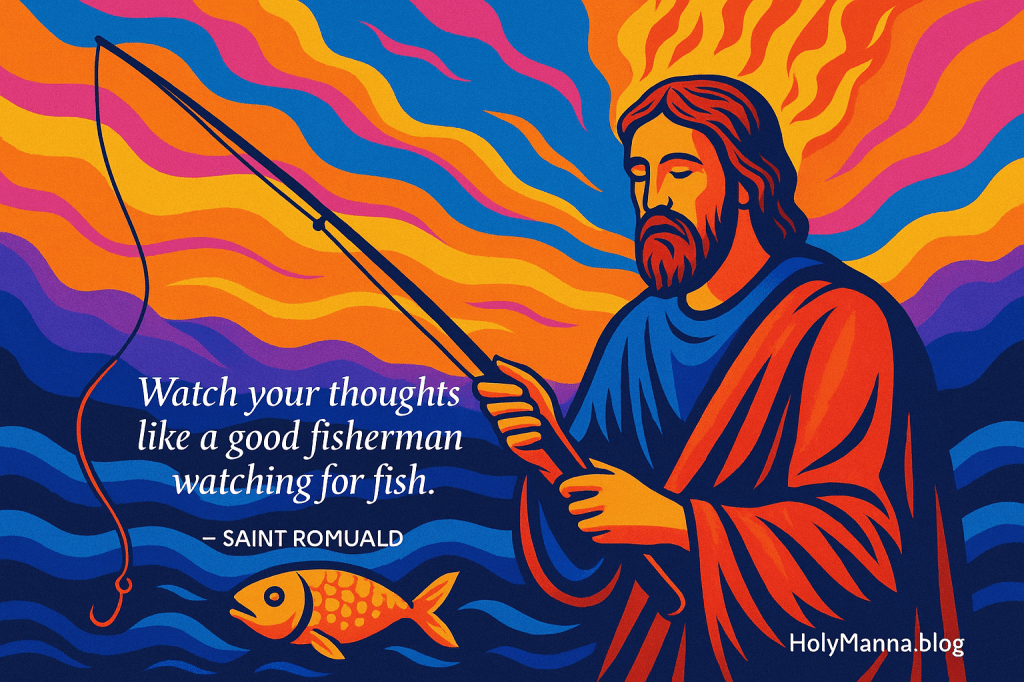
“Sit in your cell as in paradise. Put the whole world behind you and forget it. Watch your thoughts like a good fisherman watching for fish.”
These words have drawn countless souls into deeper communion with God. They are not a retreat from life but an invitation into its deepest meaning. Romuald’s voice echoes across the centuries, inviting us into the stillness where God speaks.
Lessons from the Desert
What can we learn from a man who lived over a thousand years ago in the silence of a forest? Everything.
Saint Romuald teaches us that holiness is not dependent on circumstance—it is a matter of surrender. In a world addicted to noise, his life stands as a signpost pointing us to the interior life. He reminds us that it is possible to be on fire for God even in the absence of crowds, applause, or recognition. The fire that burned in Romuald was not meant to be admired from afar—it was meant to be shared.
How can we apply his witness today? Begin by reclaiming moments of silence. Set aside time each day to sit with God, even if only for a few minutes. Embrace disciplines that strip away distractions: fasting, simplicity, solitude. Rediscover the beauty of the Psalms. Make space for confession, Eucharistic adoration, and lectio divina. Don’t be afraid to challenge spiritual mediocrity in yourself or others—but do so with the humility and mercy Romuald modeled.
Above all, believe that God is calling you to be holy—not later, but now. As The Catechism reminds us in CCC 2013, “All Christians…are called to the fullness of Christian life and to the perfection of charity.” Saint Romuald lived that perfection in the silence of his cell. We can begin living it in the silence of our hearts.
Engage with Us!
How does Saint Romuald’s fiery solitude speak to your life today? Share your thoughts and experiences in the comments—we’d love to hear from you and journey together.
Reflection Questions:
- Where is God calling you to carve out more silence and solitude in your life?
- What distractions keep you from deeper intimacy with Christ, and how can you begin to surrender them?
- Who in your life needs encouragement to reform or reignite their spiritual fervor—and how can you be a light to them?
Let us support each other in our pilgrimage of faith and strive to do all things with love, as our Lord Jesus did.
Saint Romuald, pray for us! 🎣
Follow us on Instagram and Facebook for more insights and reflections on living a faith-filled life.

 Holy Manna!
Leave a comment