One Gospel, One Lord, One Heart
Have you ever felt torn between different voices, each claiming to speak the truth, each demanding your attention, your loyalty, your heart? In today’s readings, the Word of God calls us back to a place of singular devotion—to a love that is pure, a teaching that is true, and a prayer that is simple. We are invited to remember that our faith is not built on charisma or noise, but on a deep, unshakable relationship with the true Jesus Christ. This is not just a warning against deception—it is an invitation to intimacy. What are the things in our lives that pull us away from the simplicity of the Gospel?
In 2 Corinthians 11:1–11, St. Paul pleads like a father guarding his daughter’s innocence before her wedding. He reminds the Corinthians that they were “betrothed…to one husband to present [them] as a chaste virgin to Christ”—a poetic and powerful image of the Church’s call to fidelity. Paul’s impassioned tone reflects the early Church’s real struggle against false teachers—so-called “superapostles”—who were drawing believers away from the Gospel of Jesus crucified. In the context of Greco-Roman society, where honor, eloquence, and philosophical skill often defined one’s credibility, Paul’s humble, unpaid preaching looked weak. But it was, in truth, a living icon of Christ’s own self-emptying love. This background frames the challenge: Will we be loyal to the Christ of the Cross, or seduced by a more attractive but false version of the Gospel?
The psalmist in Psalm 111 reminds us of what Paul is fighting to preserve: the reliability, justice, and beauty of the Lord’s works—“majestic and glorious is his work, his righteousness endures forever.” These works are not just mighty deeds of old; they are the foundation of trust that allows us to pray with the simple confidence Jesus teaches in The Gospel of Matthew (6:7–15). Jesus warns us not to babble like the pagans, piling up words to manipulate the divine. Instead, He gives us the Our Father—a prayer of childlike surrender that echoes Paul’s message of simplicity and purity of heart. In a world full of noise, opinions, and spiritual performance, today’s readings gently but firmly anchor us in what matters most: a sincere heart, a faithful Gospel, and a prayer that flows from trust, not fear.
First Reading – 2 Corinthians 11:1–11
Jealous Love and the War for Your Heart
The Second Letter to the Corinthians stands as one of St. Paul’s most personal and impassioned writings. Composed around A.D. 55–57, it reflects a Church caught in the tension between fidelity to the Gospel and the allure of alternative teachings brought by so-called “superapostles.” Corinth, a wealthy and diverse Roman city, was known for its philosophical schools, theatrical rhetoric, and syncretistic religious atmosphere. Within this cosmopolitan swirl, Paul had planted a community of believers rooted in the scandal of the Cross. But now, he faces the painful reality that some members were being seduced by a gospel of power, eloquence, and prestige—one that contradicted the humility and suffering of Christ. Today’s reading plunges us into Paul’s vulnerable plea, not merely as an apostle defending his mission, but as a spiritual father contending for the hearts of his children. In the context of today’s theme, Paul’s passionate jealousy mirrors God’s own desire for sincere and pure devotion to Christ, a call that resonates through both the Psalm and the Gospel of Matthew.
2 Corinthians 11:1-11
New American Bible (Revised Edition)
Preaching Without Charge. 1 If only you would put up with a little foolishness from me! Please put up with me. 2 For I am jealous of you with the jealousy of God, since I betrothed you to one husband to present you as a chaste virgin to Christ. 3 But I am afraid that, as the serpent deceived Eve by his cunning, your thoughts may be corrupted from a sincere [and pure] commitment to Christ. 4 For if someone comes and preaches another Jesus than the one we preached, or if you receive a different spirit from the one you received or a different gospel from the one you accepted, you put up with it well enough. 5 For I think that I am not in any way inferior to these “superapostles.” 6 Even if I am untrained in speaking, I am not so in knowledge; in every way we have made this plain to you in all things.
7 Did I make a mistake when I humbled myself so that you might be exalted, because I preached the gospel of God to you without charge? 8 I plundered other churches by accepting from them in order to minister to you. 9 And when I was with you and in need, I did not burden anyone, for the brothers who came from Macedonia supplied my needs. So I refrained and will refrain from burdening you in any way. 10 By the truth of Christ in me, this boast of mine shall not be silenced in the regions of Achaia. 11 And why? Because I do not love you? God knows I do!
Detailed Exegesis
Verse 1 – “If only you would put up with a little foolishness from me! Please put up with me.”
Paul begins with irony. What he calls “foolishness” is his defense of his ministry. He’s not interested in boasting for personal glory, but feels compelled to speak because the community is tolerating false teachers. His plea is heartfelt: bear with me, because what follows is an urgent appeal to spiritual fidelity.
Verse 2 – “For I am jealous of you with the jealousy of God, since I betrothed you to one husband to present you as a chaste virgin to Christ.”
Here Paul uses bridal imagery drawn from Old Testament covenant theology. Israel was often portrayed as the bride of Yahweh (cf. Hosea 2:19–20). Paul now assumes the role of a matchmaker, having “betrothed” the Church in Corinth to Christ. His “jealousy” is not petty but divine—a reflection of God’s own passionate, possessive love for His people. He longs to present them pure, undivided, faithful.
Verse 3 – “But I am afraid that, as the serpent deceived Eve by his cunning, your thoughts may be corrupted from a sincere and pure commitment to Christ.”
Paul recalls the Garden of Eden, warning that just as Eve was deceived, so too the Corinthians risk corruption—not through blatant rebellion, but through subtle distortion. This is spiritual warfare fought not with swords but with ideas. The enemy seeks to undermine “sincere and pure” devotion by introducing confusion, novelty, or pride.
Verse 4 – “For if someone comes and preaches another Jesus than the one we preached, or if you receive a different spirit from the one you received or a different gospel from the one you accepted, you put up with it well enough.”
This is a scathing rebuke. The Corinthians are too tolerant—accepting teachings that distort the Gospel and diminish Christ. Paul underscores a vital truth: not every “Jesus” preached is the true Jesus. There is only one Gospel, one Spirit. Anything else is counterfeit.
Verse 5 – “For I think that I am not in any way inferior to these ‘superapostles.’”
Paul’s tone is biting. These self-styled apostles may seem impressive, but Paul exposes their arrogance. Though lacking in rhetorical polish, he possesses something infinitely greater—apostolic authority grounded in divine truth.
Verse 6 – “Even if I am untrained in speaking, I am not so in knowledge; in every way we have made this plain to you in all things.”
The Greeks prized eloquence. Paul admits he’s not a polished orator, but insists that his knowledge—his epignosis, or deep spiritual understanding—is clear and evident. Truth doesn’t need theatrical delivery to be transformative.
Verse 7 – “Did I make a mistake when I humbled myself so that you might be exalted, because I preached the gospel of God to you without charge?”
Paul challenges their worldly thinking. In Greco-Roman culture, a teacher’s worth was often measured by how much they charged. By preaching for free, Paul subverted expectations—and yet they used this against him. He asks, was humility mistaken for weakness?
Verse 8 – “I plundered other churches by accepting from them in order to minister to you.”
This is rhetorical exaggeration—Paul had accepted support from other communities (like the Macedonians) so he wouldn’t burden the Corinthians. His priority was their salvation, not his comfort.
Verse 9 – “And when I was with you and in need, I did not burden anyone, for the brothers who came from Macedonia supplied my needs. So I refrained and will refrain from burdening you in any way.”
Paul affirms his integrity. Even in financial need, he did not make demands on the Corinthians. Instead, other believers stepped in to help—demonstrating the body of Christ in action.
Verse 10 – “By the truth of Christ in me, this boast of mine shall not be silenced in the regions of Achaia.”
Paul anchors his words in Christ. His “boast” is not in self, but in the truthfulness and faithfulness of God working through him. This is not empty rhetoric but spiritual confidence.
Verse 11 – “And why? Because I do not love you? God knows I do!”
His final appeal is intimate and raw. The Corinthians have doubted his love, perhaps seduced by flashier preachers. Paul responds with a God-invoked oath: “God knows I do!” His love is genuine, sacrificial, fatherly.
Teachings
The Catechism of the Catholic Church confirms that fidelity to the Gospel must be protected from distortion: “The Christian faith is not a ‘religion of the book.’ Christianity is the religion of the ‘Word’ of God, a word which is ‘not a written and mute word, but the Word which is incarnate and living’” (CCC 108). Paul’s anguish in this passage comes from seeing the living Word—Christ—being substituted by other versions that are neither true nor salvific. The Church has always defended the unity of the faith and its rootedness in the apostolic witness.
St. Irenaeus of Lyon, writing in the second century, echoes this: “Where the Church is, there is the Spirit of God; and where the Spirit of God is, there is the Church and all grace. But the Spirit is truth” (Against Heresies, III.24.1). False teachings have existed since the early days of the Church, but the Spirit guarantees the truth passed on through apostolic succession. Paul’s claim to knowledge is not personal pride—it’s his role as an apostle charged with transmitting the deposit of faith.
Paul’s financial independence also reflects the early Church’s concern for integrity in ministry. In contrast to pagan cults and philosophical schools, Christian leaders were called to embody humility. The Council of Trent later affirmed the importance of clerical poverty and detachment, encouraging ministers to follow the apostolic example. Today, this passage reminds both clergy and laity that authentic ministry flows from love, not gain; from truth, not status.
Reflection
This reading is a sobering examination of spiritual fidelity in an age of noise. We live in a time much like Corinth’s—awash with “new gospels,” influencers, motivational speakers, and even distorted forms of Christianity that promise comfort without the Cross. St. Paul’s words challenge us to ask: Are we listening to the voice of the true Shepherd, or being swayed by more appealing messages? The call is not just to discern truth, but to cling to it with sincere and pure devotion to Christ.
Paul’s humility in preaching without charge, his unwavering concern for the integrity of the Gospel, and his deep love for the Church serve as powerful models. In our daily lives, this might mean choosing prayer over distraction, silence over performance, simplicity over spectacle. It might mean asking ourselves hard questions like: Is the Jesus I follow the one who died for me, or one I’ve recreated in my image? Have I grown too tolerant of falsehood because it feels easier or more appealing?
The way forward is through the kind of prayer and relationship Jesus teaches in today’s Gospel—a return to the Father, in truth and trust. Let us allow Paul’s words to rekindle our love for Christ, not as an abstract idea, but as our Bridegroom, calling us to faithful, undivided hearts.
Responsorial Psalm – Psalm 111:1–4, 7–8
Worship in Wonder and Fidelity
The Book of Psalms is the heartbeat of the Church’s prayer, a sacred collection of poetry, lament, praise, and thanksgiving that formed the foundation of Israel’s worship and continues to animate the Liturgy of the Hours and the Mass today. Psalm 111 is a hymn of praise that extols the Lord for His mighty deeds and enduring justice. Composed in the post-exilic period when Israel had returned from Babylonian captivity, this psalm reflects a renewed awe for the covenantal faithfulness of God. The structure of the psalm is acrostic—each line begins with a successive letter of the Hebrew alphabet—highlighting the totality and completeness of divine praise. In the context of today’s readings, this psalm serves as a spiritual anchor: it reminds us that God’s works are true and just, a sharp contrast to the false apostles Paul denounces in 2 Corinthians, and the empty babble that Jesus warns against in The Gospel of Matthew. True prayer, true doctrine, and true worship all begin with remembering who God is and what He has done.
Psalm 111:1-4, 7-8
New American Bible (Revised Edition)
Praise of God for Goodness to Israel
1 Hallelujah!
I will praise the Lord with all my heart
in the assembled congregation of the upright.
2 Great are the works of the Lord,
studied by all who delight in them.
3 Majestic and glorious is his work,
his righteousness endures forever.
4 He won renown for his wondrous deeds;
gracious and merciful is the Lord.
7 The works of his hands are true and just,
reliable all his decrees,
8 Established forever and ever,
to be observed with truth and equity.
Detailed Exegesis
Verse 1 – “I will praise the Lord with all my heart in the assembled congregation of the upright.”
This opening line sets the tone for authentic worship. The psalmist does not praise in isolation but within the sacred assembly—God is glorified not just in private but communally. The phrase “with all my heart” reveals that worship must come from an undivided interior disposition, echoing Paul’s call to sincere and pure devotion to Christ in 2 Corinthians 11:3. Worship is not performance; it is the wholehearted response to God’s goodness.
Verse 2 – “Great are the works of the Lord, studied by all who delight in them.”
The psalm invites contemplation. God’s works are not to be skimmed over but studied, meditated upon. The Hebrew word used here suggests active inquiry. This is the antidote to superficial religion. In a world saturated with fast, shallow content, God calls us to slow down and marvel at His deeds. Do I study the works of the Lord in my life? Do I truly delight in them?
Verse 3 – “Majestic and glorious is his work, his righteousness endures forever.”
God’s works are not only powerful—they are beautiful. The term “majestic” evokes awe, while “righteousness” implies moral perfection. Unlike the fleeting allure of false teachings or emotional highs, the Lord’s righteousness endures—unchanging, eternal, and trustworthy.
Verse 4 – “He won renown for his wondrous deeds; gracious and merciful is the Lord.”
God’s deeds are not only impressive; they are personal. The psalmist shifts from describing God’s greatness to revealing His heart: “gracious and merciful”. This line echoes the covenant formula used throughout the Old Testament (Exodus 34:6), reminding us that the God who performs wonders is the same God who forgives, who redeems, who loves.
Verse 7 – “The works of his hands are true and just, reliable all his decrees.”
This verse forms the moral center of the psalm. The Hebrew emphasis on “truth” and “justice” describes the very nature of God’s action. His laws are not arbitrary—they flow from His character. Paul’s frustration in 2 Corinthians stems from the fact that the Corinthians have forgotten this—truth and justice are not based on appearances, but on fidelity to the Word of God.
Verse 8 – “Established forever and ever, to be observed with truth and equity.”
God’s commandments are not suggestions. They are eternal truths, given for our flourishing. The phrase “to be observed with truth and equity” implies not only obedience but right intention. God desires that His people live out His law with integrity and fairness—not out of fear, but out of love.
Teachings
The Catechism of the Catholic Church affirms that worship rooted in the knowledge of God’s works is essential to the Christian life. It teaches: “Adoration is the first attitude of man acknowledging that he is a creature before his Creator. It exalts the greatness of the Lord who made us and the almighty power of the Savior who sets us free from evil” (CCC 2628). The psalmist’s praise is precisely this: adoration that springs from recognizing God’s greatness and mercy. Worship is not a duty—it is a natural response to the beauty and power of God’s deeds.
St. Augustine, commenting on the psalms, wrote: “You have made us for Yourself, O Lord, and our heart is restless until it rests in You.” That restlessness is calmed when we behold God’s works and let them fill our hearts with gratitude and reverence. Augustine insisted that the Psalms were the songs of the soul and that through them, “the soul sings to God with words God Himself has given.” In this psalm, the believer finds words not just to speak about God, but to speak to Him.
Throughout Church history, the Psalms have nourished the prayer of monks, mystics, and laypeople alike. St. Thomas Aquinas called the Psalms a microcosm of Scripture because they contain every human emotion ordered toward God. Psalm 111 shows us that the more we meditate on God’s justice, the more we learn to live in it. As we grow in our study of God’s wonders, our prayer becomes deeper, our love more pure, our discernment more sure.
Reflection
Psalm 111 is an invitation to pause and praise, to reflect and remember. In a fast-paced world, it urges us to study the works of the Lord—not just with our intellects, but with hearts full of delight. Do we make time to reflect on the mercies of God? Do we praise Him for His works in our own lives, not just in Scripture?
This psalm also calls us to integrity. The works of His hands are true and just—are ours? Are our prayers, words, and actions aligned with truth and equity? If not, then our worship risks becoming empty routine. But if we respond with full hearts and honest living, our praise becomes powerful. Begin by thanking God today for a specific deed in your life that reveals His mercy. Meditate on His justice—not as a distant concept but as a personal call to transformation.
Let your day be shaped by this sacred rhythm: remember, praise, live. Like the psalmist, may we learn to say not just with our lips but with our lives: “Hallelujah!”
Holy Gospel – Matthew 6:7–15
The Simplicity of Sons and Daughters
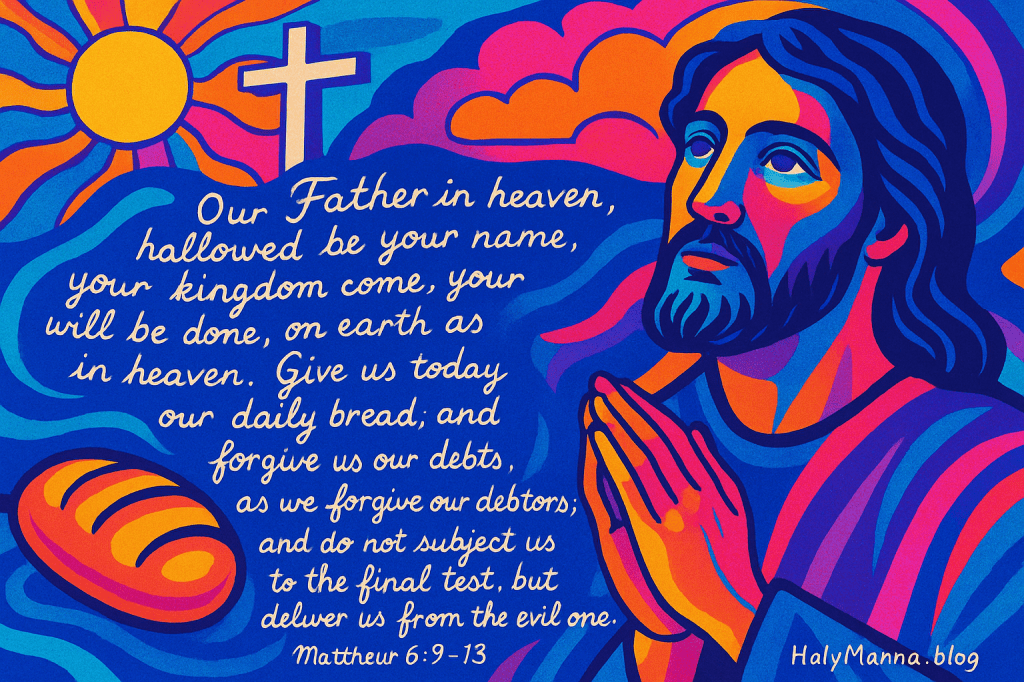
Nestled within the Sermon on the Mount, Matthew 6:7–15 offers one of the most beloved and foundational prayers in all of Christianity: the Our Father. Spoken by Jesus Himself, this passage is more than a formula—it is a revelation. In the cultural setting of the Greco-Roman world, prayer often involved elaborate rituals, long invocations, and public displays meant to impress both gods and men. Pagan prayers were frequently filled with repetition and magical formulas, seeking to control divine power. In sharp contrast, Jesus invites His disciples into a radically personal and trusting relationship with God as Father. For the Jewish audience, this would have been both intimate and awe-inspiring—Abba, a term of familial closeness, was not commonly used for God. This prayer forms the heart of Christian identity: it shapes how we relate to God, how we see ourselves, and how we live with one another. In light of today’s readings, Jesus’ teaching reinforces Paul’s call to sincere and pure devotion, and shows what it looks like in prayer—not loud, performative religion, but humble, trusting conversation with the Father.
Matthew 6:7-15
New American Bible (Revised Edition)
7 In praying, do not babble like the pagans, who think that they will be heard because of their many words. 8 Do not be like them. Your Father knows what you need before you ask him.
The Lord’s Prayer. 9 “This is how you are to pray:
Our Father in heaven,
hallowed be your name,
10 your kingdom come,
your will be done,
on earth as in heaven.
11 Give us today our daily bread;
12 and forgive us our debts,
as we forgive our debtors;
13 and do not subject us to the final test,
but deliver us from the evil one.
14 If you forgive others their transgressions, your heavenly Father will forgive you. 15 But if you do not forgive others, neither will your Father forgive your transgressions.
Detailed Exegesis
Verse 7 – “In praying, do not babble like the pagans, who think that they will be heard because of their many words.”
Jesus warns against prayer that is mechanical and performative. Pagan rituals often relied on endless repetition, believing that divine favor could be manipulated. Christ reveals that true prayer is not about verbosity but about relationship. The warning is not against long prayers, but against empty ones. Prayer must be sincere, not theatrical.
Verse 8 – “Do not be like them. Your Father knows what you need before you ask him.”
This is a profound truth: prayer does not inform God—it conforms us to Him. God is omniscient, but He delights in our approach, not because He needs information, but because He desires communion. This verse mirrors Paul’s concern in 2 Corinthians: truth and sincerity are more important than appearances.
Verse 9 – “This is how you are to pray: Our Father in heaven, hallowed be your name,”
Jesus begins with radical intimacy: Our Father. Not My Father, but Our—we are part of a family. God is both near (Father) and transcendent (in heaven). To hallow His name is to revere it, to treat it as holy. This line calls us to adoration and right orientation: worship begins with recognizing God’s holiness.
Verse 10 – “Your kingdom come, your will be done, on earth as in heaven.”
This is a surrender of control. To pray for God’s kingdom is to pray for the reign of justice, truth, and love in our world and in our hearts. It reflects Paul’s apostolic desire in 2 Corinthians—not to build his own empire, but to be faithful to God’s will. Heaven is the model, earth is the mission.
Verse 11 – “Give us today our daily bread;”
This line is rich with layered meaning. It speaks of physical needs—trusting God daily, like Israel trusted Him for manna. But it also echoes the Eucharist, the Bread of Life. The Greek word epiousios, translated “daily,” appears nowhere else in Scripture—suggesting a mystery beyond mere sustenance. We are called to live dependently, not anxiously.
Verse 12 – “And forgive us our debts, as we forgive our debtors;”
Here, mercy becomes the measure. We cannot ask for what we refuse to give. Forgiveness is the hinge of the Christian life—it keeps the door to grace open. Paul, in 2 Corinthians, lives this forgiveness by not burdening the Church, by loving even when doubted. The Church is to be a community of mutual mercy.
Verse 13 – “And do not subject us to the final test, but deliver us from the evil one.”
This final petition recognizes spiritual warfare. The “final test” refers not just to temptation, but to the great trials that threaten fidelity. Jesus teaches us to pray with vigilance, aware that evil is real and personal. Like Eve in the garden, like the Corinthians with false apostles, we are always vulnerable—but not abandoned.
Verse 14 – “If you forgive others their transgressions, your heavenly Father will forgive you.”
Jesus drives the point home: forgiveness is not optional. It is covenantal. The same mercy we seek must be the mercy we offer. Forgiveness is the sign of a heart truly conformed to Christ.
Verse 15 – “But if you do not forgive others, neither will your Father forgive your transgressions.”
This sobering conclusion echoes the psalmist’s declaration that God’s decrees are “reliable… to be observed with truth and equity.” This is divine justice—not arbitrary, but reflective. God gives what we are willing to receive and extend. Forgiveness is not weakness; it is divine strength made visible.
Teachings
The Catechism of the Catholic Church treasures the Our Father as “the summary of the whole Gospel” (CCC 2761). It states: “It is called ‘the Lord’s Prayer’ because it comes to us from the Lord Jesus, the master and model of our prayer” (CCC 2765). Every line of this prayer reveals our identity as children, our mission as disciples, and our hope as pilgrims toward heaven. In teaching us this prayer, Jesus does not merely give us words—He gives us the structure of Christian life: worship, surrender, dependence, mercy, and vigilance.
St. Cyprian of Carthage wrote in the third century: “What prayer can be more spiritual than the one given to us by Christ, by whom the Holy Spirit has been sent? What truth can be more certain than the one that came from the lips of the Son of God?” (On the Lord’s Prayer). The Church Fathers saw in the Our Father a pattern not only for private devotion, but for liturgy and communal living. This was not just a prayer—it was the new Law of the New Covenant, written not on stone but on hearts.
Forgiveness, especially, has been central to the Church’s teaching. St. John Paul II wrote: “Forgiveness is above all a personal choice, a decision of the heart to go against the natural instinct to pay back evil with evil” (Dives in Misericordia, 14). The Our Father becomes a daily examination of conscience: Am I living what I pray? Am I forgiving as I’ve been forgiven? This prayer is both comfort and challenge—a rhythm of grace and an invitation to conversion.
Reflection
This Gospel reading pierces through our spiritual habits and asks: Are we praying, or just performing? Do we approach God as children, or as beggars trying to earn favor? Jesus teaches us that true prayer is honest, humble, and rooted in relationship. The Father already knows—so we don’t have to impress Him. We only have to come.
Begin today by praying the Our Father slowly, attentively. Let each word speak to your soul. Where is your heart divided? Where are you still clinging to control? Whom do you still need to forgive? This is not just a prayer to recite—it is a way to live. Let it shape your mornings, guide your decisions, soften your judgments, and renew your trust.
In a world filled with noise and spiritual counterfeits, this Gospel reminds us that simplicity is power. To be a child of God is enough. To say “Our Father” with faith is to begin again, every day, in love.
One Voice, One Gospel, One Heart
Today’s readings sing in harmony, drawing us into a deeper understanding of what it means to belong fully to Christ. In 2 Corinthians 11:1–11, St. Paul speaks with the protective fire of divine jealousy, urging us not to trade the true Christ for a counterfeit gospel. His words reveal the heart of a shepherd longing to keep his flock pure, sincere, and unwavering in their devotion. Psalm 111 responds with reverent praise, reminding us that God’s works are not only powerful but just, reliable, and worthy of lifelong study. This deep reflection on God’s faithfulness prepares us for the words of Jesus in Matthew 6:7–15, where we are invited to approach God not with performance or fear, but as beloved children, praying with simplicity and trust.
The unifying thread through these passages is a call to integrity in our relationship with God—a heart undivided, a faith unshaken, and a prayer unpolluted by pride or pretense. Whether through Paul’s impassioned plea, the psalmist’s adoration, or Christ’s own prayer, the Spirit is speaking one message: return to the Father with all your heart. Let your mind be guarded against deceit, your lips filled with reverent praise, and your heart opened in quiet, faithful prayer.
How is God calling you today to return to simplicity? What false images of Jesus have crept into your thinking? Are there places in your life where forgiveness must be extended or received? The Lord is not far—He is your Father, your Bridegroom, your Deliverer. Step away from noise, falsehood, and self-reliance. Come back to the Gospel. Come back to the truth. Come back to the One who knows what you need before you ask and still delights when you do. Pray today with sincerity. Praise today with wonder. Live today with a heart fully His.
Engage with Us!
We’d love to hear how God is speaking to you through today’s readings. Share your thoughts, prayers, and inspirations in the comments below. Whether it’s a personal insight, a favorite verse, or a challenge you’re facing, your reflection might be just what someone else needs to hear today. Let’s grow together in faith, rooted in the Word and united in Christ’s love.
Reflection Questions:
First Reading – 2 Corinthians 11:1–11
What voices or influences in your life tempt you to follow a “different Jesus” than the one revealed in Scripture? How does Paul’s selfless love for the Corinthians inspire you to serve others without seeking recognition? Have you ever confused humility with weakness, either in yourself or others? How can you value the humility of Christ more deeply?
Responsorial Psalm – Psalm 111:1–4, 7–8
When was the last time you paused to truly study the works of the Lord in your life? Do you approach prayer and worship with awe and delight? What might help deepen your reverence? Which of God’s attributes—majesty, justice, mercy—do you most need to dwell on right now?
Holy Gospel – Matthew 6:7–15
Do your prayers reflect a relationship of trust with your Heavenly Father, or do they sometimes feel like performances? Is there someone in your life you need to forgive? How might praying the “Our Father” help you move toward healing? Which line of the Our Father speaks most deeply to your heart today? Why?
May today’s Word take root in your heart and bear fruit in your life. Live with a heart open to truth, a spirit ready to forgive, and a voice that calls on the Father with bold and childlike trust. In all things, may you act with the love and mercy Jesus taught us, walking daily in the light of His grace.
Follow us on Instagram and Facebook for more insights and reflections on living a faith-filled life.

 Holy Manna!
Leave a comment