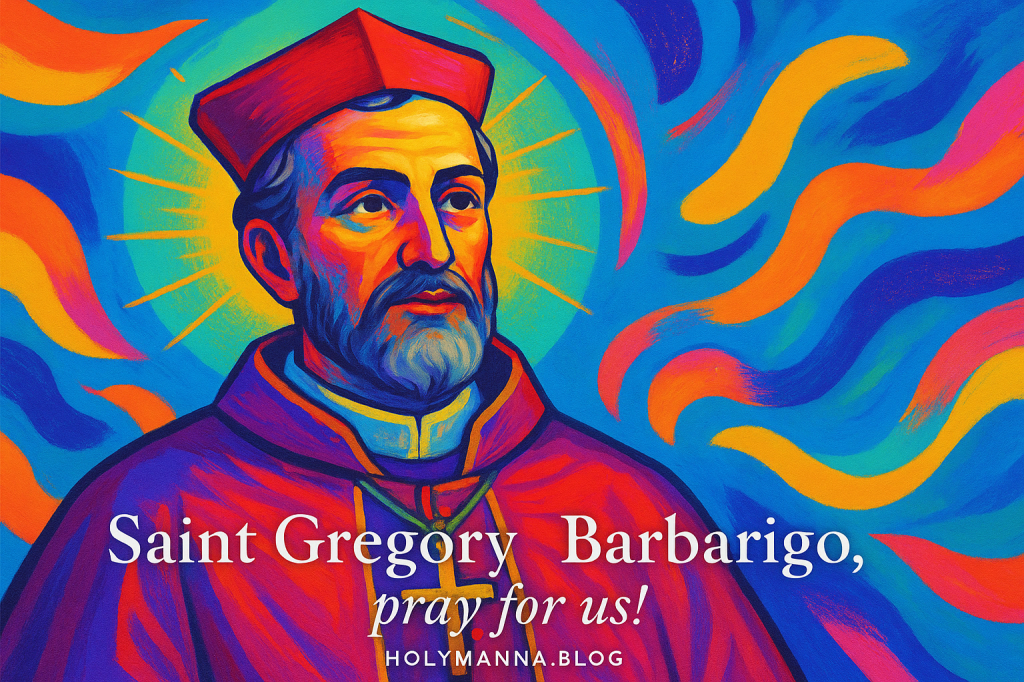
The Cardinal Who Built Bridges of Peace and Learning
Saint Gregory Barbarigo shines as one of the great reformers of the post-Tridentine Church, though his name remains lesser-known compared to other towering figures of Catholic reform. Born into Venetian nobility during a century still reeling from the Protestant Reformation, Barbarigo stepped into the breach with courage, intellect, and profound charity. He was a man of learning who never lost touch with the poor; a cardinal who saw power only as an opportunity to serve. His legacy is one of building bridges—between rich and poor, between tradition and renewal, and between faith and reason. With unwavering fidelity to the teachings of the Church and tireless work for education and ecclesial integrity, he embodied the spirit of a true shepherd. Saint Gregory was canonized in 1960 by Pope Saint John XXIII, who had once been Bishop of Bergamo himself and saw in Gregory a model bishop. In an age that often idolizes fame and fast success, Gregory’s life reminds us that the deepest transformations come quietly, through fidelity, humility, and love.
Nobility of Heart
Gregory Barbarigo was born on September 16, 1625, in the beautiful and bustling city of Venice. The son of a distinguished senator, his family background granted him access to the best education and a life of privilege. Yet even from his youth, Gregory showed a disposition not for extravagance, but for service. He was brilliant, inquisitive, and spiritually inclined. His early education at the University of Padua prepared him in law, philosophy, and natural sciences. He became fluent in multiple languages—Latin, Greek, Hebrew, Syriac—which would later serve him in theological and ecclesial contexts.
What truly set him on the path to sanctity was a providential encounter during the Peace of Westphalia negotiations in 1648. While serving as secretary to the Venetian ambassador, Gregory came under the mentorship of Fabio Chigi, the papal nuncio to Germany. Chigi, impressed by the young man’s character, foresaw great things for him. This relationship would become pivotal when Chigi was elected Pope Alexander VII. But before papal favor would call him to high office, Gregory himself underwent a deep interior transformation. He left diplomatic life behind and discerned a vocation to the priesthood. Ordained in 1655, he quickly became known for his deep piety and intellectual gifts. Only two years later, Pope Alexander VII named him Bishop of Bergamo and shortly after elevated him to the cardinalate. Eventually, he was appointed Bishop of Padua—a role in which he would pour out his life in service to the Church.
What made Gregory most beloved, however, was not his noble lineage or ecclesial titles. It was his heart—his burning desire to care for the people entrusted to him, to uphold orthodoxy, and to lead souls to Christ. He modeled himself after Saint Charles Borromeo, committing himself to the full implementation of the Council of Trent’s reforms, especially in seminary formation, catechesis, and liturgical dignity.
A Life Radiant with Quiet Wonders
Although Saint Gregory Barbarigo is not remembered for performing sensational miracles like levitation or bilocation, his entire life radiated with supernatural charity, the truest of miracles. During plagues and famines that ravaged his dioceses, he became a father to the suffering. Rather than retreat into comfort, he sold personal and family belongings to purchase food and medicine. He personally tended to the sick, organized relief efforts, and visited hospitals. This courageous charity drew people to him, not only in admiration but in conversion of heart.
His episcopal work in Padua became a model for diocesan reform throughout Europe. He founded new seminaries and reinvigorated existing ones. He opened printing presses to disseminate orthodox Catholic teaching and fought heresy not with condemnation but with the light of truth. Libraries were expanded under his guidance, and young men were trained rigorously in Scripture, theology, and virtue. His vision of the priesthood was deeply rooted in The Catechism of the Catholic Church’s teaching that “the ministerial priesthood is at the service of the common priesthood of the faithful” (CCC 1547). Every effort he made was to form holy, wise, and compassionate priests who would serve their flocks well.
He also carried out visitations of parishes in person—despite the challenges of travel and his growing responsibilities as cardinal. These visits became occasions of grace and renewal, as Gregory preached, taught, heard confessions, and encouraged both clergy and lay faithful. In every way, his life was a series of quiet wonders—proof that holiness, lived fully, changes the world.
A Pastor’s Cross
Though Saint Gregory did not shed his blood for the faith, his path was marked with crosses. Leading a diocese in the shadow of the Reformation meant constant vigilance against doctrinal confusion and clerical laxity. Resistance was not uncommon. Reforming priests who had grown comfortable, correcting liturgical abuses, and challenging local powers earned him both admiration and opposition.
He also faced political tensions. As a Venetian and a cardinal loyal to the Holy See, he had to navigate the often complex relationship between the Republic of Venice and the Papacy. This required immense prudence, courage, and trust in God’s providence. Despite these challenges, he never compromised on truth. He endured these trials with serenity and grace, clinging to Christ and offering every hardship as a sacrifice.
Gregory’s own health declined over time, but he continued to serve until his final days. His death on June 18, 1697, marked the end of a life lived entirely for God and His Church. While he did not die a martyr in body, he was certainly a martyr in spirit—a faithful witness who bore the weight of the cross in daily sacrifice.
Heaven’s Whisper
After Saint Gregory’s holy death, a gentle but persistent wave of devotion began to grow. People began visiting his tomb, asking for his intercession. Reports of answered prayers and healings began to circulate—quiet confirmations that his pastoral heart was still at work, now from heaven.
While these posthumous miracles were not widely publicized or dramatic, they were consistent and sincere. Healings, favors, and conversions were attributed to him, especially among the clergy and seminarians who sought to imitate his model of priestly virtue. His relics, venerated in the Cathedral of Padua, continue to draw pilgrims, especially those discerning vocations or involved in Church leadership.
In 1761, Pope Clement XIII beatified him, and his canonization followed nearly two centuries later. Pope John XXIII, himself formed in the Diocese of Bergamo and a great admirer of Gregory, canonized him in 1960. He saw in Gregory not only a holy bishop but also a guiding light for the modern episcopate—someone who understood that intellectual formation, compassion for the poor, and doctrinal integrity must go hand in hand.
Today, Saint Gregory Barbarigo continues to inspire educators, priests, and those in Church leadership to live their vocations with courage and integrity. His legacy reminds us that even after death, the saints remain close to us, interceding for us and guiding us toward holiness.
A Model of Discipleship for the Modern Christian
In Saint Gregory Barbarigo, we find an extraordinary harmony of intellect and compassion, of tradition and reform, of nobility and humility. He is a saint for our times precisely because he lived for others—not to gain recognition, but to glorify God. In an era often driven by ambition and image, Gregory calls us to hidden holiness—to doing good for its own sake, for love of Jesus.
How can we imitate Saint Gregory today? By embracing the responsibilities God places in our lives, no matter how small, and performing them with excellence and love. By deepening our knowledge of the faith through The Catechism, Scripture, and good formation. By serving the poor and marginalized not as projects, but as our brothers and sisters. By choosing to build up the Church, even when it is difficult, even when our efforts go unseen.
Saint Gregory Barbarigo reminds us of what Psalm 34 says: “The LORD is close to the brokenhearted; and those who are crushed in spirit He saves” (Psalm 34:18). He was close to the brokenhearted in his day, and through his example and intercession, he remains close to us today.
Let us then press forward in our own faith journey, seeking not praise but purity of heart, not comfort but charity, not status but sanctity.
Engage with Us!
What inspires you most about the life of Saint Gregory Barbarigo? We’d love to hear your reflections and how his life moves you to deepen your own faith.
Reflection Questions:
- What are some ways I can grow in spiritual and intellectual formation like Saint Gregory?
- How can I be more generous with my time, talent, and treasure toward the poor and suffering?
- In what ways is God calling me to bring unity and peace to divided places in my life?
Let’s support one another in our faith journey and strive to do everything with love, as our Lord Jesus did.
Saint Gregory Barbarigo, pray for us! 🕊️
Follow us on Instagram and Facebook for more insights and reflections on living a faith-filled life.

 Holy Manna!
Leave a comment