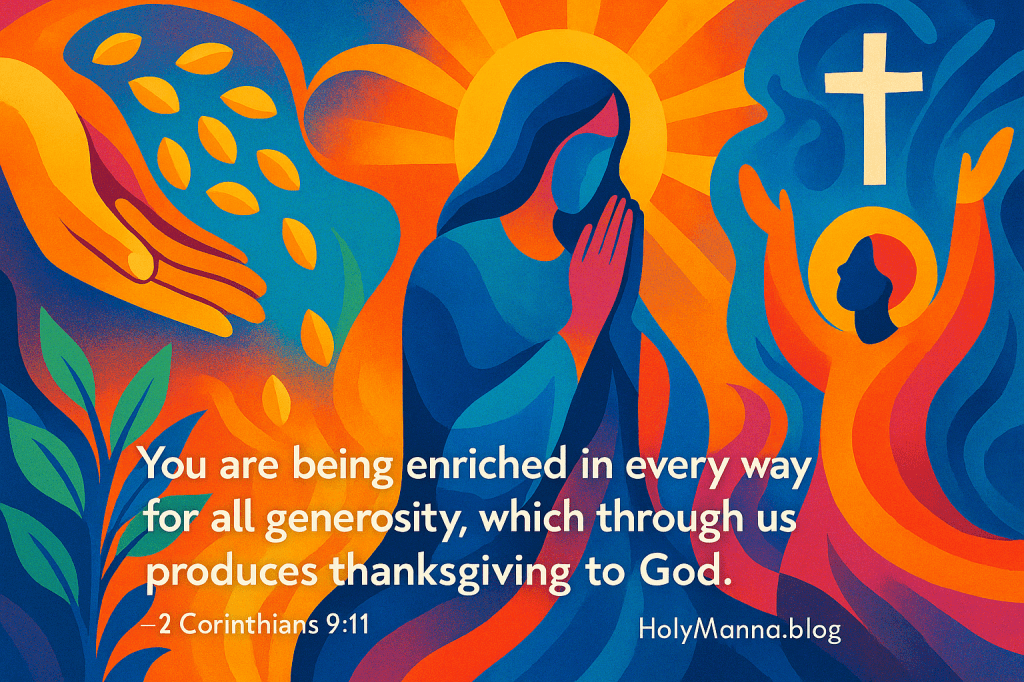
The Secret Power of Generosity and Grace
Have you ever done something good for someone and kept it completely to yourself—no social media, no telling a soul, just a quiet act between you and God? In today’s readings, the Lord draws our hearts to this secret space, where righteousness takes root not in applause but in quiet trust. We are invited into a spirituality that flourishes not in the spotlight but in the hidden places—where giving, praying, and fasting become fertile ground for divine grace. The sacred thread uniting today’s Scriptures is a call to interior authenticity—a life of deep, generous, and unseen righteousness that bears eternal fruit.
In 2 Corinthians 9:6–11, St. Paul speaks to a Christian community learning how to live out their newfound faith. At the time, the Church was still young, scattered, and dependent on the generosity of its members to support the poor and sustain missionary efforts. Paul’s encouragement is deeply rooted in Jewish agricultural imagery: sowing seed, reaping harvest, trusting God to multiply the yield. He frames generosity not as obligation but as opportunity, a participation in God’s own providence. This echoes the wisdom of Psalm 112, a hymn celebrating the just man whose wealth is not measured in coin but in righteousness—“Lavishly he gives to the poor; his righteousness shall endure forever.”
Jesus, in The Gospel of Matthew 6:1–6, 16–18, sharpens the message by warning against external piety. In first-century Jewish society, almsgiving, prayer, and fasting were pillars of religious life—but like today, these could easily become performative. Christ’s teaching is radical: withdraw from the stage, step into the hidden room of the heart, and let the Father who sees in secret reward you. Each reading challenges us to trust that what is done in love and faith—however invisible—will be seen, multiplied, and made holy by God. Are we willing to sow our lives in secret, believing in the hidden harvest to come?
First Reading – 2 Corinthians 9:6–11
Sowing with Heaven in Mind
This passage from 2 Corinthians draws us into the heart of Paul’s teaching on generosity, rooted in the divine economy of grace. Paul is writing to the Christian community in Corinth—a wealthy, culturally diverse port city in Greece—where the Church had struggled with divisions, pride, and wavering commitment. In this section, Paul appeals to the Corinthians’ sense of stewardship, asking them to support the poor in Jerusalem. But he doesn’t use guilt; instead, he offers a vision of generosity that mirrors the very nature of God—abundant, joyful, and life-giving. This exhortation is not just about almsgiving, but about cultivating a way of living that trusts God as the source of all provision. It connects perfectly with today’s theme: hidden holiness that bears great fruit. Paul is not interested in showy giving, but in the interior freedom that allows one to give cheerfully and generously from the heart.
2 Corinthians 9:6-11
New American Bible (Revised Edition)
6 Consider this: whoever sows sparingly will also reap sparingly, and whoever sows bountifully will also reap bountifully. 7 Each must do as already determined, without sadness or compulsion, for God loves a cheerful giver. 8 Moreover, God is able to make every grace abundant for you, so that in all things, always having all you need, you may have an abundance for every good work. 9 As it is written:
“He scatters abroad, he gives to the poor;
his righteousness endures forever.”
10 The one who supplies seed to the sower and bread for food will supply and multiply your seed and increase the harvest of your righteousness.
11 You are being enriched in every way for all generosity, which through us produces thanksgiving to God,
Detailed Exegesis
Verse 6 – “Consider this: whoever sows sparingly will also reap sparingly, and whoever sows bountifully will also reap bountifully.”
Paul introduces a familiar agricultural metaphor—one his audience would understand well. The image of sowing and reaping appears throughout Scripture, including in the teachings of Jesus. This verse illustrates a fundamental principle: divine generosity rewards those who give abundantly. But the reward is not necessarily material—it is spiritual, often hidden, yet deeply transformative.
Verse 7 – “Each must do as already determined, without sadness or compulsion, for God loves a cheerful giver.”
This verse is central to Paul’s theology of giving. Giving must come from an intentional, joyful heart—not out of guilt, obligation, or public pressure. The line “God loves a cheerful giver” echoes Proverbs 22:9, reinforcing that what pleases God most is the disposition of the giver. Authentic generosity begins within.
Verse 8 – “Moreover, God is able to make every grace abundant for you, so that in all things, always having all you need, you may have an abundance for every good work.”
Here Paul shifts the focus from human effort to divine provision. When we give freely, we open ourselves to receive God’s grace in abundance—not to hoard it, but to continue doing good. This reflects the idea that grace is not stagnant but multiplying when joined to a willing heart.
Verse 9 – “As it is written: ‘He scatters abroad, he gives to the poor; his righteousness endures forever.’”
Paul quotes Psalm 112:9, reinforcing the enduring nature of righteousness rooted in generosity. The man of God is not remembered for his possessions but for his righteousness, poured out for others. In giving, we become more like God—lavish in mercy, sowers of divine justice.
Verse 10 – “The one who supplies seed to the sower and bread for food will supply and multiply your seed and increase the harvest of your righteousness.”
This verse deepens the metaphor: God Himself provides both the seed (resources) and the harvest (blessings). Our role is to trust and to sow; God’s role is to increase. The “harvest of your righteousness” refers not to personal success but to the fruits of holiness, justice, and eternal reward.
Verse 11 – “You are being enriched in every way for all generosity, which through us produces thanksgiving to God.”
Paul ends by revealing the communal impact of generosity. When we give, others are moved to praise God. Generosity ripples outward—what starts in secret results in public thanksgiving, not to the giver, but to the Giver of all.
Teachings from the Church
The Catechism of the Catholic Church affirms this divine principle of self-gift: “God blesses those who come to the aid of the poor and rebukes those who turn away from them. ‘Give to him who begs from you, do not refuse him who would borrow from you’; ‘you received without pay, give without pay.’” (CCC 2443). When we give with freedom and joy, we imitate Christ, who gave Himself fully for our salvation—not reluctantly, but with love.
St. John Chrysostom, known as the “Golden-Mouthed” preacher of the early Church, emphasized this in his homilies: “Feeding the hungry is a greater work than raising the dead… When you nourish the body of Christ, you nourish the very One who gave you life.” This teaching reminds us that generosity is not optional for the Christian—it is sacramental, a tangible expression of divine love at work in the world. What seems mundane—donating, offering time, supporting a cause—is actually mystically powerful.
Historically, the early Christians took these teachings to heart. In the face of persecution and poverty, they supported one another materially and spiritually. Their quiet generosity helped the Church grow—not through public displays, but through faithful living. As St. Paul taught, they trusted that every seed of kindness would yield a holy harvest, even when unseen. Today, we are heirs to that same mission—to give, to trust, and to let God transform our small offerings into eternal fruits.
Reflection: Giving in Secret, Trusting in God
In our modern age of curated social media and public virtue-signaling, how often are we tempted to give for recognition instead of for love? Paul invites us to reflect not on how much we give, but why we give. Is it to be noticed, or is it to glorify God? What would it look like for you to give today in a hidden way, with no expectation of return or praise? Perhaps it’s buying groceries for someone anonymously, or giving time to a person who cannot repay you. Perhaps it’s offering prayer or fasting for someone in need without telling them. These hidden seeds, sown in love, are not lost—they are multiplied by the hand of God.
Generosity becomes a path of sanctification when it flows from trust and joy. Are we allowing God to enrich us in “every way for all generosity”? If we find ourselves clinging tightly to our time, money, or energy, perhaps today is the moment to open our hands—to scatter what we have, even just a little, and watch what God does with it. Let us give not for the sake of giving, but because we’ve received a love so abundant it cannot be contained.
Responsorial Psalm – Psalm 112:1–4, 9
The Quiet Legacy of the Righteous
Psalm 112 is a wisdom psalm—a portrait of the just man who lives in awe of the Lord. Written likely after the Babylonian exile, this psalm reflects a post-exilic community longing for stability, blessing, and divine favor. It pairs naturally with Psalm 111, which praises God, while Psalm 112 celebrates those who reflect His righteousness. The two are mirror images: God’s righteousness endures forever, and so does the righteousness of those who imitate Him. In today’s context, the psalm continues and deepens the theme of hidden holiness. It affirms that those who fear the Lord and live with integrity will be blessed not with flashy recognition, but with enduring fruit—especially through their generosity to the poor. This is the legacy of the hidden giver, the faithful soul who mirrors God’s justice through quiet acts of mercy.
Psalm 112:1-4, 9
New American Bible (Revised Edition)
The Blessings of the Just
1 Hallelujah!
Blessed the man who fears the Lord,
who greatly delights in his commands.
2 His descendants shall be mighty in the land,
a generation of the upright will be blessed.
3 Wealth and riches shall be in his house;
his righteousness shall endure forever.
4 Light shines through the darkness for the upright;
gracious, compassionate, and righteous.
9 Lavishly he gives to the poor;
his righteousness shall endure forever;
his horn shall be exalted in honor.
Detailed Exegesis
Verse 1 – “Blessed the man who fears the Lord, who greatly delights in his commands.”
This verse sets the foundation: fear of the Lord is not dread, but reverent awe and love that leads to obedience. The “blessed” man is not defined by worldly success but by his interior delight in God’s law. It recalls Psalm 1, another wisdom psalm, where the just man meditates on God’s law day and night. The psalm reminds us that fearing the Lord and embracing His commands leads to a life of true flourishing.
Verse 2 – “His descendants shall be mighty in the land, a generation of the upright will be blessed.”
Here we see a biblical emphasis on generational blessing. The righteous man’s fidelity to God spills over to his children and community. This is not prosperity gospel—it’s covenantal faithfulness. Obedience and righteousness have ripple effects, and this verse points to the deep truth that holiness is never isolated; it radiates outward across time and relationships.
Verse 3 – “Wealth and riches shall be in his house; his righteousness shall endure forever.”
While this verse mentions material blessing, it is deeply spiritual in context. The “wealth and riches” refer not just to gold, but to the abundance of peace, wisdom, and God’s favor. The true treasure is not temporal but eternal: “his righteousness shall endure forever.” That phrase is repeated from today’s First Reading and again in verse 9, showing that righteousness—right relationship with God and others—is the lasting fruit of a generous life.
Verse 4 – “Light shines through the darkness for the upright; gracious, compassionate, and righteous.”
The righteous man is described with attributes that echo God Himself: graciousness, compassion, and justice. Even in times of darkness—personal or societal—his life shines like a beacon. Jesus echoes this in Matthew 5:16: “Let your light shine before others, that they may see your good deeds and glorify your Father in heaven.” But again, the goal is not self-glory, but divine glory shining through a hidden, faithful life.
Verse 9 – “Lavishly he gives to the poor; his righteousness shall endure forever; his horn shall be exalted in honor.”
This final verse encapsulates the theme: generous giving is a hallmark of righteousness. The word “lavishly” suggests a freedom and abundance in charity—not calculated or stingy, but overflowing. The “horn,” a biblical symbol of strength and dignity, shows that honor comes not through boasting, but through humility and hidden generosity. The one who gives quietly is exalted by God.
Teachings from the Church
The Church has long taught that almsgiving is not simply a moral obligation but a pathway to holiness. As the Catechism teaches: “Those who are oppressed by poverty are the object of a preferential love on the part of the Church which, since her origin and in spite of the failings of many of her members, has not ceased to work for their relief, defense, and liberation through numerous works of charity which remain indispensable always and everywhere.” (CCC 2448). The man described in Psalm 112 embodies this “preferential love” not out of duty, but as a response to God’s own heart.
St. Basil the Great, one of the Cappadocian Fathers, spoke powerfully on this: “The bread which you do not use is the bread of the hungry; the garment hanging in your wardrobe is the garment of him who is naked.” His words echo the spirit of the psalm: the righteous man does not hoard; he shares, because he sees his possessions as entrusted to him for the good of others. This stewardship flows from interior righteousness—a heart conformed to Christ.
The idea that “his righteousness shall endure forever” also appears in the New Testament and in the early Christian understanding of sainthood. The Church venerates the lives of those who lived like the man in Psalm 112: quietly, humbly, often anonymously, but with unwavering love and fidelity to God. Their memory remains not because they were famous, but because their hidden faithfulness bore eternal fruit. Their legacy is holiness, and it is a model for all of us.
Reflection: The Light of Quiet Holiness
What kind of legacy are you building today? Not the one on your resume, but the one in your soul—the one your children, friends, and community will feel long after you’re gone. Are you living a life that radiates light, even in darkness? Are you sowing seeds of righteousness through hidden acts of love and mercy? The world may never see what you do behind closed doors: the prayers, the forgiveness, the generosity, the sacrifices. But God sees. And as Psalm 112 proclaims, those who fear the Lord and give freely will not only shine—they will endure.
Today, consider one hidden act of righteousness you can offer to the Lord: a quiet gift, a silent prayer, a selfless service. Let it be done not for applause, but for love. Let your life be a light in the shadows, a testimony that true holiness is never loud, but always lasting. Will your righteousness endure forever? It can—if you anchor it in love.
Holy Gospel – Matthew 6:1–6, 16–18
Seen by the Father in Secret
The passage from The Gospel of Matthew comes from the heart of Jesus’ Sermon on the Mount—a revolutionary discourse that redefined holiness not by public status or external observance, but by interior transformation. In this teaching, Jesus critiques the performative piety of the Pharisees and hypocrites of His time, who often treated religious acts like a stage show for social honor. In the first-century Jewish world, almsgiving, prayer, and fasting were the three core pillars of a devout life. Yet Jesus exposes how even these sacred practices can be twisted by pride. He redirects our gaze inward, inviting us to live a hidden spirituality rooted in sincere love for the Father. In harmony with today’s theme, Christ calls us to secret holiness—to a life where the deepest acts of faith remain between God and the soul, untouched by the need for applause.
Matthew 6:1-6, 16-18
New American Bible (Revised Edition)
Teaching About Almsgiving. 1 “[But] take care not to perform righteous deeds in order that people may see them; otherwise, you will have no recompense from your heavenly Father. 2 When you give alms, do not blow a trumpet before you, as the hypocrites do in the synagogues and in the streets to win the praise of others. Amen, I say to you, they have received their reward. 3 But when you give alms, do not let your left hand know what your right is doing, 4 so that your almsgiving may be secret. And your Father who sees in secret will repay you.
Teaching About Prayer. 5 “When you pray, do not be like the hypocrites, who love to stand and pray in the synagogues and on street corners so that others may see them. Amen, I say to you, they have received their reward. 6 But when you pray, go to your inner room, close the door, and pray to your Father in secret. And your Father who sees in secret will repay you.
Teaching About Fasting. 16 “When you fast, do not look gloomy like the hypocrites. They neglect their appearance, so that they may appear to others to be fasting. Amen, I say to you, they have received their reward. 17 But when you fast, anoint your head and wash your face, 18 so that you may not appear to others to be fasting, except to your Father who is hidden. And your Father who sees what is hidden will repay you.
Detailed Exegesis
Verse 1 – “[But] take care not to perform righteous deeds in order that people may see them; otherwise, you will have no recompense from your heavenly Father.”
Jesus opens with a warning: not against righteous deeds themselves, but against the motive behind them. The word translated here as “perform” is tied to theatricality—doing something for show. When our good works are done for human recognition, they lose their eternal value. The Father, who sees beyond appearances, withholds heavenly reward when the heart seeks only earthly praise.
Verse 2 – “When you give alms, do not blow a trumpet before you, as the hypocrites do in the synagogues and in the streets to win the praise of others. Amen, I say to you, they have received their reward.”
This image of blowing a trumpet may be metaphorical or refer to the loud collection chests shaped like trumpets at the Temple. Either way, the message is clear: public charity done for status is empty in God’s eyes. Jesus uses the word “hypocrites”—from the Greek hypokritēs, meaning stage-actor—to describe those whose religious deeds are performances. Their reward is the fleeting admiration of people, not the eternal reward of God.
Verse 3 – “But when you give alms, do not let your left hand know what your right is doing.”
Jesus teaches a radical discretion in generosity. The image is poetic and paradoxical—it suggests a level of secrecy so deep that even within ourselves, the act is hidden. True charity flows from a heart so detached from self-interest that it forgets the good it has done. This interior freedom reflects the selfless love of Christ Himself.
Verse 4 – “So that your almsgiving may be secret. And your Father who sees in secret will repay you.”
The reward is not erased; it is transferred. Hidden almsgiving stores treasure not on earth, but in heaven. God’s “repayment” is not transactional but relational—it draws us deeper into communion with Him. This verse teaches us that nothing done in love is ever wasted, even if it goes unnoticed by the world.
Verse 5 – “When you pray, do not be like the hypocrites, who love to stand and pray in the synagogues and on street corners so that others may see them. Amen, I say to you, they have received their reward.”
Jesus continues His warning, this time regarding prayer. Public prayer was common and accepted in Jewish life, but the problem was not location—it was intention. These “hypocrites” used prayer as a means of social performance. Their communion with God was a costume, not a covenant. Once again, the praise of others is their only gain.
Verse 6 – “But when you pray, go to your inner room, close the door, and pray to your Father in secret. And your Father who sees in secret will repay you.”
The “inner room” represents the most private space—both physically and spiritually. Jesus invites us to intimacy, to a one-on-one encounter with the Father. Prayer is not about being heard by others, but about being heard by God. Secrecy in prayer purifies our intentions and strengthens our relationship with the One who alone sees the heart.
Verse 16 – “When you fast, do not look gloomy like the hypocrites. They neglect their appearance, so that they may appear to others to be fasting. Amen, I say to you, they have received their reward.”
Now Jesus addresses fasting, the third spiritual discipline. Once again, the warning is about manipulation—using fasting to gain sympathy or admiration. The word “gloomy” implies a distorted spirituality, one that seeks attention rather than repentance. Such fasting, though outwardly impressive, is spiritually sterile.
Verse 17 – “But when you fast, anoint your head and wash your face.”
Jesus flips the script. Instead of dramatizing our suffering, we should hide it. Anointing and washing were daily grooming habits—He is telling us to go about our lives joyfully, not drawing attention to our sacrifice. True fasting is done not to impress but to grow closer to God.
Verse 18 – “So that you may not appear to others to be fasting, except to your Father who is hidden. And your Father who sees what is hidden will repay you.”
This final verse brings the whole teaching to its climax. God is not just the one who rewards; He is also the One who is hidden. In choosing secrecy, we mirror His hiddenness and align ourselves with His nature. What is done in love, even when invisible, echoes in eternity.
Teachings from the Church
The Catechism of the Catholic Church teaches: “In secret, the disciple meets his Father: he is free from hypocrisy and his prayer is heard. True prayer is a communion of love, a covenant relationship springing from the heart.” (CCC 2609). This echoes Jesus’ command to enter the inner room—to pray not to be seen, but to be united with the Father who knows our hearts. The Church emphasizes that authentic prayer, fasting, and almsgiving are acts of love, not religious theater.
St. Teresa of Ávila wrote powerfully about the “interior castle” of the soul, where the believer meets God in silence and solitude. She insisted: “It is foolish to think that we will enter heaven without entering into ourselves.” This Gospel passage echoes that mystical truth: the path to divine intimacy begins in the quiet, hidden chambers of the heart. By practicing our faith in secret, we open the door to encounter God in His hidden majesty.
In the early Church, especially during times of persecution, Christians often had to practice their faith in secret. The catacombs, house churches, and underground worship became sacred spaces where hidden holiness flourished. This history reminds us that God often builds His Kingdom not in palaces, but in caves; not on stages, but in silence. Jesus’ teaching is not just spiritual—it is practical wisdom for a Church that has always thrived through humility.
Reflection: Practicing the Hidden Life
What drives your spiritual life? Is your prayer rooted in intimacy or performance? Do you give, fast, or serve because you love the Father, or because you want others to admire your virtue? Today’s Gospel urges a return to the heart. It calls us to purify our motives and to rediscover the beauty of a secret life with God—a life that no one else may see, but one that pleases the Father deeply.
You don’t have to announce your fasting, post your charity, or advertise your prayer routine. In fact, Jesus invites you not to. Your soul is His temple; your heart, His throne. What would change if you lived each day for His eyes alone? Choose one act today—a prayer, a sacrifice, a gift—and keep it just between you and God. Let it be your hidden offering, your quiet yes, your private light. Because the Father who sees in secret is already there, waiting. And His reward is Himself.
Living for the Father’s Eyes Alone
Today’s readings invite us into a hidden sanctuary—the sacred interior where true righteousness is formed. From Paul’s stirring exhortation in 2 Corinthians to the poetic praise of the just man in Psalm 112, and finally to Jesus’ piercing words in The Gospel of Matthew, we hear one unifying call: live generously, pray sincerely, fast quietly, and do it all for the Father who sees in secret. The divine economy does not operate on recognition or applause, but on faith, humility, and love poured out without seeking return.
We are reminded that the most powerful acts of holiness are often unseen. The cheerful giver who trusts that God will multiply his offering. The just soul who delights in God’s commands and lets light shine in the darkness. The disciple who enters the inner room of prayer, gives without fanfare, and fasts with joy. All of these reflect the character of our hidden Father—a God who is not impressed by noise, but deeply moved by sincerity. As Jesus said, “your Father who sees what is hidden will repay you.”
So today, live as if His gaze alone matters. What one thing can you do today—just for Him? A silent prayer for someone who hurt you. A generous gift that no one knows about. A small fast, offered in love. These hidden acts are seeds in God’s Kingdom. Trust that they will bear fruit, even if the world never sees. Are you ready to build a life that is sacred in secret? Then enter into the quiet, and let the Father’s love shape your soul. He sees. He knows. He is enough.
Engage with Us!
We’d love to hear how today’s Scriptures spoke to your heart. Share your thoughts, insights, or prayer intentions in the comments below—your witness may be the encouragement someone else needs today. Let’s grow together in faith, humility, and joyful generosity.
Reflection Questions:
First Reading – 2 Corinthians 9:6–11:
What does it mean for you to be a “cheerful giver”? Is there an area of your life where you feel called to give more freely or generously? How have you experienced God multiplying your small offerings in ways you didn’t expect?
Responsorial Psalm – Psalm 112:1–4, 9:
Do you find delight in God’s commandments? How can you reflect His righteousness and compassion more fully in your daily life? What kind of spiritual legacy are you building for those who will come after you?
Holy Gospel – Matthew 6:1–6, 16–18:
Are there ways you might be seeking approval in your spiritual life without realizing it? What does your “inner room” with the Father look like right now? Which of the three practices—almsgiving, prayer, or fasting—do you feel most called to reclaim in a more hidden and intentional way?
Keep sowing seeds of love, even when no one is watching. The Father who sees in secret is forming something beautiful in you. Let us live every moment with faith, and may our hidden acts of love become echoes of Jesus’ mercy in the world.
Follow us on Instagram and Facebook for more insights and reflections on living a faith-filled life.

 Holy Manna!
Leave a comment