The Generosity of God and the Call to Imitate
There’s a kind of love that disarms us—not because it is soft, but because it is strong enough to pour itself out even when it costs everything. Today’s readings invite us to contemplate that kind of love: the kind that gives generously, prays for enemies, and looks upon the poor and oppressed with the eyes of God. This is no ordinary affection or human virtue. It is divine love—agape—a love that chooses the good of the other, even at personal loss. Are we ready to open our hearts to such a radical invitation?
In 2 Corinthians 8, St. Paul lifts up the churches of Macedonia as a powerful example of this Christ-like generosity. They gave beyond their means—not out of obligation, but from overflowing joy and a deep surrender to the Lord. Their generosity, rooted in “the grace of God,” echoes the self-emptying of Christ Himself: “For your sake he became poor although he was rich, so that by his poverty you might become rich” (2 Cor 8:9). This echoes Jesus’ own command in The Gospel of Matthew, where He calls us not just to love those who love us, but to love our enemies. This teaching would have deeply challenged His Jewish audience, accustomed to the lex talionis (the law of retaliation). Instead, Jesus proposes a revolutionary love—one that mirrors the perfection of the Father who “makes his sun rise on the bad and the good” (Mt 5:45).
The Psalm today paints a beautiful image of this divine love in action: God is the defender of the orphan and widow, the liberator of the prisoner, and the one who lifts the lowly (Psalm 146). These acts of justice and mercy are not optional for His children—they are the very measure of our imitation of Him. As Christians, we are not called merely to believe in God’s generosity; we are called to become it. In a world driven by self-interest and division, today’s readings confront us with a transformative question: Do I love the way God loves?
First Reading – 2 Corinthians 8:1–9
The Poverty That Makes Us Rich
Paul’s Second Letter to the Corinthians is deeply pastoral and intimate, reflecting his love for a church he helped establish. Written around A.D. 55–56 during his third missionary journey, Paul addresses not only theological truths but practical concerns, including the collection of aid for the poor in Jerusalem. The early Church was growing in diversity—culturally, socially, and economically—and Paul sought to cultivate unity through shared responsibility. This reading sits in the context of that appeal: he exhorts the Corinthians to give generously, using the Macedonians as an inspiring model. The Macedonian Christians were suffering their own afflictions and poverty, yet they gave joyfully and sacrificially. Today’s passage introduces us to a divine paradox: God’s grace turns scarcity into abundance when offered in love. This message fits perfectly with today’s theme of radical, Christ-like generosity—an outpouring of love that reflects the nature of God Himself.
2 Corinthians 8:1-9
New American Bible (Revised Edition)
Generosity in Giving. 1 We want you to know, brothers, of the grace of God that has been given to the churches of Macedonia, 2 for in a severe test of affliction, the abundance of their joy and their profound poverty overflowed in a wealth of generosity on their part. 3 For according to their means, I can testify, and beyond their means, spontaneously, 4 they begged us insistently for the favor of taking part in the service to the holy ones, 5 and this, not as we expected, but they gave themselves first to the Lord and to us through the will of God, 6 so that we urged Titus that, as he had already begun, he should also complete for you this gracious act also. 7 Now as you excel in every respect, in faith, discourse, knowledge, all earnestness, and in the love we have for you, may you excel in this gracious act also.
8 I say this not by way of command, but to test the genuineness of your love by your concern for others. 9 For you know the gracious act of our Lord Jesus Christ, that for your sake he became poor although he was rich, so that by his poverty you might become rich.
Detailed Exegesis
Verse 1 – “We want you to know, brothers, of the grace of God that has been given to the churches of Macedonia.”
Paul begins by attributing the Macedonians’ generosity to the grace of God, not human effort. He’s reminding the Corinthians that true charity is a divine gift, not merely a natural inclination or a response to guilt. Grace enables supernatural love.
Verse 2 – “For in a severe test of affliction, the abundance of their joy and their profound poverty overflowed in a wealth of generosity on their part.”
Here, Paul sets up the astonishing contrast: affliction and poverty lead to generosity. This defies worldly logic. The Macedonians didn’t give from surplus; they gave from scarcity, fueled by joy in Christ. Their giving reflects what The Catechism describes as the fruit of grace: “The grace of Christ is the gratuitous gift that God makes to us of his own life” (CCC 1999).
Verse 3 – “For according to their means, I can testify, and beyond their means, spontaneously.”
Their giving wasn’t coerced or minimal; it was abundant and voluntary. Paul emphasizes their initiative—an act of love that mirrors divine generosity, echoing Jesus’ teaching that almsgiving should be done in secret, from the heart (cf. Matthew 6:3–4).
Verse 4 – “They begged us insistently for the favor of taking part in the service to the holy ones.”
Rather than seeing generosity as a burden, the Macedonians begged for the privilege to give. Service to the holy ones refers to the Jerusalem collection, seen as a sacred act of communion and solidarity. Their attitude reflects the joy of self-donation.
Verse 5 – “And this, not as we expected, but they gave themselves first to the Lord and to us through the will of God.”
Paul is surprised not only by their generosity but by the order: first to God, then to the mission. Their giving flows from total surrender to the Lord, aligning with Christ’s commandment to love God above all and our neighbor as ourselves (cf. Matthew 22:37–39).
Verse 6 – “So that we urged Titus that, as he had already begun, he should also complete for you this gracious act also.”
Titus, Paul’s co-worker, is encouraged to help the Corinthians match the Macedonians’ zeal. Paul hopes their faith becomes active in works of mercy, aligning their spiritual maturity with tangible action.
Verse 7 – “Now as you excel in every respect, in faith, discourse, knowledge, all earnestness, and in the love we have for you, may you excel in this gracious act also.”
Paul affirms their strengths but challenges them to grow in charity. True discipleship isn’t static. Love—especially shown through sacrificial giving—is the fullest expression of Christian maturity.
Verse 8 – “I say this not by way of command, but to test the genuineness of your love by your concern for others.”
This is not a legalistic requirement, but a loving invitation. Paul knows that love, to be authentic, must be expressed in action. This echoes 1 John 3:18: “Let us love not in word or speech but in deed and truth.”
Verse 9 – “For you know the gracious act of our Lord Jesus Christ, that for your sake he became poor although he was rich, so that by his poverty you might become rich.”
This is the theological heart of the reading. Christ, eternally rich in divinity, embraced the poverty of the Incarnation and the Cross. In doing so, He bestowed upon us the riches of divine life. This verse is a profound summary of the Paschal Mystery.
Teachings from the Church
The Church teaches that almsgiving is not only an act of justice but also one of charity. The Catechism of the Catholic Church explains: “In its various forms—almsgiving, work of mercy, and voluntary self-denial—charity expresses the Eucharistic life. ‘If you knew the gift of God!’” (CCC 1397). Participation in Christ’s sacrifice must manifest in concrete acts of love toward the poor and marginalized.
St. John Chrysostom, known for his fiery homilies on wealth and poverty, preached that the rich exist to serve the poor and that generosity cleanses the soul. He said, “Feeding the hungry is a greater work than raising the dead.” The Macedonians’ giving becomes an early Church witness to this truth: that in serving the poor, we serve Christ Himself (cf. Matthew 25:40).
Historically, this passage has inspired movements of Christian charity throughout the ages—from early monastic almsgiving to modern Catholic Relief Services. In a world still deeply fractured by economic inequality, Paul’s words remain relevant. He is not proposing a transactional economy of salvation, but a spiritual economy of grace: a Church where no one suffers alone because love binds the members together.
Reflection
This reading challenges us to ask: What am I willing to give—even when it hurts? Do we see generosity as a burden, or a privilege? The Macedonians weren’t wealthy, but they gave with hearts on fire. Today, we often wait until we “have more” before giving, yet Scripture calls us to trust God enough to give from what we have now. Whether it’s money, time, attention, or emotional presence—generosity is always an act of faith. How might God be inviting you to imitate Christ’s poverty, that others might experience His richness through you? Pray today for the grace to give yourself first to the Lord, and then let that surrender overflow into radical love for others.
Responsorial Psalm – Psalm 146:2, 5–9
The God Who Lifts the Lowly
Psalm 146 is a hymn of praise from the final section of the Psalter, often referred to as the “Hallelujah Psalms” (Psalms 146–150). These songs are known for their exuberant worship and deep trust in God’s character. Composed after the return from exile, this psalm reflects a mature faith that has known suffering and restoration. It redirects the focus from earthly powers to the Lord, who reigns with justice and mercy. In the midst of political instability and human betrayal, Israel is reminded to place their hope not in princes, but in the eternal God of Jacob. This psalm complements the message of 2 Corinthians 8 and The Gospel of Matthew by painting a portrait of divine generosity and justice. Where human strength fails, God steps in to lift the humble, feed the hungry, and liberate the captive. This is the God we are called to imitate—a God who gives and restores, not for merit, but from overflowing love.
Psalm 146:2, 5-9
New American Bible (Revised Edition)
2 Praise the Lord, my soul;
I will praise the Lord all my life,
sing praise to my God while I live.
5 Blessed the one whose help is the God of Jacob,
whose hope is in the Lord, his God,
6 The maker of heaven and earth,
the seas and all that is in them,
Who keeps faith forever,
7 secures justice for the oppressed,
who gives bread to the hungry.
The Lord sets prisoners free;
8 the Lord gives sight to the blind.
The Lord raises up those who are bowed down;
the Lord loves the righteous.
9 The Lord protects the resident alien,
comes to the aid of the orphan and the widow,
but thwarts the way of the wicked.
Detailed Exegesis
Verse 2 – “Praise the Lord, my soul; I will praise the Lord all my life, sing praise to my God while I live.”
The psalmist begins with a personal call to worship. The repetition emphasizes a life-long commitment to praise. This verse frames the entire psalm in a context of trust: the speaker is declaring allegiance not to human power, but to the eternal faithfulness of God. It’s not just a moment of praise—it’s a way of life.
Verse 5 – “Blessed the one whose help is the God of Jacob, whose hope is in the Lord, his God.”
This beatitude echoes others in the Psalms and in The Gospel of Matthew (cf. Matthew 5:3–12). The blessed person is not the powerful or the wealthy, but the one who trusts in God. “The God of Jacob” highlights covenant faithfulness—God does not forget His promises to His people. This hope is not wishful thinking, but firm reliance on a faithful God.
Verse 6 – “The maker of heaven and earth, the seas and all that is in them, who keeps faith forever.”
This verse draws attention to God’s power as Creator. Unlike mortal leaders who rise and fall, God’s authority is cosmic and eternal. But this Creator is not distant—He “keeps faith forever.” His sovereignty is married to His loyalty, a truth central to Israel’s hope and to the Church’s understanding of God as both all-powerful and all-loving.
Verse 7 – “Secures justice for the oppressed, gives bread to the hungry. The Lord sets prisoners free.”
God’s concern for the vulnerable is central to this verse. These are not just spiritualized metaphors; in the Hebrew worldview, justice was communal and tangible. Feeding the hungry and freeing prisoners are marks of God’s kingdom. This verse prefigures the ministry of Christ, who declares in Luke 4:18 that He has come to fulfill this very prophecy. It is also the foundation of the Church’s social teaching.
Verse 8 – “The Lord gives sight to the blind. The Lord raises up those who are bowed down; the Lord loves the righteous.”
Healing and restoration are signs of God’s active love. Physical healing, such as sight to the blind, symbolizes spiritual awakening as well. God lifts the downtrodden, not merely with consolation, but with dignity. His love for the righteous shows that holiness and justice are always linked in the biblical tradition.
Verse 9 – “The Lord protects the resident alien, comes to the aid of the orphan and the widow, but thwarts the way of the wicked.”
Aliens, orphans, and widows represent society’s most vulnerable. God’s preferential love for them is a recurring theme throughout Scripture. His justice is not blind—it is actively protective. While the wicked may flourish for a time, their path will ultimately be blocked. This verse calls both Israel and the Church to imitate God’s compassion with action.
Teachings from the Church
The Catechism reminds us that our trust belongs to God alone: “It is right and just to entrust oneself wholly to God and to believe absolutely what he says” (CCC 150). This echoes the psalmist’s declaration that blessed are those whose help is the Lord. Trust is not passive resignation but the active surrender of our hearts to a faithful and just God. True faith expresses itself not only in worship but in living as God’s hands in the world—feeding, freeing, and lifting.
This psalm also resonates with CCC 2447, which defines the corporal works of mercy: “The works of mercy are charitable actions by which we come to the aid of our neighbor in his spiritual and bodily necessities.” Feeding the hungry, visiting prisoners, and caring for the sick are not optional extras—they are the actions of those who praise the Lord with their lives. The God of Psalm 146 is the blueprint for Christian discipleship.
St. Teresa of Calcutta once said, “If we have no peace, it is because we have forgotten that we belong to each other.” Her whole life was a living response to this psalm. In seeing Christ in the poorest of the poor, she embodied the justice and compassion of God. Likewise, the early Church Fathers understood praise not as mere words but as a life aligned with divine mercy. Our worship becomes authentic when it reflects God’s love for the least among us.
Reflection
Do I trust in God more than in myself or others? Psalm 146 invites us to take inventory of where our hope truly lies. In a world that celebrates self-sufficiency and power, this psalm lifts up dependence on the Lord as the greatest strength. It also asks us to imitate the God we praise. How am I serving the hungry, the lonely, the imprisoned, or the grieving in my daily life? Whether it’s donating, volunteering, or simply offering time and love to someone in need, we are called to manifest God’s justice. Let this psalm stir not only your lips to sing, but your hands to serve and your heart to hope.
Holy Gospel – Matthew 5:43–48
The Divine Standard of Love
This passage is part of the Sermon on the Mount, one of the most radical and beloved teachings of Jesus found in The Gospel of Matthew. Spoken to a Jewish audience steeped in the Law of Moses, Jesus delivers not a rejection of the law, but its divine fulfillment. His words here come after several “antitheses” where He contrasts what was taught with what He now reveals: the law said one thing, but Christ, the divine lawgiver, reveals the heart of God. In a culture where the lex talionis (“eye for an eye”) guided justice, and kinship defined moral responsibility, Jesus’ command to love one’s enemies would have sounded both shocking and impossible. Yet it is this very call that ties today’s readings together: the call to love as God loves—freely, universally, sacrificially. Jesus challenges not just behavior, but the heart, and in doing so, He raises the standard of holiness to nothing less than divine perfection.
Matthew 5:43-48
New American Bible (Revised Edition)
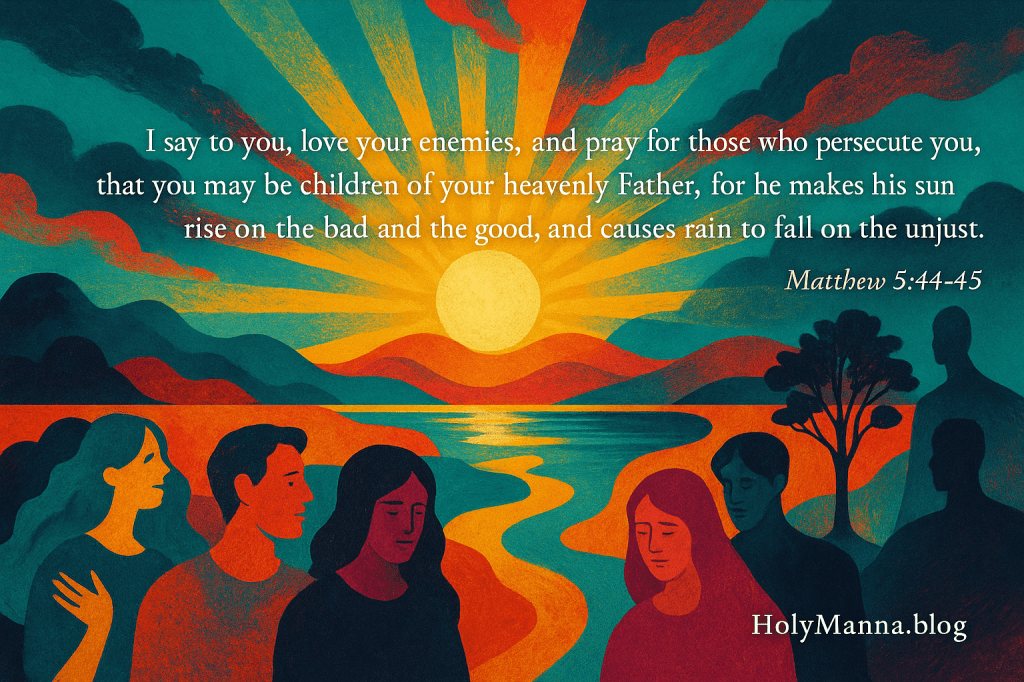
43 “You have heard that it was said, ‘You shall love your neighbor and hate your enemy.’ 44 But I say to you, love your enemies, and pray for those who persecute you, 45 that you may be children of your heavenly Father, for he makes his sun rise on the bad and the good, and causes rain to fall on the just and the unjust. 46 For if you love those who love you, what recompense will you have? Do not the tax collectors do the same? 47 And if you greet your brothers only, what is unusual about that? Do not the pagans do the same? 48 So be perfect, just as your heavenly Father is perfect.
Detailed Exegesis
Verse 43 – “You have heard that it was said, ‘You shall love your neighbor and hate your enemy.’”
The first part of this statement, “love your neighbor,” comes directly from Leviticus 19:18. However, the second part, “hate your enemy,” was never written in the Law. It was a common interpretation or oral tradition, reflecting how people lived under Roman occupation and in a culture of religious tribalism. Jesus confronts this cultural attitude head-on.
Verse 44 – “But I say to you, love your enemies, and pray for those who persecute you.”
Here is the radical heart of Jesus’ message. Love is not limited to those who love us. True Christian love is active goodwill toward those who harm us. To pray for enemies is to entrust them to God, to intercede for their good, and to free our hearts from bitterness. This teaching prepares His disciples for persecution and mirrors Jesus’ own prayer on the Cross: “Father, forgive them” (Luke 23:34).
Verse 45 – “That you may be children of your heavenly Father, for he makes his sun rise on the bad and the good, and causes rain to fall on the just and the unjust.”
To love universally is to act as God acts. This agricultural image shows God’s impartial generosity—sun and rain are blessings given to all, regardless of merit. When we love in this way, we don’t just imitate God—we participate in His nature as His children.
Verse 46 – “For if you love those who love you, what recompense will you have? Do not the tax collectors do the same?”
Jesus points to the tax collectors, widely despised by the Jews for collaborating with Rome and exploiting their own people. Even they love those who love them. This verse exposes how natural, transactional love is unremarkable in the kingdom of heaven.
Verse 47 – “And if you greet your brothers only, what is unusual about that? Do not the pagans do the same?”
A greeting in ancient cultures signified respect and goodwill. Jesus points out that even the godless, or Gentiles (ethnoi), are capable of basic kindness. The Kingdom of God demands something more: supernatural love that reflects the heart of the Father.
Verse 48 – “So be perfect, just as your heavenly Father is perfect.”
This verse is the culmination of the passage. “Perfect” (teleios in Greek) does not mean without flaw, but complete, mature, fulfilled. We are called to grow into the fullness of love. God’s perfection is His mercy and boundless charity—and that is our model. This verse also prepares the ground for deeper teachings about sanctity and spiritual maturity that will be echoed in the rest of the New Testament.
Teachings from the Church
The Catechism speaks directly to this Gospel when it teaches: “Jesus has not abolished the law but fulfilled it by giving its ultimate interpretation in the divine law of love: ‘You have heard that it was said to the men of old… But I say to you…’” (CCC 1972). The New Law, or Law of the Gospel, is centered not on rules, but on grace-filled transformation through love. It is expressed especially in the Sermon on the Mount.
St. Thomas Aquinas, in his Summa Theologiae, reflects on this perfection and teaches that charity is the form of all virtue. He explains: “Now the end of the commandment is charity” (1 Timothy 1:5), showing that perfection lies in loving God and neighbor—even when it is most difficult. To love an enemy is the clearest test of whether charity is divine or merely human.
The saints have lived this Gospel in astounding ways. St. Maria Goretti forgave her attacker before dying. St. John Paul II visited and forgave the man who tried to assassinate him. These are not myths—they are the fruits of grace in hearts conformed to Christ. Forgiveness and enemy-love are not easy, but they are possible when we live by the Spirit. As CCC 2844 teaches, “Christian prayer extends to the forgiveness of enemies, transfiguring the disciple by configuring him to his Master.”
Reflection
Who is your enemy today—someone who has wounded you, angered you, or turned their back on you? This Gospel doesn’t deny the pain others cause us. But it does call us to a different kind of response. Love doesn’t mean ignoring justice or pretending evil didn’t happen. It means choosing to act from God’s heart rather than our wounds. How might you begin to pray for your enemies this week? Start with the Cross. Recall Jesus’ words in your own moment of suffering. Love like that is what makes Christians salt and light in the world. May we dare to be perfect—not by our own strength, but by growing in the perfection of mercy, which is the heart of our heavenly Father.
Love Without Limits
Today’s readings illuminate the breathtaking depth of Christian love—one that goes beyond obligation, beyond comfort, even beyond fairness. In 2 Corinthians 8, we witnessed the Macedonians who, though afflicted and poor, gave with overflowing joy. They gave not only their resources, but first gave themselves to the Lord. In Psalm 146, we praised the God who feeds the hungry, lifts the lowly, and protects the vulnerable—a God whose justice flows from mercy. And in The Gospel of Matthew, Jesus set before us the highest standard: “Love your enemies… be perfect, just as your heavenly Father is perfect.”
All three readings teach us that divine love is not reserved for the saints in stained glass—it is our calling, our inheritance, and our mission. God doesn’t ask for what we do not have. He asks that we give what we do have—generously, courageously, and with hearts fixed on Him. This love is not transactional. It’s transformational. It makes us more like Jesus, who “became poor although he was rich, so that by his poverty you might become rich” (2 Cor 8:9).
What would your life look like if you truly loved like this? Who in your world needs generosity, mercy, or even your prayer for their conversion? The invitation is simple and bold: live today as a child of the Father. Let your love be extravagant, your forgiveness sincere, your mercy unbounded. Because when we love without limits, we become the living image of the God who loved us first.
Engage with Us!
We’d love to hear how God is speaking to your heart through today’s readings. Share your reflections, struggles, and insights in the comments below—your journey may inspire someone else who needs encouragement today. Let’s grow together as a community rooted in Christ’s love and mercy.
Reflection Questions:
First Reading – 2 Corinthians 8:1–9
How does the example of the Macedonians challenge your understanding of generosity? Have you ever experienced joy through sacrificial giving? What might it look like for you to “give yourself first to the Lord” in your daily life?
Responsorial Psalm – Psalm 146:2, 5–9
Where do you place your trust—more in people, circumstances, or in God? Which of the Lord’s actions in this psalm (feeding the hungry, lifting the lowly, protecting the orphan) resonates most with your life right now? How can you reflect God’s justice and compassion in a concrete way this week?
Holy Gospel – Matthew 5:43–48
Who is God inviting you to love or forgive that feels difficult or undeserved? What steps can you take to begin praying for someone who has hurt you? How are you being called to grow in the perfection of love—not by being flawless, but by being merciful as the Father is merciful?
May the grace of God empower you today to love more boldly, give more freely, and forgive more deeply. Let every act, no matter how small, be done with the love and mercy Jesus taught us—because that is how the world will come to know Him through you. Keep going. You are not alone. You are being perfected in love.
Follow us on Instagram and Facebook for more insights and reflections on living a faith-filled life.

 Holy Manna!
Leave a comment