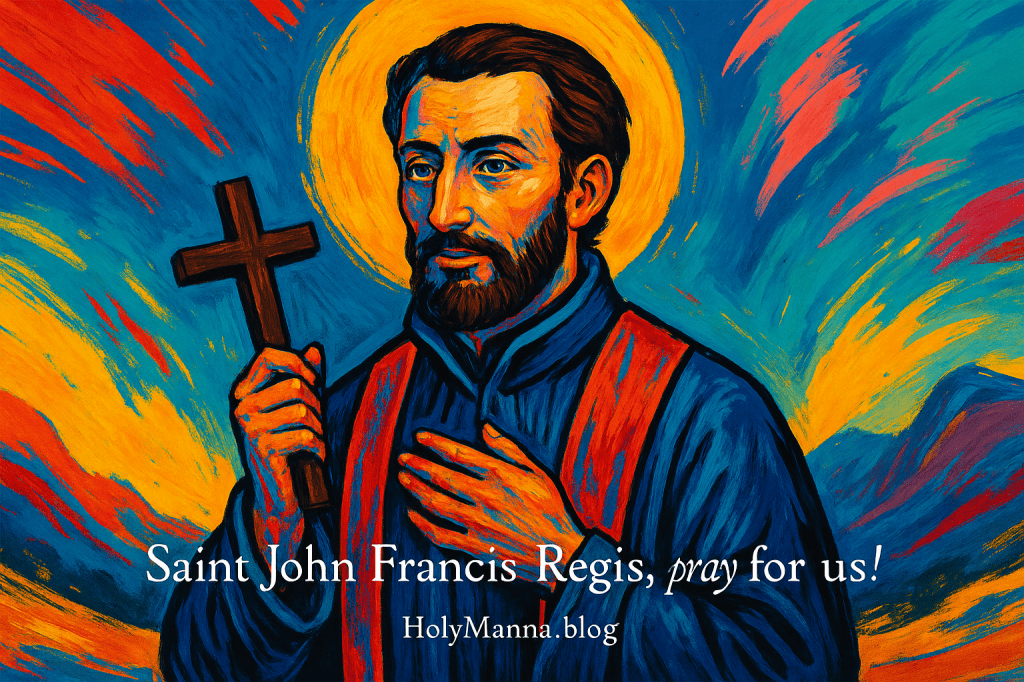
The Apostle of the Poor and Forgotten
Saint John Francis Regis, S.J. (1597–1640), is one of the Catholic Church’s shining examples of what it means to live the Gospel in both word and action. A French Jesuit priest with a heart that burned for the salvation of souls, he devoted his short but powerful priestly life to ministering to the spiritually and materially impoverished. Regis is remembered as a fearless missionary who walked hundreds of miles through rugged terrain to bring the sacraments to the forgotten, to preach repentance to lukewarm Catholics, and to offer refuge and dignity to women trapped in prostitution. What makes him particularly beloved is not only his eloquent preaching or organizational brilliance, but his tender compassion and relentless perseverance in the face of adversity. Though he lived only 43 years, his impact echoes through centuries, especially in southern France where many still walk in his missionary footsteps. His feast day, celebrated on June 16, invites us to reflect on the power of grace when it’s lived out with fiery love and unwavering fidelity to Christ.
A Jesuit’s Journey Begins
Born on January 31, 1597, in the picturesque village of Fontcouverte in the Languedoc region of southern France, John Francis Regis came into a world still reeling from the effects of the Protestant Reformation and Catholic Counter-Reformation. His father, Jean Régis, was a wealthy merchant, and his mother, Marguerite de Cugunhan, raised him in a devout Catholic household. From a young age, John showed signs of piety and sensitivity to the needs of the poor. His childhood was marked by a love for prayer, purity of heart, and a strong desire to belong wholly to God. He joined the Jesuits at age 18, drawn by the Society of Jesus’s zeal for education, missionary work, and spiritual discipline.
His interior conversion, however, deepened as he advanced in his formation. Through the Spiritual Exercises of Saint Ignatius of Loyola, Regis developed a strong desire to become not just a good man, but a holy one—a living instrument of God’s mercy. After years of intense study and spiritual formation, he was ordained a priest in 1630 and immediately assigned to the home missions in France. Unlike many missionaries who sailed to far-off lands, Regis understood that the spiritual poverty in post-Reformation France was equally in need of urgent care. Especially in rural areas, many Catholics had abandoned the sacraments or adopted heretical ideas. Regis began preaching missions to bring them back to the faith with burning love and boldness.
His days were filled with preaching, catechizing, hearing confessions for hours on end, and organizing communities to better care for the vulnerable. What he is most known for, however, is his fearless outreach to women engaged in prostitution. Instead of condemning them, he offered them love, shelter, and a way out. He helped establish safe houses and taught them trades so they could begin new lives rooted in dignity and grace. Regis was not a man of comfortable conversions—he was a man who went to the peripheries before it became a popular slogan.
The Miraculous Touch of Saint Regis
While Saint John Francis Regis never sought recognition for supernatural gifts, the Lord worked through him in ways that clearly testified to the presence of divine favor. One of the most remarkable manifestations of this was his uncanny ability to pierce the hearts of sinners. Many who came to hear him preach or who simply encountered him in the streets found themselves weeping with contrition. People spoke of feeling convicted and comforted at the same time, a grace that can only come from the Holy Spirit working through a soul in deep union with God. It was as if Regis saw into their hearts, uncovering hidden sins not to shame but to heal.
In the confessional, he had the gift of reading souls. Penitents would later confess that he knew details of their lives they had never spoken aloud. But rather than being frightened, they felt embraced by the mercy of Christ. It was as though Jesus Himself, the Good Shepherd, had spoken to them through Regis.
There are also stories of physical miracles during his missions. In one instance, when food was running low for the large crowds that came to hear him preach, he prayed over the provisions, and they were miraculously multiplied. In another account, he is said to have cured a sick child during one of his missions by making the Sign of the Cross and invoking the name of Jesus. Yet Regis never drew attention to these events. To him, they were not wonders to be marveled at, but moments to give glory to God and bring souls to repentance and healing.
The Crosses of a Missionary Heart
The life of Saint John Francis Regis was not marked by glamour or worldly praise, but by suffering, opposition, and fatigue. His missionary journeys took him through some of the harshest terrain in France—snow-covered mountains, muddy back roads, and isolated villages. He often traveled on foot, poorly clothed and with little food. His body suffered constant aches, and he endured extreme weather conditions, sometimes collapsing from cold or exhaustion. Yet he never once complained.
But his physical suffering was only half the story. Regis also endured ridicule and opposition from within the Church and among local authorities. His uncompromising call to conversion upset those who were comfortable in sin, and his defense of the poor and outcast made powerful people uncomfortable. Certain clergy, jealous or embarrassed by his success, accused him of fanaticism and reported him to superiors. Despite this, he remained obedient, humble, and silent in the face of slander. He trusted entirely in God’s justice and continued his work without bitterness.
His final days were perhaps the most poignant testimony to his missionary zeal. In December 1640, he learned of a village in the mountains that had not yet received the sacraments that Advent. Despite a severe snowstorm and his own illness, he insisted on making the journey. He was burning with fever when he arrived but still preached the Gospel and heard confessions. Shortly after completing his mission, he collapsed and died in a nearby hut, whispering “Into Thy hands, I commend my spirit.” He was only 43, but he had poured out every ounce of himself for the Kingdom of God.
Miracles That Flow from Heaven
The miracles did not end with his death. In the years following his passing, countless healings and spiritual conversions were attributed to his intercession. Pilgrims traveled from all over France to visit his tomb in Lalouvesc, and many returned healed in body and soul. The faithful began praying novenas to him, invoking his aid in moments of distress, and asking for the same zeal he had shown in his earthly life.
Stories began to spread of incurable diseases being cured, barren women conceiving children, and hardened sinners returning to the faith after calling upon his name. His shrine at Lalouvesc became a beacon of hope, and to this day, it continues to draw thousands who seek the healing and courage he once offered the poor in person.
His relics, venerated throughout France, have become instruments of consolation and conversion. In 1737, Pope Clement XII canonized him, declaring officially what the people of France had long known: this man was a saint, a friend of God, and a protector of the poor. The Church holds him up as a model of pastoral charity, reminding us that holiness is not reserved for cloisters or courts, but flourishes in muddy streets, freezing mountains, and broken hearts.
The Saint Who Walks Beside Us
What does the life of Saint John Francis Regis mean for us today? It’s a challenge—a gentle but unrelenting challenge to live our faith with action, courage, and deep compassion. Regis did not wait for the world to be convenient or for conditions to be favorable. He walked into danger, into poverty, into misunderstanding because he was convinced that Christ lived in the hungry, the prostitute, the sinner, and the suffering.
He reminds us that being Catholic is not simply about attending Mass or following rules. It is about burning with the love of Christ so brightly that we cannot help but seek out the lost and bring them home. His life echoes the call of Matthew 25—“Whatever you did for the least of these, you did for Me.”
As the Catechism of the Catholic Church beautifully puts it, “Charity is the soul of the holiness to which all are called: it governs, shapes, and perfects all the means of sanctification” (CCC 826). Saint Regis lived this charity to the end, not just in moments of glory, but in the hidden, messy, exhausting labor of love. He also shows us that holiness is not about being perfect—it’s about being faithful.
How can we begin to imitate his example today? What is one concrete way we can serve those on the margins? Are we willing to step out in faith, even when it’s uncomfortable or misunderstood?
Let Saint John Francis Regis walk beside you today. Let his courage become your courage. Let his love become your love. Let his fire light your path to heaven.
Engage with Us!
Let’s carry the fire of Saint John Francis Regis into our daily lives. How can we better serve those most in need today? Where can we be bold in our proclamation of the Gospel? How can we unite our prayer life with compassionate action?
Here are three questions to reflect on:
- Where is God calling me to serve “the forgotten” in my community?
- What comforts or fears might be holding me back from boldly living the Gospel?
- How can I make prayer the foundation of my mission, as Saint John Francis Regis did?
Let’s support each other in our walk with Christ and strive, like Regis, to do all things with love.
Saint John Francis Regis, pray for us! 📿
Follow us on Instagram and Facebook for more insights and reflections on living a faith-filled life.

 Holy Manna!
Leave a comment