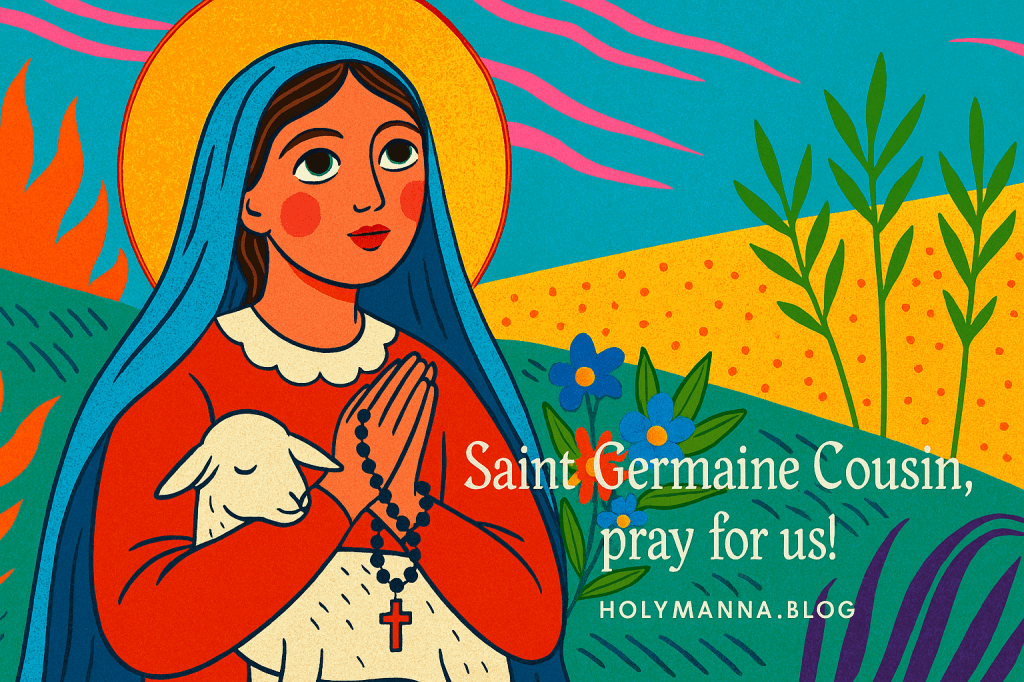
The Hidden Flower of Pibrac
In the grand garden of the Church’s saints, some bloom like majestic roses, their lives filled with visible miracles, eloquent preaching, or martyr’s blood. But there are others—hidden violets, delicate and fragrant—whose sanctity lies in their simplicity, silence, and steadfast love. Saint Germaine Cousin was one such flower, a poor and deformed shepherdess from the village of Pibrac, France, who lived a life of quiet suffering and radiant faith. Born into poverty, scorned by her family, and largely ignored by society, Germaine became a living icon of the Beatitudes. Her unwavering devotion to God, her tenderness toward all creatures, and her capacity to forgive those who mistreated her earned her a place among the great saints of the Church. Today, she stands as a heavenly patron for the abused, the disabled, the poor, and anyone who suffers in silence. Her story reminds us that God sees what the world overlooks and that “the last will be first, and the first will be last” (The Gospel of Matthew 20:16).
The Shepherdess of Sorrows
Germaine’s life began in hardship. Born in 1579 in the village of Pibrac, near Toulouse, she came into the world already marked by suffering. Her mother died shortly after her birth, and her father, a farmer named Laurent Cousin, soon remarried. His new wife, however, harbored no maternal love for Germaine. Viewing her as a burden—both due to her deformed right hand and the scrofula that afflicted her neck—Germaine’s stepmother treated her with cruelty and disdain. She was banished from the house and made to sleep in the stable or under the stairs, fed on scraps, and dressed in rags. She received no formal education, no warmth from her family, and no kindness from her peers.
Yet it was in this environment of desolation that the light of her faith burned brightest. From her earliest years, Germaine displayed a deep love for God. She prayed constantly, attended Mass daily whenever she could, and showed special devotion to the Blessed Virgin Mary. There was no dramatic conversion in her story—no moment of falling and rising again—because she seemed to live in grace from the beginning. Her life was a testimony to “Blessed are the poor in spirit, for theirs is the kingdom of heaven” (The Gospel of Matthew 5:3). Tending sheep in the fields became her sanctuary of prayer. Though she was scorned and insulted, she never responded with bitterness. Instead, she radiated peace, charity, and forgiveness, offering her sufferings to God in the silence of her soul.
Germaine became known in her village not for strength, intelligence, or beauty, but for holiness. Her life was hidden, like the life of Christ in Nazareth, yet profoundly fruitful. She is remembered not for sermons or visions but for how she endured cruelty with love, how she offered her work and wounds to God, and how she found heaven in the midst of rejection.
Heaven in Her Apron
Even during her lifetime, heaven revealed signs of its special favor toward Germaine. These miracles were never sought by her, nor did she speak of them as proof of her holiness. They flowed naturally from a life immersed in prayer, faith, and trust in divine providence.
One of the most beloved miracles associated with her occurred on a cold winter’s day. Her stepmother, suspicious and cruel, accused Germaine of hiding stolen bread in her apron. Demanding she open it before witnesses, the woman prepared to punish her. But when Germaine unfolded her apron, fresh summer flowers—impossible in the dead of winter—spilled to the ground. This stunning display of God’s protection mirrored the miracle of Saint Elizabeth of Hungary and served as a divine rebuke to the harsh judgment Germaine suffered. It also served as a revelation: “Nothing is hidden that will not be made manifest” (The Gospel of Luke 8:17).
Another extraordinary occurrence was the unexplainable safety of her sheep. Germaine never neglected her spiritual duties to protect her flock. She would leave them unattended in the fields to attend daily Mass, entrusting them to God. Strangely, no harm ever came to them. Despite wolves and other dangers, not a single sheep was lost. Villagers who mocked her piety began to take notice of these signs and slowly came to see her with awe and reverence.
There were also smaller, subtler miracles—the way she seemed to know people’s hearts, how her presence brought peace to the anxious, how even wild animals appeared to trust her. Germaine was a child of nature and of grace, and the miracles of her life flowed as naturally as the waters of a spring. They were not spectacles but sacraments of her inner purity and her communion with heaven.
Crushed but Not Broken
Germaine’s life was a long martyrdom without blood. She bore physical pain, social rejection, and emotional neglect with heroic patience. Her disfigurement and illness made her an object of ridicule. Her stepmother heaped verbal abuse and forced labor upon her. Her father, though not cruel, remained largely passive and failed to intervene. Even the villagers of Pibrac, at first, saw her as a pitiful outcast.
She was made to sleep in a barn, often went barefoot in the winter cold, and wore clothing that barely protected her from the elements. She had no books, no formal instruction, and no earthly comforts. And yet, she possessed a serenity that surpassed understanding. She forgave her tormentors, prayed for them, and never complained. Her silence was not the silence of submission but the silence of trust. She embodied “He was oppressed and he was afflicted, yet he opened not his mouth” (Isaiah 53:7).
Though not a martyr in the traditional sense, Germaine’s daily suffering was redemptive. Her life was an altar on which her body and heart were offered to God. She had opportunities to escape her situation—her father once invited her back into the home—but she gently refused, saying she was content with how things were. In this, she reflected the humility of Christ, who “though He was in the form of God… emptied Himself, taking the form of a servant” (Philippians 2:6–7).
Her death came quietly and without fanfare. One morning in 1601, she was found lifeless on her straw pallet in the barn. She was 22 years old. In her hand was her Rosary; on her face, a look of peace.
The Unfading Bloom
If Germaine’s life was hidden, her glory after death could not be concealed. Forty-three years after her passing, her body was exhumed during church renovations. To the astonishment of all present, it was found to be incorrupt—her body flexible and preserved, her face still bearing the gentleness for which she had been known. It was a visible confirmation of God’s favor and a testament to her sanctity.
From that moment on, miracles flowed abundantly through her intercession. Pilgrims began arriving in Pibrac, seeking healing and consolation. One of the most striking healings involved a young child who had been born blind. After his parents prayed at Germaine’s tomb, the child regained his sight. Others claimed deliverance from illnesses, protection from plagues, and conversion of heart.
During times of great turmoil, including epidemics and war, the faithful of Pibrac would turn to Saint Germaine. Her shrine became a place of refuge and hope, and many recorded instances of divine intervention were attributed to her prayers. The memory of her purity and gentleness began to spread far beyond her village.
Eventually, her cause for canonization was introduced, and after careful investigation and recognition of miracles, Pope Pius IX canonized her on June 29, 1867. Today, her relics are venerated in the Church of Saint Germaine in Pibrac, and her story continues to inspire the lowly and suffering throughout the world.
A Saint for the Forgotten
The life of Saint Germaine Cousin is a luminous paradox. She was unloved on earth, yet beloved in heaven. She was uneducated, yet deeply wise. She was physically weak, yet spiritually invincible. Her example challenges us in an age obsessed with status, appearance, and success. She reminds us that God often chooses the small, the hidden, the wounded, and the forgotten to accomplish His greatest works.
Her story invites us to examine how we treat the poor, the disabled, and the marginalized. Do we recognize Christ in them? Do we show compassion, or do we look away? Germaine teaches us to embrace suffering as a means of union with Christ and to offer even our smallest sorrows as gifts of love.
The Catechism of the Catholic Church states, “By his passion and death on the cross Christ has given a new meaning to suffering: it can henceforth configure us to him and unite us with his redemptive Passion” (CCC 1505). Germaine lived this truth daily. She invites us to do the same—not with heroic feats, but with daily acts of trust, prayer, and quiet perseverance.
Her presence calls out to anyone who feels unloved, abandoned, or overlooked: You are seen. You are loved. You are precious in the eyes of God.
Engage with Us!
Have you ever felt overlooked, misunderstood, or unappreciated? Saint Germaine Cousin walks with you.
Let’s reflect together:
- How can I better trust God when I feel abandoned or rejected by others?
- In what ways can I practice charity, even toward those who mistreat or ignore me?
- What small, daily sacrifices can I offer with love, as Saint Germaine did with her suffering?
We’d love to hear your thoughts in the comments! Let’s encourage one another to persevere in faith, walk in humility, and—like Saint Germaine—do everything with love, just as our Lord Jesus did.
Saint Germaine Cousin, pray for us! 🌸
Follow us on Instagram and Facebook for more insights and reflections on living a faith-filled life.

 Holy Manna!
Leave a comment