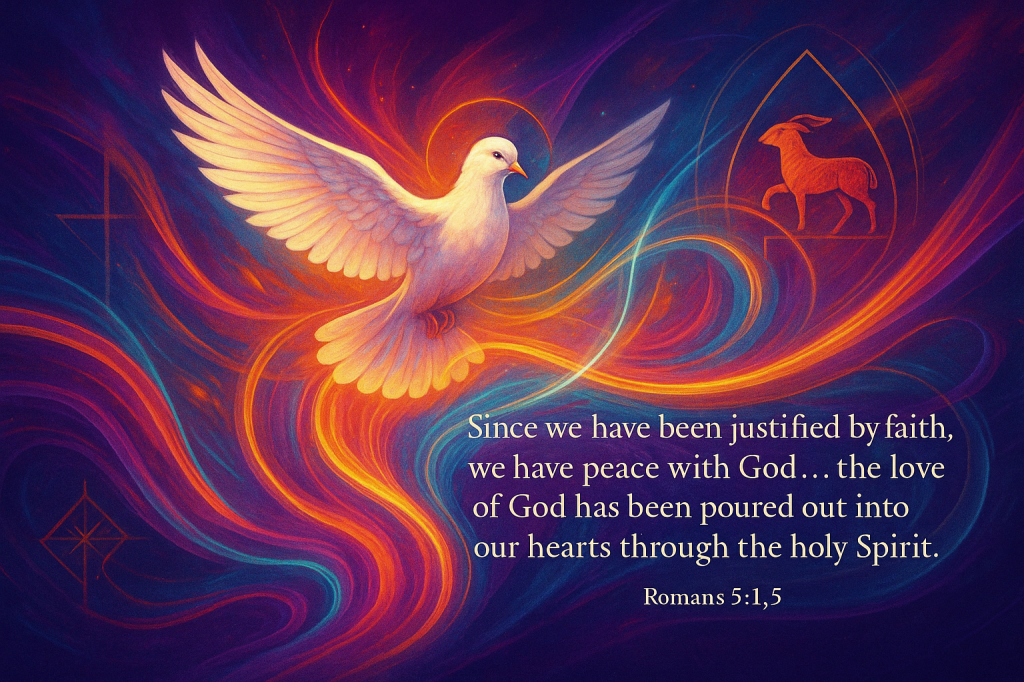
The Trinity’s Eternal Invitation
Have you ever gazed at the stars and felt your soul stretch toward something greater—something ancient, intimate, and beautiful beyond words? Today’s Solemnity of the Most Holy Trinity beckons us into that very mystery. It invites us not merely to ponder God’s nature as Father, Son, and Holy Spirit, but to encounter His eternal love that created us, sustains us, and draws us into communion. The readings today form a poetic and theological tapestry, revealing a God who has never been distant or indifferent, but who has always delighted in His creation and now calls us into His own divine life.
In Proverbs 8, we hear Wisdom personified—present before creation, “playing before him all the while, playing over the whole of his earth, having my delight with human beings” (Proverbs 8:30-31). This passage, often read through a Christological lens by the Church Fathers, hints at the eternal Logos—the Son—delighting with the Father before the world began. Psalm 8 echoes the wonder of humanity’s place in this divine story: “What is man that you are mindful of him… yet you have made him little less than a god” (Psalm 8:5-6). This awe before God’s majesty and love sets the stage for the Second Reading, where Romans 5 proclaims that we are not only created but redeemed—“justified by faith… the love of God has been poured out into our hearts through the Holy Spirit” (Romans 5:1, 5). And finally, in The Gospel of John, Jesus promises the coming of the Spirit of truth, “who will guide you to all truth… he will take from what is mine and declare it to you” (John 16:13-14), revealing the Trinity not as an abstract doctrine but as a living, active communion of love into which we are invited.
Historically, the doctrine of the Trinity developed as the early Church grappled with Jesus’ divinity and the sending of the Holy Spirit. Councils like Nicaea (325 AD) and Constantinople (381 AD) clarified that the Father, Son, and Holy Spirit are not three gods but one God in three persons, consubstantial and coeternal. This feast reminds us that the Trinity is not a puzzle to solve but a mystery to adore—a mystery rooted in Scripture and lived in the sacraments. How does this eternal dance of love, this triune unity, shape your understanding of who God is—and who you are? Today’s readings are not theological footnotes but invitations to dwell in the heart of God’s eternal love story.
First Reading – Proverbs 8:22–31
Wisdom Before the World Was Made
The Book of Proverbs is part of the wisdom literature of the Old Testament, deeply rooted in the traditions of ancient Israelite teaching and instruction. These writings—filled with poetic parallelism, vivid imagery, and moral exhortations—were crafted to guide the people of God in the ways of righteousness and divine order. Proverbs 8 stands apart as a majestic hymn in which Wisdom is personified and speaks in the first person. This poetic monologue is more than just literary art; it is a theological masterpiece that reaches into the mystery of God Himself. In today’s context—the Solemnity of the Most Holy Trinity—this passage opens a window into the eternal inner life of God, prefiguring the Word made flesh. The Church Fathers often saw this figure of Wisdom as a type of Christ, the eternal Logos, through whom all things were made (cf. John 1:1–3). The passage not only celebrates Wisdom’s role in creation but reveals the deep joy and communion shared by God in forming the world—especially in delighting in humanity.
Proverbs 8:22-31
New American Bible (Revised Edition)
22 “The Lord begot me, the beginning of his works,
the forerunner of his deeds of long ago;
23 From of old I was formed,
at the first, before the earth.
24 When there were no deeps I was brought forth,
when there were no fountains or springs of water;
25 Before the mountains were settled into place,
before the hills, I was brought forth;
26 When the earth and the fields were not yet made,
nor the first clods of the world.
27 When he established the heavens, there was I,
when he marked out the vault over the face of the deep;
28 When he made firm the skies above,
when he fixed fast the springs of the deep;
29 When he set for the sea its limit,
so that the waters should not transgress his command;
When he fixed the foundations of earth,
30 then was I beside him as artisan;
I was his delight day by day,
playing before him all the while,
31 Playing over the whole of his earth,
having my delight with human beings.
Detailed Exegesis
Verse 22 – “The Lord begot me, the beginning of his works, the forerunner of his deeds of long ago.”
This verse introduces Wisdom as “begotten” by the Lord—language rich with theological implication. While not implying literal birth in a human sense, it suggests an eternal origin from God Himself. The term “beginning” (re’shit in Hebrew) mirrors Genesis 1:1 and is echoed in John 1:1. For the Church, this verse resonates with Christ as the “firstborn of all creation” (Colossians 1:15), not in chronology but in primacy and divinity.
Verse 23 – “From of old I was formed, at the first, before the earth.”
Wisdom is timeless. This verse reinforces her presence before the foundations of the earth. The Hebrew verb used here can mean “anointed” or “poured forth,” connoting both intimacy and purpose. In the Trinitarian lens, it evokes the eternal relationship between the Father and the Son—before space, time, or matter existed.
Verse 24 – “When there were no deeps I was brought forth, when there were no fountains or springs of water.”
The imagery returns us to the primeval chaos of Genesis 1:2—the deep waters over which the Spirit hovered. Wisdom exists even before the taming of chaos, revealing her as a principle of divine order and structure. Christ, as the Logos, brings cosmos out of chaos.
Verse 25 – “Before the mountains were settled into place, before the hills, I was brought forth.”
The mountains, symbols of permanence and majesty in ancient Israel, are not eternal—Wisdom predates even these. The repetition of “brought forth” accentuates her divine origin and unique status in creation. Again, the early Church saw this as pointing to Christ’s preexistence.
Verse 26 – “When the earth and the fields were not yet made, nor the first clods of the world.”
Even the most basic elements of terrestrial life—the “clods”, the dust of the ground—came after Wisdom. This places Wisdom not within creation, but outside of it, involved in the act of creation itself.
Verse 27 – “When he established the heavens, there was I, when he marked out the vault over the face of the deep.”
This verse transitions into cosmic architecture. The “vault” or “firmament” (raqia) was seen as the dome that held back the waters of chaos. Wisdom is present as a witness and participant, much like the Word through whom all was made (cf. John 1:3).
Verse 28 – “When he made firm the skies above, when he fixed fast the springs of the deep.”
God’s mastery over the waters—a biblical symbol of chaos—is emphasized here. Wisdom is depicted as a stabilizing presence. Her proximity to God’s ordering acts foreshadows the Holy Spirit, the “Spirit of Truth” who brings order to the human heart.
Verse 29 – “When he set for the sea its limit, so that the waters should not transgress his command; when he fixed the foundations of earth.”
This verse celebrates divine sovereignty. God’s laws are not arbitrary—they are rooted in Wisdom. Even the sea, powerful and untamable in ancient Near Eastern thought, obeys the divine boundary. This reveals Wisdom’s role in sustaining moral and natural order.
Verse 30 – “Then was I beside him as artisan; I was his delight day by day, playing before him all the while.”
Here, Wisdom is both artisan and companion, revealing the inner joy and intimacy of the divine act of creation. The Hebrew word ‘amôn has been interpreted as “master workman”, but also carries meanings of nurturer or confidante. The “playfulness” evokes joy, not randomness—an eternal dance of delight.
Verse 31 – “Playing over the whole of his earth, having my delight with human beings.”
God’s delight culminates in humanity. This stunning verse anticipates the Incarnation, where divine Wisdom enters the human condition. It also reminds us that God’s ultimate joy is found not just in creation’s grandeur, but in relationship—with us.
Teachings of the Church
The Catechism of the Catholic Church confirms that all creation springs from and is sustained by divine Wisdom: “With creation, God does not abandon his creatures to themselves. He not only gives them being and existence, but also, and at every moment, upholds and sustains them in being, enables them to act and brings them to their final end” (CCC 301). Creation is not a distant historical event—it is a continual act of divine love. The presence of Wisdom from the beginning, as revealed in this reading, emphasizes that everything was made with intentionality and order, not by chance.
The Church Fathers frequently identified this Wisdom with the pre-incarnate Christ. St. Athanasius taught that Wisdom “was with the Father as Wisdom and the Word, and was not external to Him.” St. Augustine, in De Trinitate, writes: “For just as the Wisdom itself is begotten of God, being His Word… so that Wisdom was with God from the beginning, and all things were made through it” (Book I, Ch. 15). These insights show that even before the manger or the cross, Christ was already present—delighting in the world He would one day enter.
This reading has long been linked to the theology of the Trinity. The eternal presence of Wisdom beside the Creator, rejoicing in the work of His hands, mirrors the unity of love shared between Father, Son, and Holy Spirit. The joy, playfulness, and intimacy described here is not sentimental poetry but a revelation of the interior life of God—a communion of persons who delight in giving life and sharing it. This is the God we worship: not an isolated monarch but a family of love, into which we are welcomed.
Reflection
In a world obsessed with productivity and performance, it is profoundly healing to hear that God’s Wisdom delights in us. Not for what we do, but simply for who we are. What would your day look like if you began with the knowledge that you are not a burden to God, but His delight? This reading invites us to enter into that playful reverence, to see life not as a grind, but as a dance choreographed by divine Wisdom. It invites us to return to a childlike wonder, to trust that even in chaos, God is present, guiding, and delighting in His creation.
Take a moment today to observe something beautiful—sunlight through leaves, the rhythm of breath, the face of someone you love—and let it remind you that divine Wisdom is still playing over the earth. How can you make space in your life for joy, for divine order, and for the quiet voice of Wisdom whispering in your heart? Through prayer, attentiveness, and a willingness to marvel, we begin to walk with the same Wisdom that was with God at the beginning—and who now walks with us still.
Responsorial Psalm – Psalm 8:4–9
The Dignity of Humanity in God’s Design
The Book of Psalms is the prayerbook of Israel and the Church, a sacred collection of songs, poems, and petitions inspired by the Holy Spirit. Psalm 8 stands out as a hymn of cosmic wonder and profound reflection on human identity. Likely composed by David, this psalm arises from the ancient Jewish worldview that recognized God’s grandeur in creation—and yet marveled at His tender care for mankind. In the ancient Near East, creation was often associated with divine conflict or chaos, but in the Hebrew tradition, creation is the fruit of divine love and wisdom. This psalm echoes Proverbs 8 and reinforces today’s theme of the Most Holy Trinity by situating man’s dignity within the broader mystery of God’s creative and relational design. The psalmist gazes into the heavens and is moved not only by their vastness but by the stunning truth that humanity—small and seemingly insignificant—has been given dominion and crowned with glory.
Psalm 8:4-9
New American Bible (Revised Edition)
4 When I see your heavens, the work of your fingers,
the moon and stars that you set in place—
5 What is man that you are mindful of him,
and a son of man that you care for him?
6 Yet you have made him little less than a god,
crowned him with glory and honor.
7 You have given him rule over the works of your hands,
put all things at his feet:
8 All sheep and oxen,
even the beasts of the field,
9 The birds of the air, the fish of the sea,
and whatever swims the paths of the seas.
Detailed Exegesis
Verse 4 – “When I see your heavens, the work of your fingers, the moon and stars that you set in place—”
The psalmist begins with awe. Creation is not random or chaotic; it is the “work of your fingers”—a phrase that communicates precision, intimacy, and artistry. In biblical language, “fingers” symbolize deliberate craftsmanship, pointing to a God who forms with care. The mention of the “moon and stars” evokes both beauty and order, recalling Genesis 1 and suggesting that all creation is intentional and sustained by divine Wisdom.
Verse 5 – “What is man that you are mindful of him, and a son of man that you care for him?”
This is one of the most breathtaking questions in all of Scripture. Compared to the grandeur of the heavens, what is man? And yet, God is “mindful”—a word that implies remembrance, covenant, and love. To “care” in Hebrew (paqad) can also mean to visit or intervene, suggesting divine attention and action. This anticipates the Incarnation, where God truly visits His people in Christ, the Son of Man.
Verse 6 – “Yet you have made him little less than a god, crowned him with glory and honor.”
Here we find a bold affirmation of human dignity. The phrase “little less than a god” (or “angels” in other translations) reflects humanity’s unique place in creation. This exaltation is not prideful but a gift: man is “crowned with glory and honor”, made in the image and likeness of God (cf. Genesis 1:27). This verse finds its fulfillment in Christ, who assumed human nature and was exalted above all creation (cf. Hebrews 2:6–9).
Verse 7 – “You have given him rule over the works of your hands, put all things at his feet:”
This verse affirms the role of stewardship given to man. Dominion is not domination, but a call to reflect divine order and care. The phrase “put all things at his feet” echoes messianic language and is used by St. Paul to describe Christ’s universal lordship (cf. 1 Corinthians 15:27). In Christ, humanity’s vocation is fulfilled and elevated.
Verse 8 – “All sheep and oxen, even the beasts of the field,”
The psalm narrows its focus to creatures under man’s care. Domestic animals like sheep and oxen symbolize civilization and sustenance, while “beasts of the field” point to the wild and untamed parts of creation. This shows that all levels of nature fall under humanity’s entrusted dominion.
Verse 9 – “The birds of the air, the fish of the sea, and whatever swims the paths of the seas.”
This closing verse broadens the scope once again, linking sky, sea, and land. All creation is included in the sweep of human vocation. The “paths of the seas” may also allude to God’s mysterious and sovereign hand in guiding the natural world—paths that only He truly understands (cf. Job 38:16). Humanity, in being placed over these creatures, reflects God’s image as a wise and loving ruler.
Teachings of the Church
The Church affirms that man is the summit of visible creation. The Catechism of the Catholic Church teaches: “Man occupies a unique place in creation: (1) he is ‘in the image of God’; (2) in his own nature he unites the spiritual and material worlds; (3) he is created ‘male and female’; (4) God established him in his friendship” (CCC 355). This psalm encapsulates all of this—man as image-bearer, as ruler of creation, and as beloved of God.
Saint John Paul II, in his Theology of the Body, emphasized that human dignity is not rooted in function or utility but in relationship. He wrote: “Man cannot live without love… his life is senseless if love is not revealed to him, if he does not encounter love, if he does not experience it and make it his own” (TOB, 15:1). Psalm 8 speaks of such a love—a Creator who is mindful and caring, bestowing honor and calling us to loving stewardship.
In the context of the Most Holy Trinity, this psalm also prefigures the divine intention that humanity would one day be drawn into the inner life of God. Through Christ, the Son of Man who perfectly fulfills Psalm 8, we are invited into communion with the Father through the Spirit. As St. Irenaeus wrote, “The glory of God is man fully alive, and the life of man is the vision of God” (Adversus Haereses, IV, 20, 7). This psalm is thus not just about nature, but about destiny—our eternal vocation to share in divine life.
Reflection
Psalm 8 reminds us who we are—and whose we are. In a world that often reduces identity to status, achievement, or external validation, God gently reminds us that we are already “crowned with glory and honor”. Do you believe that about yourself? Do you see the people around you as crowned in glory too? This reading calls us to rediscover the sacredness of the human person and our vocation to care for creation with reverence and responsibility.
Take time today to walk in nature, to observe the beauty of the world God has entrusted to us, and to remember that you, too, are part of that creation—but set apart with purpose. How might God be inviting you to reflect His care today—in your work, in your relationships, in the way you speak about yourself and others? Let this psalm reawaken your sense of awe and purpose, so you may live with deeper gratitude and renewed reverence for every breath, every person, and every part of creation.
Second Reading – Romans 5:1–5
The Overflowing Love of the Trinity in Our Hearts
St. Paul’s Letter to the Romans is his most comprehensive theological treatise, written to a community he had not yet visited but longed to serve. Addressed to both Jewish and Gentile Christians living in the heart of the Roman Empire, the letter articulates the heart of the Gospel: humanity is justified not by works of the law but by faith in Jesus Christ. In Romans 5, Paul begins a new section that reflects on the fruits of this justification. Today’s passage is rich with Trinitarian language—highlighting the work of the Father, the mediation of the Son, and the indwelling of the Holy Spirit. As we celebrate the Most Holy Trinity, this reading unveils the reality that the inner life of God is not far removed from our own. It is poured into our hearts, animating us with peace, hope, and love even in suffering.
Romans 5:1-5
New American Bible (Revised Edition)
Faith, Hope, and Love. 1 Therefore, since we have been justified by faith, we have peace with God through our Lord Jesus Christ, 2 through whom we have gained access [by faith] to this grace in which we stand, and we boast in hope of the glory of God. 3 Not only that, but we even boast of our afflictions, knowing that affliction produces endurance, 4 and endurance, proven character, and proven character, hope, 5 and hope does not disappoint, because the love of God has been poured out into our hearts through the holy Spirit that has been given to us.
Detailed Exegesis
Verse 1 – “Therefore, since we have been justified by faith, we have peace with God through our Lord Jesus Christ,”
The word “therefore” signals a conclusion from Paul’s prior argument in Romans 4, where Abraham is justified by faith. Justification is a divine act by which God declares the sinner righteous. Through faith in Christ, we are no longer alienated from God but reconciled. The phrase “peace with God” is not mere inner calm but restored relationship—the Hebrew concept of shalom—wholeness, communion, and harmony. This peace is only possible “through our Lord Jesus Christ”, the only mediator between God and man.
Verse 2 – “through whom we have gained access [by faith] to this grace in which we stand, and we boast in hope of the glory of God.”
Christ is not only the one through whom we receive peace, but also the gateway to “grace in which we stand”. This standing is firm, rooted in divine favor rather than human effort. The word “access” (Greek: prosagōgē) implies introduction into the presence of royalty. In Christ, we are welcomed into the divine life. Paul then introduces the theme of “hope”, not as wishful thinking but confident expectation of sharing in the “glory of God”, a phrase that hints at the beatific vision.
Verse 3 – “Not only that, but we even boast of our afflictions, knowing that affliction produces endurance,”
The Christian paradox is on full display here. Rather than flee from suffering, believers can “boast” (or rejoice) in their afflictions. Why? Because suffering has redemptive power when united to Christ. It produces “endurance” (Greek: hypomonē), a steadfastness that is not passive resignation but courageous perseverance in the face of trials.
Verse 4 – “and endurance, proven character, and proven character, hope,”
Suffering refines the soul. “Proven character” (dokimē) refers to tested virtue, like gold purified by fire. Such character is the fertile ground where “hope” is born—not naïve optimism, but trust forged through experience. This is not a linear sequence of moral growth, but a spiral drawing the believer ever closer to the heart of God.
Verse 5 – “and hope does not disappoint, because the love of God has been poured out into our hearts through the holy Spirit that has been given to us.”
This final verse anchors everything in the Trinity. Our hope is secure because it is rooted not in our ability to believe, but in the “love of God”—not a concept, but a living reality. That love has been “poured out” (Greek: ekchythē) lavishly, abundantly, and irrevocably through the “holy Spirit”. This is the same Spirit who hovered over the waters of creation, who inspired the prophets, who descended at Pentecost—and who now dwells within each baptized believer.
Teachings of the Church
The Catechism of the Catholic Church emphasizes that justification is both a gift and a transformation. It teaches: “Justification is not only the remission of sins, but also the sanctification and renewal of the interior man” (CCC 1989). Through faith in Christ, we are made new and reconciled to the Father. This reconciliation brings peace, not as an emotional state, but as participation in divine life.
Further, the Catechism echoes Romans 5:5 when it teaches that the Holy Spirit is the one who enables us to love with God’s own love: “By the power of the Spirit, God’s children can bear much fruit. He who has grafted us onto the true vine will make us bear ‘the fruit of the Spirit: . . . love, joy, peace, patience, kindness, goodness, faithfulness, gentleness, self-control’” (CCC 736). The pouring out of the Spirit is not a private emotional experience but the very life of the Trinity active in the soul, empowering us to live as sons and daughters.
St. Catherine of Siena, Doctor of the Church, beautifully illustrates the soul’s journey through suffering toward glory. She wrote: “Eternal Trinity… you are a deep sea, in which the more I seek, the more I find; and the more I find, the more I seek to know you” (Dialogue, Prayer 167). In her own trials, she found that the love of God does not shield us from affliction but sanctifies us through it. Paul’s teaching in Romans 5 reflects this dynamic: suffering is not meaningless when it is caught up into the life of the Trinity.
Reflection
This passage is a balm for weary hearts. Have you ever felt crushed by suffering, tempted to believe that hope is foolish? Paul assures us: hope in God will not disappoint. Why? Because it is not manufactured—it is poured into us. This is the miracle of divine life shared with us: the Father loves us, the Son redeems us, and the Spirit fills us. What if your struggles are not signs of God’s absence, but invitations to encounter His love more deeply?
Take time to reflect today: Where do you see affliction turning into endurance in your life? Where is God building character and awakening hope within you? Ask the Holy Spirit to show you how the love of God is already at work in your story. Let this reading reassure you that your place in the Trinity’s love is secure, not because you are perfect, but because you are His.
Holy Gospel – John 16:12–15
Guided by the Spirit Into the Heart of the Trinity
The Gospel of John is profoundly theological, steeped in mystery and revelation. Unlike the Synoptic Gospels, John focuses less on chronology and more on unveiling the identity of Jesus as the eternal Word made flesh. This passage is part of Jesus’ Farewell Discourse (John 14–17), spoken during the Last Supper, where He prepares His disciples for life after His Ascension. These intimate chapters reveal Jesus’ deep concern for His followers and His desire to draw them into the unity He shares with the Father and the Spirit. In John 16:12–15, Jesus reveals the forthcoming mission of the Holy Spirit, the “Spirit of truth,” who will guide the Church in every age. On this Solemnity of the Most Holy Trinity, the passage is a perfect complement to our celebration: it reveals how the Father, Son, and Holy Spirit are distinct yet united in love, mission, and glory—and how we are drawn into this divine communion through the Spirit’s ongoing presence.
John 16:12-15
New American Bible (Revised Edition)
12 “I have much more to tell you, but you cannot bear it now. 13 But when he comes, the Spirit of truth, he will guide you to all truth. He will not speak on his own, but he will speak what he hears, and will declare to you the things that are coming. 14 He will glorify me, because he will take from what is mine and declare it to you. 15 Everything that the Father has is mine; for this reason I told you that he will take from what is mine and declare it to you.
Detailed Exegesis
Verse 12 – “I have much more to tell you, but you cannot bear it now.”
Jesus speaks with tenderness and restraint. The disciples are overwhelmed, confused, and afraid. Jesus acknowledges their limitations and does not burden them beyond what they can carry. The phrase “you cannot bear it now” suggests that divine truth unfolds progressively. The fullness of revelation is not a one-time event but a lifelong journey guided by grace.
Verse 13 – “But when he comes, the Spirit of truth, he will guide you to all truth. He will not speak on his own, but he will speak what he hears, and will declare to you the things that are coming.”
Jesus promises the coming of the “Spirit of truth”, a title that echoes John 14:17. The Spirit does not replace Jesus but continues His mission, leading the Church into deeper understanding over time. To “guide you to all truth” reflects the Spirit’s role in unfolding the full mystery of Christ—particularly through Scripture, Tradition, and the Magisterium. The phrase “he will not speak on his own” emphasizes Trinitarian unity: the Spirit communicates the will of the Father and the Son, not as a separate authority, but in loving harmony. “The things that are coming” may refer to future events, including the Paschal Mystery and the life of the Church in the world.
Verse 14 – “He will glorify me, because he will take from what is mine and declare it to you.”
The Holy Spirit is not focused on Himself. His mission is to “glorify” the Son by making Him known and loved. In declaring “what is mine”, the Spirit illuminates the words, deeds, and identity of Jesus in the hearts of believers. This verse also hints at the Spirit’s role in sanctification—helping the faithful internalize and live out the Gospel, thereby glorifying Christ in their lives.
Verse 15 – “Everything that the Father has is mine; for this reason I told you that he will take from what is mine and declare it to you.”
Here Jesus reveals the profound unity of the Trinity. “Everything that the Father has is mine” is a claim of divinity and perfect communion. What belongs to the Father belongs also to the Son—and is revealed through the Spirit. The verse encapsulates the perichoresis, or mutual indwelling, of the Trinity: distinct Persons, yet one essence, one will, one love. Revelation is not fragmented; it is a gift from the Triune God to the Church.
Teachings of the Church
The Catechism of the Catholic Church teaches that the mystery of the Trinity is the central mystery of the Christian faith: “It is the mystery of God in himself. It is therefore the source of all the other mysteries of faith” (CCC 234). The Gospel passage shows this mystery in motion—the Father gives all to the Son, the Son speaks and glorifies the Father, and the Spirit reveals and declares all that is shared between them. This Trinitarian love is not static—it reaches outward to draw humanity into divine intimacy.
Further, the Catechism explains the Spirit’s role in guiding the Church: “By this revelation, then, the invisible God, from the fullness of his love, addresses men as his friends, and moves among them, in order to invite and receive them into his own company” (CCC 142). Jesus’ words in this Gospel reflect this divine friendship. The Spirit does not merely relay information but leads believers into deeper communion, into the very heart of God. This is not an abstract theological idea but a lived experience accessible through prayer, sacraments, and fidelity to the Church’s teaching.
St. Gregory of Nazianzus, one of the great Trinitarian theologians, once wrote: “When I speak of God, you must be illumined at once by one flash of light and by three… They are distinct, yet one; not differing in substance or nature, but in degree, in order, and in manifestation” (Oration 40). In the light of today’s Gospel, this unity-in-distinction is not only a doctrinal truth but a pastoral reality: the Spirit works quietly, progressively, faithfully, to draw us deeper into the mystery of Father and Son.
Reflection
This Gospel is an invitation to trust in the Spirit’s gentle guidance. Have you ever felt like your faith is incomplete, like you don’t yet grasp the fullness of truth? That’s okay—Jesus told His disciples the same. But He also promised that the Spirit would lead them—and us—into all truth. The life of faith is not about mastering information; it’s about listening, responding, and being led into divine intimacy one step at a time.
Let this reading remind you that you are not alone in your questions, your confusion, or your longing for clarity. The Holy Spirit is with you, declaring what belongs to Jesus, what flows from the Father—truth, love, healing, mission. How might you open yourself to the Spirit more fully this week? Are you willing to be led, to wait patiently, and to rejoice in what is slowly being revealed? Ask the Spirit to glorify Jesus in your life and to help you live more deeply in the unity and love of the Holy Trinity.
Drawn Into the Dance
Today’s readings unveil a breathtaking portrait of God—not distant or abstract, but eternally close, relational, and gloriously united as Father, Son, and Holy Spirit. From Proverbs, we witness divine Wisdom rejoicing before time began, delighting in the world and especially in us: “having my delight with human beings” (Proverbs 8:31). In Psalm 8, we are reminded of our dignity: though small in the vastness of creation, we are “crowned with glory and honor” (Psalm 8:6), entrusted with stewardship and loved beyond comprehension. Romans 5 leads us deeper, showing how this love is not just spoken but poured into our hearts through the Holy Spirit: “hope does not disappoint, because the love of God has been poured out into our hearts through the Holy Spirit” (Romans 5:5). And in John’s Gospel, Jesus assures us that the Spirit of truth will continue guiding us, gently revealing the heart of the Trinity, saying, “He will take from what is mine and declare it to you” (John 16:14).
These readings do not merely teach us about the Trinity—they invite us into it. They proclaim that we are not spectators of divine mystery, but participants in divine life. Through baptism and grace, we are welcomed into the eternal exchange of love between Father, Son, and Spirit. This is the foundation of our faith, the meaning of our hope, and the wellspring of our mission in the world.
How can you live more intentionally from this truth? What would change if you walked through your day knowing you are the delight of the Trinity, crowned with purpose, held in love, and led by the Spirit? Today, let your prayer be one of openness—open to being guided, transformed, and drawn deeper into the dance of divine love. Let every moment become an offering to the One who made you, redeemed you, and now dwells within you. The mystery of the Trinity is not only to be adored—it is to be lived.
Engage with Us!
We’d love to hear how the Holy Spirit is moving in your heart through today’s readings. What verse stood out to you? What truth spoke to your current season of life? Share your reflections in the comments below and join us in community as we grow together in faith and love.
Reflection Questions:
First Reading – Proverbs 8:22–31
What does it mean to you that God delighted in humanity before the world began? How can you live with a deeper awareness that you were created in divine Wisdom and for divine joy?
Responsorial Psalm – Psalm 8:4–9
How does recognizing your God-given dignity affect the way you view yourself and others? What small moments in nature help you reconnect with your place in God’s creation?
Second Reading – Romans 5:1–5
Have you experienced suffering that, in hindsight, led to growth in endurance, character, or hope? How can you open your heart more fully to the love of God being poured out through the Holy Spirit?
Holy Gospel – John 16:12–15
Are there truths in your spiritual journey that you are still waiting to understand or embrace? How can you be more attentive to the guidance of the Holy Spirit in your daily decisions?
As you reflect and respond, remember this: you are not alone. The Father who created you, the Son who redeemed you, and the Spirit who dwells within you are inviting you deeper into the divine life. Live today with intention. Walk in love, speak with mercy, and do all things for the glory of the Triune God.
Follow us on Instagram and Facebook for more insights and reflections on living a faith-filled life.

 Holy Manna!
Leave a comment