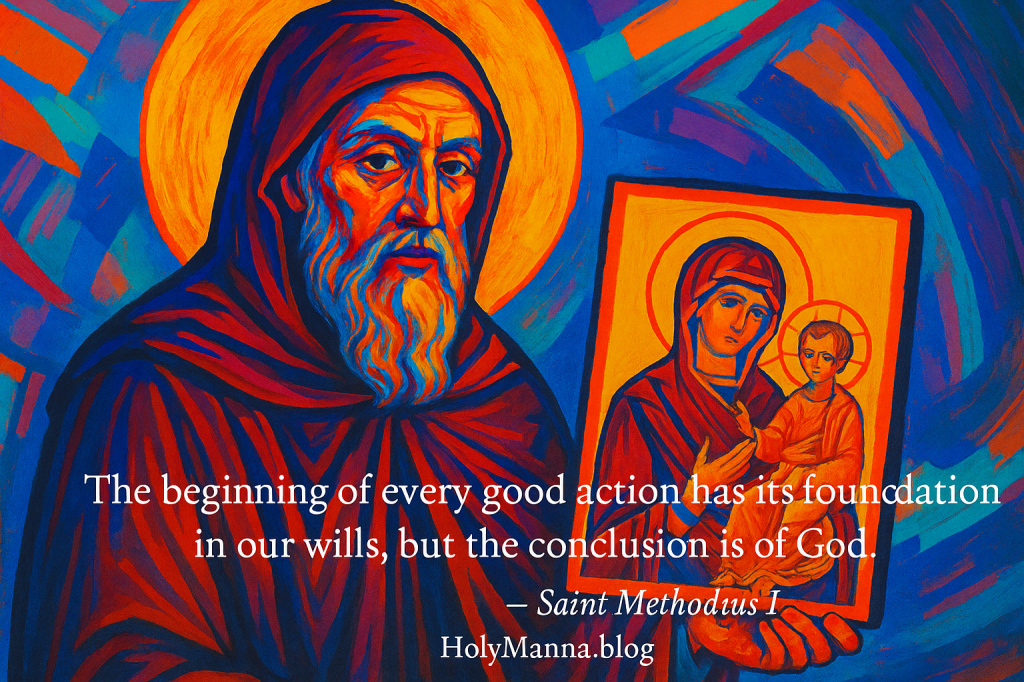
The Icon Defender of Constantinople
Saint Methodius I of Constantinople (c. 790–847) stands as a radiant beacon in the tapestry of Church history, embodying the virtues of steadfast faith, courage, and peacemaking during one of the most tumultuous periods in the Eastern Church—the Iconoclastic Controversy. Raised to the Patriarchate during a time of deep ecclesial division, Methodius proved to be a healing balm for a wounded Church. He courageously championed the sacred tradition of venerating holy icons, which had been suppressed by imperial decree for decades. Under his leadership, the Church not only reclaimed this ancient devotion but also experienced a profound spiritual renewal. His enduring legacy is immortalized in the “Triumph of Orthodoxy,” a feast that continues to be celebrated each year on the first Sunday of Great Lent, commemorating the official restoration of the veneration of icons. As a confessor of the faith, Methodius is revered not for dying a martyr’s death, but for suffering boldly for the truth, ultimately leading the Church into unity and truth. His feast day, observed on June 14, is a celebration of fidelity to apostolic tradition and courageous witness in the face of persecution.
From Sicilian Nobility to Monastic Solitude
Saint Methodius was born around 790 into a wealthy and noble family in Syracuse, Sicily. Gifted with intelligence and blessed with access to an excellent education, he was sent to Constantinople with hopes of achieving a high position in the imperial court. Yet, Divine Providence had other plans for his life. While pursuing his career in the capital, Methodius encountered the spiritual richness of the Christian monastic tradition. It was during this period that he met a devout monk whose profound humility and wisdom stirred something deep in Methodius’s heart. Moved by this holy example and touched by the Holy Spirit, he renounced his worldly aspirations and embraced the ascetic life of a monk.
He journeyed to the island of Chios, where he founded a monastery and immersed himself in prayer, study, and contemplation. There, in solitude and silence, Methodius’s soul was formed in the furnace of divine love. His theological acumen and commitment to the truths of the faith quickly became apparent. When the Church entered a season of fierce debate and persecution over the veneration of icons, Methodius emerged as a key defender of orthodoxy. Appointed by Patriarch Nicephorus, he was sent as an ambassador to Rome in 815 to seek support from the Holy See against the heretical iconoclastic policy enforced by Emperor Leo V. This mission was the beginning of his life’s defining struggle—a fight not just for painted images, but for the truth of the Incarnation and the dignity of the human face made in the image of God.
Grace Woven in Flesh
Although Saint Methodius is not traditionally known for spectacular miracles like healings or levitations, his entire life radiates the quiet, persistent miracle of fidelity under pressure. One might say that his greatest miracle was the grace to endure suffering with serenity, to respond to hatred with love, and to lead with wisdom in a time of great confusion. Like Saint Paul, his spiritual power was made perfect in weakness.
Through his writings—particularly hagiographies of other saints and theological treatises—he fed the faithful with the richness of doctrine and devotion. He was known for his deep knowledge of Scripture and for promoting reverence toward sacred traditions. Even during his imprisonment, his steadfastness was a miracle of interior strength. The Catechism of the Catholic Church teaches that, “By canonizing some of the faithful, the Church recognizes the power of the Spirit of holiness within her” (CCC 828). Methodius’s endurance and unwavering commitment to truth in the face of political and physical trials manifest that same Spirit. In an age when many leaders compromised for the sake of safety or favor, Methodius stood as a miracle of unwavering faith—a living icon of Christ.
Chains for the Truth
The life of Saint Methodius was marked by tremendous suffering and persecution, not for crimes or rebellion, but for his unyielding belief in the truth and tradition of the Church. After returning from his mission to Rome, Emperor Michael II, who upheld iconoclastic policies, saw Methodius as a threat. He was arrested, flogged, and confined for over seven years in a dark, filthy prison. There, he suffered alongside other defenders of the icons, surviving in poor health, under constant abuse, and deprived of proper nourishment. Yet he bore all with dignity, clinging to his hope in Christ, echoing the words of Psalm 34: “Many are the afflictions of the righteous, but the Lord delivers him out of them all.”
He was eventually released, and after the death of Emperor Theophilus in 842, the tide turned. Theodora, widow of the late emperor and a secret iconophile, became regent for her son. Recognizing Methodius’s integrity and holiness, she appointed him Patriarch of Constantinople. In 843, Methodius presided over a synod that restored the veneration of icons once and for all. That same year, he led a solemn procession through Constantinople, carrying icons into Hagia Sophia, reinstating them in their rightful place. This triumph is still honored in the Eastern Church, but it is a victory for all who believe in the Incarnation of Christ and the sacredness of Christian art. His suffering bore fruit, not just in his personal sanctification, but in the healing and restoration of an entire Church.
Heaven’s Echo
Saint Methodius died on June 14, 847, leaving behind a Church restored to orthodoxy and a people inspired by his courage and holiness. Following his death, devotion to him spread quickly. His body was venerated by the faithful, and his relics became objects of pilgrimage and prayer. Stories began to circulate of healings and answers to prayers attributed to his intercession. Though not officially canonized in the modern process, he was proclaimed a saint by popular acclamation and remains honored particularly in the Byzantine Rite and Eastern Catholic Churches.
The site of his burial, near the Church of the Holy Apostles in Constantinople, became a place of veneration. Pilgrims sought his prayers for courage in faith, healing from division, and strength to endure trials. His memory is especially invoked during times of confusion and theological controversy, for he is a saint of both truth and peace. The Catechism reminds us that, “The communion of saints is the Church” (CCC 946)—and Methodius remains a living member of that communion, praying for us, guiding us, and pointing the way to Christ through the clarity of tradition and the beauty of sacred worship.
Icons of Christ
Saint Methodius I calls each of us to courage and faithfulness in an age often hostile to tradition and truth. His life reminds us that true reform never abandons the Church’s foundations—it builds upon them with fidelity and love. His unwavering defense of icons challenges us to cherish the tangible expressions of our faith and to never be ashamed of showing our devotion publicly.
How can you be a voice for truth and peace in a divided world? Methodius teaches us to confront error not with rage, but with reason and compassion. What challenges in your life can you embrace with the same steadfast spirit? His long imprisonment and perseverance inspire us to endure even when the road is long and painful. How might you grow closer to Christ by embracing sacred traditions with love and reverence? We live in a world that often discards the past. Methodius invites us to return to the heart of the Church and find Christ where He has always been—in Scripture, in sacrament, and in the sacred rhythms of the Church.
To live like Saint Methodius is to live with conviction, to honor what is holy, and to guide others gently toward truth. Let us, like him, become living icons of God’s love, bearing His image to the world with courage, clarity, and compassion.
Engage with Us!
We invite you to reflect on Saint Methodius’s life and share your thoughts in the comments below. Consider these questions:
- How can we stand firm in our faith when facing societal pressures?
- In what ways can we promote unity and reconciliation in our communities?
- What practices can we adopt to deepen our spiritual resilience?
Let’s support each other in our faith journeys, striving to do everything with love—as our Lord Jesus did.
Saint Methodius I, pray for us! ✝️
Follow us on Instagram and Facebook for more insights and reflections on living a faith-filled life.

 Holy Manna!
Leave a comment