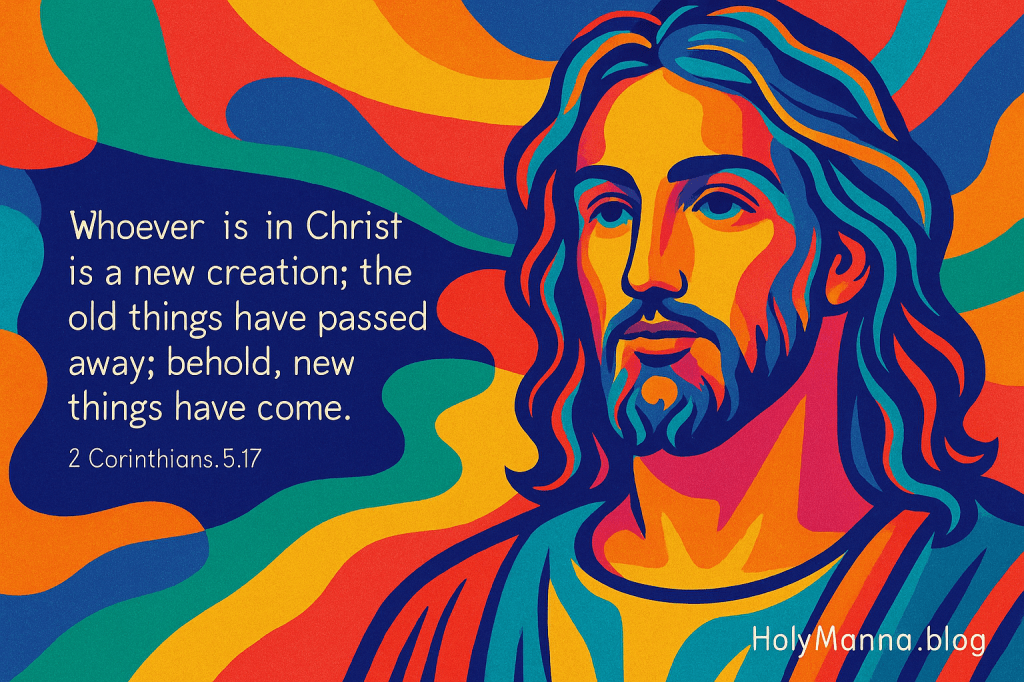
A Life Rewritten by Mercy
Have you ever felt the need to start over—not just clean the slate, but become someone new entirely? Today’s readings whisper to the weary heart that this is not only possible but already unfolding through Christ. The Word of God draws us into a deep truth: to be reconciled in Jesus is to live in a whole new way, one defined not by past sins or human standards, but by divine mercy, truth, and mission. Through each passage, we see God reaching out—not with condemnation, but with healing, calling us to integrity of life rooted in our new identity as His redeemed children.
Saint Paul, writing to the Corinthians, proclaims the radical message that we are a “new creation” in Christ (2 Cor 5:17). In a culture where identity was often tied to social status, past failures, or religious affiliation, Paul announces a spiritual transformation that transcends all human labels. This reconciliation is not a private consolation—it commissions us to become “ambassadors for Christ”, ministers of the same mercy we’ve received. Psalm 103 expands this theme beautifully, reminding Israel—and us—that the Lord is not a harsh taskmaster but a compassionate Father who “has not dealt with us as our sins merit” (Ps 103:10). This psalm was likely sung in the Temple liturgies as a hymn of thanksgiving for divine forgiveness and restoration.
Then comes the voice of Jesus in The Gospel of Matthew, urging His disciples to live with complete honesty and transparency: “Let your ‘Yes’ mean ‘Yes,’ and your ‘No’ mean ‘No’” (Mt 5:37). In a time when oaths were often used to manipulate or create appearances of truth, Jesus calls for a radical inner integrity that mirrors the Father’s own faithfulness. Taken together, these readings invite us into a life that has been rewritten by mercy—a life where reconciliation is not just received but lived out through our words, choices, and relationships. Are we ready to embrace this transformation?
First Reading – 2 Corinthians 5:14–21
Ambassadors of a New Creation
Saint Paul’s Second Letter to the Corinthians is one of the most passionate and theologically rich writings in the New Testament. Addressed to a fractured and spiritually embattled Christian community in Corinth, Paul writes as a spiritual father defending his ministry and reminding the faithful of the life-altering power of the Gospel. Corinth was a bustling Greco-Roman city, culturally diverse and morally complex—an ideal backdrop for Paul’s radical message of reconciliation in Christ. In today’s reading, he unveils one of the core tenets of our faith: that through Christ’s death and resurrection, humanity is not merely improved, but entirely made new. Paul’s words strike at the heart of today’s theme—a divine mercy so powerful it transforms identity, purpose, and mission. Through this passage, we’re reminded that reconciliation is not a distant ideal but a daily vocation, calling us to live as “ambassadors for Christ” in a world that longs for healing.
2 Corinthians 5:14-21
New American Bible (Revised Edition)
14 For the love of Christ impels us, once we have come to the conviction that one died for all; therefore, all have died. 15 He indeed died for all, so that those who live might no longer live for themselves but for him who for their sake died and was raised.
16 Consequently, from now on we regard no one according to the flesh; even if we once knew Christ according to the flesh, yet now we know him so no longer. 17 So whoever is in Christ is a new creation: the old things have passed away; behold, new things have come. 18 And all this is from God, who has reconciled us to himself through Christ and given us the ministry of reconciliation, 19 namely, God was reconciling the world to himself in Christ, not counting their trespasses against them and entrusting to us the message of reconciliation. 20 So we are ambassadors for Christ, as if God were appealing through us. We implore you on behalf of Christ, be reconciled to God. 21 For our sake he made him to be sin who did not know sin, so that we might become the righteousness of God in him.
Detailed Exegesis
Verse 14 – “For the love of Christ impels us, once we have come to the conviction that one died for all; therefore, all have died.”
Paul begins by revealing the divine force behind his apostolic mission: Christ’s love. The Greek word used here for “impels” (συνέχει) can mean “urges,” “controls,” or “presses.” It expresses how Christ’s sacrificial love leaves no room for apathy. Since Christ died for all, then all—by implication—have died to their former way of life. This verse introduces the radical idea of participation in Christ’s death, central to Paul’s theology (cf. Romans 6:6).
Verse 15 – “He indeed died for all, so that those who live might no longer live for themselves but for him who for their sake died and was raised.”
Here Paul explains the purpose of Christ’s death: not only to save, but to transform. The believer is no longer to live a self-centered life but one that is Christ-centered. This echoes the concept of discipleship found in The Gospel of Luke—“Whoever wishes to come after me must deny himself, take up his cross daily, and follow me” (Lk 9:23).
Verse 16 – “Consequently, from now on we regard no one according to the flesh; even if we once knew Christ according to the flesh, yet now we know him so no longer.”
Paul urges a shift in perspective: to no longer see people through merely human lenses. The “flesh” refers not just to the body but to worldly categories like status, appearance, or past sins. Even Christ is no longer to be seen only as the historical figure of Nazareth but as the risen Lord. This verse hints at the mystery of the glorified Christ and our own future resurrection.
Verse 17 – “So whoever is in Christ is a new creation: the old things have passed away; behold, new things have come.”
This is the climax of Paul’s message: salvation is not cosmetic; it is regenerative. The phrase “new creation” (καινὴ κτίσις) recalls Genesis and signals a kind of spiritual rebirth. The believer enters into a new existence where sin and death no longer have dominion. This is the foundation of Christian hope.
Verse 18 – “And all this is from God, who has reconciled us to himself through Christ and given us the ministry of reconciliation.”
Reconciliation is God’s initiative, not ours. Through Christ’s atonement, God restores a broken relationship with humanity. But this reconciliation is not meant to stop with us—it is a ministry entrusted to every Christian. We become instruments of peace and mercy in a world still in need of divine healing.
Verse 19 – “Namely, God was reconciling the world to himself in Christ, not counting their trespasses against them and entrusting to us the message of reconciliation.”
Here Paul expands the scope of salvation: it is global. God doesn’t hold sin over us like a grudge. Instead, He entrusts this liberating message to fallible human messengers, which reflects the mystery and humility of divine love. This verse resonates deeply with the Parable of the Prodigal Son (Lk 15:11–32), where mercy triumphs over judgment.
Verse 20 – “So we are ambassadors for Christ, as if God were appealing through us. We implore you on behalf of Christ, be reconciled to God.”
This verse encapsulates the Christian vocation: to speak and act on Christ’s behalf. The term “ambassadors” (πρεσβεύομεν) carries weight—it implies authority, mission, and accountability. Paul begs the Corinthians to respond to this call. Reconciliation is not a suggestion but an urgent invitation.
Verse 21 – “For our sake he made him to be sin who did not know sin, so that we might become the righteousness of God in him.”
One of the most profound theological statements in the New Testament. Jesus, though sinless, took on our sin—not by becoming sinful, but by bearing its full weight—so that we could share in His righteousness. This is the core of the atonement: divine exchange. It points back to Isaiah 53:6—“The Lord laid upon him the guilt of us all.”
Teachings
The Catechism of the Catholic Church affirms this message of reconciliation in profound terms: “Justification has been merited for us by the Passion of Christ. It is granted through Baptism, it conforms us to the righteousness of God, who makes us inwardly just by the power of his mercy” (CCC 2017). This passage reflects the interior transformation that Paul describes as becoming a “new creation.” It is not merely a change in behavior, but a radical renewal of our very being—a work of grace that comes through the sacraments and participation in the life of the Church.
Saint Ambrose wrote, “The Lord who took away the sins of the world alone could take away mine, because in Him there was no sin.” His insight reminds us that only the sinless one could become the spotless victim for our sake. Similarly, Saint Catherine of Siena marveled at God’s mercy, saying: “O sweet and loving Word of God, you make the heart leap with joy and cast away the darkness of sin by the light of your truth.” For her, reconciliation was not a doctrine to be debated, but a lived and vibrant relationship with the Lord of Mercy.
Historically, the Church has seen Paul’s teaching as foundational to the Sacrament of Penance. The Council of Trent solemnly declared: “The sacrament of Penance is necessary for salvation for those who have fallen after Baptism” (Session XIV, Chapter 1). This echoes Paul’s insistence that reconciliation is not just a status but a continuous ministry—an urgent, living response to the grace that has made us new. In a culture that often avoids the language of sin, the Church continues to proclaim the joy of forgiveness and the dignity of those reconciled through Christ.
Reflection
What does it mean to live as a new creation? It means choosing daily to live for Christ rather than for ourselves. It means looking at others not through the lens of past failures or worldly labels, but as beloved souls also offered this gift of reconciliation. How would our conversations, our thoughts, even our social media habits change if we truly believed we were ambassadors of mercy? Today’s reading invites us to embrace our dignity as reconciled children of God and to extend that same invitation to others. Are you living as a messenger of reconciliation, or are you still holding onto the old self? Let us walk as those made new, with hearts impelled by Christ’s love and voices that echo His call to healing.
Responsorial Psalm – Psalm 103:1–4, 9–12
Crowned with Mercy and Compassion
Psalm 103 is a beloved hymn of thanksgiving composed by King David, overflowing with praise for the Lord’s mercy, healing, and redeeming power. As a psalm of individual praise, it would have been sung during liturgical worship in the Temple, expressing deep personal gratitude for God’s forgiving and restorative nature. Set within the context of today’s theme—radical reconciliation and renewal—this psalm becomes a lyrical echo of Paul’s message in 2 Corinthians 5. While Paul articulates the theological framework of reconciliation, David gives it voice in poetic form, rejoicing that God does not treat us as our sins deserve, but rather draws us into His tender mercy. The psalm serves as a spiritual bridge, helping us move from abstract doctrine to heartfelt adoration.
Psalm 103:1-4, 9-12
New American Bible (Revised Edition)
Praise of Divine Goodness
1 Of David.
Bless the Lord, my soul;
all my being, bless his holy name!
2 Bless the Lord, my soul;
and do not forget all his gifts,
3 Who pardons all your sins,
and heals all your ills,
4 Who redeems your life from the pit,
and crowns you with mercy and compassion,
9 He will not always accuse,
and nurses no lasting anger;
10 He has not dealt with us as our sins merit,
nor requited us as our wrongs deserve.
11 For as the heavens tower over the earth,
so his mercy towers over those who fear him.
12 As far as the east is from the west,
so far has he removed our sins from us.
Detailed Exegesis
Verse 1 – “Bless the Lord, my soul; all my being, bless his holy name!”
The psalmist begins with a call to his own soul, urging the deepest part of himself to rise in praise. “All my being” indicates complete engagement—body, mind, and spirit united in worship. The repetition underscores sincerity and totality. This is not routine worship, but a response to the overwhelming goodness of God.
Verse 2 – “Bless the Lord, my soul; and do not forget all his gifts,”
This verse is a summons to memory—to recall the concrete acts of God’s love. Gratitude begins with remembrance. Forgetting God’s blessings leads to spiritual apathy, while remembering renews trust and joy. In a culture where we often measure worth by productivity, this is a powerful call to recollect the unearned gifts of grace.
Verse 3 – “Who pardons all your sins, and heals all your ills,”
God’s mercy extends both spiritually and physically. This verse highlights divine forgiveness as the foundation of healing. Sin wounds the soul, but God restores. The word “all” emphasizes the completeness of His mercy—not selective or partial, but total. This line mirrors Jesus’ ministry, where He often healed and forgave in the same breath (cf. Mark 2:5–12).
Verse 4 – “Who redeems your life from the pit, and crowns you with mercy and compassion,”
“The pit” symbolizes death or despair. God not only saves but exalts. The imagery of crowning reveals that we are not only rescued but honored—as children of the King. Mercy and compassion are not just actions of God; they become our new identity. This ties directly to Paul’s language of being a “new creation” in Christ.
Verse 9 – “He will not always accuse, and nurses no lasting anger;”
God’s justice is never vengeful. His wrath is real but not eternal. This stands in stark contrast to human anger, which often lingers and festers. Divine anger is tempered by infinite love. God’s accusations are not meant to crush but to correct, to draw us back into right relationship.
Verse 10 – “He has not dealt with us as our sins merit, nor requited us as our wrongs deserve.”
This verse is the heart of divine mercy. Justice would require retribution, but God chooses mercy instead. It anticipates the fullness of Christ’s redemptive sacrifice. It is not that sin is ignored—it is paid for by Christ, the sinless one who became sin for our sake (cf. 2 Cor 5:21).
Verse 11 – “For as the heavens tower over the earth, so his mercy towers over those who fear him.”
Here, poetic imagery conveys the immeasurable scope of divine mercy. “Fearing” the Lord is not terror, but reverent awe. For those who live in humble reverence, God’s mercy is not abstract—it surrounds, protects, and uplifts.
Verse 12 – “As far as the east is from the west, so far has he removed our sins from us.”
East and west never meet—this is a metaphor for total separation. Our sins, once forgiven, are gone beyond retrieval. This line complements Paul’s declaration in 2 Corinthians: we are new, not merely improved. God’s forgiveness is not temporary or hesitant—it is decisive and freeing.
Teachings
The Catechism of the Catholic Church beautifully echoes Psalm 103 in its teaching on divine mercy: “God reveals his fatherly omnipotence by the way he takes care of our needs… above all by the forgiveness of sins” (CCC 270). This kind of mercy is not weakness, but the strongest expression of divine power. The psalm celebrates this strength—not as domination, but as deliverance. Mercy is how God reigns.
Saint John Paul II often quoted Psalm 103 in his reflections on Divine Mercy. In his encyclical Dives in Misericordia, he wrote: “The Church must consider it one of her principal duties to proclaim and to introduce into life the mystery of mercy” (DM 14). Psalm 103 is not only a personal hymn but a mandate for the Church. As ambassadors of reconciliation, we must first be witnesses to this very mercy—alive and active in our own lives.
Saint Augustine, in his Confessions, wrote: “You were more inward than my most inward part, and higher than my highest”, which echoes the psalm’s call to bless the Lord “with all my being.” For Augustine, mercy was not simply something God did; it was something God was. The early Church Fathers saw Psalm 103 as a mirror for the Christian soul—a way to remember God’s goodness and to reject despair, which often tempts us to believe our sins are greater than His mercy.
Reflection
Psalm 103 is an invitation to rest in the heart of the Father. Do you believe God actually delights in forgiving you? Often we carry our sins like chains, even after confession. But God tells us—“As far as the east is from the west, so far has he removed our sins from us.” If God has forgiven you, who are you to keep punishing yourself? This psalm teaches us to live in joy, not shame. Can you name the gifts God has given you this week? Have you blessed the Lord with all your being today? Gratitude sharpens our awareness of grace and prepares our hearts to share that mercy with others. Start by blessing Him aloud, recalling His goodness, and letting His compassion crown your day. Let this psalm shape the rhythm of your soul.
Holy Gospel – Matthew 5:33–37
Let Your Life Speak Truth
The passage from The Gospel of Matthew comes from the Sermon on the Mount, Jesus’ most famous discourse in which He radically deepens the meaning of the Law given to Moses. Speaking to a crowd of Jews under Roman occupation—many of whom were burdened by religious legalism and social injustice—Jesus teaches a righteousness that surpasses mere rule-following. In today’s reading, He addresses the practice of oath-taking, a common cultural and religious norm in ancient Judaism. Swearing by sacred things was often used to manipulate truth or add weight to one’s words when trust was lacking. But Jesus, the Word made flesh, calls His disciples to a deeper authenticity. In the context of today’s theme—reconciliation and new life in Christ—this Gospel challenges us to let our interior renewal be reflected in the honesty of our speech and the integrity of our lives. Our “Yes” and “No” must flow from hearts that have been made righteous in Him.
Matthew 5:33-37
New American Bible (Revised Edition)
Teaching About Oaths. 33 “Again you have heard that it was said to your ancestors, ‘Do not take a false oath, but make good to the Lord all that you vow.’ 34 But I say to you, do not swear at all; not by heaven, for it is God’s throne; 35 nor by the earth, for it is his footstool; nor by Jerusalem, for it is the city of the great King. 36 Do not swear by your head, for you cannot make a single hair white or black. 37 Let your ‘Yes’ mean ‘Yes,’ and your ‘No’ mean ‘No.’ Anything more is from the evil one.
Detailed Exegesis
Verse 33 – “Again you have heard that it was said to your ancestors, ‘Do not take a false oath, but make good to the Lord all that you vow.’”
Jesus begins by quoting the Mosaic Law, which emphasized the importance of truthfulness in speech, particularly when invoking the Lord’s name (cf. Leviticus 19:12, Deuteronomy 23:22). Swearing falsely was not only dishonest—it was an offense against God Himself. Oaths were a way of invoking divine witness to human promises, especially in legal and religious contexts.
Verse 34 – “But I say to you, do not swear at all; not by heaven, for it is God’s throne;”
Christ’s authority surpasses that of Moses, and He intensifies the Law rather than abolishing it. Instead of regulating oaths, He calls for their elimination. Swearing “by heaven” was seen as a lesser oath that avoided directly invoking God’s name, but Jesus exposes this as disingenuous. Since heaven is God’s throne, to swear by it is still to call upon His majesty. Jesus invites total honesty, rendering such oaths unnecessary.
Verse 35 – “Nor by the earth, for it is his footstool; nor by Jerusalem, for it is the city of the great King.”
These examples were common swearing formulas among the Jews of the time, seen as less binding than swearing “by the Lord.” Jesus dismantles this illusion by reminding His audience that all creation belongs to God—whether earth or holy city. Nothing is neutral. To invoke anything is ultimately to invoke the Creator of all.
Verse 36 – “Do not swear by your head, for you cannot make a single hair white or black.”
Even our own bodies are not fully under our control; they belong to God. Jesus points to our limitations to underscore the absurdity of swearing by ourselves. We do not possess ultimate authority over even the smallest details of our lives, much less over the truth. Therefore, truth must be spoken simply and plainly, without adornment.
Verse 37 – “Let your ‘Yes’ mean ‘Yes,’ and your ‘No’ mean ‘No.’ Anything more is from the evil one.”
This final command is both beautiful and convicting. Jesus insists that the integrity of our speech must be so strong that oaths are unnecessary. Anything more, He says, opens the door to manipulation and deceit—the tactics of the evil one. This radical honesty is a sign of inner transformation and reflects the God of truth who now dwells within us.
Teachings
The Catechism of the Catholic Church upholds this Gospel teaching, stating: “The ninth commandment forbids misrepresenting the truth in our relations with others. This moral prescription flows from the vocation of the holy people to bear witness to their God who is the truth and wills the truth” (CCC 2464). To lie or deceive is to betray not just a neighbor, but the God in whose image we are made. Jesus doesn’t merely teach us to avoid lies—He calls us to embody truth in every word.
Saint Augustine, reflecting on this passage, wrote: “When you swear, you are either affirming the truth, in which case the oath is unnecessary, or you are lying, in which case the oath is blasphemous.” His words reinforce the deeper wisdom of Christ’s teaching: if we are truly trustworthy, there should be no need for added assurances. The saints modeled this simplicity. Saint Teresa of Ávila once said, “Let nothing you say require an oath, and let your life itself bear the seal of your truth.”
In the early Church, Christians were known for their integrity. Tertullian observed that pagans would marvel at Christian honesty and refusal to swear by the emperor or pagan gods. The community of believers understood that being reconciled to Christ meant speaking and living in truth. Jesus, who is “the way, the truth, and the life” (Jn 14:6), becomes the standard for our communication. Our words should reflect His light in a world clouded by duplicity.
Reflection
This Gospel challenges us in the ordinary yet sacred area of our speech. Do your words carry the weight of your character, or do you feel the need to embellish, persuade, or exaggerate to be heard? In a culture saturated with spin, flattery, and half-truths, Christ calls us back to holy simplicity. What would it look like to speak with such clarity and honesty that people naturally trust you? Begin today with small acts: keep your commitments, speak truth even when it costs you, and avoid over-explaining. If you say “Yes,” let it be done. If you say “No,” let it be firm but kind. Your voice, reconciled and renewed in Christ, can become a witness to the truth the world so desperately needs. Will you let your life speak truth?
Living the Word, Breathing the Truth
Today’s readings draw us into the heart of Christian transformation. In 2 Corinthians 5, Saint Paul reveals that through Christ we are not simply forgiven—we are recreated. As “ambassadors for Christ”, we are entrusted with more than a message; we are invited into a mission. Psalm 103 answers this call with a soul-deep hymn of praise to the God who “pardons all your sins, and heals all your ills”. It reminds us that divine mercy is not hesitant or partial, but as expansive as the heavens above the earth. Finally, in The Gospel of Matthew, Jesus teaches us that this new life must be lived out in daily integrity—where our “Yes” means Yes, and No means No”, and our words flow from hearts rooted in truth.
These readings are not separate threads but a single tapestry woven by the hand of the Spirit. God reconciles us to Himself in Christ, heals us with compassion, and calls us to live with transparent honesty. This is not merely moralism—it is evidence of being made new. A reconciled soul cannot help but reflect reconciliation. A forgiven heart overflows with mercy. A life rooted in Christ cannot speak lies without wounding itself. How is your life speaking the truth of who God is?
Let today be a fresh beginning. Bless the Lord with all your being. Speak truth simply, faithfully, and with love. And above all, receive His mercy not as a one-time gift but as the rhythm of your walk with Him. Will you be His ambassador today? Will you carry reconciliation into your conversations, your decisions, and your relationships? The Lord is making all things new—and He’s starting with you.
Engage with Us!
We’d love to hear how today’s Word spoke to your heart. Share your thoughts, prayers, and reflections in the comments below. Let’s grow together as a community of believers seeking to live as new creations in Christ. Whether a particular verse moved you, challenged you, or gave you peace, your voice matters—because we are all ambassadors of His love.
Reflection Questions:
First Reading – 2 Corinthians 5:14–21
What does it mean for you to live no longer for yourself, but for Christ? Where in your life is God inviting you to be an ambassador of reconciliation? Is there an “old self” you are still clinging to that Christ wants to make new?
Responsorial Psalm – Psalm 103:1–4, 9–12
Have you taken time lately to bless the Lord with all your being? Do you truly believe God has removed your sins “as far as the east is from the west”? How can gratitude for God’s mercy shape your attitude and interactions today?
Holy Gospel – Matthew 5:33–37
Do your words reflect a life rooted in Christ’s truth? Are there areas where you’re tempted to exaggerate or hide the truth? How can you grow in simplicity and integrity in your speech this week?
Go forth today with courage and joy, knowing that you are deeply loved, fully forgiven, and beautifully called. Live your faith boldly, speak with truth, and do everything with the mercy and love that Jesus taught us. Let your life be a living testimony that in Christ, all things are made new.
Follow us on Instagram and Facebook for more insights and reflections on living a faith-filled life.

 Holy Manna!
Leave a comment