A Voice That Shook the World
In the long and luminous history of the Catholic Church, few saints shine as brightly as Saint Anthony of Padua. Known across the globe as the patron saint of lost items, he is far more than a celestial helper for misplaced keys. He was a Franciscan friar ablaze with divine love, a preacher so gifted that even heretics and hardened hearts melted under his words, and a theologian so learned that he earned the rare distinction of Doctor of the Church.
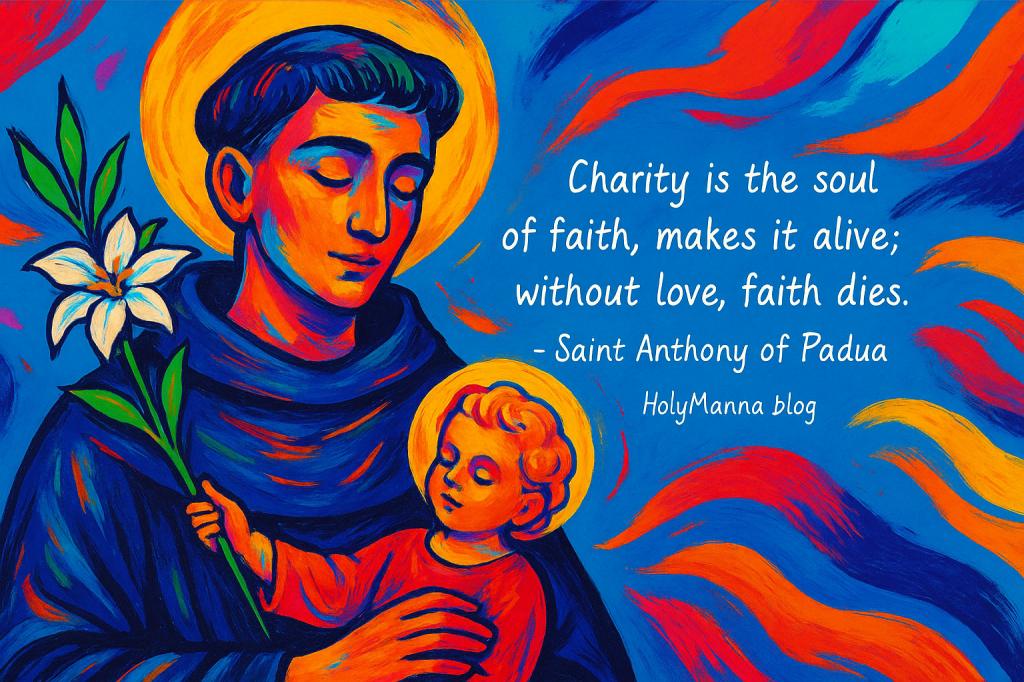
His homilies brought the Scriptures to life, filled with both profound wisdom and tender compassion. Often depicted holding the Christ Child, Saint Anthony invites us into a deeper intimacy with the Word made flesh. He was a fearless warrior for truth, a healer of the body and soul, and a man of radical humility. His life is a testament to how the Holy Spirit can utterly transform a heart that says yes.
What might God do in your life if you let Him speak through you, as He did through Saint Anthony?
From Palaces to Poverty
Fernando Martins de Bulhões was born in 1195 in Lisbon, Portugal, into a wealthy and noble family. The comforts of privilege and status surrounded him, and his future likely seemed destined for power or prestige. But God had other plans. Drawn to the things of heaven from an early age, Fernando left everything behind to join the Canons Regular of Saint Augustine. For nearly a decade, he studied Sacred Scripture, meditated on the writings of the Church Fathers, and cultivated a life of prayer and penance.
The real pivot in his life came in a flash of grace when the bodies of five Franciscan martyrs were brought to Coimbra. These friars had died preaching the Gospel in Muslim lands, and their blood stirred Fernando’s soul like a trumpet call. He longed to be like them—burning with love for Christ, fearless in the face of death, poured out entirely for the Kingdom. He joined the Franciscan Order and took the name Anthony, in honor of Saint Anthony the Great, the desert hermit.
Anthony set sail for Morocco to follow the martyrs’ path, but divine providence intervened. He became severely ill and had to return home. A storm rerouted his ship to Sicily, where he remained unknown among his Franciscan brothers—until one day, during an ordination, he was unexpectedly asked to preach. What poured forth from his mouth astonished everyone. His speech was eloquent, his theology profound, and his soul radiant with God’s presence. Word of his gifts quickly spread, and Saint Francis of Assisi himself appointed him to teach theology to the friars, a rare and sacred trust.
From that point on, Anthony traversed Italy and southern France, preaching to crowds that sometimes numbered in the tens of thousands. He confronted heresies, consoled the brokenhearted, uplifted the poor, and turned sinners toward God. His life became an unceasing sermon—a living icon of divine mercy, truth, and love.
Have you ever considered how God might be calling you to leave something behind to follow Him more fully?
Heaven Breaks Through
The life of Saint Anthony was so steeped in the supernatural that his biography reads like the Acts of the Apostles. Wherever he went, miracles followed—not for spectacle, but as divine confirmation of his holiness and mission. He was known as a healer, a prophet, and a worker of wonders, all of which served one purpose: to bring souls to Christ.
One of the most striking accounts is the Miracle of the Mule. To silence a local heretic who mocked the Real Presence of Jesus in the Eucharist, Anthony proposed a test. The man’s donkey would be deprived of food for three days and then presented with both a pile of hay and the Blessed Sacrament. On the appointed day, the mule bypassed the hay and knelt before the Eucharist. The crowd, stunned, erupted in praise, and many converted on the spot.
Another powerful story is that of the sermon to the fish. When the people of Rimini would not listen to his preaching, Anthony turned to the sea. As he spoke, fish gathered near the shore, lifting their heads above the water, appearing to listen in reverent silence. Shamed by the sight, the townspeople repented.
He also performed countless healings: restoring sight to the blind, speech to the mute, and freedom to those tormented by evil spirits. Often, he would raise a hand in prayer, and miracles would occur without a word.
And yet, Anthony never took credit. He always directed attention to Jesus, the true healer. These wonders were not about him—they were manifestations of divine love flowing through an empty vessel.
Do we allow God’s power to work through us in our own limited ways, or do we shrink back from the extraordinary?
A Warrior’s Trials
Though he did not die a martyr’s death, Saint Anthony lived a life of daily martyrdom. His was the white martyrdom of poverty, rejection, physical exhaustion, and relentless service. As a missionary preacher in the 13th century, he faced long travels on foot, primitive conditions, and the weight of spiritual warfare. He frequently battled heresies such as Catharism, often putting himself at personal risk in regions hostile to the Church.
Despite his dazzling intellect, he was sometimes dismissed or envied by those in authority. His radiant gifts were a threat to prideful hearts, yet Anthony never retaliated. He answered cruelty with gentleness, opposition with truth, and injustice with humble silence.
His health was frail, and the intensity of his preaching life took a heavy toll. In his final years, Anthony withdrew to a small hermitage near Padua, where he continued to teach, write, and pray. There, in a treehouse-like cell built in a walnut tree, he spent his last days in contemplation. On June 13, 1231, at just 36 years old, he surrendered his soul to God, whispering the words: “I see my Lord.”
How do you respond to trials and opposition? Could they be invitations to union with Christ’s Cross?
The Saint Who Never Sleeps
Saints do not stop working when they die—they continue their mission from heaven with even greater power. This has never been more evident than in the life of Saint Anthony of Padua, whose posthumous miracles have spanned centuries and continents.
Almost immediately after his death, reports of healings, conversions, and divine interventions multiplied. So widespread were the testimonies that Pope Gregory IX canonized him within a year, a rare occurrence in Church history. Anthony became known as the “Saint of the Whole World,” beloved across cultures and languages.
One of the most curious and enduring devotions to Saint Anthony is his role as the patron of lost things. This comes from a story in which a novice stole Anthony’s valuable psalter. The saint prayed, and not only was the book miraculously returned, but the novice repented and rejoined the friars. Since then, countless people have experienced his help in finding lost objects, but more importantly, many have found their way back to God through his intercession.
Perhaps most extraordinary is the miracle of his incorrupt tongue. When his body was exhumed in 1263, it had decayed, except for his tongue, which remained perfectly preserved—shining, moist, and red, as if alive. Saint Bonaventure, awestruck, cried out: “O blessed tongue, that always praised the Lord and made others bless Him, now it is evident how great were your merits before God!”
Today, the Basilica of Saint Anthony in Padua stands as a beacon of hope. Pilgrims from around the world visit his tomb, pray before his relics, and ask for his help. He is a saint who never tires of working miracles, never ceases to draw souls to Christ, and never stops reminding us that heaven is close.
When was the last time you asked a saint to intercede for you? Are you open to the grace that God might want to pour into your life through them?
Becoming a Living Gospel
Saint Anthony did not merely preach the Gospel—he became the Gospel. His life was a radiant flame that burned with Scripture, Eucharist, and charity. He did not live for applause or comfort, but to make Christ known and loved. In him, the words of 2 Timothy 4:2 come alive: “Preach the word; be ready in season and out of season; reprove, rebuke, and exhort, with complete patience and teaching.”
We are not all called to be miracle-workers or preachers to the multitudes, but we are all called to holiness. We are called to let our lives preach—to become living letters of Christ, written not with ink but with the Spirit of the living God (cf. 2 Corinthians 3:3).
As the Catechism of the Catholic Church reminds us:
“The saints have always been the source and origin of renewal in the most difficult moments in the Church’s history” (CCC 828).
What if you and I are being called to be such saints today? Not in stained glass, but in real life—in the classroom, the office, the family dinner table, the silence of prayer. Like Saint Anthony, we can offer our intellect, our voice, our heart, our suffering—all for Jesus.
Are we willing to be vessels of truth, even when it’s unpopular?
Can we commit to daily prayer and Scripture like Anthony did?
What would it look like to serve the poor in our own neighborhood, to forgive our enemies, to live with radical generosity?
Saint Anthony, pray for us, that we might become faithful instruments of God’s love, now and forever.
Engage with Us!
Let Saint Anthony’s life stir your soul and deepen your faith. Share your story in the comments—how has Saint Anthony helped you? Which of his virtues do you want to grow in?
Reflection Questions:
- What part of Saint Anthony’s story most inspires or challenges you today?
- Have you ever experienced the power of intercessory prayer through a saint?
- In what ways can you imitate Saint Anthony’s love for the poor, the Eucharist, and Scripture?
May we, like Saint Anthony, preach not only with words but with our lives—becoming living tabernacles of Christ’s mercy and truth.
Let us walk together, supporting one another in faith and love—just as Saint Anthony continues to do for the Church.
Saint Anthony of Padua, pray for us! 🔥
Follow us on Instagram and Facebook for more insights and reflections on living a faith-filled life.

 Holy Manna!
Leave a comment