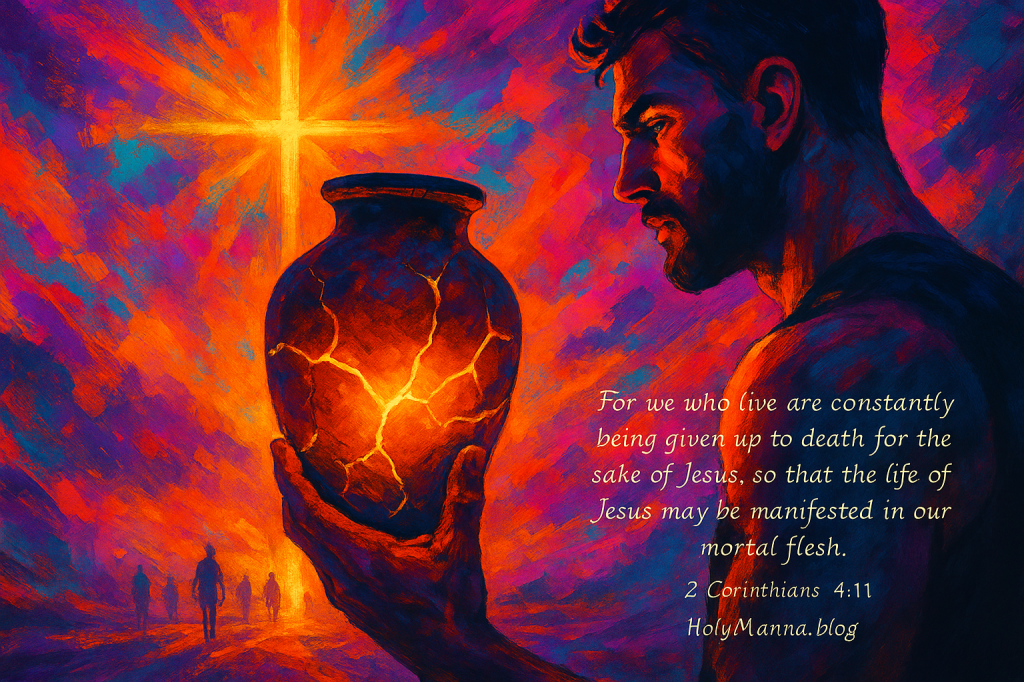
When Dying Becomes Living
Have you ever felt that letting go of something inside you—some desire, habit, or wound—felt like a kind of death? Today’s readings speak directly to that sacred tension between dying and living, between suffering and resurrection, between purity and pain. They remind us that in the Christian life, sanctity is not about comfort or self-preservation. It’s about becoming a vessel that carries the very life of Christ, even if that means being broken open to let His light shine through. This isn’t a feel-good spirituality; it’s a call to deep, transformative holiness that touches every part of us—body, soul, and heart.
St. Paul opens the door with his words in 2 Corinthians 4:7-15, painting the Christian minister as an “earthen vessel”—fragile, afflicted, struck down, yet not destroyed. In Paul’s Jewish and Greco-Roman context, such vulnerability might have seemed shameful or weak. Yet Paul turns that on its head: our human weakness becomes the canvas on which God’s power is displayed. This is no abstract philosophy. The early Church, forged in persecution, lived out this mystery daily. The Psalmist echoes this with a deeply personal prayer from Psalm 116, confessing faith amid affliction and proclaiming that “Dear in the eyes of the Lord is the death of his devoted”. Suffering isn’t wasted—it’s sacred.
And then, The Gospel of Matthew pierces through with Jesus’ radical teachings on adultery, lust, and divorce. At first glance, these might seem like a moral pivot from Paul’s message of suffering. But Jesus’ words in Matthew 5:27-32 call us to a different kind of mortification: a death to interior sin. “Everyone who looks at a woman with lust has already committed adultery with her in his heart”, He says—revealing that true holiness is not skin-deep but soul-deep. Jesus invites us to go so far as to “cut off” anything that causes us to sin. This is not cruelty—it’s love that wants us whole, even if it requires us to die to parts of ourselves. Through affliction, through fidelity, through the fire of moral discipline, today’s readings draw us into the paradox of divine life: when we die to sin, Christ lives in us. Are we willing to let the old self fall away, so that His glory may shine through our weakness?
First Reading – 2 Corinthians 4:7-15
When Weakness Becomes Witness
Paul’s second letter to the Corinthians is one of the most vulnerable, heartfelt writings in the New Testament. Penned around A.D. 55–57, this letter reveals Paul not only as a theologian but as a suffering servant of Christ who has been bruised by persecution, misunderstood by the Church, and challenged in his authority. In Greco-Roman society, honor and power were highly valued, so Paul’s public admission of weakness would have sounded almost scandalous. Yet he flips cultural values upside down to reveal something astonishing: our fragility is the very place where God’s power dwells. This passage fits beautifully into today’s theme of dying in order to live. Paul is writing to a community plagued by division and spiritual pride, and he reminds them—and us—that sanctity is not proven by external glory but by internal faithfulness through trial. His paradoxes become promises for those walking through affliction in faith.
2 Corinthians 4:7-15
New American Bible (Revised Edition)
The Paradox of the Ministry. 7 But we hold this treasure in earthen vessels, that the surpassing power may be of God and not from us. 8 We are afflicted in every way, but not constrained; perplexed, but not driven to despair; 9 persecuted, but not abandoned; struck down, but not destroyed; 10 always carrying about in the body the dying of Jesus, so that the life of Jesus may also be manifested in our body. 11 For we who live are constantly being given up to death for the sake of Jesus, so that the life of Jesus may be manifested in our mortal flesh.
12 So death is at work in us, but life in you. 13 Since, then, we have the same spirit of faith, according to what is written, “I believed, therefore I spoke,” we too believe and therefore speak, 14 knowing that the one who raised the Lord Jesus will raise us also with Jesus and place us with you in his presence. 15 Everything indeed is for you, so that the grace bestowed in abundance on more and more people may cause the thanksgiving to overflow for the glory of God.
Detailed Exegesis
Verse 7 – “But we hold this treasure in earthen vessels, that the surpassing power may be of God and not from us.”
Here, “this treasure” refers to the Gospel, the very light of Christ. Paul uses the image of “earthen vessels” (clay jars) to describe human frailty. In antiquity, clay jars were cheap, fragile, and disposable—yet it is precisely these containers that God chooses to house His power. The contrast is intentional: it’s not about the worth of the vessel but the glory of what it contains. This underscores a key Christian mystery—our weaknesses don’t disqualify us from God’s mission; they magnify His grace.
Verse 8 – “We are afflicted in every way, but not constrained; perplexed, but not driven to despair.”
Paul catalogs his afflictions as part of the apostolic calling. Each phrase is a contrast between external suffering and interior perseverance. This verse reveals a Christian’s interior life: though circumstances press us, we are not crushed; though confused, we are not hopeless. It’s a lived echo of Psalm 34:19: “Many are the afflictions of the righteous, but the Lord delivers him out of them all.”
Verse 9 – “Persecuted, but not abandoned; struck down, but not destroyed.”
Paul continues the pattern. “Persecuted” suggests both physical threat and social exclusion, but the assurance is that God has not abandoned him. “Struck down” may recall public stonings or beatings, but Paul declares that he is not finished. This verse resonates with the enduring truth of Romans 8:35: “Who will separate us from the love of Christ?”
Verse 10 – “Always carrying about in the body the dying of Jesus, so that the life of Jesus may also be manifested in our body.”
This verse encapsulates the Paschal Mystery: death leads to life. Paul embodies the Crucified Christ, not only spiritually but physically, in his sufferings. But these sufferings are not ends in themselves—they reveal the resurrected Christ to the world. We are called to be “living icons” of Jesus, even when it hurts.
Verse 11 – “For we who live are constantly being given up to death for the sake of Jesus, so that the life of Jesus may be manifested in our mortal flesh.”
Paul’s sufferings are not accidental; they are a participation in Christ’s own mission. “Given up to death” is a daily reality for Paul, but it’s not pointless. The more he suffers for Jesus, the more Jesus becomes visible through him. This is a profound theology of redemptive suffering: God uses our mortality as a stage for eternal life.
Verse 12 – “So death is at work in us, but life in you.”
This is the paradox of Christian ministry. Paul suffers, not for his own sake, but so others may live spiritually. His sacrifices are intercessory, echoing Christ’s priestly role. This verse reflects the Eucharistic rhythm of dying to self so that others may be nourished.
Verse 13 – “Since, then, we have the same spirit of faith, according to what is written, ‘I believed, therefore I spoke,’ we too believe and therefore speak.”
Paul quotes Psalm 116:10, the very Psalm used in today’s Responsorial. Faith compels speech. He’s linking himself to the psalmist, saying that despite affliction, belief drives proclamation. Suffering cannot silence the one who trusts in God.
Verse 14 – “Knowing that the one who raised the Lord Jesus will raise us also with Jesus and place us with you in his presence.”
Paul anchors his hope in the resurrection. Just as Jesus was raised, so will we be. This is not just personal hope—it’s communal. Paul expects to be reunited with the faithful in the presence of Christ. This eschatological vision fuels his perseverance.
Verse 15 – “Everything indeed is for you, so that the grace bestowed in abundance on more and more people may cause the thanksgiving to overflow for the glory of God.”
Paul’s sufferings are for the sake of the Church. His ministry leads to more grace, which leads to more thanksgiving. The cycle ends not in human praise, but in the glory of God. Even pain becomes praise when it is offered for the Kingdom.
Teachings from the Church
The Catechism teaches us that our sufferings, united to Christ’s, participate in His redemptive work: “By his passion and death on the cross Christ has given a new meaning to suffering: it can henceforth configure us to him and unite us with his redemptive Passion” (CCC 1505). Paul’s declaration that “we carry in our bodies the dying of Jesus” is lived out in every baptized Christian who offers their trials as a living sacrifice (cf. Romans 12:1). The Church doesn’t glorify pain for its own sake, but sees it as a means to deepen our conformity to Christ.
St. John Paul II, in his apostolic letter Salvifici Doloris, echoes this mystery: “Suffering, more than anything else, makes present in the history of humanity the force of the Redemption” (SD, §27). This aligns perfectly with Paul’s theology in 2 Corinthians. The early martyrs and confessors of the faith often recited passages like this one to bolster courage in persecution. They saw their broken bodies not as curses, but as vessels of heavenly fire. That fire did not consume them—it glorified Christ.
Historically, this passage shaped the Church’s understanding of holy witness under trial. During Roman persecutions, bishops like St. Cyprian would quote Paul to embolden their flocks. The Communion of Saints is built on those who embraced the call to suffer well—not passively, but as active participants in Christ’s redeeming love. Their legacy affirms the Church’s timeless message: weakness is not the end; it’s the beginning of glory.
Reflection
What part of you feels like an earthen vessel today—fragile, cracked, or easily shattered? Paul’s message is a balm to every soul who has felt inadequate or weary. He tells us that it is precisely there—in the place of your perceived insufficiency—that the surpassing power of God wants to shine. Are you willing to let His grace dwell in your brokenness, rather than covering it with pride or shame? If we dare to carry the dying of Jesus in our bodies—through patience, chastity, forgiveness, and sacrificial love—then His life will break through us like sunlight through stained glass.
In your daily walk, begin to notice where suffering arises: in misunderstanding, in temptation, in health issues, or in the cost of obedience. Then, with Paul, whisper: “I believed, therefore I spoke”—and let your life speak boldly of hope. Don’t run from affliction. Offer it. Don’t silence your witness. Speak it. And in doing so, you become part of the divine paradox: a fragile vessel, yes—but one that pours out glory. What are you being asked to surrender today so that Christ may be more visible in you?
Responsorial Psalm – Psalm 116:10-11, 15-18
Faith That Endures Affliction
Psalm 116 is a heartfelt cry of gratitude from someone who has passed through the shadow of death and come out the other side alive. It’s part of the Hallel Psalms (Psalms 113–118), which were traditionally sung by the Jewish people during Passover. That means these very words were likely on Jesus’ lips during the Last Supper, just before He entered His own Passion. The psalmist, overwhelmed by suffering, affirms his faith in God not after the trial, but in the midst of it. This song echoes Paul’s message in 2 Corinthians 4, where suffering becomes the vessel for divine life. And in today’s Gospel from Matthew 5, where Jesus calls for radical interior purity and sacrifice, this psalm models the necessary heart posture: humble, obedient, and full of trust even when afflicted. In its rawness, Psalm 116 reminds us that praising God in pain is one of the most powerful forms of worship.
Psalm 116:10-11, 15-18
New American Bible (Revised Edition)
10 I kept faith, even when I said,
“I am greatly afflicted!”
11 I said in my alarm,
“All men are liars!”
15 Dear in the eyes of the Lord
is the death of his devoted.
16 Lord, I am your servant,
your servant, the child of your maidservant;
you have loosed my bonds.
17 I will offer a sacrifice of praise
and call on the name of the Lord.
18 I will pay my vows to the Lord
in the presence of all his people,
Detailed Exegesis
Verse 10 – “I kept faith, even when I said, ‘I am greatly afflicted!’”
Here, faith is not defined by comfort or certainty but by endurance. The psalmist does not wait for affliction to pass before believing. He believes while acknowledging the weight of suffering. This is biblical faith—trusting in God’s goodness while walking through trial. It echoes the courage of martyrs and saints who professed God’s name in prison, illness, and persecution. It also connects directly to 2 Corinthians 4:13, which Paul quotes in today’s reading: “I believed, therefore I spoke.” Faith is not silent. It confesses, even through tears.
Verse 11 – “I said in my alarm, ‘All men are liars!’”
In distress, the psalmist laments betrayal or the unreliability of people. It’s a deeply human cry, a moment of spiritual honesty. While not doctrinally accusing all people of evil, it reflects the feeling of isolation in suffering, especially when others fail to help. This line reminds us of Christ’s own betrayal and desertion by His disciples. When human supports fail, we are invited to rely wholly on the Lord.
Verse 15 – “Dear in the eyes of the Lord is the death of his devoted.”
This stunning verse reveals God’s tender gaze upon the faithful who suffer and die. The Hebrew word translated “dear” or “precious” also means “costly.” It implies that the suffering and death of God’s holy ones are never meaningless—they are seen, valued, and held with love. This fits today’s theme perfectly: the paradox that what looks like loss is, in God’s eyes, gain. The Church has long seen this verse as a reflection on the dignity of Christian martyrdom.
Verse 16 – “Lord, I am your servant, your servant, the child of your maidservant; you have loosed my bonds.”
This declaration affirms belonging and freedom in the same breath. The speaker identifies as a servant—not in slavery, but in joyful allegiance to a merciful Master. Referring to himself as the “child of your maidservant” is a poetic way of saying, “I was born into Your household.” The phrase “you have loosed my bonds” echoes the Exodus, when God delivered Israel from slavery. It reminds us that God’s deliverance often comes not by removing pain but by restoring dignity and communion in the midst of it.
Verse 17 – “I will offer a sacrifice of praise and call on the name of the Lord.”
This is the psalmist’s response to deliverance. In the Old Testament, a “sacrifice of praise” often involved public worship and thanksgiving offerings. But this verse transcends ritual. Praise itself becomes the sacrifice—especially when it costs us something. Like Paul’s affliction and Christ’s passion, the praise that rises from pain is holy.
Verse 18 – “I will pay my vows to the Lord in the presence of all his people.”
Vows were sacred commitments made during times of distress, promising acts of devotion once help was received. Fulfilling them in public was a form of witness. Here, the psalmist closes with a pledge to live out his gratitude before the community. Our private deliverance should flow into public faithfulness.
Teachings from the Church
The Catechism of the Catholic Church teaches that praise in the midst of suffering is an act of the theological virtue of hope. “Hope is expressed and nourished in prayer, especially in the Our Father, the summary of everything that hope leads us to desire” (CCC 1820). The psalmist models this hope-driven prayer, choosing trust over despair. The Church’s liturgical use of this psalm during Holy Week reinforces this connection: we are called to remember God’s saving power, especially in the hour of affliction.
St. Augustine offers a moving commentary on verse 15, writing: “Precious in the sight of the Lord is the death of His saints, not because He delights in their suffering, but because He crowns their endurance” (Enarrationes in Psalmos, Psalm 116). The psalmist’s words take on deeper meaning in light of the martyrs and all those who die in fidelity to Christ. Their deaths are not erased by time; they are etched into the heart of God.
Historically, this psalm has inspired saints to offer themselves completely to God, even when it costs everything. St. Teresa of Avila, during a time of great illness and abandonment, would frequently pray: “Let nothing disturb you, let nothing frighten you; all things pass, God never changes”—a living echo of this psalm’s spirit. The Church venerates those who, like the psalmist, lift up a “sacrifice of praise” amid pain, transforming their trial into a testimony.
Reflection
When you face hardship, do you tend to pull away from God—or lean in? Psalm 116 teaches us that the moment of affliction is not the time to go silent. It is the time to speak—to speak faith, to speak truth, to speak the name of the Lord. What if your pain was not a barrier to worship, but the place where true worship begins? Like the psalmist, you can declare, “I kept faith, even when I said, ‘I am greatly afflicted!’” Let that line become your anthem on the hard days.
Today, take a moment to reflect on the vows you have made to the Lord. Maybe it was a promise to pray more, to give generously, to forgive someone, or to change your life. Are you fulfilling your vows in the presence of His people, or hiding your gratitude in the shadows? God has loosed your bonds in countless ways—through the Cross, through grace, through mercy. Don’t keep your praise to yourself. Let it be a living sacrifice. What vow of gratitude can you make or renew today, as a servant of the God who sees your suffering and calls it precious?
Holy Gospel – Matthew 5:27-32
Purity of Heart, Fire of the Cross
The Gospel of Matthew was written primarily for a Jewish-Christian audience, deeply familiar with the Law of Moses. Jesus’ Sermon on the Mount, from which this passage comes, presents a revolutionary re-reading of the Law—not to abolish it, but to fulfill and deepen it. In this section, Jesus moves from external observance to the heart’s interior movements, revealing that sin is not only what we do but also what we desire. This is a radical shift from the prevailing Jewish legal interpretation of the time, which emphasized outward behavior over inward intent. Within today’s theme, this Gospel brings us to the very marrow of what it means to “carry in our bodies the dying of Jesus”—dying not just to suffering and persecution, but to the disordered desires that corrupt the heart. It is a call to interior martyrdom, a daily dying that allows the life of Jesus to be manifested within.
Matthew 5:27-32
New American Bible (Revised Edition)
Teaching About Adultery. 27 “You have heard that it was said, ‘You shall not commit adultery.’ 28 But I say to you, everyone who looks at a woman with lust has already committed adultery with her in his heart. 29 If your right eye causes you to sin, tear it out and throw it away. It is better for you to lose one of your members than to have your whole body thrown into Gehenna. 30 And if your right hand causes you to sin, cut it off and throw it away. It is better for you to lose one of your members than to have your whole body go into Gehenna.
Teaching About Divorce. 31 “It was also said, ‘Whoever divorces his wife must give her a bill of divorce.’ 32 But I say to you, whoever divorces his wife (unless the marriage is unlawful) causes her to commit adultery, and whoever marries a divorced woman commits adultery.
Detailed Exegesis
Verse 27 – “You have heard that it was said, ‘You shall not commit adultery.’”
Jesus begins with a direct quotation from the sixth commandment in Exodus 20:14. This would have been familiar and uncontroversial to His audience. Yet by opening with “You have heard,” Jesus signals that He’s about to deepen their understanding. The external act of adultery was clearly prohibited in the Law, but what about the internal posture of the heart?
Verse 28 – “But I say to you, everyone who looks at a woman with lust has already committed adultery with her in his heart.”
Here is the heart of the matter—literally. Jesus doesn’t abolish the commandment; He intensifies it. Lust is not mere attraction or recognition of beauty—it is a willful, disordered desire that turns another person into an object. By addressing the heart, Jesus calls for purity that penetrates thought, imagination, and intention. This verse also reflects Jesus’ dignity for the human person; He calls for love, not possession. As CCC 2528 affirms: “‘Everyone who looks at a woman lustfully has already committed adultery with her in his heart.’ The battle for purity passes through the struggle against concupiscence of the flesh and disordered desires.”
Verse 29 – “If your right eye causes you to sin, tear it out and throw it away. It is better for you to lose one of your members than to have your whole body thrown into Gehenna.”
Jesus uses stark, shocking language—not because He advocates literal mutilation, but because the urgency of sin demands radical action. The “right eye” represents something precious and useful, yet if it leads us to sin, it must be sacrificed. Gehenna was a valley outside Jerusalem used for burning refuse—a symbol of divine judgment. Jesus warns that even cherished things must be surrendered if they cause the soul to stumble.
Verse 30 – “And if your right hand causes you to sin, cut it off and throw it away. It is better for you to lose one of your members than to have your whole body go into Gehenna.”
This repeats the previous verse with another essential body part: the hand, symbolizing action and agency. Jesus again underscores the principle of radical self-denial. Nothing—no habit, no behavior, no attachment—is worth the cost of eternal separation from God. Discipleship requires courage to part with sin at the root, even when it hurts.
Verse 31 – “It was also said, ‘Whoever divorces his wife must give her a bill of divorce.’”
Jesus now transitions to another area of sexual ethics. This alludes to Deuteronomy 24:1, where Mosaic law permitted divorce with a formal writ. At the time, this practice had become casual and one-sided, often leaving women vulnerable and discarded. Jesus invokes this context to protect the sanctity of marriage.
Verse 32 – “But I say to you, whoever divorces his wife (unless the marriage is unlawful) causes her to commit adultery, and whoever marries a divorced woman commits adultery.”
Jesus speaks with divine authority to restore God’s original plan for marriage, as seen in Genesis 2:24. The exception clause—“unless the marriage is unlawful”—has been interpreted by the Church as referring to unions that were invalid from the start. The Catechism upholds this with clarity: “The Lord Jesus insisted on the original intention of the Creator who willed that marriage be indissoluble. He abrogates the accommodations that had slipped into the old Law” (CCC 1614). This verse is not a condemnation, but a restoration of sacred covenant love.
Teachings from the Church
The Catechism emphasizes that purity of heart is essential to seeing God: “There is a connection between purity of heart, of body, and of faith: The faithful must believe in the resurrection of the dead, and hope for it; they must live in accordance with the dignity of their bodies, and with the holiness required by their new being” (CCC 2518). Jesus’ words in Matthew 5 are not merely moral restrictions—they are invitations to wholeness. By training our desires in truth and charity, we become capable of true love.
St. Thomas Aquinas teaches that chastity, properly understood, is not the suppression of desire but the ordering of it toward its divine end. He writes, “Chastity is the spiritual energy which defends love from the perils of selfishness and aggressiveness” (Summa Theologiae, II-II, Q.151). Jesus’ strong language in this Gospel is a safeguard for that spiritual energy. It is not prudishness—it is passion refined by grace.
In Church history, many saints—such as St. Maria Goretti, St. Augustine, and St. John Paul II—lived out these teachings with heroic witness. St. John Paul II’s Theology of the Body sheds luminous light on these verses, teaching that the human body is meant to be a sign of divine love, never a tool for personal gratification. He wrote: “The body, in fact, and only the body, is capable of making visible what is invisible: the spiritual and the divine” (TOB, Jan. 2, 1980). Jesus calls us to such reverence for our own bodies and for others’.
Reflection
When Jesus speaks these words, He is not merely correcting behavior—He is calling us into a new kind of holiness. Are you willing to let Him purify your desires, even when it feels like dying to yourself? The “cutting off” He speaks of may be the end of an unholy habit, the letting go of an impure relationship, or the silencing of a lingering fantasy. It will hurt. But it will heal.
In your daily life, this Gospel invites you to examine the hidden spaces of the heart. What do you entertain in your thoughts or watch with your eyes that does not honor the dignity of the person? Jesus calls us to discipline not for shame, but for freedom. The world says, “Follow your desires.” Jesus says, “Cut off what leads you to sin”—because what’s at stake is eternal joy. Let His words today stir your conscience, not in fear, but in love. Where is Jesus calling you to interior martyrdom, to die a little so that you may truly live in Him?
Wounds That Shine
Today’s readings reveal the path of the Christian disciple as one of paradox and transformation. From 2 Corinthians, we learn that our weakness is not an obstacle to God’s power, but its very dwelling place. “We hold this treasure in earthen vessels”—we carry in our bodies the dying of Jesus so that His life may radiate through us. Psalm 116 reminds us that suffering is sacred, and that “precious in the eyes of the Lord is the death of his devoted”. Even in distress, we are called to lift up a “sacrifice of praise.” Finally, The Gospel of Matthew confronts us with Jesus’ radical invitation to interior purity. It’s not enough to look righteous on the outside—our hearts must be clean, our desires ordered, our choices refined by the fire of love. “If your right eye causes you to sin, tear it out”—not out of fear, but because nothing is worth more than union with God.
At the heart of each reading is this truth: we must die to self in order to live in Christ. Whether that death comes through affliction, abandonment, temptation, or the painful surrender of disordered desire, it is always a death that leads to resurrection. Jesus does not call us to mutilation but to transformation. And that transformation happens when we allow His grace to meet us right in our vulnerability, our brokenness, and our need.
What part of you is God asking to break open today, so His light can shine through? Let Him in. Offer your weakness. Speak faith through your affliction. Say no to sin—even in secret. And praise Him, even when it costs you. You are an earthen vessel, but you carry eternal treasure. Walk today in that truth. Be radiant in your surrender. Let your wounds become windows through which the world sees the glory of God.
Engage with Us!
We’d love to hear how today’s readings spoke to your heart. Where did you feel the challenge? Where did you sense hope? Share your thoughts, prayers, or personal reflections in the comments below. Your story could inspire someone else on their journey of faith!
Reflection Questions:
First Reading – 2 Corinthians 4:7-15
What parts of your life feel like “earthen vessels” right now—fragile, hidden, or unworthy? How might God be inviting His surpassing power to shine through those areas of weakness? What does “carrying in the body the dying of Jesus” look like in your daily routine or vocation?
Responsorial Psalm – Psalm 116:10-11, 15-18
Have you ever experienced God’s presence in the middle of suffering? How did that shape your faith? What “sacrifice of praise” can you offer God today, even if things feel heavy or uncertain? Is there a vow or commitment to the Lord that you need to renew with love and devotion?
Holy Gospel – Matthew 5:27-32
Are there habits, thoughts, or desires in your life that Jesus is asking you to “cut off” in order to grow in holiness? What does purity of heart mean to you—not just in action, but in intention? How can you love others with greater reverence, seeing them as icons of God rather than objects of desire or use?
As you go forward today, remember: holiness is not perfection—it’s surrender. Live your faith boldly. Offer your wounds humbly. And do all things—yes, all things—with the mercy and love that Jesus taught us. You are a vessel of His glory. Shine with it.
Follow us on Instagram and Facebook for more insights and reflections on living a faith-filled life.

 Holy Manna!
Leave a comment