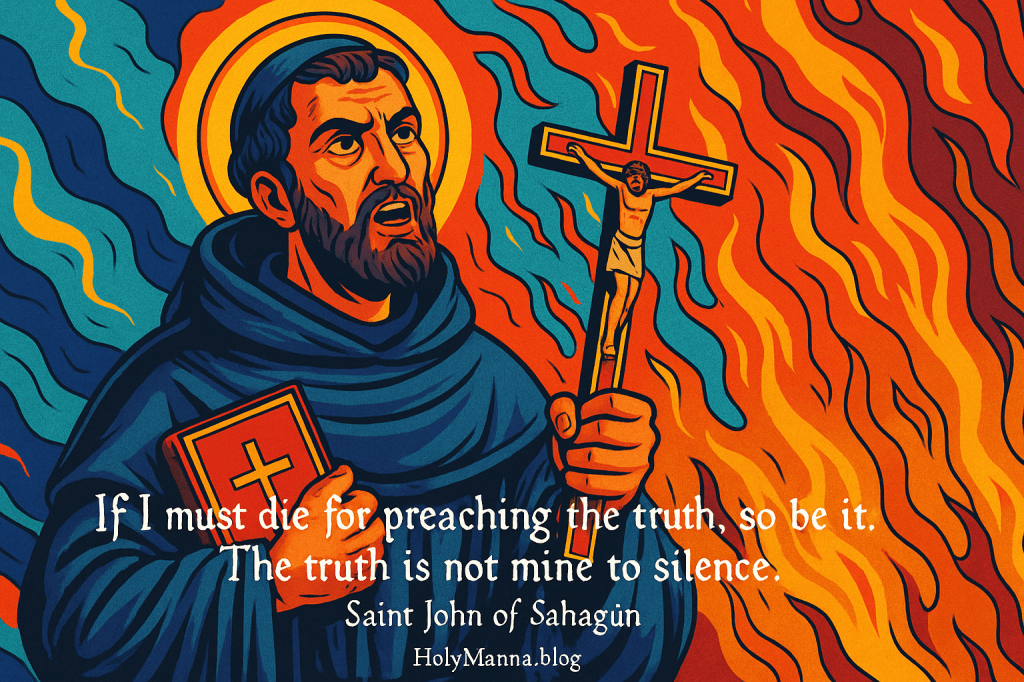
A Prophet in the Pulpit
In the golden heart of 15th-century Spain, where the Church’s voice often mingled with political favor and public complacency, God raised up a fearless reformer—Saint John of Sahagún. He was not a saint who stayed safely cloistered away from the world’s corruption. Rather, he was called to step into it, illuminate it with truth, and set it ablaze with love. Known throughout the city of Salamanca as “the Apostle of Truth,” Saint John was a man of prayer, discipline, and fervent preaching. He used his voice not to charm, but to convict; not to flatter, but to awaken. His sermons regularly challenged the powerful and comforted the oppressed. He was equally unafraid of princes as he was concerned for peasants. His devotion to the Eucharist burned brightly in every word he spoke, in every injustice he fought, and in every act of healing that followed him. Canonized by Pope Alexander VIII in 1690, he remains today a spiritual model for those called to proclaim the Gospel without compromise. “Blessed are those who hunger and thirst for righteousness, for they shall be satisfied” (Matthew 5:6) was not just a beatitude for him—it was a mission.
A Scholar Called to Holiness
Born around the year 1419 in the village of Sahagún, in the ancient Kingdom of León, Juan González del Castrillo grew up in a devout family steeped in Christian values. His early years were marked by piety and academic brilliance. Recognizing his gifts, his parents sent him to the famed University of Salamanca. There, young John distinguished himself in philosophy and theology. His intellect, however, was rivaled by his desire to serve the Church. Encouraged by Bishop Alfonso of Cartagena, he received the minor orders and began to enjoy a comfortable life in the Church’s service—accumulating benefices and titles as many did in his day.
Yet something within him was unsettled. His soul began to ache for deeper union with Christ, a hunger no worldly honor could satisfy. A profound conversion took root in his heart as he recognized that to truly serve God, he must first surrender completely. In a radical act of detachment, he renounced his benefices and entered the Order of Saint Augustine in Salamanca around the age of 44. This was not a career move—it was a death to self and a rebirth in grace. In the monastery, he embraced poverty, humility, obedience, and an intense rhythm of prayer and study. His transformation was immediate and unmistakable. The man who had once lived in clerical comfort now lived in ascetic simplicity. He rose quickly in the esteem of his brethren not for his past titles, but for his present holiness.
What Saint John is most remembered for, however, is his prophetic preaching. He became the conscience of Salamanca. Whether preaching in the Cathedral or on street corners, he addressed corruption, adultery, exploitation, and injustice with fearless clarity. He upheld the dignity of the poor and called out abuses among the powerful. People flocked to hear him—not because his words were easy, but because they were true. He called sinners to repentance with tears in his eyes and the fire of Christ in his voice.
Miracles of the Living Flame
Saint John of Sahagún was not merely a moral reformer or a passionate preacher—he was a man through whom God revealed His power. The miracles attributed to him during his life were not rare exceptions, but visible expressions of his deep communion with the Lord.
One of the most striking features of his ministry was the healing power associated with the Holy Eucharist. Time and time again, the sick and suffering would come to him and be healed after receiving Holy Communion from his hands. Parents brought dying children. The crippled came with canes and left walking. Others reported peace in tormented hearts and the lifting of spiritual oppression after attending his Masses. His devotion to the Real Presence of Christ in the Eucharist was contagious, and people began to approach the Sacrament with new reverence.
He also possessed a mysterious gift of prophecy and discernment. He could read souls with divine insight, often revealing to individuals sins or wounds they had hidden for years. Rather than rebuke them harshly, he led them tenderly to confession and restoration. His fame spread far and wide, not for fame’s sake, but because hearts were being converted and healed.
On one occasion, while denouncing public sin, he was attacked by a hired assassin. The attempt failed completely—John walked away without a scratch. To those who witnessed it, it was a clear sign of divine protection. In this and many other moments, God seemed to place His seal on John’s mission: this was a man not acting on his own, but in the Spirit.
Fire of the Cross
To preach against sin is to invite resistance—and Saint John of Sahagún knew this all too well. As his popularity among the faithful grew, so too did hostility from those whose lives he exposed to the light of Christ. Local authorities, noble families, and even some clerics took offense at his preaching. They accused him of meddling, arrogance, and causing unrest. But John’s conscience was anchored not in public opinion but in the truth of the Gospel.
The threats became more serious. Attempts were made to silence him, and false accusations were leveled to tarnish his name. Still, he refused to retreat. He spoke from the pulpit with even greater urgency, urging people to repentance and reminding them of their eternal destiny. His sermons began to draw comparisons to the prophets of old—fiery, fearless, and Spirit-led.
Toward the end of his life, John fell seriously ill. Many suspected he had been poisoned by enemies who could no longer bear his rebukes. Though no formal investigation ever confirmed it, tradition holds that this was a martyrdom of conscience—a man killed not by the sword but by the hatred of those who rejected truth. He bore his final suffering with the same calm and confidence he had shown throughout his ministry. “If they persecute you in one town, flee to the next” (Matthew 10:23)—but Saint John chose to stay. He offered his pain for the conversion of his enemies and the sanctification of the Church.
He passed into eternal life on June 11, 1479, surrounded by his Augustinian brothers, and was buried in their monastery in Salamanca. His death marked the end of a holy struggle and the beginning of a legacy that would stretch across centuries.
After the Final Amen
Even in death, the voice of Saint John of Sahagún did not fall silent. Almost immediately, the faithful began to report miraculous favors received through his intercession. His tomb in Salamanca became a place of pilgrimage and prayer, and countless pilgrims testified to healings—both physical and spiritual—after invoking his name.
Blind eyes were opened. Tumors vanished. Despairing hearts found hope. Women struggling with infertility credited his intercession for miraculous conceptions. The Augustinian monastery preserved relics of his clothing and items he had touched, which were reverently carried to the homes of the sick during plagues. His spiritual power seemed even more vibrant after death than before.
The Church, ever prudent in her discernment of miracles, gathered testimonies and evidence. By the end of the 17th century, the holiness of Saint John of Sahagún could no longer be denied. Pope Alexander VIII canonized him in 1690, raising him to the altars and inviting the universal Church to venerate him as a saint.
To this day, Salamanca honors him as one of its most cherished patrons. His feast day, June 11, is marked with solemn liturgies, processions, and acts of charity. The Church continues to turn to him for strength in speaking the truth and courage in confronting injustice. “The righteous will flourish like the palm tree and grow like a cedar of Lebanon” (Psalm 92:12)—indeed, his roots still nourish the faithful, centuries after his death.
A Voice for Our Times
What does Saint John of Sahagún say to us today? Perhaps more than ever, his voice is needed in a world riddled with moral confusion, passive Christianity, and spiritual lukewarmness. His life challenges us to speak truth not with anger but with love—to confront injustice not with hatred, but with the heart of Christ. He reminds us that holiness is not about hiding from the world, but about transforming it from within.
How are you being called to be a prophetic witness in your workplace, your family, or your parish?
What comforts or attachments might you need to surrender in order to fully live for Christ, as John did when he left his benefices behind?
Do you believe in the power of the Eucharist to transform you, heal you, and send you on mission?
Saint John teaches us that to be Christian is to be courageous. To follow Christ is to follow Him to the Cross—and beyond it, to the glory of the Resurrection. Let us imitate his zeal, his humility, and his bold love for souls. Let us not be afraid to speak up, to live differently, and to stand for truth in a world that desperately needs it.
Let us be bold. Let us be holy. Let us be saints.
💬 Engage with Us!
What part of Saint John of Sahagún’s story moved your heart the most? Share your thoughts in the comments below!
Here are a few reflection questions to help you go deeper:
- What injustice in your community or personal life needs to be addressed with truth and love?
- How can you cultivate a deeper love and reverence for the Eucharist, as Saint John did?
- Who is someone in your life who needs a prophetic word of encouragement or correction, spoken in love?
Let’s lift each other up and strive to live as Saint John of Sahagún did with fearless faith, deep compassion, and unwavering love for Jesus Christ.
Together, may we echo his witness in our own time and boldly proclaim, “Lord, make me an instrument of Your truth and peace.”
Saint John of Sahagún, pray for us! 🔥
Follow us on Instagram and Facebook for more insights and reflections on living a faith-filled life.

 Holy Manna!
Leave a comment