Unveiled and Reconciled
Have you ever felt like there was something keeping you from truly seeing God? Like there’s a spiritual film over your eyes or a weight on your heart that clouds your vision? Today’s readings invite us into a profound encounter with the transforming light of Christ—a light that unveils, heals, and reconciles.
In the time of St. Paul, many of his fellow Jews clung to the Law of Moses without recognizing its fulfillment in Christ. Paul, writing to the Corinthians, explains that “a veil lies over their hearts” when Moses is read, but that “whenever a person turns to the Lord the veil is removed” (2 Corinthians 3:15–16). This veil isn’t just a metaphor for misunderstanding—it represents spiritual blindness, a refusal or inability to see the fullness of God’s glory revealed in Jesus. In contrast, those who live in the Spirit can gaze “with unveiled face” and be transformed “from glory to glory” into His image. The early Church was formed by this radical shift: from a veiled religion of externals to an unveiled relationship with the living Christ.
This same unveiling is what Jesus calls for in The Gospel of Matthew—a righteousness not of appearances, but of the heart. The scribes and Pharisees followed the Law rigorously, yet Jesus insists: “Unless your righteousness surpasses that of the scribes and Pharisees, you will not enter into the kingdom of heaven” (Matthew 5:20). He draws us deeper, past external obedience into interior reconciliation: not just avoiding murder, but uprooting anger; not just offering sacrifice, but restoring relationships. The psalm beautifully captures the fruit of such transformation: “Love and truth will meet; justice and peace will kiss” (Psalm 85:11). Are we willing to let Christ’s light reach into the dark, angry, or prideful corners of our hearts? The unveiled heart, illumined by Christ, becomes fertile ground for justice, mercy, and peace to flourish. As we journey through today’s Scriptures, how is God inviting you to remove the veil and step into His light?
First Reading – 2 Corinthians 3:15–4:1, 3–6
Becoming Radiant in the Spirit
Have you ever felt like something is keeping you from seeing God clearly? Like a spiritual fog that clouds your soul? In today’s First Reading, St. Paul speaks into that exact human condition. Written to the Corinthian church around A.D. 55–57, this letter addresses a community torn by divisions, doubts, and spiritual immaturity. Paul contrasts the glory of the old covenant, mediated by Moses and the Law, with the surpassing glory of the new covenant in Christ, mediated by the Spirit. He refers to a “veil” that lies over the hearts of those who cling to the Law without seeing Christ as its fulfillment—an image drawn from Exodus 34:29–35, where Moses veiled his radiant face after speaking with God. In today’s verses, Paul reveals that only through turning to the Lord is this veil lifted. What follows is one of the most beautiful teachings on Christian transformation in all of Scripture. The passage not only connects deeply to the Gospel’s call for inner conversion but also illuminates our journey from blindness to sight, from law to grace, from shadow to glory.
2 Corinthians 3:15-4:1, 3-6
New American Bible (Revised Edition)
3:15 To this day, in fact, whenever Moses is read, a veil lies over their hearts, 16 but whenever a person turns to the Lord the veil is removed. 17 Now the Lord is the Spirit, and where the Spirit of the Lord is, there is freedom. 18 All of us, gazing with unveiled face on the glory of the Lord, are being transformed into the same image from glory to glory, as from the Lord who is the Spirit.
Integrity in the Ministry. 4:1 Therefore, since we have this ministry through the mercy shown us, we are not discouraged.
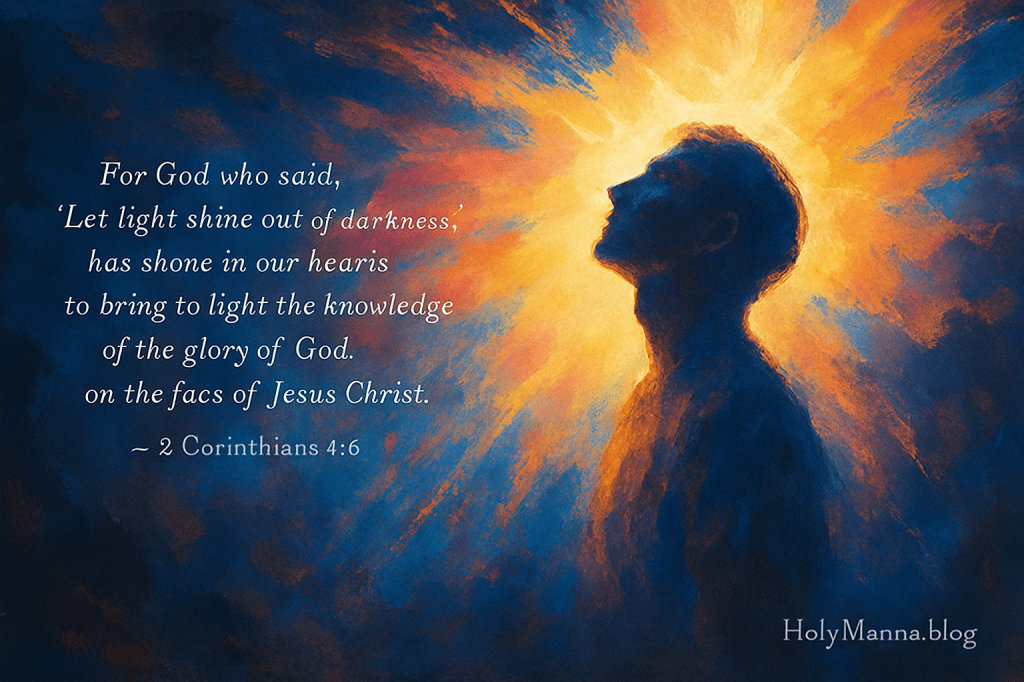
3 And even though our gospel is veiled, it is veiled for those who are perishing, 4 in whose case the god of this age has blinded the minds of the unbelievers, so that they may not see the light of the gospel of the glory of Christ, who is the image of God. 5 For we do not preach ourselves but Jesus Christ as Lord, and ourselves as your slaves for the sake of Jesus. 6 For God who said, “Let light shine out of darkness,” has shone in our hearts to bring to light the knowledge of the glory of God on the face of [Jesus] Christ.
Detailed Exegesis
Verse 15 – “To this day, in fact, whenever Moses is read, a veil lies over their hearts.”
Paul describes the ongoing spiritual blindness among some of his fellow Jews. The “veil” over their hearts is not literal but symbolizes a hardened resistance to the truth. This veil prevents them from understanding that the Law of Moses points to Christ, the fulfillment of the covenant.
Verse 16 – “But whenever a person turns to the Lord the veil is removed.”
Here Paul emphasizes personal conversion. Turning to the Lord removes the veil—this is a clear affirmation that Christ alone brings true spiritual sight. The act of turning echoes biblical themes of repentance and renewal, found throughout both Old and New Testaments.
Verse 17 – “Now the Lord is the Spirit, and where the Spirit of the Lord is, there is freedom.”
Paul makes a profound statement about the unity of Christ and the Holy Spirit. The presence of the Holy Spirit brings not only revelation but freedom—freedom from sin, from the burden of the Law, and from the power of darkness. This verse echoes John 8:36: “If the Son sets you free, you will be free indeed.”
Verse 18 – “All of us, gazing with unveiled face on the glory of the Lord, are being transformed into the same image from glory to glory, as from the Lord who is the Spirit.”
This verse describes the ongoing transformation of the believer. The Greek term for “transformed” is metamorphousthe, implying deep, spiritual metamorphosis. To gaze with “unveiled face” means to contemplate Christ directly, and in doing so, to become more like Him. This is the heart of Christian sanctification.
Chapter 4, Verse 1 – “Therefore, since we have this ministry through the mercy shown us, we are not discouraged.”
Paul sees his apostolic mission not as a burden, but as a mercy. Because this calling is rooted in divine mercy, not personal merit, he remains steadfast. The verse sets the tone for the rest of the chapter: endurance rooted in grace.
Verse 3 – “And even though our gospel is veiled, it is veiled for those who are perishing.”
Paul acknowledges that the message of the Gospel is not understood by all. The veil remains for those who reject it—those who are “perishing” due to their refusal to accept the truth. This underscores the tragedy of spiritual blindness and the urgency of evangelization.
Verse 4 – “In whose case the god of this age has blinded the minds of the unbelievers, so that they may not see the light of the gospel of the glory of Christ, who is the image of God.”
This is one of the strongest spiritual warfare verses in Scripture. The “god of this age” is a reference to Satan, who blinds minds to keep them from seeing Christ. Paul affirms that Christ is not merely a teacher or prophet, but “the image of God.”
Verse 5 – “For we do not preach ourselves but Jesus Christ as Lord, and ourselves as your slaves for the sake of Jesus.”
Paul makes it clear that the Gospel is not about ego or self-promotion. His identity is rooted in servanthood for Christ. This humility is essential for authentic Christian witness.
Verse 6 – “For God who said, ‘Let light shine out of darkness,’ has shone in our hearts to bring to light the knowledge of the glory of God on the face of Christ.”
Drawing from Genesis 1:3, Paul links the creation of physical light to the creation of spiritual light within the human heart. This divine light reveals the full glory of God—now made visible in the face of Jesus Christ. It is a cosmic and personal truth.
Teachings of the Church
The Catechism of the Catholic Church connects deeply with this passage when it states: “The Word became flesh to make us ‘partakers of the divine nature’” (CCC 460, quoting 2 Peter 1:4). When Paul says we are being transformed into Christ’s image, he is referring to our participation in the divine life, a core doctrine of the Church. This transformation is not a metaphor; it is the goal of the Christian life—divinization through grace.
St. Athanasius famously echoed this mystery: “God became man so that man might become God.” That is, through Christ, we are brought into intimate union with the divine. This transformation is gradual and glorious, moving “from glory to glory,” especially through the sacraments. Baptism removes the veil. The Eucharist feeds the light within us. Reconciliation restores clarity when sin dims our hearts. The Christian life is not static; it is a continual unveiling.
Historically, this passage inspired great mystics and saints who saw the journey of the soul as one of divine illumination. St. Teresa of Ávila spoke of the “interior castle” where Christ dwells in radiant glory. St. John of the Cross described the soul’s purification as a dark night, followed by the radiant dawn of union with God. Their teachings echo Paul’s vision: to contemplate the face of Christ is to be transformed by it. The Church, too, has clung to this truth in times of persecution, always returning to the light that shines in the darkness.
Reflection
Where am I still veiled? What parts of my life remain hidden from Christ’s light? These questions are at the heart of today’s reading. The veil could be resentment, pride, shame, or fear—anything that keeps us from seeing God as He truly is. To turn to the Lord is to invite Him into these dark spaces, trusting that His light will not condemn but heal.
What would it mean to gaze on the Lord with an unveiled face today? Maybe it’s taking time in silent adoration. Maybe it’s making that long-overdue confession. Maybe it’s choosing reconciliation with someone you’ve been avoiding. The Spirit of the Lord brings freedom—not just from sin, but from the burdens we carry when we hide from the truth.
Christ wants to shine in your heart. Not just to comfort you, but to transform you. Let today’s reading be an invitation to allow His light to break through the veil. As Paul proclaims, “God… has shone in our hearts to bring to light the knowledge of the glory of God on the face of Christ.” Let that light in. Let it transform you—from glory to glory.
Responsorial Psalm – Psalm 85:9–14
When Justice Kisses Peace
Psalm 85 is a prayer of national renewal, likely composed after the Babylonian exile, when Israel was beginning to rebuild both its temple and its identity. This psalm stands as a bridge between divine mercy and human repentance, invoking God’s past faithfulness as a reason to hope for present restoration. At its heart is a vision of divine harmony—where God’s qualities of justice, mercy, peace, and truth come together in unity. This fits perfectly into today’s theme of reconciliation and transformation. While the First Reading speaks of unveiling the heart and the Gospel commands inner conversion, this psalm paints the fruit of that conversion: a world where God’s presence dwells among His people, and His virtues become incarnate in the land. In a fractured world yearning for peace and meaning, Psalm 85 is both a promise and a prayer—a vision of what happens when God’s people return to Him.
Psalm 85:9-14
New American Bible (Revised Edition)
9 I will listen for what God, the Lord, has to say;
surely he will speak of peace
To his people and to his faithful.
May they not turn to foolishness!
10 Near indeed is his salvation for those who fear him;
glory will dwell in our land.
11 Love and truth will meet;
justice and peace will kiss.
12 Truth will spring from the earth;
justice will look down from heaven.
13 Yes, the Lord will grant his bounty;
our land will yield its produce.
14 Justice will march before him,
and make a way for his footsteps.
Detailed Exegesis
Verse 9 – “I will listen for what God, the Lord, has to say; surely he will speak of peace to his people and to his faithful. May they not turn to foolishness!”
The psalmist opens with an attentive heart, ready to hear God’s voice. This listening posture is key: God speaks peace, but His people must be open to receive it. The prayer ends with a plea—not to return to “foolishness,” which in biblical terms often means sin, idolatry, or spiritual forgetfulness. True peace, then, is not merely the absence of conflict but the presence of faithfulness.
Verse 10 – “Near indeed is his salvation for those who fear him; glory will dwell in our land.”
Here, fear of the Lord is presented as the condition for experiencing salvation and divine glory. “Glory” dwelling in the land evokes the Shekinah—the tangible presence of God that once filled the Temple. This verse anticipates the Incarnation, when the glory of God would again dwell among us in the person of Christ.
Verse 11 – “Love and truth will meet; justice and peace will kiss.”
This is one of the most poetic and theologically rich verses in the Psalter. These virtues are not in conflict but in communion. God’s hesed (steadfast love) meets His emet (truth), and His tzedek (justice) unites with shalom (peace). In Christ, the fullness of these attributes is revealed: “full of grace and truth” (John 1:14).
Verse 12 – “Truth will spring from the earth; justice will look down from heaven.”
This verse beautifully envisions divine and human cooperation. As truth emerges from below, justice descends from above. In a spiritual sense, this foreshadows the Incarnation—truth springing from the earth in the humanity of Christ, while divine justice pours down from heaven in the mission of salvation.
Verse 13 – “Yes, the Lord will grant his bounty; our land will yield its produce.”
A restored relationship with God brings material as well as spiritual blessings. The earth itself responds to divine favor. This recalls the covenantal promise in Leviticus 26—that faithfulness would lead to fertility and harvest.
Verse 14 – “Justice will march before him, and make a way for his footsteps.”
This closing image is eschatological—looking forward to the coming of the Lord. Justice prepares His path, as Isaiah 40:3 foretells: “Prepare the way of the Lord, make straight his paths.” For God to come, the world must be made ready through justice—both personal and social.
Teachings of the Church
The Catechism teaches that peace is more than the end of war: it is “the tranquility of order” and the “work of justice and the effect of charity” (CCC 2304). This harmonizes directly with the psalm’s vision. When the psalmist writes “justice and peace will kiss”, he anticipates the Catholic understanding that true peace cannot be achieved apart from a just social and moral order rooted in love. Justice is not merely punitive; it is restorative and redemptive, pointing always to right relationship—with God, neighbor, and creation.
St. Augustine, commenting on this psalm, reflects on the beautiful union of virtues: “Truth springs from the earth because Christ is born of a woman. Justice looked down from heaven because God granted pardon through Him.” In this vision, the coming of Christ is the fulfillment of Psalm 85’s hope. The Psalm speaks prophetically of the Incarnation, when God would unite earth and heaven, man and God, in one flesh. This meeting of justice and mercy in Christ becomes the foundation of Christian ethics and spiritual life.
Historically, this psalm has been prayed in times of renewal and reform. The monastic movements of the Middle Ages often recited Psalm 85 during Advent, seeing in it a longing for Christ’s coming—not only at Christmas but in the daily transformation of the soul. It continues to be prayed today in the Liturgy of the Hours, especially in Morning Prayer, reminding us that each new day is a chance for renewal, peace, and divine harmony.
Reflection
Where do I need justice and peace to kiss in my own life? What places in my heart remain divided—longing for reconciliation, healing, or truth? Today’s psalm gives us a vision not only of what God wants for the world, but for each of us personally. Love and truth, justice and peace—they are not at odds. They meet in Christ and desire to meet within us.
This reading challenges us to cultivate both an interior and exterior spirituality. It begins by listening—“I will listen for what God, the Lord, has to say”—and then moves into living out His voice through justice, peace, and right relationship. What would it look like to live today in such a way that prepares the path for His footsteps? Maybe it means forgiving someone. Maybe it means advocating for justice. Maybe it means turning back to the Lord in silence and trust.
God’s glory wants to dwell in our land—in our hearts, homes, and communities. Let this psalm be your prayer today. Let it awaken your hope. Let it draw you into that beautiful place where “truth will spring from the earth” and the light of Christ will unveil what is broken and make it whole.
Holy Gospel – Matthew 5:20–26
The Path of the Heart:
The Gospel of Matthew was written primarily for a Jewish-Christian audience, and it portrays Jesus as the New Moses, the fulfillment of the Law and the Prophets. Chapter 5 marks the beginning of the Sermon on the Mount, where Jesus ascends a mountain—not unlike Moses on Sinai—to proclaim a new covenant of the heart. Today’s passage is part of His radical reinterpretation of the Law. He begins not by abolishing it but by deepening it. Instead of external observance alone, Jesus calls for an interior transformation, one that reveals whether the heart has truly turned toward God. This Gospel passage fits seamlessly with the day’s theme of unveiling and reconciliation. Like Paul in the First Reading, Jesus unmasks superficial righteousness and reveals what true conversion looks like: not merely refraining from evil, but actively choosing peace, justice, and reconciliation.
Matthew 5:20-26
New American Bible (Revised Edition)
20 I tell you, unless your righteousness surpasses that of the scribes and Pharisees, you will not enter into the kingdom of heaven.
Teaching About Anger. 21 “You have heard that it was said to your ancestors, ‘You shall not kill; and whoever kills will be liable to judgment.’ 22 But I say to you, whoever is angry with his brother will be liable to judgment, and whoever says to his brother, ‘Raqa,’ will be answerable to the Sanhedrin, and whoever says, ‘You fool,’ will be liable to fiery Gehenna. 23 Therefore, if you bring your gift to the altar, and there recall that your brother has anything against you, 24 leave your gift there at the altar, go first and be reconciled with your brother, and then come and offer your gift. 25 Settle with your opponent quickly while on the way to court with him. Otherwise your opponent will hand you over to the judge, and the judge will hand you over to the guard, and you will be thrown into prison. 26 Amen, I say to you, you will not be released until you have paid the last penny.
Detailed Exegesis
Verse 20 – “I tell you, unless your righteousness surpasses that of the scribes and Pharisees, you will not enter into the kingdom of heaven.”
This bold statement would have stunned Jesus’ audience. The scribes and Pharisees were known for their scrupulous observance of the Law. Yet Jesus declares that external compliance is not enough. True righteousness must be deeper—interior, authentic, Spirit-led. Entry into the kingdom requires a new heart, not just polished behavior.
Verse 21 – “You have heard that it was said to your ancestors, ‘You shall not kill; and whoever kills will be liable to judgment.’”
Jesus begins with the traditional commandment from Exodus 20:13. He acknowledges the teaching that His listeners have received—one focused on outward action. Murder, indeed, is a grave sin. But Jesus is about to go further, to the interior seed of violence.
Verse 22 – “But I say to you, whoever is angry with his brother will be liable to judgment, and whoever says to his brother, ‘Raqa,’ will be answerable to the Sanhedrin, and whoever says, ‘You fool,’ will be liable to fiery Gehenna.”
With divine authority, Jesus penetrates to the root of the sin: anger. He shows that the kingdom of God demands more than the avoidance of homicide—it calls for the healing of relationships. “Raqa” was an Aramaic insult meaning “empty-headed,” and “fool” was a serious moral accusation. Such speech reveals contempt, which corrodes the soul and breaks communion. Jesus warns that unresolved anger and contempt lead to spiritual death.
Verse 23 – “Therefore, if you bring your gift to the altar, and there recall that your brother has anything against you,”
Jesus now links reconciliation directly to worship. This would have struck a chord with His Jewish listeners, who understood the importance of temple offerings. The message is clear: God desires mercy more than sacrifice. The state of one’s heart must be right before offering a gift to God.
Verse 24 – “Leave your gift there at the altar, go first and be reconciled with your brother, and then come and offer your gift.”
Reconciliation takes precedence over ritual. God is not interested in pious gestures that mask a hardened heart. This verse challenges us to take action—to initiate peace with those we have hurt or who have hurt us. Only then can our worship be pleasing to God.
Verse 25 – “Settle with your opponent quickly while on the way to court with him. Otherwise your opponent will hand you over to the judge, and the judge will hand you over to the guard, and you will be thrown into prison.”
Jesus uses a legal metaphor to emphasize the urgency of reconciliation. Delay carries consequences. The “prison” can be interpreted both literally and spiritually—unforgiveness is its own form of bondage. Jesus urges us to make peace before it is too late.
Verse 26 – “Amen, I say to you, you will not be released until you have paid the last penny.”
This final warning reflects divine justice. Unforgiven debts—whether material or relational—must be addressed. The “last penny” (Greek: kodrantēs) symbolizes the completeness of restitution. In spiritual terms, Jesus is showing that reconciliation is non-negotiable in the life of a disciple.
Teachings of the Church
The Catechism affirms the radical call of this Gospel when it says: “Anger is a desire for revenge. To desire vengeance in order to do evil to someone who should be punished is illicit” (CCC 2302). Jesus is not saying that all anger is sinful—indeed, righteous anger has its place—but that harboring resentment or contempt in the heart opposes divine love. The Catechism continues: “If anger reaches the point of a deliberate desire to kill or seriously wound a neighbor, it is gravely against charity; it is a mortal sin” (CCC 2302). Christ’s words illuminate the interior path of charity that must define Christian life.
St. John Chrysostom, a Doctor of the Church, emphasized that reconciliation is more important than worship itself: “God is not appeased by sacrifices, but by love and peace. If you are at enmity with your brother, God will not accept your offering.” This teaching is deeply rooted in the early Church, where communal love was seen as the very sign of discipleship. The Didache, a first-century Christian manual, echoed this by instructing believers to confess their sins and be reconciled before partaking in the Eucharist.
Historically, this Gospel passage shaped the Church’s understanding of the sacrament of Reconciliation. The necessity of confessing sins and making peace before receiving Holy Communion comes directly from this teaching. The early Church practiced public reconciliation for grave sins, and even today, the Church exhorts the faithful to be at peace with one another before receiving the Eucharist. As CCC 2838 reminds us, “This petition [in the Lord’s Prayer] is astonishing. If it consisted only of the first phrase, ‘and forgive us our trespasses,’ it might have been included implicitly in the first three petitions of the Lord’s Prayer.… But according to the second phrase, our petition will not be heard unless we have first met a strict requirement: our forgiveness of others.”
Reflection
What is the state of my heart when I come before God in prayer or Mass? Is there someone I need to forgive—or someone who needs to hear my apology? Jesus is not asking for surface-level niceness. He is inviting you into a radical reconciliation that mirrors the love He poured out on the Cross. His warning is urgent, but so is His mercy.
Today’s Gospel is a call to action. Don’t delay. The altar can wait—your brother cannot. Reconciliation might feel vulnerable or painful, but it is the path to true freedom. What gift are you trying to offer God while carrying unresolved anger or bitterness? Leave it for now. Go find peace. Then return, and your offering will shine like the morning sun.
Let this Gospel be a mirror. Not just a lesson on anger, but a revelation of your interior life. When Jesus says “go first and be reconciled with your brother”, He is pointing the way to the kingdom—a kingdom built not on rule-following but on love that heals. Let the veil fall. Let your heart be reconciled. Let your righteousness surpass the scribes and Pharisees—not because of what you do, but because of how much you love.
Let the Veil Fall, Let the Light In
Today’s readings draw us into the heart of the Gospel—a God who desires to unveil our hearts, transform our minds, and reconcile our relationships. From Paul’s letter to the Corinthians, we see that spiritual blindness is not cured by effort alone, but by turning to the Lord, who removes the veil and replaces it with radiant clarity. In Psalm 85, we are given a vision of what that unveiled life looks like: a world in which “justice and peace will kiss”, where love and truth are no longer opposites, but companions. And finally, in The Gospel of Matthew, Jesus presses deeper still—calling us not just to avoid wrongdoing, but to uproot anger, to seek reconciliation, and to live righteousness from the inside out.
What ties these readings together is the transformative power of God’s presence—His light. This is not a light that merely exposes; it is a light that heals. It lifts the veil that covers our eyes, softens hearts hardened by pride or pain, and sets us free to love as Christ loves. The readings also challenge us to see worship not as a performance, but as a relationship—one that demands authenticity, humility, and forgiveness. “Leave your gift there at the altar, go first and be reconciled” is more than a command; it’s an invitation to freedom.
Are you willing to let Christ unveil your heart today? What is He asking you to bring into the light—what wound, what relationship, what hidden anger or fear? Let today be the day you stop hiding. Let today be the day you stop pretending. Come into His presence with nothing but a sincere heart, ready to be changed. You were made to shine—“from glory to glory”—until His image is reflected in your life. Let the veil fall. Let the light in.
Engage with Us!
We’d love to hear how today’s readings spoke to your heart. Did a particular verse resonate with your current season of life? Did the Holy Spirit stir something new within you? Share your thoughts, prayers, or questions in the comments below—your reflection could be the encouragement someone else needs today.
Reflection Questions:
First Reading – 2 Corinthians 3:15–4:1, 3–6
What veil might still be covering your heart? How has Christ’s light already begun to transform you “from glory to glory”? Are there areas in your life where you are still spiritually blind or hesitant to surrender to the Spirit’s freedom?
Responsorial Psalm – Psalm 85:9–14
What does it mean for “justice and peace” to kiss in your life today? Do you listen for what God, the Lord, has to say? How can you help “truth spring from the earth” through your own witness and daily actions?
Holy Gospel – Matthew 5:20–26
Is there someone you need to reconcile with before offering your gift to God? How is Jesus challenging your understanding of righteousness? What steps can you take to uproot anger or contempt and replace them with mercy and love?
May today’s Word shape your thoughts, soften your heart, and transform your actions. Go forth in freedom and truth. Let His light shine in every corner of your life, and may you do all things with the love, mercy, and courage that Jesus has taught us.
Follow us on Instagram and Facebook for more insights and reflections on living a faith-filled life.

 Holy Manna!
Leave a comment