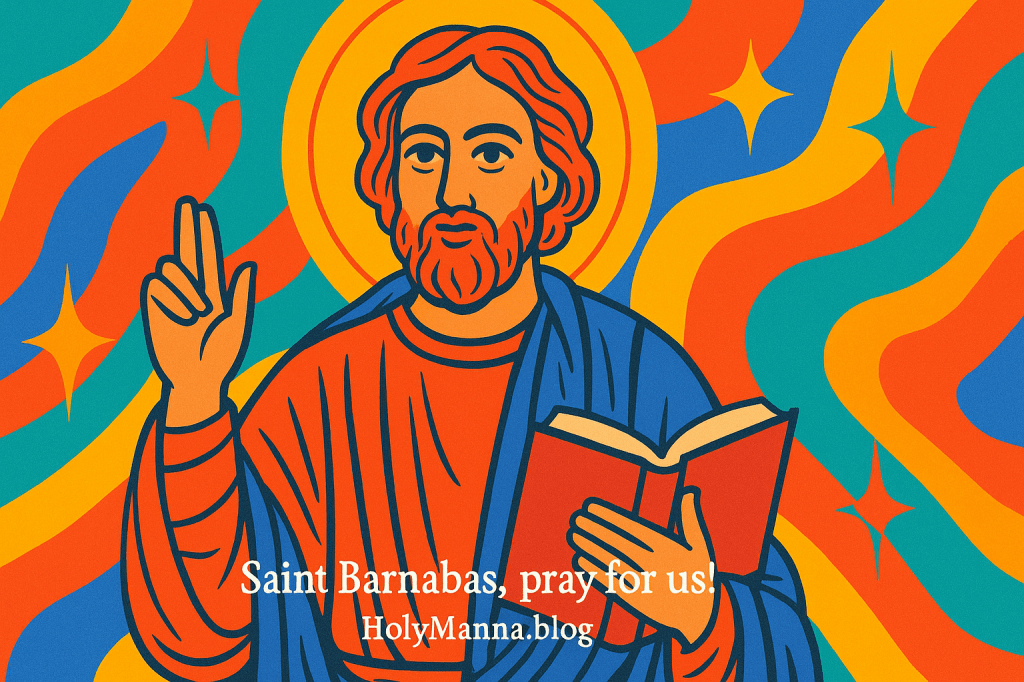
The Quiet Thunder of the Early Church
Saint Barnabas is one of those radiant yet often underappreciated figures in the early Church—an apostle not by number, but by heart. He was not among the original Twelve chosen by Jesus, but he quickly emerged as a foundational pillar of the fledgling Christian community. The Book of Acts honors him as a “good man, full of the Holy Spirit and of faith” (Acts 11:24), and his life’s work proved it. He was a missionary, a reconciler, a generous soul, and—perhaps most notably—an encourager. His influence was subtle yet seismic, often working behind the scenes to lift up others, most famously Saint Paul and Saint Mark. Without Barnabas, the New Testament might have looked very different. His gift was not just proclamation, but recognition—he saw grace where others saw risk. He built bridges between divided hearts and scattered communities. Today, the Church remembers him as one of its earliest missionaries, a martyr for the Gospel, and a man whose encouragement changed the world.
From Island Roots to Apostolic Heights
Barnabas was born Joseph, a Levite from the island of Cyprus. He was a Hellenistic Jew, meaning he had been shaped by both Jewish faith and Greek culture. His background gave him a unique ability to navigate the multicultural world of the Roman Empire—a skill that would later become essential in the missionary movement of the Church. From the start, his heart leaned toward God and others. In Acts 4:36–37, we read that he sold a field he owned and laid the money at the feet of the apostles, earning him the name “Barnabas,” meaning “son of encouragement”. This was no ordinary gesture—it was a public, wholehearted act of surrender to Christ and His Church.
But Barnabas was not just a donor; he was a disciple. When Saul of Tarsus—once a fearsome persecutor of Christians—converted to Christianity, the disciples were understandably terrified. Yet it was Barnabas who “took him and brought him to the apostles” (Acts 9:27), recounting Saul’s encounter with Jesus and defending his sincerity. Without Barnabas’ trust and mediation, Paul might have remained on the margins of the Christian community. Barnabas then took leadership of the Church in Antioch, a crucial center of early Christianity, where “a great many people were brought to the Lord” (Acts 11:24). It was there that Barnabas and Saul began their missionary work together, preaching the Gospel across Cyprus, Asia Minor, and beyond. Barnabas’ legacy lies in this work of encouragement and multiplication: he made saints by believing in them.
Wonders of Grace in the Journey
While Saint Barnabas is not often remembered for dramatic miracles like raising the dead or calming storms, the Acts of the Apostles does attest to moments when God’s power flowed through his ministry. Perhaps the most famous occurred in Lystra, where Barnabas and Paul healed a man crippled from birth (Acts 14:8–10). The people, astonished by this miraculous healing, mistook them for Greek gods—calling Barnabas “Zeus” and Paul “Hermes.” Though they quickly corrected the misunderstanding and pointed the crowd back to the living God, the event reveals how visibly the Spirit of God worked through them. The healing was not just physical; it was evangelistic. The miracle opened the hearts of pagans to the Gospel, proving that God’s kingdom was not confined to Jerusalem but was breaking into every land.
Yet even more astonishing was Barnabas’ spiritual charism—the miracle of encouragement. In a Church wracked by fear, uncertainty, and cultural divides, Barnabas was a living balm. His ability to trust others, to bring out the best in people, and to restore unity where there had been suspicion or hurt was itself miraculous. Saint John Chrysostom would later praise him for this gift, noting that “he was able to correct without provoking, to guide without dominating, and to inspire without overshadowing.” That kind of love is rare and radiant—and in the eyes of Heaven, surely just as mighty as physical healing.
The Cross He Carried
The road of a missionary in the early Church was paved with hardship, and Saint Barnabas walked it with unwavering courage. From the moment he stepped into leadership, he faced the dual burden of persecution from without and misunderstanding from within. His alliance with Paul, while fruitful, was not without conflict. Their missionary partnership was tested when John Mark—Barnabas’ cousin—abandoned their journey. Paul refused to take Mark again, but Barnabas, ever the encourager, believed in giving second chances. The disagreement became so sharp that the two apostles parted ways (Acts 15:36–40). Though painful, this moment reveals Barnabas’ heart: he valued restoration more than efficiency. He chose to walk the slower path of reconciliation, one that would ultimately bear fruit as Mark would later write The Gospel of Mark and become a pillar of the Church.
Barnabas’ final years are not detailed in Scripture, but tradition tells us that he returned to his native Cyprus to continue preaching the Gospel. There, he was met with fierce resistance from both Jews and pagans. In the city of Salamis, he was dragged from the synagogue, beaten, and ultimately stoned to death around the year 61 A.D. He died as he lived—boldly, faithfully, and with Jesus on his lips. His martyrdom reminds us that encouragement is not weakness. It is courage, perfected in love. As Jesus said: “Blessed are those who are persecuted for righteousness’ sake, for theirs is the kingdom of heaven” (Matthew 5:10).
Legacy in Light
The life of Saint Barnabas didn’t end with his martyrdom. His witness echoed across generations, especially in his homeland of Cyprus. According to early accounts, in the 5th century, Bishop Anthemius of Salamis had a dream in which Barnabas appeared to him and revealed the location of his tomb. Upon digging, the bishop found the saint’s remains clutching a copy of The Gospel of Matthew, confirming his apostolic identity and deep scriptural devotion. This discovery not only ignited local devotion but also secured the autonomy of the Cypriot Church, which had long been contested by the Patriarch of Antioch.
Pilgrimages to Barnabas’ tomb became a source of healing and inspiration for countless Christians. Stories emerged of the sick being healed, the desperate finding hope, and communities being renewed by his intercession. His relics became a touchstone of divine presence—a reminder that the grace that once moved through Barnabas had not ceased but continued to pour forth through the communion of saints. Even today, the Monastery of Saint Barnabas near Famagusta remains a place of reverence and historical memory, where faith and tradition meet in sacred soil.
The Encourager’s Challenge
Saint Barnabas’ life calls out to each of us—not from a place of dramatic spectacle, but from the gentle force of consistent love. In a digital age saturated with criticism, performance, and division, Barnabas reminds us that faithfulness in hiddenness can be revolutionary. He didn’t need to be the loudest voice in the room or the author of epistles. His strength was his ability to lift others up, to believe in people when they faltered, and to pursue peace even at personal cost.
What if we lived like Barnabas today? What if we gave others the benefit of the doubt, supported their growth, and sacrificed our own recognition to see someone else flourish? The Catechism teaches us that “charity is the soul of the holiness to which all are called” (CCC 826). That charity—self-giving love—was the very air Barnabas breathed.
Are there voices around you being silenced because no one will stand up for them? Are there people in your family or workplace who need a second chance? Could God be asking you to see them with His eyes, as Barnabas once saw Paul and Mark?
Living like Barnabas does not mean being passive or naïve. It means being bold enough to hope, strong enough to forgive, and faithful enough to believe that the Church is at her best when her members lift one another up.
Engage with Us!
We’d love to hear from you! How has Saint Barnabas’ life inspired you? Share your thoughts in the comments below. Let’s encourage each other, just as he did for so many in the early Church.
Reflection Questions:
- Who in your life could use encouragement or a second chance right now?
- How can you imitate Barnabas’ generosity and trust in your own walk with Christ?
- Have you ever felt like the “unknown” supporter behind the scenes—how might that be your hidden path to sainthood?
May we support one another in the faith, reminding each other that God is not done writing our stories. Let’s strive to do everything with love, just as our Lord Jesus did.
Saint Barnabas, pray for us! 🤝
Follow us on Instagram and Facebook for more insights and reflections on living a faith-filled life.

 Holy Manna!
Leave a comment