The Unshakable Mission of Christ
There are days when the Word of God rushes in like a river—strong, clear, and unstoppable—refreshing the heart and stirring it into action. Today is one of those days. In a world that often celebrates innovation without roots and progress without principle, today’s readings call us to a different kind of mission: one that is bold and outward-facing, yet deeply anchored in divine truth. They remind us that to be a true disciple of Christ means to be both a faithful keeper of the commandments and a fearless messenger of the Gospel.
The early Church in Acts of the Apostles is alive with the Holy Spirit, not because the apostles crafted a new religion, but because they remained faithful to the One who fulfilled the old. Barnabas and Saul are set apart through prayer, fasting, and discernment—an act that beautifully reflects the balance between contemplation and mission. The disciples in Antioch, where believers were first called “Christians,” represent the birth of a distinct identity: not in contradiction to the Law and the Prophets, but as its natural outgrowth. Meanwhile, Psalm 98 bursts with praise, declaring God’s victory to all nations—victory not limited to Israel, but offered to the whole world, a foretaste of the universal mission of the Church.
Then comes Jesus’ voice in The Gospel of Matthew, crystal clear and firm: “I have come not to abolish but to fulfill” (Mt 5:17). In a cultural climate where religious leaders debated which commandments mattered most, Jesus doesn’t lessen the Law—He deepens it. He teaches us that obedience and mission are not two separate tracks but one path walked in love. Evangelization is not about replacing the old but revealing its deepest meaning through Christ. Are we living as Christians called and sent, anchored in truth yet ablaze with love for the nations?
First Reading – Acts 11:21–26; 13:1–3
The Birthplace of Missionary Christianity
The Acts of the Apostles is often called the Gospel of the Holy Spirit. Written by St. Luke, it documents the explosive growth of the early Church after the resurrection and ascension of Jesus. Today’s passage takes us to Antioch, a pivotal center in early Christianity, where the faith began to transcend its Jewish roots and enter into the Gentile world. This moment in salvation history marks a critical turning point: the emergence of the missionary Church. In Antioch, the disciples are first called “Christians”—a name that would identify them not by ethnicity or ritual observance, but by their belonging to Christ. The passage also marks the formal commissioning of Barnabas and Saul (Paul), a sending forth into the Gentile world, showing how mission and fidelity to divine calling are inseparably linked. The events in this reading illustrate the theme of being anchored and sent—rooted in God’s law and Spirit, yet boldly going into the world with the Gospel.
Acts 11:21-26; 13:1-3
New American Bible (Revised Edition)
11:21 The hand of the Lord was with them and a great number who believed turned to the Lord. 22 The news about them reached the ears of the church in Jerusalem, and they sent Barnabas [to go] to Antioch. 23 When he arrived and saw the grace of God, he rejoiced and encouraged them all to remain faithful to the Lord in firmness of heart, 24 for he was a good man, filled with the holy Spirit and faith. And a large number of people was added to the Lord. 25 Then he went to Tarsus to look for Saul, 26 and when he had found him he brought him to Antioch. For a whole year they met with the church and taught a large number of people, and it was in Antioch that the disciples were first called Christians.
13:1 Now there were in the church at Antioch prophets and teachers: Barnabas, Symeon who was called Niger, Lucius of Cyrene, Manaen who was a close friend of Herod the tetrarch, and Saul. 2 While they were worshiping the Lord and fasting, the holy Spirit said, “Set apart for me Barnabas and Saul for the work to which I have called them.” 3 Then, completing their fasting and prayer, they laid hands on them and sent them off.
Verse-by-Verse Exegesis
Verse 21 – “The hand of the Lord was with them and a great number who believed turned to the Lord.”
This phrase, “the hand of the Lord,” is a biblical expression signifying divine power and guidance (cf. Ex 13:3). The success of the missionary effort in Antioch is not due to human skill but to God’s initiative. The conversion of many Gentiles shows that the Gospel was beginning to bear fruit far beyond the boundaries of Jerusalem.
Verse 22 – “The news about them reached the ears of the church in Jerusalem, and they sent Barnabas to go to Antioch.”
Jerusalem, still the mother Church, maintains a role of oversight. Barnabas—whose name means “son of encouragement” (Acts 4:36)—is chosen as a delegate. His mission underscores the unity between Jewish and Gentile believers and reflects the early Church’s commitment to discernment and oversight through trusted leaders.
Verse 23 – “When he arrived and saw the grace of God, he rejoiced and encouraged them all to remain faithful to the Lord in firmness of heart.”
Barnabas recognizes the grace of God at work. Rather than enforcing rigid uniformity, he encourages fidelity and perseverance. This echoes Hebrews 3:14, which calls believers to hold firm until the end. “Firmness of heart” evokes the Hebrew concept of lev, or heart as the seat of will and commitment.
Verse 24 – “For he was a good man, filled with the holy Spirit and faith. And a large number of people was added to the Lord.”
Luke highlights Barnabas’s character—goodness, Spirit-filled, faithful—qualities that make him an effective witness. His integrity is not merely moral but spiritual, showing how holiness attracts and multiplies disciples. Evangelization is not technique; it is holiness on fire.
Verse 25 – “Then he went to Tarsus to look for Saul.”
Barnabas, recognizing the growing community’s need for teaching and structure, seeks out Saul (Paul), who had been in relative obscurity. This act of seeking reveals humility—Barnabas is not seeking fame but is eager to bring in someone more gifted. Discipleship requires both cooperation and the recognition of others’ gifts.
Verse 26 – “And when he had found him he brought him to Antioch. For a whole year they met with the church and taught a large number of people, and it was in Antioch that the disciples were first called Christians.”
This verse is monumental. Antioch becomes a model church: evangelizing, teaching, and forming disciples. The new name “Christians” reflects both a badge of honor and a new identity. The suffix -ian denotes belonging—these are people of the Messiah (Christos in Greek).
Chapter 13, Verse 1 – “Now there were in the church at Antioch prophets and teachers: Barnabas, Symeon who was called Niger, Lucius of Cyrene, Manaen who was a close friend of Herod the tetrarch, and Saul.”
This diverse group reflects the universality of the Church: different ethnicities, social standings, and backgrounds. From a companion of Herod to men of Cyrene, the leadership of Antioch embodies the catholic (universal) nature of the Church.
Verse 2 – “While they were worshiping the Lord and fasting, the holy Spirit said, ‘Set apart for me Barnabas and Saul for the work to which I have called them.’”
Worship and fasting are the context for hearing God’s call. The Spirit speaks in community, affirming the Church’s charism of discernment. Being “set apart” recalls Old Testament language for consecration (cf. Jer 1:5), showing continuity between old and new covenants.
Verse 3 – “Then, completing their fasting and prayer, they laid hands on them and sent them off.”
The laying on of hands is the biblical sign of commissioning and empowerment. The Church, through communal prayer and sacramental action, sends forth missionaries, echoing Christ’s own mission (cf. Jn 20:21). This is apostolic succession in action—not merely preserving tradition but extending it dynamically.
Teachings of the Church
The Catechism of the Catholic Church teaches that the Church is “missionary by her very nature” (CCC 849), because she is rooted in the sending of the Son and the Holy Spirit. Barnabas and Paul are not lone rangers—they are commissioned by a praying, discerning community that listens to the Spirit. CCC 852 echoes this reality: “The Holy Spirit is the protagonist, ‘the principal agent of the whole of the Church’s mission.’” The growth of the Church in Antioch is not accidental; it flows from divine initiative and faithful response.
St. John Paul II often returned to Antioch as a symbol of the Church’s missionary horizon. In his encyclical Redemptoris Missio, he wrote: “The Church is an evangelizer, but she begins by being evangelized herself… Only a Church that is deeply united with Christ can authentically preach Him” (RM 15). The Church at Antioch was able to evangelize because it had first been evangelized by grace, teaching, and prayer. We are reminded that missionary zeal cannot be manufactured; it is the fruit of inner conversion and communal fidelity.
The early saints understood this as well. St. Ignatius of Antioch—bishop and martyr just a few generations later—urged Christians to remain “united in faith and love, which is the beginning and the end of life” (Letter to the Ephesians, 14). Antioch was fertile soil because it was soaked in worship, rich in teaching, and ablaze with love for Christ. This missionary identity is not just for Church history—it is a blueprint for us today.
Reflection – Sent from the Heart of the Church
What would it look like if our parishes were more like Antioch—places of deep worship, joyful teaching, and bold sending? This reading challenges us to build communities where prayer and discernment are not occasional events but the very rhythm of life. We are reminded that holiness and mission are not separate callings. When we are rooted in the truth of Christ, we too can be sent—not necessarily across the globe, but into our neighborhoods, families, and workplaces.
Do we see ourselves as “set apart” for God’s work, even in the ordinary? The Holy Spirit still speaks in the context of worship and fasting. If we want to hear God’s call, we must create space for Him—through silence, sacraments, Scripture, and community. Barnabas went out and brought Saul in, not out of duty but discernment. Who might God be asking you to bring into deeper friendship with Christ?
To be a Christian is not just to believe in Christ—it is to belong to Him. In being called “Christian,” the believers in Antioch accepted both identity and mission. Are we ready to do the same?
Responsorial Psalm – Psalm 98:1–6
A Song for the Whole Earth
The Psalms are the prayerbook of the Church, the inspired hymns that voice the deepest cries of the human heart—from anguish to exaltation. Psalm 98 is a royal psalm, proclaiming God’s kingship through His saving deeds. Likely sung during liturgical celebrations, it invites all creation to praise the Lord, not just Israel. Historically, this psalm celebrates God’s deliverance of His people, but prophetically, it looks ahead to the universal mission of salvation. In the context of today’s readings, it mirrors the expansion of the Gospel from Jerusalem to Antioch and into the world. It reminds us that the mission of the Church is not just to speak truth, but to do so with joy and beauty, proclaiming the Lord’s marvelous deeds to all nations.
Psalm 98:1-6
New American Bible (Revised Edition)
The Coming of God
1 A psalm.
Sing a new song to the Lord,
for he has done marvelous deeds.
His right hand and holy arm
have won the victory.
2 The Lord has made his victory known;
has revealed his triumph in the sight of the nations,
3 He has remembered his mercy and faithfulness
toward the house of Israel.
All the ends of the earth have seen
the victory of our God.
4 Shout with joy to the Lord, all the earth;
break into song; sing praise.
5 Sing praise to the Lord with the lyre,
with the lyre and melodious song.
6 With trumpets and the sound of the horn
shout with joy to the King, the Lord.
Verse-by-Verse Exegesis
Verse 1 – “Sing a new song to the Lord, for he has done marvelous deeds. His right hand and holy arm have won the victory.”
The phrase “new song” signifies a fresh outpouring of praise in response to new acts of salvation. This echoes Isaiah 42:10, where singing a new song is tied to proclaiming God’s glory among the nations. The reference to God’s “right hand and holy arm” is military language, emphasizing God as the victorious warrior who saves—not by human strength but by divine might.
Verse 2 – “The Lord has made his victory known; has revealed his triumph in the sight of the nations.”
God’s saving power is not hidden. What He has done for Israel is a sign for all peoples. In the age of the early Church, this verse becomes especially powerful, as the triumph of Christ in the resurrection and the spread of the Gospel are made manifest to both Jew and Gentile. The missionary movement in Acts fulfills this psalm’s proclamation.
Verse 3 – “He has remembered his mercy and faithfulness toward the house of Israel. All the ends of the earth have seen the victory of our God.”
“Remembered” in Hebrew thought does not mean passive recall but active faithfulness. God acts in mercy (hesed) and truth (emet)—two central attributes of His covenant love. But now, His mercy overflows beyond Israel: “All the ends of the earth” signals the universality of salvation. This verse directly parallels the Church’s missionary outreach in Antioch.
Verse 4 – “Shout with joy to the Lord, all the earth; break into song; sing praise.”
This is not a quiet rejoicing but a thunderous, communal outburst of joy. It echoes the jubilant worship in Acts 13, where fasting and praise precede the sending of missionaries. Joy is not optional for the Christian—it is the hallmark of those who have witnessed God’s victory.
Verse 5 – “Sing praise to the Lord with the lyre, with the lyre and melodious song.”
The psalmist calls for instrumental praise, showing that worship involves the whole self—voice, body, and creativity. The lyre, a common string instrument in temple worship, points to the importance of beauty and art in glorifying God. Mission, when done with joy and artistry, becomes attractive and compelling.
Verse 6 – “With trumpets and the sound of the horn shout with joy to the King, the Lord.”
The use of trumpet and horn (shofar) evokes temple ceremonies and the enthronement of God as King. This royal imagery ties to the proclamation of Christ as King over all nations. As Acts shows the Gospel advancing into new territories, Psalm 98 invites all to acclaim Christ not just as Savior but as King.
Teachings of the Church
The Church has always linked the joy of the Psalms with the joy of the Gospel. The Catechism of the Catholic Church teaches that “song and music fulfill their function as signs in a manner all the more significant when they are ‘more closely connected… with the liturgical action’” (CCC 1156). Psalm 98 is fulfilled in the liturgy of the New Covenant, where Christ is praised in every nation through Word and Sacrament. Joyful worship becomes a means of evangelization, drawing the world to the beauty of truth.
St. Augustine, commenting on the Psalms, wrote: “Sing to the Lord a new song—sing, that is, not with your lips but with your life.” For Augustine, true praise was inseparable from holy living. The new song is the life of grace, made possible by Christ’s victory over sin. This victory is not limited to the past but is ongoing, as the Church continues her mission to proclaim Christ’s triumph in every generation.
In Church history, moments of renewal often began with a recovery of joyful worship and beautiful praise. The early Church in Antioch grew not only because of doctrinal clarity but also because of the visible joy and transformation of its members. The Second Vatican Council reaffirmed this when it said, “The liturgy is the summit toward which the activity of the Church is directed… and the fount from which all her power flows” (Sacrosanctum Concilium, 10). The praise of God is not a break from mission; it is its source and goal.
Reflection – Joy That Sends
Are we known as a people of praise, a people whose worship reflects the victory of Christ? This psalm reminds us that Christian joy is not a feeling but a decision rooted in the knowledge that God has already triumphed. We are not waiting for the victory—it has already been won. The challenge is to live and sing as if that’s true.
What song are we singing with our lives? Our worship, our service, our relationships—all of it is meant to be a hymn of gratitude to the Lord. Evangelization begins with amazement. When others see us rejoice, even in trial, they encounter a God worth knowing. As St. Teresa of Avila said, “God save us from gloomy saints.” Joy, especially joyful worship, is an act of witness.
Let this psalm challenge us to cultivate daily praise—not only in church but in our homes, our hearts, and our habits. How can I incorporate more beauty and joy into my spiritual life? What instruments—whether music, words, or acts of love—can I use to proclaim God’s victory today?
Holy Gospel – Matthew 5:17–19
The Fulfillment That Sends
We find ourselves today in the heart of The Gospel of Matthew, where Jesus delivers His most famous teaching: the Sermon on the Mount. Addressed to both disciples and crowds, this discourse is a radical interpretation of the Law given to Moses. Matthew, writing primarily to a Jewish audience, presents Jesus not as abolishing the Torah, but as the one who fulfills and reveals its deepest meaning. In a time when some were accusing Jesus of undermining tradition, His words in this passage correct that misunderstanding and elevate the call to holiness. His mission is not rupture, but completion—not demolition, but divine fulfillment. Today’s Gospel grounds the bold missionary efforts of the early Church (seen in Acts) and the joyful universal praise of Psalm 98 in the unchanging truth of God’s commandments. It shows us that true evangelization must flow from faithful obedience.
Matthew 5:17-19
New American Bible (Revised Edition)
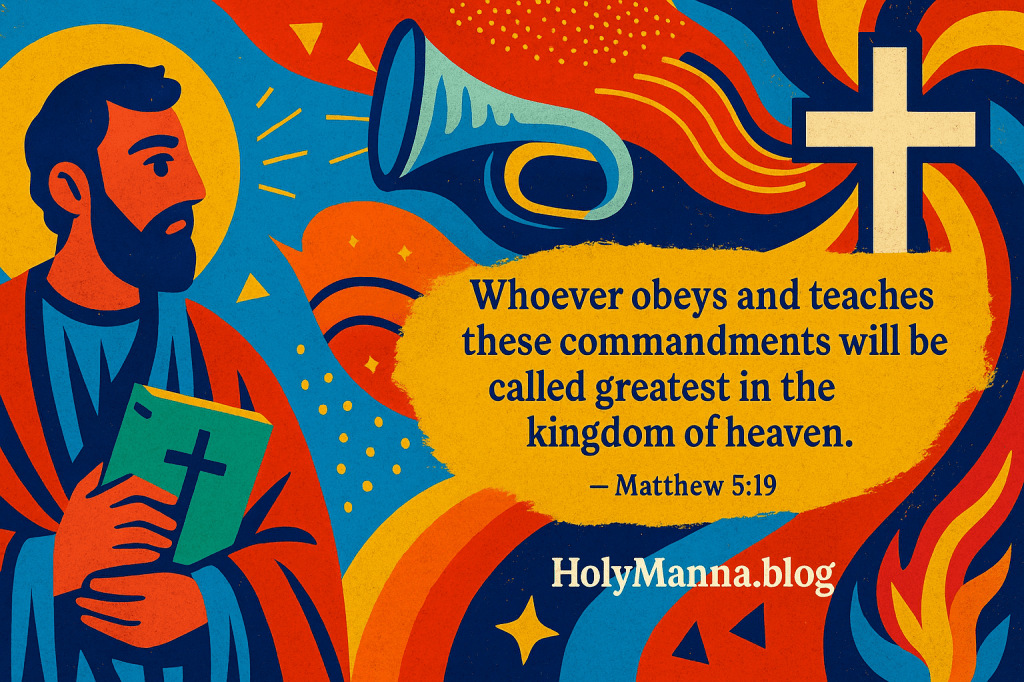
Teaching About the Law. 17 “Do not think that I have come to abolish the law or the prophets. I have come not to abolish but to fulfill. 18 Amen, I say to you, until heaven and earth pass away, not the smallest letter or the smallest part of a letter will pass from the law, until all things have taken place. 19 Therefore, whoever breaks one of the least of these commandments and teaches others to do so will be called least in the kingdom of heaven. But whoever obeys and teaches these commandments will be called greatest in the kingdom of heaven.
Verse-by-Verse Exegesis
Verse 17 – “Do not think that I have come to abolish the law or the prophets. I have come not to abolish but to fulfill.”
Jesus makes a definitive declaration: His mission is not in opposition to the Old Covenant, but its perfection. The “Law and the Prophets” was a common Jewish phrase encompassing all of Scripture. To “fulfill” means to bring to completion, to embody its ultimate purpose. He is the living Torah—the Word made flesh (cf. John 1:14). This sets the tone for His entire ministry and rebukes any antinomian (anti-law) interpretations of grace.
Verse 18 – “Amen, I say to you, until heaven and earth pass away, not the smallest letter or the smallest part of a letter will pass from the law, until all things have taken place.”
This verse underscores the eternal validity of God’s law. The “smallest letter” likely refers to the Hebrew yod, the tiniest character in the alphabet. Jesus is saying that divine revelation is precise, unchangeable, and sacred. His use of “Amen, I say to you” adds solemn authority—it is a divine oath. The phrase “until all things have taken place” points toward the eschaton, when God’s Kingdom is fully realized. In the meantime, the law stands—not as a burden, but as the path of holiness.
Verse 19 – “Therefore, whoever breaks one of the least of these commandments and teaches others to do so will be called least in the kingdom of heaven. But whoever obeys and teaches these commandments will be called greatest in the kingdom of heaven.”
Jesus shifts from principle to practice. There is a grave responsibility for those who teach—and all Christians, by baptism, share in Christ’s prophetic office. The commandments are not to be ranked or selectively followed; even the “least” matters. Obedience is not legalism—it is love expressed in action (cf. John 14:15). Teaching others to obey is part of discipleship. Here we see a seamless thread between fidelity to the law and fruitful mission.
Teachings of the Church
The Catechism of the Catholic Church is unequivocal in affirming this Gospel. “The Law of the Gospel ‘fulfills,’ refines, surpasses, and leads the Old Law to its perfection” (CCC 1967). Christ’s teaching does not discard the Mosaic Law but elevates it to a new level through the interior transformation of grace. This fulfillment is not external conformity but inward conversion—the law written on hearts, as promised in Jeremiah 31:33.
This harmony between old and new is deeply rooted in Church tradition. St. Thomas Aquinas wrote, “The New Law is chiefly the grace itself of the Holy Spirit, which is given to those who believe in Christ. But this grace does not abolish the Old Law; rather, it makes it possible to fulfill it perfectly” (Summa Theologiae, I-II, q. 106, a.1). Jesus’ role as fulfillment shows that grace never contradicts truth. The commandments are not negated by love; they are fulfilled by it. As the apostles were sent out from Antioch to proclaim the Good News, they carried not only the message of Christ crucified and risen but also the moral clarity of His teaching.
The Church’s moral teaching remains rooted in this Gospel. The Second Vatican Council emphasized, “Christ… by preaching both repentance and the Kingdom of God… confirmed the dignity of the moral conscience, and fulfilled the Law by His life and teaching” (Gaudium et Spes, 41). In an age of moral confusion, the Church does not create her own laws, but safeguards the commandments of Christ. Authentic missionary witness must be united with moral coherence.
Reflection – Faithful and Fruitful
Are we willing to embrace the fullness of the Gospel—not just its consolations, but also its demands? In a world that often urges us to “move on” from tradition, Jesus invites us to go deeper into it. His words are not a leash but a light, not a limit but a ladder toward holiness. We cannot separate obedience from evangelization; one feeds the other. The early Church grew because it taught and lived what Jesus commanded.
What is the “least commandment” we are tempted to ignore? Perhaps it’s an area of sexual ethics, forgiveness, Sabbath rest, or honesty in business. Jesus tells us that even the smallest detail matters, because every part of God’s law reveals something of His heart. And when we obey out of love—not out of fear—we become radiant witnesses to His truth.
Let this Gospel stir our conscience and sharpen our mission. We are called to be like Barnabas and Paul—sent out with zeal, but never detached from the firm foundation of divine teaching. Is your life aligned with the commandments you profess? Are you both obeying and teaching the law of Christ with courage, humility, and joy? That is how we become great in the Kingdom of Heaven.
Rooted in Truth, Radiating Joy
Today’s readings form a symphony of mission, fidelity, and joy. From Antioch, where the disciples are first called Christians, to the psalmist’s cry that “all the ends of the earth have seen the victory of our God”, to Jesus’ bold assurance that “not the smallest letter… will pass from the law”, the message is clear: we are called to be a people who are deeply rooted in God’s truth and joyfully sent into the world. Evangelization isn’t about clever words or flashy programs—it’s about holiness that overflows, obedience that inspires, and praise that pierces the noise of the world with beauty.
The Church’s mission begins in worship, matures in fidelity to the commandments, and bears fruit in loving proclamation. Barnabas and Saul didn’t go because they felt like it—they went because the Spirit sent them. But that sending only came after prayer, fasting, and worship. In the same way, we too must root ourselves in the life of the Church—Word, Sacrament, and community—so that when God calls, we are ready to go.
What would it look like for you to live today as one who has been called, formed, and sent? Let the Gospel be your compass and the joy of the Lord your strength. Sing your new song. Obey with love. Teach with courage. And wherever you go—whether across the world or across the street—bring Christ with you. You are not just called Christian by name. You are called to live as one.
Engage with Us!
We’d love to hear how God is speaking to you through today’s readings. The Holy Spirit stirs different insights in each heart, and your reflections may bless someone else who’s reading. Share your thoughts, prayers, or personal stories in the comments below—and let’s grow together as disciples who are anchored in truth and sent with joy.
Reflection Questions:
First Reading – Acts 11:21–26; 13:1–3
How is God calling you to be more involved in your parish or faith community? Who might be a “Saul” in your life—someone whose gifts you can help bring forward?
Responsorial Psalm – Psalm 98:1–6
When was the last time you truly rejoiced in the Lord’s goodness? What are some concrete ways you can incorporate praise and gratitude into your daily routine?
Holy Gospel – Matthew 5:17–19
Are there any commandments or teachings of the Church that you struggle to accept or live out? How can obedience to God’s law become a deeper act of love in your daily life?
May today’s Word inspire you to go forth with hearts on fire—faithful in worship, bold in witness, and always rooted in the love and mercy that Jesus taught us. Let your life be a joyful song to the Lord, and may everything you do reflect the radiant beauty of His truth.
Follow us on Instagram and Facebook for more insights and reflections on living a faith-filled life.

 Holy Manna!
Leave a comment