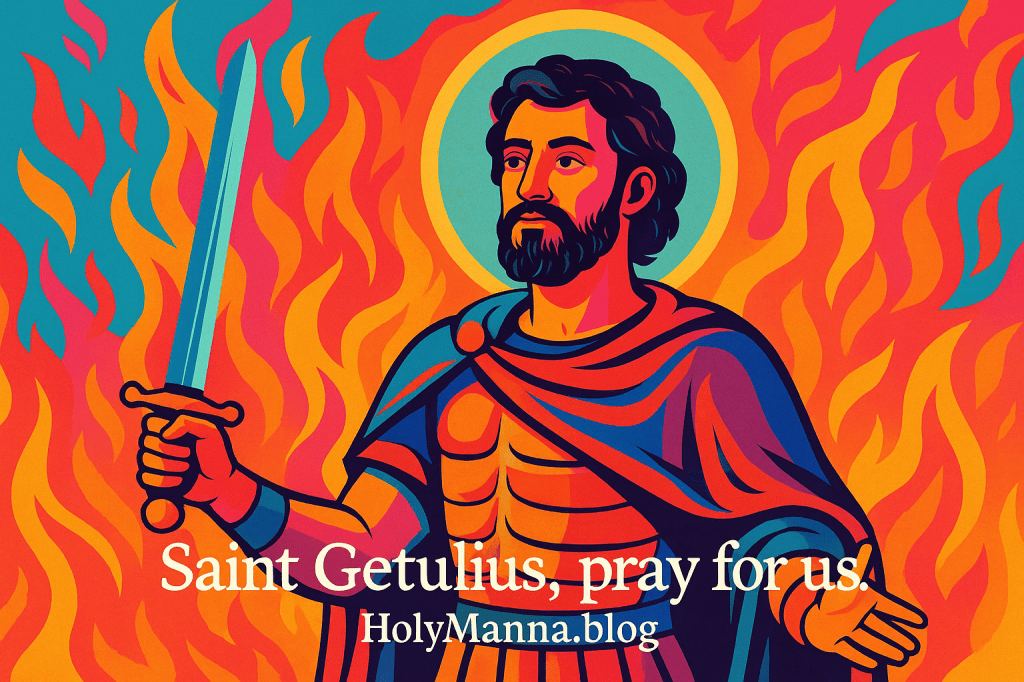
A Witness in the Fire
In the great tapestry of early Christian martyrdom, Saint Getulius stands as a radiant example of divine transformation. His story may not be widely known today, but in the days of the Roman Empire—an age steeped in persecution and cruelty—his unwavering commitment to Jesus Christ lit a fire that no worldly power could extinguish. A former Roman officer, Getulius renounced a life of military prestige to follow Christ with boldness and humility. He did not merely retreat into private faith but proclaimed the Gospel so openly that he soon found himself the target of Rome’s wrath. His courage inspired others to follow Christ, even in the face of death, and his martyrdom became a beacon of hope for generations to come. The Church honors Saint Getulius on June 10, together with his companions—Amantius, Caerealis, and Primitivus—all of whom shared in his zeal and his crown of glory. Their story invites us to ask: What am I willing to surrender for the sake of Jesus?
The Warrior Who Found the True King
Getulius was born in the late 1st century in the region of Sabina, just north of Rome, into a culture steeped in Roman tradition, polytheism, and military honor. He grew into adulthood in a time when the Roman Empire was suspicious of the growing Christian sect, seeing it as both a religious and political threat. Following in the footsteps of many Roman men of standing, Getulius pursued a career in the military. He became a tribune—a high-ranking officer entrusted with authority and allegiance to Caesar. His life would have been one of discipline, command, and loyalty to Rome. And yet, something greater called to him.
The historical sources do not tell us the exact moment of his conversion, but we do know this: the Gospel of Jesus Christ radically transformed him. Getulius left behind his military post, forsaking comfort, power, and public honor for the sake of following a crucified Lord. This was no small act; to walk away from imperial service meant not only disgrace but also danger. And yet, filled with the Holy Spirit, he began to preach the Gospel openly.
What’s more, he didn’t do this alone. His brother Amantius joined him, as did the soldier Primitivus, and, most strikingly, Caerealis, a Roman official originally sent to arrest Getulius. Caerealis was so moved by the words and witness of the former officer that he, too, became a Christian. This dramatic conversion recalls the moment in Acts of the Apostles when Saul became Paul—reminding us that no one is beyond the reach of divine mercy. Getulius and his companions are most known for this bold evangelization and their defiance of unjust laws. They chose Christ, even when the cost was their very lives.
The Gospel That Sets Hearts Ablaze
Although early hagiographies do not record a list of physical miracles during Getulius’s life, there is one miracle that speaks even louder: the miracle of conversion. Caerealis, once a loyal servant of the empire, was sent to apprehend Getulius, but instead became a disciple of Christ. What grace must have flowed from Getulius’s presence, what light from his eyes, that a persecutor would lay down his sword and take up the cross!
This moment is not merely symbolic—it is supernatural. The Catechism of the Catholic Church reminds us that “conversion is first of all a work of the grace of God who makes our hearts return to him” (CCC 1432). In this way, we can say that Getulius’s greatest miracle was the transformation of hearts. Just as Jesus turned water into wine and death into life, He used the faith of one man to awaken the souls of many. The early Church grew because men and women like Getulius were willing to speak truth with love, even when it was dangerous.
Have we underestimated the miracle of a changed heart? Do we recognize the power of testimony and personal witness in leading others to Christ?
Through the Fire and into Glory
It wasn’t long before the Roman authorities discovered Getulius’s preaching. His refusal to offer incense to the Roman gods and his open proclamation of Jesus Christ led to his arrest. Bound with Amantius, Caerealis, and Primitivus, he was sentenced to die by fire—a punishment meant not only to destroy but to terrorize. But God, ever faithful, intervened in a dramatic way. The flames that were meant to consume them refused to touch their bodies. Like the three young men in Daniel 3, these Christian brothers stood in the midst of the fire, untouched and undeterred.
The authorities, astonished and angered by what they witnessed, ordered a new sentence: the four men were beaten with clubs and then beheaded. It was a brutal and final attempt to silence their witness. Yet even in death, the light of Christ shone. Their martyrdom became a testimony of fearless love—echoing the words of Our Lord: “Greater love has no man than this, that a man lay down his life for his friends” (John 15:13).
The Church teaches us in CCC 2473 that “martyrdom is the supreme witness given to the truth of the faith: it means bearing witness even unto death.” Getulius bore this witness with dignity, courage, and unshakeable peace. His blood became the seed of new Christians, and his death, a triumph in the eyes of Heaven.
Hearts Still Moved by the Martyr’s Fire
After their martyrdom, the bodies of Saint Getulius and his companions were secretly recovered by devout Christians and buried with reverence near Gabii, close to modern-day Tivoli. It was not long before miracles began to be reported at their gravesite. Pilgrims traveled from nearby towns and distant regions, seeking healing and strength through the intercession of these brave witnesses.
Over time, the fame of Saint Getulius grew, and devotion to him spread throughout Italy and into parts of Spain. A basilica was built over his tomb, and his relics became a powerful symbol of divine presence and protection. Even in death, he continued to draw souls closer to God. In Rome, the church of San Getulio honored his memory and held some of his sacred remains. The faithful continued to ask for his intercession, particularly in times of trial and fear, trusting that the one who stood in the fire would also stand with them in their suffering.
The veneration of relics and the miracles that follow are not superstition, but sacred tradition. As CCC 1674 explains, “besides the liturgy, Christian life is nourished by various forms of popular piety, rooted in different cultures… especially the veneration of relics, visits to sanctuaries, pilgrimages, processions.” These practices remind us that the saints are not distant figures of the past but living members of the Body of Christ, still active in the Church today.
Do we bring our needs to the saints with confidence? Are we attentive to the miracles God still performs through them today?
Let His Witness Set Your Faith on Fire
Saint Getulius invites us to examine the cost of discipleship in our own lives. He did not begin his journey as a Christian, but when grace knocked on the door of his heart, he opened it wide. And once he knew the truth, he lived it without compromise. His story speaks directly to all of us who are navigating a world that increasingly calls good evil and evil good.
His life urges us to ask hard questions: What are we willing to sacrifice for the sake of Christ? What “military rank” or comfort are we clinging to that prevents us from full surrender? In our homes, our workplaces, and our social circles, we are each called to be witnesses. While we may not face a literal fire, we all encounter “fires” of pressure, rejection, temptation, and fear. Saint Getulius shows us that it is possible to stand firm—not because of our own strength, but because the Holy Spirit gives us the grace to endure.
We are reminded in 2 Timothy 1:7 that “God did not give us a spirit of fear, but of power and love and self-control.” May we, like Getulius, proclaim Christ boldly and persevere in the face of opposition, confident that our faith will bear fruit in the lives of others.
Engage with Us!
We want to hear from you! How has the story of Saint Getulius inspired you? Do you know someone who, like Getulius, had a powerful conversion story? Share your thoughts in the comments and let us walk together on this journey of faith.
Reflection Questions:
- What part of Saint Getulius’s story challenges or inspires you the most?
- Have you ever experienced a moment when your faith was tested? How did you respond?
- How can you witness to Christ more boldly in your workplace, family, or community?
Let’s encourage one another to stand firm in our faith and to always remember that “perfect love casts out fear” (1 John 4:18). May we, like Saint Getulius, do all things with love—for Christ, for the Church, and for the salvation of souls.
Saint Getulius, pray for us! 🔥
Follow us on Instagram and Facebook for more insights and reflections on living a faith-filled life.

 Holy Manna!
Leave a comment