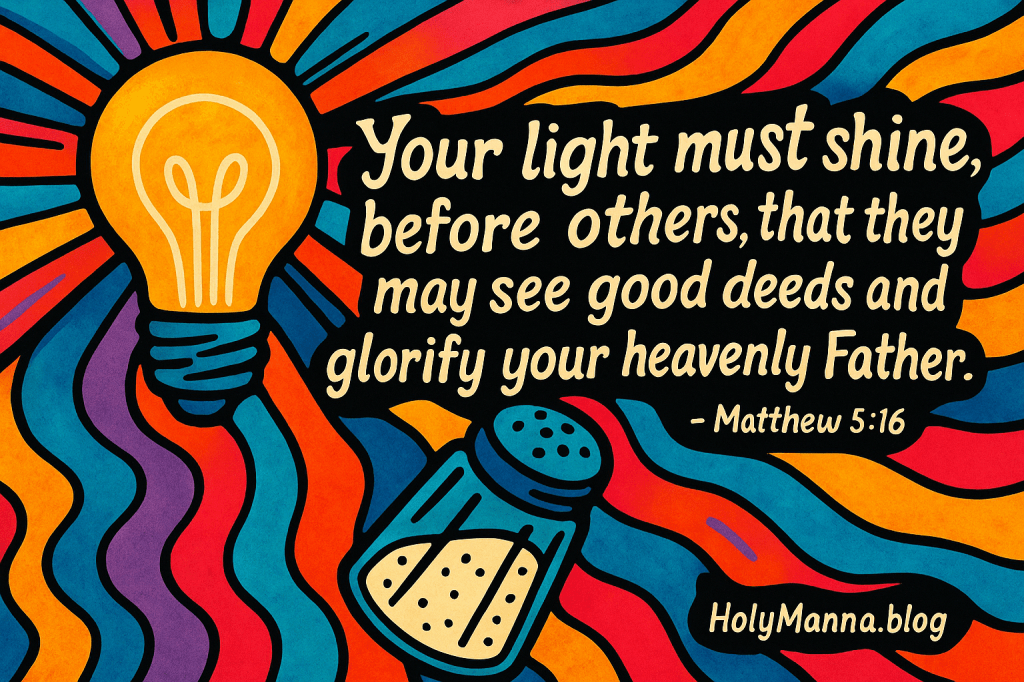
Sealed with Light, Seasoned with Faithfulness
Have you ever tasted a dish that was missing just a pinch of salt? Or walked through a dark hallway and instinctively reached for a light switch? In today’s readings, God invites us to consider our lives as instruments of seasoning and illumination—offering His flavor and light to a world in desperate need of both. We are reminded that this call isn’t based on our perfection, but on His promise, fulfilled in Christ and sealed by the Holy Spirit.
In the time of Jesus and St. Paul, covenants were sealed not just with words but with visible signs—salt in Jewish culture symbolized purity and preservation, and light was a sign of God’s presence and guidance. Paul, writing to the Corinthians, anchors his message in the unchanging faithfulness of God. He proclaims that all of God’s promises find their “Yes” in Jesus, and through Him we say our “Amen” to the glory of God (2 Corinthians 1:20). This certainty, Paul continues, is not just theology—it is experience: God has “put his seal upon us and given the Spirit in our hearts as a first installment” (2 Corinthians 1:22). That same Spirit, poured into our hearts at Baptism and Confirmation, empowers us to become what Jesus calls us in The Gospel of Matthew: “the salt of the earth” and “the light of the world”.
These readings form a radiant thread: God is faithful, His Word enlightens, and we are called to shine. Psalm 119 beautifully echoes this desire with poetic longing: “The revelation of your words sheds light, gives understanding to the simple” (Psalm 119:130). As disciples, we don’t manufacture light—we reflect it. Our faith isn’t a hidden spark but a public witness. When we live God’s commandments with sincerity and joy, our lives become a testimony to His glory. Are we allowing His Spirit to shine through us today? Are we living as His “Yes” in a world full of “maybe”?
First Reading – 2 Corinthians 1:18–22
Faithfulness Sealed with the Spirit
St. Paul’s Second Letter to the Corinthians is deeply personal—full of passion, correction, and encouragement. Written around A.D. 55–57, it addresses a community shaken by divisions, misunderstandings, and questions about Paul’s authority and sincerity. In this particular passage, Paul confronts doubts about his integrity by pointing to something far greater than his own character: the unwavering faithfulness of God. To a culture immersed in oaths, contracts, and fluctuating loyalties—especially in a bustling, cosmopolitan city like Corinth—Paul boldly proclaims that God’s promises are not conditional or fickle. They are fulfilled completely and unchangingly in Christ. This message ties directly into today’s central theme: just as God is faithful, we too are called to be steady lights and flavorful salt in a world of shifting truths and shadowed hearts.
2 Corinthians 1:18-22
New American Bible (Revised Edition)
18 As God is faithful, our word to you is not “yes” and “no.” 19 For the Son of God, Jesus Christ, who was proclaimed to you by us, Silvanus and Timothy and me, was not “yes” and “no,” but “yes” has been in him. 20 For however many are the promises of God, their Yes is in him; therefore, the Amen from us also goes through him to God for glory. 21 But the one who gives us security with you in Christ and who anointed us is God; 22 he has also put his seal upon us and given the Spirit in our hearts as a first installment.
Detailed Exegesis
Verse 18 – “As God is faithful, our word to you is not ‘yes’ and ‘no.’”
Paul begins with a solemn affirmation of God’s character: faithfulness. In contrast to human inconsistency, Paul insists that his ministry is rooted in the constancy of God. He rejects the idea that his message wavers based on convenience or fear. Instead, he stands firmly on the reliability of the God who sent him.
Verse 19 – “For the Son of God, Jesus Christ, who was proclaimed to you by us, Silvanus and Timothy and me, was not ‘yes’ and ‘no,’ but ‘yes’ has been in him.”
Here, Paul shifts focus to Jesus Christ as the embodiment of divine fidelity. Christ is not a half-hearted answer or a flexible opinion. He is the definitive “Yes” to every promise God has made. Paul includes Silvanus (Silas) and Timothy to emphasize the unified and consistent proclamation of the Gospel by all who ministered in Corinth.
Verse 20 – “For however many are the promises of God, their Yes is in him; therefore, the Amen from us also goes through him to God for glory.”
This verse is a crescendo of theological beauty. Every promise—from Abraham to the prophets—finds its fulfillment in Christ. And when the Church says “Amen” in her prayers and liturgies, it is not just affirmation but participation in Christ’s perfect “Yes” to the Father. Our “Amen” becomes a response of worship, glorifying God through Jesus.
Verse 21 – “But the one who gives us security with you in Christ and who anointed us is God.”
Now Paul moves to our personal experience of this divine faithfulness. God gives us security—a Greek word meaning firmness or steadfastness—in Christ. He also anointed us, an echo of the Old Testament practice of setting someone apart for a sacred mission, as kings and prophets were anointed with oil.
Verse 22 – “He has also put his seal upon us and given the Spirit in our hearts as a first installment.”
Paul concludes with powerful sacramental imagery. God has “sealed” us—marking us as His own—and given us the Holy Spirit as a “first installment” or down payment of eternal life. This language connects directly to the sacraments of Baptism and Confirmation, where the Spirit is poured out and the believer is sealed for Christ.
Teachings of the Church: Sealed in the Spirit’s Yes
The Catechism of the Catholic Church powerfully affirms this passage’s theology in the context of Confirmation: “By this anointing the confirmand receives the ‘mark,’ the seal of the Holy Spirit… a sign of total belonging to Christ, of being enrolled in his service forever” (CCC 1295). This seal is not a temporary stamp but an indelible spiritual mark—a divine “Yes” written upon the soul.
St. Irenaeus, a 2nd-century bishop and martyr, echoes Paul’s certainty: “Where the Church is, there is the Spirit of God; and where the Spirit of God is, there is the Church and all grace” (Against Heresies, Book 3). This connection between the Spirit and the Church reminds us that our faithfulness is not isolated but ecclesial—we belong to a community rooted in God’s promises and animated by His Spirit.
Historically, in the early Church, the “seal” mentioned by Paul was also understood as connected to martyrdom. Christians who were sealed in the Spirit were prepared to witness to Christ even unto death. In our age, the seal prepares us to live out daily martyrdoms—dying to pride, fear, and sin—so that we might rise with Christ in truth and love.
Reflection: Living the Yes in a World of Maybes
This reading invites us to reflect on what or whom we’ve placed our trust in. Is our “yes” to God firm, or is it dependent on circumstances? Paul reminds us that we are not tossed about by doubts or human judgments because we stand on the promises of God fulfilled in Christ. If we’ve been anointed and sealed, then we’re called to live as evidence of God’s reliability. That means keeping our commitments, honoring the truth, and walking steadily even when the road feels uncertain.
Our world today is full of double-speak and half-promises. We are constantly tempted to compromise or soften our witness. But we have been given the Holy Spirit—not just as a helper, but as a guarantee of God’s faithfulness. Are we living in the security of that seal? Do others see in our lives a clear “Yes” to God? The Church needs men and women who live and speak with clarity, conviction, and compassion—whose every “Amen” truly glorifies the Father through the Son.
Responsorial Psalm – Psalm 119:129–133, 135
Illuminated by the Word
Psalm 119 is the longest chapter in all of Scripture—a sprawling, deeply meditative acrostic that extols the beauty and transformative power of God’s Word. It was likely composed after the Babylonian exile, during a time when the Jewish people were rediscovering their identity through the Law (Torah). Every verse in this psalm, organized by the Hebrew alphabet, is a love song to God’s statutes, precepts, and commandments. Today’s selected verses reflect the heart of a person yearning not for power or riches, but for understanding, clarity, and nearness to God. Within the context of today’s theme—living as confirmed witnesses of God’s faithfulness and light—this psalm reminds us that God’s Word is both a light and a compass, guiding our steps so we may live as His “Yes” in the world.
Psalm 119:129-133, 135
New American Bible (Revised Edition)
129 Wonderful are your testimonies;
therefore I keep them.
130 The revelation of your words sheds light,
gives understanding to the simple.
131 I sigh with open mouth,
yearning for your commandments.
132 Turn to me and be gracious,
according to your judgment for those who love your name.
133 Steady my feet in accord with your promise;
do not let iniquity lead me.
135 Let your face shine upon your servant;
teach me your statutes.
Detailed Exegesis
Verse 129 – “Wonderful are your testimonies; therefore I keep them.”
The psalmist opens this section with awe. God’s testimonies—His laws, stories, and judgments—are not merely rules; they are wonderful, filled with divine wisdom and beauty. Keeping them is not burdensome, but a loving response to their wonder. The verse invites us to see obedience not as obligation, but as devotion.
Verse 130 – “The revelation of your words sheds light, gives understanding to the simple.”
This verse echoes the theme of light found in The Gospel of Matthew. God’s Word reveals truth, dispelling darkness. Even the “simple”—those lacking worldly wisdom—gain insight through divine revelation. The verse affirms that Scripture is accessible and transformative for every soul who seeks God with humility.
Verse 131 – “I sigh with open mouth, yearning for your commandments.”
This is a visceral image: the psalmist is like a parched traveler, gasping for water. His desire for God’s commandments is physical, emotional, and spiritual. It is a longing born not from fear of punishment, but from deep love. It mirrors our call as confirmed disciples—to hunger for God’s will.
Verse 132 – “Turn to me and be gracious, according to your judgment for those who love your name.”
Here, the psalmist petitions for grace. God’s justice is not cold or punitive; it is filled with mercy for those who love His name. This verse highlights the covenantal relationship between God and His people—He turns to those who turn to Him. It is a reminder that divine favor follows loving trust.
Verse 133 – “Steady my feet in accord with your promise; do not let iniquity lead me.”
The image of feet being steadied suggests a journey—one that can easily go astray. The psalmist leans on God’s promise as both path and protector. The verse reflects the daily battle to remain faithful in a world full of snares. We cannot walk securely without God’s guidance.
Verse 135 – “Let your face shine upon your servant; teach me your statutes.”
To ask God to let His face shine is to desire His presence, favor, and blessing. The language recalls the priestly blessing of Numbers 6:24–26. The psalmist desires not just knowledge of the Law but intimacy with the Lawgiver. Light again becomes a metaphor for divine closeness.
Teachings of the Church: The Word That Guides and Transforms
The Church affirms that Scripture is not static text, but the living voice of God. The Catechism of the Catholic Church states: “The Church has always venerated the Scriptures as she venerates the Lord’s Body… In the sacred books, the Father who is in heaven comes lovingly to meet his children, and talks with them” (CCC 104). The psalmist’s longing in Psalm 119 is a model for how we should approach Scripture: with wonder, reverence, and deep thirst.
St. Gregory the Great once said, “Scripture is like a river… shallow enough here for the lamb to go wading, but deep enough there for the elephant to swim” (Homilies on Ezekiel). The verse about understanding given to the “simple” reveals the genius of divine revelation: it can enlighten both the learned and the humble. The psalm encourages us to approach the Word not only as students but as beloved children.
During the monastic reform movements of the Middle Ages, monks and nuns would memorize Psalm 119, reciting it in their daily Liturgy of the Hours. Why? Because it formed the soul in discipline and love of God’s Word. In the age of spiritual distraction, the Church invites us back to this interior rhythm of longing, studying, and walking in the light of the Lord.
Reflection: Thirsting for Light in a Darkened World
This psalm invites us to assess our own desires. Do we yearn for God’s Word like the psalmist, or do we often reach first for our phones, our entertainment, or the opinions of others? To live as salt and light, as Jesus calls us to do, we must be people formed by the light of His Word. We cannot give what we do not possess.
Take time today to pray with Scripture—perhaps start with this very psalm. Ask the Holy Spirit to stir up that longing in your heart, to teach you how to love God’s statutes, not just understand them. Do I trust God’s Word enough to let it “steady my feet” through moral confusion and cultural compromise? The Church needs witnesses who are not just informed by Scripture but transformed by it—who carry God’s light not only in their minds but in their manner of life.
Holy Gospel – Matthew 5:13–16
The Radiance of Authentic Discipleship
In this short but potent passage from the Gospel of Matthew, Jesus continues His Sermon on the Mount, speaking directly to His disciples about their identity and mission. Situated right after the Beatitudes (Matthew 5:1–12), these verses are meant to awaken the hearers to their calling—not just as private believers, but as public witnesses. First-century Jews hearing these words would have understood the immense weight of the metaphors Jesus uses. Salt was a treasured preservative and purifier in a time without refrigeration. Light was not taken for granted in a world without electricity; it symbolized truth, revelation, and the presence of God. Jesus isn’t simply offering nice imagery—He is proclaiming a radical vision of discipleship: one that transforms the world by remaining distinct from it. Within today’s theme of being sealed and sent by the Spirit, this Gospel provides the clearest blueprint: to be Christ’s enduring “Yes” in a culture of compromise, we must season and shine.
Matthew 5:13-16
New American Bible (Revised Edition)
13 “You are the salt of the earth. But if salt loses its taste, with what can it be seasoned? It is no longer good for anything but to be thrown out and trampled underfoot. 14 You are the light of the world. A city set on a mountain cannot be hidden. 15 Nor do they light a lamp and then put it under a bushel basket; it is set on a lampstand, where it gives light to all in the house. 16 Just so, your light must shine before others, that they may see your good deeds and glorify your heavenly Father.
Detailed Exegesis
Verse 13 – “You are the salt of the earth. But if salt loses its taste, with what can it be seasoned? It is no longer good for anything but to be thrown out and trampled underfoot.”
Jesus begins with an identity: “You are the salt of the earth”—not you might be, but you are. Salt had multiple symbolic meanings in Judaism. It was used in sacrifices (Leviticus 2:13), symbolizing covenant and purity. It preserved and purified. If salt lost its flavor—a theoretical possibility, since pure salt doesn’t spoil—it became worthless. Jesus warns that disciples must retain their distinctiveness and moral clarity. When we lose our identity in Christ, we lose our mission.
Verse 14 – “You are the light of the world. A city set on a mountain cannot be hidden.”
Now Jesus expands the metaphor. Light, in the Jewish tradition, was associated with the Law, the Temple, and God Himself. Isaiah prophesied that Israel would be a light to the nations (Isaiah 42:6). Jesus transfers this role to His followers. A city on a hill—perhaps evoking Jerusalem—is visible to all. Likewise, the Church is meant to be a beacon of truth and mercy in a darkened world.
Verse 15 – “Nor do they light a lamp and then put it under a bushel basket; it is set on a lampstand, where it gives light to all in the house.”
This verse is almost humorous in its absurdity—who would light a lamp and hide it? Yet that’s exactly what Christians are tempted to do when they hide their faith for fear of rejection or discomfort. Jesus is urging His followers to live visibly. The lamp on a stand is meant to benefit everyone in the house—suggesting our witness is meant to serve others, not just ourselves.
Verse 16 – “Just so, your light must shine before others, that they may see your good deeds and glorify your heavenly Father.”
This final verse reveals the purpose of Christian witness: not self-promotion, but divine glorification. Our good deeds, rooted in the Spirit, are meant to draw others toward God. This echoes today’s first reading where Paul says, “The Amen from us also goes through him to God for glory” (2 Corinthians 1:20). When we live as salt and light, we glorify the Father and fulfill our mission.
Teachings of the Church: Visible and Venerable Witness
The Catechism of the Catholic Church reinforces this Gospel message with clarity and power: “The disciple of Christ must not only keep the faith and live on it, but also profess it, confidently bear witness to it, and spread it…” (CCC 1816). Faith is not a private possession but a public vocation. We are called to be bold, not bland—distinct, not diluted.
St. John Chrysostom preached on this passage with urgency: “It is not for your sake alone that the light is kindled, but for the sake of the world. A lamp does not shine for itself, but for those who sit in darkness” (Homily on Matthew 15). He reminds us that our faith is a gift meant to be given. To hide it is to rob the world of the light it desperately needs.
The early Church understood this profoundly. During times of persecution, Christians were known not only for their courage but for their charity. Pagans remarked, “See how they love one another.” Their light could not be hidden—even when they were forced underground. Like them, we are called to radiate holiness not only in words, but in action, especially in a culture skeptical of truth and hostile to faith.
Reflection: Are You Shining or Hiding?
Today’s Gospel poses a challenge to each of us: Are we the salt that flavors conversations, workplaces, and homes with grace and integrity? Or have we lost our distinctiveness? Are we lamps on a stand—openly radiant with God’s love—or are we hidden under the basket of fear, shame, or comfort?
Living as light in the world requires more than theological knowledge—it demands holiness. It means letting our good deeds speak volumes, even when we don’t use words. It means honoring our Baptism and Confirmation by walking in the Spirit, guided by God’s Word, and bearing fruit that glorifies the Father. Where is God calling you to shine today? What part of your life still needs to be uncovered and lifted onto the lampstand? The world needs your light—and Christ has already called you to let it shine.
Marked by the Spirit, Made for the World
Today’s readings come together in a radiant harmony that calls us to remember who we are and whose we are. St. Paul reminds us that in Christ, every promise of God finds its “Yes”—a definitive affirmation of love, redemption, and purpose. We have been sealed by the Holy Spirit, not as a private comfort but as a public mission. Psalm 119 reveals the interior longing of a soul that delights in God’s Word, trusting that His commandments bring light and understanding. And in The Gospel of Matthew, Jesus calls each of us to be “the salt of the earth” and “the light of the world”, boldly and visibly proclaiming God’s glory through the witness of our lives.
We live in an age that desperately craves both flavor and illumination. When we lose our identity in Christ, we lose our effectiveness in the world. But God, in His mercy, has anointed us, steadied our feet, and placed His Spirit in our hearts. We are not wandering aimlessly; we are pilgrims with a purpose. The testimonies of God are not just truths to memorize but realities to embody. His Word steadies us, His grace sustains us, and His Spirit empowers us to shine.
So let us walk into this day with courage. Let us live as God’s definitive “Yes” in a culture of hesitation. Let our lives be seasoned with truth, our words illuminated by Scripture, and our deeds filled with mercy. Where can you shine today? Who needs the salt of your witness? How will you let your “Amen” rise to heaven in all you do? The world may not know it yet—but it is hungry for the very light and flavor you were made to give.
Engage with Us!
We’d love to hear how today’s Word spoke to your heart. Share your thoughts, prayers, or questions in the comments below—your reflection could be the very light someone else needs today. Let’s walk this journey of faith together, encouraging one another to grow deeper in Christ.
Reflection Questions:
First Reading – 2 Corinthians 1:18–22
What does it mean to you that God’s promises are always a “Yes” in Christ? Have you recognized the seal of the Holy Spirit in your own life? In what ways has He guided or strengthened you recently?
Responsorial Psalm – Psalm 119:129–133, 135
Do you thirst for God’s Word the way the psalmist does? What part of Scripture brings you the most light right now? How can you let God “steady your feet” when temptations or discouragement threaten to lead you astray?
Holy Gospel – Matthew 5:13–16
Where in your life is God asking you to be salt or light more boldly? Are there places where you’ve been hiding your light out of fear, comfort, or self-doubt? How can you courageously set it on the lampstand today?
As you move forward, remember: you are sealed, chosen, and sent. Live each day as a visible testimony of God’s faithfulness. Let every word, every action, and every prayer be done with the love and mercy that Jesus taught us—a love that seasons the earth and a mercy that lights the world.
Follow us on Instagram and Facebook for more insights and reflections on living a faith-filled life.

 Holy Manna!
Leave a comment