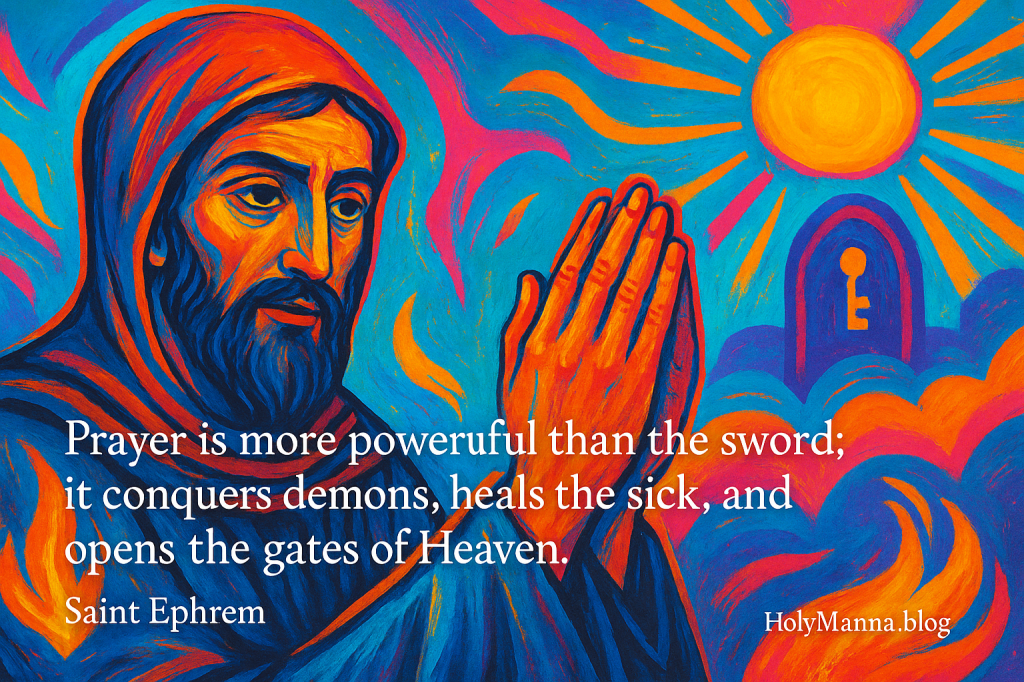
The Harp of the Holy Spirit
In an age marked by fierce theological conflict and doctrinal confusion, one man found his voice—not in the cathedrals of Rome or the universities of Athens—but in the hymns of a humble deacon who lived on the fringes of the Roman Empire. Saint Ephrem the Syrian, often called “the Harp of the Holy Spirit,” remains one of the most beloved and influential Fathers of the Church. His poetic theology, deep Marian devotion, and tireless defense of orthodoxy have left an indelible mark on both Eastern and Western Christianity.
Unlike many other saints who led through episcopal authority or apostolic mission, Ephrem chose a quieter path—one of contemplation, service, and sacred song. His legacy was not etched into stone with the sword, but carved into the hearts of the faithful through verse and melody. A master theologian and lyricist, he transformed deep doctrinal truths into beautiful hymns that could be sung by all, thus preserving the faith in a time of rampant heresy. His title as Doctor of the Church, bestowed in 1920 by Pope Benedict XV, honors not just the brilliance of his mind, but the holiness of his life and the sweetness of his soul.
From Pagan Borderlands to the Psalms of Truth
Saint Ephrem was born around 306 A.D. in the bustling city of Nisibis, situated in the borderlands between the Roman and Persian empires—an area that would later suffer both political and religious upheaval. Though the details of his family life remain somewhat shrouded in mystery, most accounts suggest that he grew up in a largely pagan environment. Some sources imply that his father may have been a pagan priest, while others maintain that Ephrem was born into a Christian household. Regardless of his exact upbringing, what is certain is that he underwent a profound transformation that led him to embrace Christ wholeheartedly.
As a young man, Ephrem became a disciple of Saint Jacob of Nisibis, a wise and holy bishop who had participated in the First Council of Nicaea. Under Jacob’s mentorship, Ephrem was baptized and began to deepen his knowledge of Scripture, liturgy, and theology. His zeal for truth and his growing understanding of the mysteries of faith led him to enter into the service of the Church as a deacon—a role he would hold for the rest of his life. In his humility, Ephrem never sought ordination to the priesthood, believing himself unworthy of such an office.
During his years in Nisibis, Ephrem taught theology, composed hymns, and helped establish a theological school that became a beacon of orthodoxy. But when the city fell into Persian hands in 363 A.D., he fled to Edessa, a center of Syriac Christian learning and culture. There, he continued his ministry, writing some of his most powerful hymns and theological reflections. His love for the Blessed Virgin Mary, whom he called “the pure dove” and “the gateway of salvation,” blossomed during this time and inspired a deep and enduring Mariology in the Christian East. Ephrem’s hymns and poems frequently reflected on her virginity, maternity, and role as the New Eve—echoing the teachings of Saint Irenaeus and anticipating those of Saint John Damascene.
Ephrem’s writings also offer one of the earliest theological commentaries on Scripture in the Syriac tradition. He interpreted the Bible through what the Church would later call the fourfold sense of Scripture—literal, allegorical, moral, and anagogical—aligning beautifully with the guidance of the Church in CCC 115–119. His exegesis was always rooted in a reverent love for the Word of God, which he called “a fountain with many spouts, each giving a different taste.” His contributions, then, were not just to liturgical life, but to the development of a distinctly poetic theology that nourished both heart and mind.
Famine, Fire, and the Fruit of Compassion
Though Saint Ephrem was not primarily known as a miracle worker, the holiness of his life made room for divine wonders to flow through his compassion and service. One of the most remarkable events in his lifetime was his response to a devastating famine in Edessa. While many retreated in fear or turned inward, Ephrem stepped forward as a servant of all. Despite being a hermit and ascetic, he emerged from solitude to organize relief efforts. He begged on behalf of the starving, distributed bread to the poor, and even mobilized wealthy citizens to act with generosity and responsibility.
His eloquence and moral authority inspired the rich to open their granaries and give liberally to the hungry. It is said that through his coordination and intercessory prayers, the city avoided even greater tragedy. Many considered this outpouring of charity and unity to be a miracle—a testimony not of supernatural spectacle, but of the Spirit moving through human hearts, stirred by the sanctity of one man’s selfless love.
Ephrem also exhibited a gift of prophetic insight. He foretold the death of Emperor Julian the Apostate, a ruler who had attempted to revive paganism and suppress Christianity. Though this prophecy is not recorded with the precision of later medieval hagiographies, early accounts affirm that Ephrem warned the faithful of Julian’s failure, urging them to remain steadfast in Christ. Such spiritual foresight, combined with his deep understanding of Scripture and human nature, made him a revered teacher and intercessor in his own lifetime.
The Fire That Consumes but Does Not Destroy
Saint Ephrem’s life was not free of suffering. Far from it. He lived in an age when Christians were persecuted not only by pagan emperors but also from within the Church through the spread of dangerous heresies. He watched his beloved Nisibis fall into enemy hands. He endured exile, instability, and the collapse of a Christian society that once flourished. Yet in all of this, Ephrem responded not with bitterness, but with songs of praise. “Blessed is He who became a child, so that I might become mature. Blessed is He who wore a poor garment, so that I might find glory in His riches.”
In Edessa, Ephrem chose the path of radical humility. He lived in a cave, dressed in simple clothes, and fasted constantly. His body grew frail, but his spirit burned brightly. He never sought attention or acclaim. When pressed to become a bishop, he declined, saying he was unworthy. When offered praise, he deflected it to God. He considered himself “dust and ashes,” echoing Genesis 18:27, and yet he was aflame with the Spirit.
Though he was not a martyr in the sense of bloodshed, his life was a living martyrdom—a daily dying to self for the sake of Christ and His Church. His suffering was a form of offering, his body a temple of penance. And ultimately, he laid down his life by caring for victims of plague. Around the year 373 A.D., Ephrem succumbed to illness while ministering to the sick and dying, giving up his life in an act of supreme charity.
A Melody That Never Fades
After his death, the fame of Saint Ephrem only grew. His tomb in Edessa became a site of pilgrimage and healing, and many miracles were attributed to his intercession. Those who came to pray at his grave reported being cured of illnesses, delivered from spiritual oppression, and comforted in times of grief. The power of his presence lingered, as though the earth itself had absorbed his holiness.
Perhaps most powerfully, his hymns continued to heal. They were sung in churches across the East and eventually made their way westward, translated into Greek and Latin, treasured by theologians and monks alike. Saint Jerome himself praised Ephrem’s writings, calling him “a deacon of the Church, filled with the Holy Spirit, whose writings surpassed the eloquence of the Greeks.” His hymns became spiritual medicine—words that stirred repentance, ignited love for Christ, and brought clarity to confused hearts.
Even today, the Syriac Churches continue to honor Saint Ephrem as their greatest teacher and poet. His feast is celebrated on June 9 in the Roman Catholic Church and on various dates in Eastern traditions. His relics, though dispersed, are held with reverence, and his legacy continues in every song that glorifies truth with beauty.
Lessons from the Harp of the Spirit
Saint Ephrem speaks to us across centuries with a voice that is still relevant, still urgent. In a time when digital noise drowns out divine silence, he reminds us that our words matter—and that when offered in love, they can become instruments of grace. He teaches us that theology is not just for scholars; it is for singers, artists, and anyone with a heart open to God.
His life is a call to humility. He had every reason to assert his intellect, his reputation, his influence. But he chose the path of hiddenness, choosing to glorify God rather than himself. He reminds us that greatness in the Kingdom of Heaven does not come from climbing ladders, but from kneeling in service.
Ephrem also shows us that beauty is a gateway to truth. In his hymns, we encounter the mystery of the Incarnation, the splendor of Mary’s yes, the majesty of divine mercy. His life encourages us to make space for beauty in our own spiritual practices—whether through music, poetry, or acts of love offered in silence.
How can we, like Ephrem, use our gifts to draw others toward God? How might our humility become a platform for His glory? How can our speech, our silence, and our service become hymns to the living God?
Engage with Us!
Have Saint Ephrem’s life and writings touched your heart? We’d love to hear your thoughts and reflections. Join the conversation in the comments and help us build a vibrant, faithful community.
Reflection Questions:
- What false “songs” of the world have I allowed into my heart, and how can I replace them with hymns of truth like Ephrem’s?
- How can I use beauty—through music, art, or writing—to draw others closer to Christ?
- In what ways can I imitate Ephrem’s humility and service to the poor in my daily life?
Let us lift each other up in prayer, striving to live and love like Jesus, the Eternal Word made flesh. May our voices, like Saint Ephrem’s, become harps strung by the Holy Spirit, singing truth to a weary world.
Saint Ephrem, pray for us! 🎶
Follow us on Instagram and Facebook for more insights and reflections on living a faith-filled life.

 Holy Manna!
Leave a comment