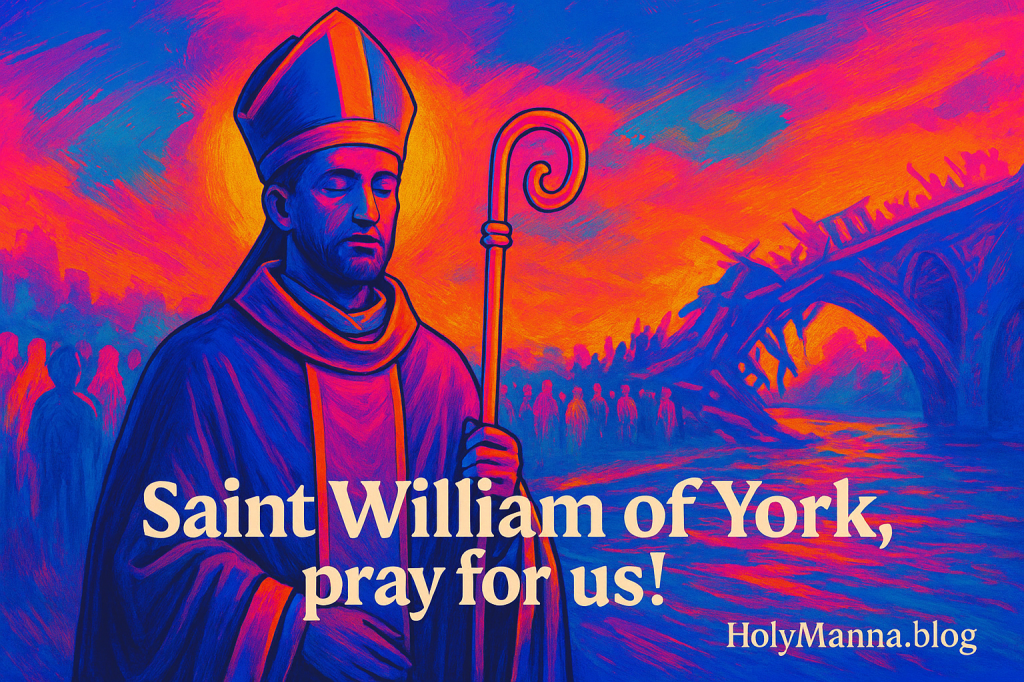
A Shepherd in Stormy Times
Saint William of York, though not a martyr in the traditional sense, was a man deeply acquainted with suffering, betrayal, and public humiliation—all endured for the sake of Christ and His Church. His life was one of quiet heroism, filled with false accusations, political intrigue, exile, and eventual vindication. And yet, through it all, he never once abandoned his post as a spiritual father. He is not remembered for eloquent preaching or founding a religious order; he is remembered because he refused to fight back when wronged. Instead, he chose the path of humility and trust in divine providence. This is precisely why the Church honors him: not because he won in the worldly sense, but because he conquered the world’s temptations with Christ-like meekness. He reminds us that sanctity is not always dramatic—it often takes root in silence, patience, and steady endurance under pressure. Saint William’s feast day, June 8th, calls us to honor not only his witness, but also the enduring truth of the Gospel: “Blessed are the pure in heart, for they shall see God” (The Gospel of Matthew 5:8).
A Bishop Born of Power but Clothed in Simplicity
William was born into privilege around the year 1110. His father, Herbert of Winchester, served as the treasurer to King Henry I of England, a position of significant political power. With such a lineage, William could have easily chosen a life of luxury or political maneuvering. But from a young age, he displayed a love for the Church, a thirst for truth, and a heart attuned to the needs of the people of God. Raised in the royal court and educated within ecclesial structures, he developed a reputation for justice, administrative talent, and piety. He held influential positions in the Church, including treasurer of York and archdeacon of the East Riding.
Though there is no dramatic conversion moment like Saint Augustine’s or Saint Paul’s in his life, what sets William apart is the quiet, consistent “yes” he gave to God throughout his life. When he was elected Archbishop of York in 1141, he accepted the position with a sincere desire to shepherd the faithful, despite knowing that his appointment was bound to stir political opposition. His election was marred by controversy, with the Cistercian order—led vocally by Saint Bernard of Clairvaux—raising concerns over its legitimacy. Yet even as questions mounted and reputations clashed, William remained faithful, obedient, and unwilling to sow division.
Saint William’s life was ultimately defined by this inner disposition: a shepherd who would rather suffer in exile than tear the Church apart by insisting on his rights. His love for the Body of Christ was greater than his ambition, and his fidelity to God outweighed any desire for personal vindication.
The Bridge That Didn’t Break
Though Saint William is remembered more for his endurance than for a multitude of wonders, one powerful miracle has come down to us—a visible sign of God’s favor and William’s sanctity. In 1153, after years of painful exile, he was finally reinstated by Pope Anastasius IV and welcomed back to York with public rejoicing. The people loved him. They poured into the streets to greet their long-suffering archbishop, filling the city in a joyful, overwhelming procession.
As William’s retinue crossed the Ouse Bridge—overloaded with people eager to see him—a section of it collapsed. In any other circumstance, such a disaster would have ended in tragedy. And yet, not a single person was harmed or killed. The city’s faithful immediately saw this as a miracle wrought through William’s intercession, a sign that the archbishop who had been humiliated and silenced was indeed a man favored by God.
In this quiet but startling moment, we see the Lord confirming William’s role as a true shepherd—not by thrones or triumphs, but by the preservation of life, by the gentleness of grace protecting His people.
The Humble Cross of a Deposed Shepherd
William’s election as Archbishop of York was contested almost from the beginning. Despite having been canonically elected and consecrated, he faced relentless opposition from the powerful Cistercian order. Saint Bernard of Clairvaux, deeply revered for his own holiness, feared that William’s election had been politically motivated and urged Pope Eugene III—himself a former Cistercian monk—to intervene.
In 1147, William was officially deposed by papal authority. This was not the removal of a bishop for heresy or corruption; it was a painful political move, influenced by Church factions and earthly alliances. William, though deeply wounded, accepted the decision without resistance. He withdrew from public ministry and lived in quiet obscurity in Winchester. For nearly six years, he watched from the shadows as another man took his seat, endured false assumptions about his character, and bore the emotional pain of being cast out unjustly.
Yet through all of this, he never stopped loving the Church. He never spoke ill of those who opposed him. “Blessed are you when men revile you and persecute you and utter all kinds of evil against you falsely on my account” (The Gospel of Matthew 5:11). William lived these words. When, in 1153, a new pope reversed the decision and restored him to his rightful role, he returned with dignity and forgiveness.
Only a month later, however, William fell ill and died on June 8. Many believe he was poisoned by those who still opposed his return. If this is true, he died not only a confessor, but a martyr in spirit—martyred by the malice of men whose ambitions could not tolerate a holy man in power.
A Saint Confirmed by Signs from Heaven
After William’s death, the faithful of York instinctively turned to his tomb as a place of intercession. The man who had suffered so much was now seen as one who could plead their cause in Heaven. His relics quickly became associated with miracles—healings, conversions, and physical cures. The blind saw. The lame walked. The sick were restored. The Archbishop who had once been driven out in shame now drew the people in waves to his grave, confirming in the hearts of many that he was indeed a holy man.
Pilgrims came from across England to pray at his tomb, located in York Minster, one of the most important Christian sites in the country. The site became so well-attested for miracles that Pope Honorius III canonized William as a saint in 1227, seventy-three years after his death. His legacy endures not in the annals of political history, but in the spiritual memory of a people who loved him for his gentleness, patience, and unwavering hope.
Today, he is venerated as a patron of those suffering from false accusations and injustice. His intercession is a refuge for the humble who seek peace over power.
Grace in the Furnace of Humiliation
Saint William of York leaves us with one of the most difficult, yet beautiful, challenges of the Christian life: to suffer well. His life is a living example of what it means to carry the cross not once, but every day—quietly, without bitterness, without complaint. He shows us that there is tremendous grace in submitting to God’s will, even when it feels unfair. He reminds us that to follow Christ is not always to be celebrated or vindicated, but often to be misunderstood, overlooked, or even betrayed.
Are there people or situations in your life that call for patient endurance instead of retaliation?
Have you experienced injustice and struggled to keep your heart open?
Can you find peace in knowing that God’s justice is perfect—even when the world is not?
Saint William’s example calls us to ask: What kind of Christian am I when the world is watching? But even more—what kind of Christian am I when no one is? Am I faithful in the dark, as William was in Winchester? Do I trust God when everything is stripped away? Or only when I am affirmed?
Let us resolve to follow William’s example. May we forgive those who wrong us. May we love the Church, even when it wounds us. May we bear humiliation for the sake of Christ, and do so with open hands and silent strength. “He who endures to the end will be saved” (The Gospel of Matthew 10:22). In this, Saint William of York has already gone before us—and now prays that we might follow.
Engage with Us!
We’d love to hear how Saint William’s life inspires you. Share your reflections in the comments below!
Here are a few questions to pray and ponder:
- What injustices have I faced, and how did I respond? Did I trust God to handle them, or try to control the outcome myself?
- Am I willing to be faithful even when falsely accused or misunderstood?
- What virtues from Saint William’s life can I cultivate in my relationships and ministry today?
Let us encourage one another in this journey of faith—holding fast to truth, walking humbly with God, and striving to do everything with love, just as Jesus did.
Saint William of York, pray for us! ✨
Follow us on Instagram and Facebook for more insights and reflections on living a faith-filled life.

 Holy Manna!
Leave a comment