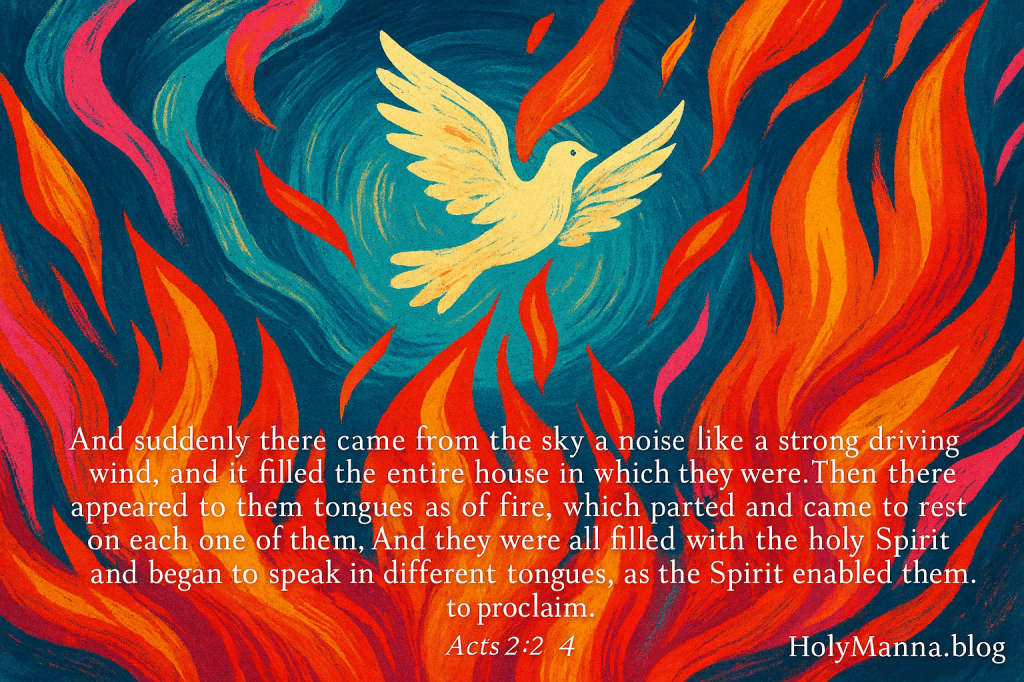
Heaven’s Fire, Earth’s Unity
Have you ever felt the world shift—not just around you, but within you? That sacred, trembling moment when fear gives way to peace, confusion turns to clarity, and a breath you didn’t know you were holding suddenly fills you with life? Pentecost is that moment. Today we celebrate the descent of the Holy Spirit, the divine breath that ignites the Church into being, sends disciples into mission, and weaves together what was once scattered and broken. This is not just a feast on the liturgical calendar—it is a feast of transformation, power, and divine intimacy.
Fifty days after Easter and rooted in the Jewish Feast of Weeks (Shavuot), Pentecost historically celebrated the giving of the Law on Mount Sinai. But for Christians, it becomes the giving of the Spirit on Mount Zion. The Law carved in stone is now inscribed on human hearts. In Acts 2, we witness tongues of fire resting on the apostles as they are filled with the Holy Spirit, suddenly able to proclaim the “mighty acts of God” in every language under heaven. This miracle of unity through diversity echoes through Psalm 104, where the Spirit is praised as the breath that creates, renews, and sustains all life. We are reminded that God is not only majestic but intimately involved with His creation, bringing forth order and life from chaos and dust.
1 Corinthians 12 takes us deeper into the mystery: though we each receive different gifts, it is the same Spirit who empowers us, baptizing us into one body—Christ’s. The Spirit is not merely a divine force; He is the unifier, the sanctifier, the soul of the Church. Then in The Gospel of John, the Risen Jesus breathes on His disciples and says, “Receive the Holy Spirit”, commissioning them to forgive sins and extend His peace to the world. Today’s readings remind us that Pentecost isn’t the end of Easter—it is its explosion. The resurrection overcomes death, and the Spirit ensures that this victory is shared. Are you ready to be set ablaze by the Spirit and sent into the world to proclaim the wonders of God?
First Reading – Acts 2:1–11
When Heaven Speaks Your Language
The Book of Acts of the Apostles is often referred to as the “Gospel of the Holy Spirit,” and today’s passage captures one of the most pivotal moments not only in the book but in all of salvation history: the birth of the Church at Pentecost. Written by Saint Luke as a sequel to his Gospel, Acts chronicles the expansion of the early Church under the power and guidance of the Holy Spirit. Pentecost itself, originally a Jewish feast known as Shavuot, commemorated the giving of the Law to Moses on Mount Sinai fifty days after Passover. In divine symmetry, it is now the day when the Spirit writes the new law of love upon the hearts of the disciples, fulfilling the promise of Jesus to send the Advocate. The descent of the Holy Spirit marks a profound shift—from fear to courage, from closed rooms to public witness, from many tongues to one proclamation of the mighty works of God. It is the ultimate expression of unity in diversity, a divine answer to the scattering of nations at Babel.
Acts 2:1-11
New American Bible (Revised Edition)
The Coming of the Spirit. 1 When the time for Pentecost was fulfilled, they were all in one place together. 2 And suddenly there came from the sky a noise like a strong driving wind, and it filled the entire house in which they were. 3 Then there appeared to them tongues as of fire, which parted and came to rest on each one of them. 4 And they were all filled with the holy Spirit and began to speak in different tongues, as the Spirit enabled them to proclaim.
5 Now there were devout Jews from every nation under heaven staying in Jerusalem. 6 At this sound, they gathered in a large crowd, but they were confused because each one heard them speaking in his own language. 7 They were astounded, and in amazement they asked, “Are not all these people who are speaking Galileans? 8 Then how does each of us hear them in his own native language? 9 We are Parthians, Medes, and Elamites, inhabitants of Mesopotamia, Judea and Cappadocia, Pontus and Asia, 10 Phrygia and Pamphylia, Egypt and the districts of Libya near Cyrene, as well as travelers from Rome, 11 both Jews and converts to Judaism, Cretans and Arabs, yet we hear them speaking in our own tongues of the mighty acts of God.”
Detailed Exegesis
Verse 1 – “When the time for Pentecost was fulfilled, they were all in one place together.”
This verse grounds us in the intentionality of God’s timing. Pentecost was not random; it was fulfillment. The apostles, obedient to Jesus’ command in Acts 1:4 to wait in Jerusalem, are gathered in prayer and unity. Their being “in one place” is not only geographical but spiritual—a sign that the Church is born in communion, not isolation.
Verse 2 – “And suddenly there came from the sky a noise like a strong driving wind, and it filled the entire house in which they were.”
Wind, in both Hebrew (ruach) and Greek (pneuma), is the same word for “spirit” or “breath.” This powerful, audible sign echoes Genesis 1:2 and Ezekiel 37:9-10, where the Spirit brings life out of chaos and raises dry bones. The Spirit’s arrival is not subtle—it is commanding, life-altering, and unmistakable.
Verse 3 – “Then there appeared to them tongues as of fire, which parted and came to rest on each one of them.”
Fire in Scripture symbolizes God’s presence (Exodus 3:2, Hebrews 12:29). These tongues of fire are both purifying and empowering, distributed individually yet equally—signaling that each disciple is personally equipped by God for mission. Unlike the fire that once consumed the unworthy, this fire consecrates and commissions.
Verse 4 – “And they were all filled with the holy Spirit and began to speak in different tongues, as the Spirit enabled them to proclaim.”
Here the word “proclaim” (Greek: apophthengomai) implies inspired, authoritative speech. The speaking in different tongues isn’t for chaos or spectacle—it is purposeful, Spirit-led communication that bridges nations and hearts. It prefigures the Church’s universal mission and its sacramental capacity to speak truth in all cultures.
Verse 5 – “Now there were devout Jews from every nation under heaven staying in Jerusalem.”
This detail reminds us that God chose a moment when the nations were gathered to make His Church visible and global from the beginning. Pentecost isn’t the start of a sect; it is the fulfillment of God’s covenant with the whole world.
Verse 6 – “At this sound, they gathered in a large crowd, but they were confused because each one heard them speaking in his own language.”
Confusion at unity is ironic. Unlike Babel, where language divided (see Genesis 11:7-9), here language unites. The miracle is not just in speaking, but in hearing—God ensures that each heart hears the Gospel personally.
Verse 7 – “They were astounded, and in amazement they asked, ‘Are not all these people who are speaking Galileans?’”
Galileans were seen as simple, unsophisticated folk. That such profound, multilingual proclamation could come from them is a divine sign. God exalts the humble, echoing 1 Corinthians 1:27—“God chose the foolish of the world to shame the wise.”
Verse 8 – “Then how does each of us hear them in his own native language?”
This verse emphasizes intimacy and particularity. The Gospel doesn’t erase identity—it speaks directly into it. God doesn’t flatten culture; He sanctifies it.
Verses 9–11 – “We are Parthians, Medes, and Elamites… yet we hear them speaking in our own tongues of the mighty acts of God.”
This list of peoples spans the known world—from Persia to North Africa, from Rome to Arabia. The miracle is not nationalism but universality. Each one hears the same message: “the mighty acts of God”. The Spirit speaks in every language but proclaims one truth—God’s saving love in Christ.
Teachings of the Church
The Catechism of the Catholic Church teaches that “on the day of Pentecost, Christ’s Passover is fulfilled in the outpouring of the Holy Spirit” (CCC 731). It continues: “On that day, the Holy Trinity is fully revealed. Since that day, the Kingdom announced by Christ has been open to those who believe in him” (CCC 732). This shows that Pentecost is not merely an event—it is the beginning of a new age, the age of the Church animated and sustained by the Spirit of Christ Himself.
The Church Fathers, particularly St. John Chrysostom, emphasized Pentecost as the reversal of Babel and the beginning of evangelization. He writes, “So then the Holy Spirit came down… and the whole world was renewed”—linking the moment of fire with the universal mission of the Church. For Chrysostom, Pentecost is not only the moment of bold speech but also the manifestation of divine wisdom, poured out upon the humble for the conversion of the world.
Saint Augustine offers a personal dimension to this mystery: “You were made to be a vessel of God. If you are filled with other things, there is no room for Him.” He draws our attention to the interior preparation necessary to receive the Holy Spirit—not just once, but daily. Saint Catherine of Siena furthers this call, reminding us that “If you are what you should be, you will set the whole world on fire.” Pentecost is not just about tongues or signs—it is about being consumed by divine love so profoundly that others cannot help but be drawn to it.
Reflection
What might happen if you allowed the Holy Spirit to truly rest upon you today? Pentecost isn’t a story we admire from afar; it is a reality we’re meant to live. Do you feel scattered, like your life speaks in conflicting tongues? Invite the Spirit to bring order, purpose, and unity. Do you feel silenced by fear or unqualified to proclaim Christ? Remember that the apostles were ordinary men transformed by extraordinary grace. How is the Lord inviting you to speak of His mighty acts—to your family, your coworkers, your neighbors? Today, ask for a fresh outpouring of the Spirit. Open your heart, breathe in His wind, and let the fire fall.
Responsorial Psalm – Psalm 104:1, 24, 29–31, 34
The Breath That Sustains All Things
Psalm 104 is a majestic hymn of praise that exalts the creative and sustaining power of God, particularly through the life-giving action of His Spirit. This psalm, attributed to King David, stands within the Wisdom tradition of ancient Israel, marveling at the intricacies of creation and the divine order embedded in nature. It reflects not just poetic wonder, but theological truth: creation is not autonomous—it is upheld at every moment by the will and breath of God. In the context of Pentecost, this psalm reminds us that the same Spirit who hovered over the waters at creation (cf. Genesis 1:2) is the Spirit poured out upon the Church at her birth. Just as the Spirit brings order from chaos in the natural world, so too does He bring unity and life to the Body of Christ. The psalm connects today’s theme by showing that the Holy Spirit is not only a fire from heaven, but also the gentle breath that animates all life and renews the face of the earth.
Psalm 104:1, 24, 29-31, 34
New American Bible (Revised Edition)
Praise of God the Creator
1 Bless the Lord, my soul!
Lord, my God, you are great indeed!
You are clothed with majesty and splendor,
24 How varied are your works, Lord!
In wisdom you have made them all;
the earth is full of your creatures.
29 When you hide your face, they panic.
Take away their breath, they perish
and return to the dust.
30 Send forth your spirit, they are created
and you renew the face of the earth.
31 May the glory of the Lord endure forever;
may the Lord be glad in his works!
34 May my meditation be pleasing to him;
I will rejoice in the Lord.
Detailed Exegesis
Verse 1 – “Bless the Lord, my soul! Lord, my God, you are great indeed! You are clothed with majesty and splendor.”
This opening call to worship is deeply personal and profoundly cosmic. The soul blesses the Lord, acknowledging both intimacy and grandeur. To be “clothed with majesty” links God’s creative role to His kingship; He reigns not through domination, but through the beauty and order of creation. It is a cry of awe and reverence from a heart that recognizes its smallness before God’s greatness.
Verse 24 – “How varied are your works, Lord! In wisdom you have made them all; the earth is full of your creatures.”
Here, creation is celebrated not just for its diversity but for its intentionality. The phrase “in wisdom” echoes Proverbs 8, where divine Wisdom is personified as being with God at creation. This verse reminds us that nothing God makes is random; everything has a purpose. The Spirit’s wisdom permeates all created life, from the smallest insect to the largest star.
Verse 29 – “When you hide your face, they panic. Take away their breath, they perish and return to the dust.”
This is a sobering verse. It captures the utter dependence of all creation on God’s presence. The “breath” here is the Hebrew ruach, meaning both wind and spirit. Without God’s Spirit, life collapses into lifeless matter—dust. This connects directly to Genesis 2:7, where man becomes a living being only after receiving God’s breath. The panic described is not emotional but existential—a collapse of the created order when the Creator withdraws.
Verse 30 – “Send forth your spirit, they are created and you renew the face of the earth.”
This is the heart of the Pentecost connection. The same Spirit who animates creation now renews it. Renewal here implies both physical regeneration and spiritual restoration. The Church Fathers often saw this verse as fulfilled in the outpouring of the Holy Spirit on the Church, who is the “new creation” in Christ (cf. 2 Corinthians 5:17).
Verse 31 – “May the glory of the Lord endure forever; may the Lord be glad in his works!”
This is a liturgical affirmation of God’s sovereignty and delight. That the Lord would “be glad” in His works recalls Genesis 1, where God sees all that He made and calls it “very good.” The Spirit’s creative work is not cold efficiency but joyful artistry, and we are invited to rejoice in it with Him.
Verse 34 – “May my meditation be pleasing to him; I will rejoice in the Lord.”
The psalmist moves from cosmic praise to personal response. Meditation here implies not passive thought, but a heart engaged in loving contemplation. True joy is found not merely in observing the wonders of creation but in aligning our inner lives with the Spirit who animates them.
Teachings of the Church
The Catechism of the Catholic Church declares, “The Holy Spirit is the ‘finger of God’s right hand’… He is the artisan of God’s works, the master of prayer, and the principle of every vital and truly saving action in each part of the body” (CCC 741–742). This echoes the Spirit’s role in Psalm 104, where He is both Creator and Sustainer. The breath of God does not merely give life; it sanctifies, instructs, and sends.
Saint Basil the Great, in his Treatise on the Holy Spirit, writes: “The Spirit restores paradise to us, leads us into the kingdom of heaven, and adopts us as children of God. He enlightens our minds, teaches us to pray, and sanctifies our bodies and souls”. For Basil, Psalm 104 is not mere poetry—it is a revelation of the Spirit’s intimate role in every dimension of life. Creation is the first Gospel, and the Spirit is its divine author.
Historically, Psalm 104 has been prayed during the Liturgy of the Hours on Pentecost Sunday, and verse 30—“Send forth your Spirit and they shall be created”—is the inspiration for the traditional chant Veni Sancte Spiritus. This antiphon, often called the “Golden Sequence,” is a liturgical treasure of the Church that begs the Spirit to come with light, joy, strength, and healing. The chant and the psalm together form a mosaic of spiritual longing and divine fulfillment.
Reflection
Do you see the Holy Spirit at work in creation around you—and within you? This psalm challenges us to open our eyes to the Spirit’s quiet, continuous action in our daily lives. When we are weary, it is His breath that renews. When we feel like dust, it is His presence that brings us back to life. What areas of your life feel like dry bones in need of His breath today? Ask Him to renew the face of your heart as He does the face of the earth. Take time to walk outdoors today and marvel with the psalmist—“How varied are your works, Lord!” In your meditations, let your heart be pleasing to God, and rejoice in Him—not only as Creator, but as the Spirit who sustains you moment by moment.
Second Reading – 1 Corinthians 12:3–7, 12–13
One Spirit, Many Gifts, One Body
Saint Paul’s First Letter to the Corinthians is one of his most pastoral and corrective writings, aimed at a deeply divided community in Corinth—a prosperous, multicultural port city riddled with factionalism, moral confusion, and spiritual pride. Paul writes not only to correct abuses but to teach the Corinthians the heart of Christian unity: life in the Spirit. In chapter 12, he begins a powerful reflection on spiritual gifts (charismata) and their purpose—not as personal achievements or signs of superiority, but as Spirit-given tools for building up the Church. This reading is perfectly placed on Pentecost, the feast that marks the outpouring of the Holy Spirit upon the Church. Paul’s words remind us that this same Spirit is alive in every believer today, orchestrating the unity of the Church by empowering diverse members to live as one body in Christ.
1 Corinthians 12:3-7
New American Bible (Revised Edition)
3 Therefore, I tell you that nobody speaking by the spirit of God says, “Jesus be accursed.” And no one can say, “Jesus is Lord,” except by the holy Spirit.
4 There are different kinds of spiritual gifts but the same Spirit; 5 there are different forms of service but the same Lord; 6 there are different workings but the same God who produces all of them in everyone. 7 To each individual the manifestation of the Spirit is given for some benefit.
12 As a body is one though it has many parts, and all the parts of the body, though many, are one body, so also Christ. 13 For in one Spirit we were all baptized into one body, whether Jews or Greeks, slaves or free persons, and we were all given to drink of one Spirit.
Detailed Exegesis
Verse 3 – “Therefore, I tell you that nobody speaking by the spirit of God says, ‘Jesus be accursed.’ And no one can say, ‘Jesus is Lord,’ except by the holy Spirit.”
This verse distinguishes true inspiration from falsehood. The ultimate test of the Spirit’s presence is fidelity to Christ. In Paul’s time, various ecstatic or mystical utterances could be mistaken as divine. Paul clarifies: the Spirit always glorifies Jesus as Lord. The simple but profound confession—“Jesus is Lord”—is itself a gift of grace. It echoes the earliest Christian creed and affirms that faith is not merely intellectual assent, but Spirit-infused conviction.
Verse 4 – “There are different kinds of spiritual gifts but the same Spirit.”
Here begins Paul’s triad of diversity in unity. While gifts vary, their source is singular: the Holy Spirit. This verse lays the foundation for understanding charisms not as self-generated abilities but as divine bestowals for a greater good. The unity of the Church depends not on uniformity, but on harmonious diversity rooted in one Spirit.
Verse 5 – “There are different forms of service but the same Lord.”
Just as spiritual gifts differ, so do vocations and ministries. Yet all are directed toward the same Lord—Jesus Christ. Paul subtly teaches humility here: no form of service is superior to another if it is done in the name of the Lord. Whether one preaches, serves, or prays in silence, all are participating in the same divine mission.
Verse 6 – “There are different workings but the same God who produces all of them in everyone.”
This completes the Trinitarian pattern—Spirit, Lord (Son), and God (Father). Paul shows that the entire Trinity is active in the distribution of gifts and ministries. “Workings” (energemata in Greek) suggests that God is not only the initiator but the ongoing source of spiritual activity in the Church.
Verse 7 – “To each individual the manifestation of the Spirit is given for some benefit.”
Every believer is gifted, and every gift has a purpose. The Spirit does not favor a few elite Christians but equips each individual for the good of the whole. This verse is both empowering and sobering: what we have received is not for our ego but for others’ edification.
Verse 12 – “As a body is one though it has many parts, and all the parts of the body, though many, are one body, so also Christ.”
The metaphor of the body is one of Paul’s most profound teachings. Just as the human body is composed of many parts working in unity, so the Church is one body made up of diverse members. “So also Christ” affirms that the Church is not just like Christ—it is His mystical body. This unity-in-diversity is the hallmark of Pentecost.
Verse 13 – “For in one Spirit we were all baptized into one body, whether Jews or Greeks, slaves or free persons, and we were all given to drink of one Spirit.”
This verse reveals the radical equality introduced by the Holy Spirit. Ethnic, social, and economic divisions are transcended in baptism. To “drink of one Spirit” evokes Eucharistic imagery as well—the Spirit is not only the initiator of our life in Christ but its sustainer. This is true unity: not forced conformity, but shared indwelling.
Teachings of the Church
The Catechism of the Catholic Church emphasizes the inseparability of the Church and the Holy Spirit. It teaches, “To each is given the manifestation of the Spirit for the common good” (CCC 951), and explains that “the Holy Spirit builds, animates, and sanctifies the Church” (CCC 747). The Church, as the Body of Christ, is both one and holy precisely because the Spirit is her soul. These gifts, services, and workings are not occasional extras; they are constitutive of the Church’s very life and mission.
Saint Thomas Aquinas, in his Summa Theologiae, writes: “Grace is given not for one’s own sake alone, but for the benefit of others” (ST I-II, q. 111, a. 1). This echoes Paul’s teaching: the gifts we receive are never meant to be hoarded. They are ecclesial by nature. Saint John Paul II further expanded this in Christifideles Laici, stating: “The Holy Spirit also gives special graces, called charisms… which are to be received with gratitude… and are particularly suited to and useful for the renewal and building up of the Church” (CL 24).
Historically, the rediscovery of charisms in the modern Church, especially through the Catholic Charismatic Renewal, has reignited the living reality of this teaching. Pope Benedict XVI encouraged the Church to see charisms not as fringe experiences but as vital expressions of the Spirit’s creativity. At Pentecost, we recall not only the tongues of fire and rushing wind, but the deep truth that every baptized person has been uniquely anointed for the mission of Christ.
Reflection
Have you discovered your spiritual gifts? Do you know what the Spirit is doing in you for the good of others? Too often, we think of holiness as something reserved for priests, religious, or the particularly pious. But Saint Paul makes it clear: “To each individual the manifestation of the Spirit is given”. That means you. The Spirit who came upon the apostles in fire also rests on you in baptism and confirmation. How are you using your gifts to build up the Body of Christ? Maybe you teach, lead, encourage, pray, serve, or simply listen. Whatever it is, the Spirit desires to work through you.
Today, ask the Holy Spirit to reveal your gifts more clearly. Spend time in prayer and spiritual reflection. Ask a trusted friend, spiritual director, or member of your parish community where they see the Spirit at work in you. Step out in faith, even if your offering feels small. The Body needs every part—yes, even yours. Are you willing to drink deeply of the one Spirit and allow Him to make you a living part of Christ’s mission? The world is waiting for the gifts the Spirit has placed within you.
Holy Gospel – John 20:19–23
The Breath That Brings Peace
The Gospel of John presents Pentecost in a deeply personal and intimate light. Unlike the dramatic descent of fire and wind in Acts 2, John 20 recounts the gentle yet transformative moment when the risen Christ appears to His disciples on Easter evening. This passage is steeped in Jewish tradition and the rhythm of creation itself. In Genesis, God breathes life into Adam; here, Jesus breathes new life into His apostles, making them new creations. Historically, this Gospel was written for a Christian community navigating persecution, confusion, and questions about Jesus’ divinity. John’s Pentecost moment is not about spectacle but about identity and mission. This reading completes today’s theme by showing that the gift of the Spirit is not just for power or proclamation—it is for peace, forgiveness, and mission. It is the breath of divine mercy that creates the Church.
John 20:19-23
New American Bible (Revised Edition)
19 On the evening of that first day of the week, when the doors were locked, where the disciples were, for fear of the Jews, Jesus came and stood in their midst and said to them, “Peace be with you.” 20 When he had said this, he showed them his hands and his side. The disciples rejoiced when they saw the Lord. 21 [Jesus] said to them again, “Peace be with you. As the Father has sent me, so I send you.” 22 And when he had said this, he breathed on them and said to them, “Receive the holy Spirit. 23 Whose sins you forgive are forgiven them, and whose sins you retain are retained.”
Detailed Exegesis
Verse 19 – “On the evening of that first day of the week, when the doors were locked, where the disciples were, for fear of the Jews, Jesus came and stood in their midst and said to them, ‘Peace be with you.’”
The scene is filled with tension and fear. The disciples are behind locked doors, afraid that the same fate that befell Jesus might soon be theirs. Yet the risen Lord enters without force, standing in their midst, and speaks “Peace be with you.” This greeting is not mere sentiment—it is the fulfillment of His promise in John 14:27: “Peace I leave with you; my peace I give to you.” His presence brings peace because it brings assurance: death has been defeated, and He is alive.
Verse 20 – “When he had said this, he showed them his hands and his side. The disciples rejoiced when they saw the Lord.”
Jesus reveals His wounds—not to horrify, but to glorify. The scars are signs of victory, not shame. In seeing them, the disciples recognize Him not as a ghost or a memory, but as the crucified and risen One. Their fear gives way to joy, just as Jesus had foretold in John 16:20: “You will grieve, but your grief will become joy.”
Verse 21 – “[Jesus] said to them again, ‘Peace be with you. As the Father has sent me, so I send you.’”
The repetition of “Peace be with you” emphasizes its importance—it is both a gift and a commissioning. Just as the Father sent the Son to heal, forgive, and proclaim the Kingdom, now Jesus sends His disciples to do the same. Pentecost is not only a moment of reception—it is a moment of sending. The Church is born to be missionary.
Verse 22 – “And when he had said this, he breathed on them and said to them, ‘Receive the holy Spirit.’”
This is John’s Pentecost. The verb “breathed” (enephysēsen in Greek) is used only once in the entire New Testament—and it is the same verb used in the Greek Old Testament for Genesis 2:7, when God breathed life into Adam. Jesus is creating new life in His disciples, making them sharers in the divine mission through the Holy Spirit. This moment is sacramental, foundational, and deeply Trinitarian.
Verse 23 – “Whose sins you forgive are forgiven them, and whose sins you retain are retained.”
This verse reveals one of the most profound gifts of the Holy Spirit: the authority to forgive sins. This is the institution of the Sacrament of Reconciliation. The Spirit is not given merely for bold speech or ecstatic joy, but for the ministry of mercy. The apostles are entrusted with a divine power—one that is exercised even today through the Church’s ordained ministers.
Teachings of the Church
The Catechism of the Catholic Church explains this passage as the foundation for the Sacrament of Penance. It teaches: “In imparting to his apostles his own power to forgive sins the Lord also gives them the authority to reconcile sinners with the Church” (CCC 1444). Furthermore, “The Lord’s words to Peter, ‘I will give you the keys of the kingdom of heaven,’ and to the apostles, ‘Whose sins you forgive…’ clearly refer to the mission of the Church to continue Christ’s work of reconciliation and peace” (CCC 981).
Saint Cyril of Jerusalem writes, “The Holy Spirit, the Comforter, is given to the apostles, and through them to the Church. It is he who forgives sins and restores peace”. For Cyril and other Church Fathers, this moment is the fulfillment of Christ’s promise in John 14 and 16. The Spirit not only guides the Church into all truth but also makes her a vessel of divine mercy.
Pope Benedict XVI beautifully reflected on this Gospel, saying, “The Spirit is the gift of the Risen Christ, the breath of His love poured into the Church. And the first fruit of that gift is forgiveness—the power that defeats sin and renews life”. Historically, this passage was the cornerstone for the early Church’s understanding of sacramental confession. The Fathers saw here the divine commission to the Church to be the “hospital for sinners,” breathing out peace to a wounded world.
Reflection
Do you live as someone who has been breathed upon by God? This Gospel invites us to remember that the Holy Spirit is not just a theological idea or a dramatic event from the past—He is the living breath of Christ, still exhaled upon the Church and upon you. Have you allowed Him to enter your locked doors? The places where fear hides, where shame lives, where you feel unworthy or stuck? Jesus wants to stand in your midst and say, “Peace be with you.”
The Spirit you received in Baptism and Confirmation is the same Spirit who empowered the apostles. You are also sent—to forgive, to heal, to announce mercy. One of the most concrete ways to live this Gospel is by going to Confession and by offering forgiveness to others. Who in your life needs to hear words of peace? Who do you need to forgive? Where is the Spirit sending you today? Ask the Lord to breathe on you again. Let His peace settle in your bones and His mission burn in your heart. Then go—and forgive as you have been forgiven.
Set Ablaze, Sent Forth
From the roaring wind of Acts, to the breath of life in John, to the gifts poured out in 1 Corinthians, and the creative Spirit sung in Psalm 104, today’s Feast of Pentecost surrounds us with the blazing truth that God has not left us orphaned. He has come to us—within us—as fire, as breath, as peace, and as power. Pentecost is not just the close of the Easter season; it is the launch of our mission as Spirit-filled disciples. It is the Church’s birthday and the soul’s ignition point, when ordinary men and women are set ablaze to transform the world with love.
The Holy Spirit is not an optional part of the Christian life—He is the Christian life. He makes Jesus present. He fills each of us with divine gifts meant not for status but for service. He breathes forgiveness where there was sin, unity where there was division, and courage where there was fear. Today’s readings remind us that the Spirit speaks every language, renews every heart, and binds every soul into one mystical Body. Whether it’s in fire that transforms, breath that revives, or gifts that unite, the Holy Spirit is the living presence of God with us, in us, and through us.
Are you ready to say yes to that Spirit? Ask today for a new Pentecost in your heart. Invite the Holy Spirit to reveal your gifts, renew your prayer, and reawaken your zeal. Let His fire purify what is impure, and let His breath revive what feels dead. Go to Confession. Make time for silence. Speak to someone about Jesus. And above all, listen—because the wind still blows, the fire still burns, and the Spirit is still being poured out. Will you let yourself be set ablaze and sent forth?
Engage with Us!
We would love to hear how the Holy Spirit is moving in your life this Pentecost. Share your thoughts, inspirations, or prayer requests in the comments below. Whether you’re experiencing a renewal of faith or seeking guidance on your spiritual journey, your voice matters and may bless others who are reading along with you.
Reflection Questions:
First Reading – Acts 2:1–11
What “locked doors” in your heart need the fire of the Holy Spirit today? How can you be more open to proclaiming the mighty acts of God in your daily life?
Responsorial Psalm – Psalm 104:1, 24, 29–31, 34
How do you see the Holy Spirit at work in creation around you? In what ways can you cultivate a heart of wonder and praise for God’s wisdom and design?
Second Reading – 1 Corinthians 12:3–7, 12–13
What spiritual gifts do you recognize in yourself, and how are you using them to serve others? How can you grow in unity with the Body of Christ, especially with those who are different from you?
Holy Gospel – John 20:19–23
Where do you most need Jesus to breathe His peace into your life? Who might the Holy Spirit be calling you to forgive, or to bring the message of mercy to?
As we go forth today, let us live with the boldness of the apostles, the joy of the psalmist, the unity of the Body of Christ, and the peace of the risen Lord. May we allow the Spirit to animate every thought, word, and deed—and may we do all things with the love and mercy that Jesus taught us. Come, Holy Spirit, fill the hearts of your faithful and kindle in them the fire of your love!
Follow us on Instagram and Facebook for more insights and reflections on living a faith-filled life.

 Holy Manna!
Leave a comment