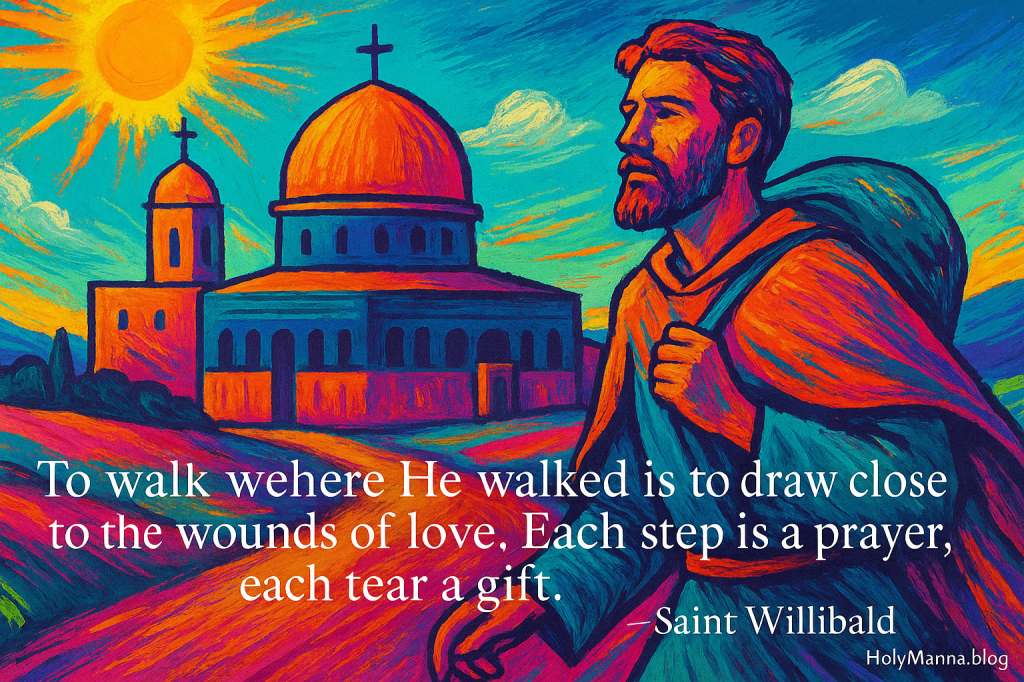
A Missionary for the Ages
Saint Willibald is one of those rare souls whose life unfolds like an epic tale of faith, resilience, and divine purpose. His story stretches across continents and empires, marked by a singular desire: to follow Christ wherever He may lead. Revered as a bishop, missionary, and spiritual pioneer, Willibald is perhaps best known for being the first Englishman to travel to the Holy Land and for establishing the Diocese of Eichstätt in Germany. But his greatness lies not in the titles he bore or the lands he crossed—it lies in his unwavering trust in God and his total surrender to divine providence. He is a saint for pilgrims of all kinds: those seeking healing, those wandering in the wilderness of doubt, and those who feel called to something deeper, holier, and more eternal. “Blessed are those whose strength is in you, whose hearts are set on pilgrimage” (Psalm 84:5).
Roots of Radiance
Born around the year 700 in Wessex, England, Willibald was nurtured in the soil of sanctity. His father, Saint Richard the Pilgrim, and his siblings, Saint Winebald and Saint Walburga, were all saints—a family whose spiritual legacy still shines across the Church. From his earliest days, Willibald was marked for something extraordinary. As a child of five, he became gravely ill, so ill that his life was despaired of. Yet, through the fervent prayers of his family, he miraculously recovered—a moment that foreshadowed a life filled with God’s intervention and grace.
By the age of seven, he was entrusted to the monastery of Waltham, where the Rule of Saint Benedict shaped his young soul. In the quiet rhythms of prayer, labor, and study, Willibald grew in holiness and resolve. But the monastic life was only a prelude. A call was stirring in his heart—a call to seek Christ in the lands where He had walked. At the age of twenty-one, accompanied by his father and brother, Willibald embarked on what would become one of the most daring pilgrimages of the early medieval period.
The journey was fraught with sorrow. His father died en route to Italy and was buried in Lucca, where miracles soon began to occur at his grave. Undeterred, Willibald continued, reaching Rome and then traveling on to Constantinople, Cyprus, Syria, and the Holy Land. He spent years in sacred contemplation at the holy sites of our faith, becoming the first known Englishman to set foot in Jerusalem. What must it have been like for him to kneel at the Mount of Olives, to pray at the Church of the Holy Sepulchre, to walk where Jesus had walked? One imagines him whispering, “My heart says of you, ‘Seek his face!’ Your face, Lord, I will seek” (Psalm 27:8).
Returning to Italy, he entered the famed monastery of Monte Cassino and deepened his formation under the Benedictine tradition. But God was not done with him yet. Pope Gregory III, moved by his holiness and intelligence, appointed him bishop at the request of Saint Boniface, who was spearheading the evangelization of Germany. Willibald accepted the appointment with humility and courage, becoming the first Bishop of Eichstätt. He would spend the next forty-five years sowing seeds of faith in soil still thick with paganism.
God’s Power in Motion
While Saint Willibald is not remembered for a multitude of sensational miracles, his life was, in itself, a miracle of perseverance and divine orchestration. He survived diseases, shipwrecks, imprisonment, and physical exhaustion, always trusting that Christ was his guide and shield. One of the most striking moments of divine protection occurred during his travels in Syria, where he was mistaken for a spy and thrown into prison. Surrounded by hostile guards, isolated in a foreign land, Willibald remained composed, even joyful. His serene demeanor confounded his captors. He prayed continuously, and soon, inexplicably, he was released. “The Lord is my light and my salvation—whom shall I fear?” (Psalm 27:1).
In Germany, he preached with such love and truth that hearts were converted, not just by logic, but by grace. Villagers who had lived for generations in darkness embraced the Gospel and received baptism. Many people reported physical healings and spiritual awakenings through his prayers and presence. In one village, after a lengthy drought, Willibald’s prayers brought rain. In another, a sick child was healed after he blessed her. But perhaps the greatest miracle was the flourishing of a Catholic diocese in a place once hostile to Christ—a miracle not wrought in a single moment, but over a lifetime of holy labor.
A Cross Carried Daily
Saint Willibald’s life was not free of pain. It was defined by it. As a missionary, he bore the daily cross of rejection, language barriers, physical deprivation, and spiritual fatigue. The landscape of medieval Germany was not only physically rugged, but spiritually resistant. He walked through thick forests, climbed jagged mountains, and slept in caves or under open skies. He faced not only pagans but demonic opposition. Yet, he endured it all—not with bitterness, but with deep peace.
Though not martyred by sword or flame, Willibald endured a lifelong martyrdom of service. Every sleepless night, every aching footstep, every disappointing mission was an offering to the Lord. His life echoed the words of The Catechism: “By his Passion and death on the cross, Christ has given a new meaning to suffering: it can henceforth configure us to him and unite us with his redemptive Passion” (CCC 1505). He never ran from hardship. He embraced it, knowing that the cross is the only true path to resurrection.
Sanctified in Memory
After nearly five decades of tireless ministry, Saint Willibald died peacefully around the year 787. But death did not end his story. The faithful began to report miracles at his tomb. Those suffering from fevers and blindness claimed healing through his intercession. His relics became a source of grace and protection, and the Diocese of Eichstätt became a destination for pilgrims, drawn by the memory of this holy man who had given everything for Christ.
The Church enshrined his remains in the cathedral he helped to build. Even today, the faithful visit his tomb to seek healing, offer petitions, and find inspiration. His feast is celebrated on July 7th—a day to remember a saint who never stopped moving, never stopped trusting, never stopped loving.
Saint Willibald’s life reminds us that holiness is a journey. It is found not just in moments of ecstasy but in the dust on your feet, the ache in your bones, and the fire in your heart. “Let us run with endurance the race that is set before us, looking to Jesus, the pioneer and perfecter of our faith” (Hebrews 12:1–2).
Pilgrimage Within
Saint Willibald calls out to all who feel restless, all who sense a deeper calling, all who are not content with a comfortable Christianity. He challenges us to leave behind the known and walk toward Christ, even when the path is long, dry, or steep. His courage and obedience show us what happens when we say yes to the wild grace of God.
Perhaps your pilgrimage won’t take you across continents—but maybe it will take you across your fears. Perhaps your mission isn’t to baptize a village—but to bring Jesus to your family, your office, your social media feed. You don’t need to be a bishop to be a missionary. You only need to be willing. Willing to walk. Willing to trust. Willing to love.
Are you willing to walk the difficult path God asks of you?
Do you see suffering as part of your mission—or as a punishment to be avoided?
How can you, like Willibald, offer your life in total surrender to God’s plan, trusting that His grace is enough?
Saint Willibald shows us that when we walk in faith, we never walk alone. The Church walks with us. The saints cheer us on. And Christ Himself lights our way.
Engage with Us!
How has Saint Willibald’s story inspired you today? Share your thoughts in the comments—we’d love to hear your reflections.
Reflection Questions:
- What journey—spiritual or physical—has God been calling you to embark upon, and what holds you back?
- How can you better trust in God’s providence, especially during times of uncertainty and hardship?
- What is one concrete way you can be a missionary in your own community this week?
Let’s continue walking this path of holiness together. Support each other in prayer, and remember: “Do everything in love” (1 Corinthians 16:14). “Just as our Lord Jesus did.”
Saint Willibald, pray for us! ✝️
Follow us on Instagram and Facebook for more insights and reflections on living a faith-filled life.

 Holy Manna!
Leave a comment