Chains, Questions, and the Quiet Triumph of Faith
Have you ever felt like your faith was being tested—not through some grand persecution, but in the quiet spaces of life, where confusion, comparison, or limitation quietly creep in? Today’s readings invite us into those sacred tensions where we are asked not for answers, but for trust. They remind us that following Christ is often about remaining faithful in the midst of uncertainty, clinging to hope when outcomes are unknown, and keeping our eyes on Jesus when we’re tempted to look elsewhere.
In Acts 28, we find Paul at the end of a long journey, under Roman house arrest. Yet rather than retreat into silence or bitterness, he preaches the Kingdom of God “with complete assurance and without hindrance” (Acts 28:31). His chains become a platform for evangelization. This bold endurance is not isolated—it reflects a deep-rooted Jewish hope in God’s promises, now fulfilled in Christ. Psalm 11 underscores that same trust in God’s sovereignty: “The Lord is in his holy temple; the Lord’s throne is in heaven” (Ps 11:4). Despite injustice and violence, the psalmist reminds us that God sees, tests, and ultimately reveals His face to the upright.
In the closing lines of The Gospel of John, Peter looks at John and asks Jesus, “Lord, what about him?” (Jn 21:21). But Jesus redirects him with a piercing and personal command: “You follow me” (Jn 21:22). These words echo across the ages to every disciple tempted by comparison or distraction. John’s mysterious destiny is left unresolved, but the Gospel ends not in uncertainty, but in quiet confidence: “We know that his testimony is true” (Jn 21:24). Today, we’re called to proclaim truth like Paul, trust God’s justice like the psalmist, and fix our eyes on Jesus like Peter—especially when we don’t have all the answers. Where is Christ calling you to be faithful today, even when the road ahead isn’t clear?
First Reading – Acts 28:16–20, 30–31
Chained, Yet Unhindered
The final chapter of The Acts of the Apostles is both an end and a beginning. Written by St. Luke as a continuation of his Gospel, Acts traces the birth and spread of the Church from Jerusalem to the heart of the Roman Empire. By the time we reach chapter 28, Paul has endured arrest, trials, shipwreck, and threats on his life—all for the sake of proclaiming Christ. Now, he arrives in Rome under house arrest, awaiting a hearing before Caesar. Rome, the center of worldly power and pagan religion, now becomes a platform for the Gospel. This moment is deeply symbolic: the Kingdom of God, though invisible and seemingly powerless, is infiltrating the seat of empire through a chained apostle. Today’s theme of Faithful Witness in the Midst of Uncertainty is brought into sharp relief by Paul’s ability to preach “with complete assurance and without hindrance” (Acts 28:31) while living in legal and physical limitation. His boldness echoes the call to trust God’s purposes even when outcomes are unclear.
Acts 28:16-20, 30-31
New American Bible (Revised Edition)
16 When he entered Rome, Paul was allowed to live by himself, with the soldier who was guarding him.
Testimony to Jews in Rome. 17 Three days later he called together the leaders of the Jews. When they had gathered he said to them, “My brothers, although I had done nothing against our people or our ancestral customs, I was handed over to the Romans as a prisoner from Jerusalem. 18 After trying my case the Romans wanted to release me, because they found nothing against me deserving the death penalty. 19 But when the Jews objected, I was obliged to appeal to Caesar, even though I had no accusation to make against my own nation. 20 This is the reason, then, I have requested to see you and to speak with you, for it is on account of the hope of Israel that I wear these chains.”
30 He remained for two full years in his lodgings. He received all who came to him, 31 and with complete assurance and without hindrance he proclaimed the kingdom of God and taught about the Lord Jesus Christ.
Detailed Exegesis
Verse 16 – “When he entered Rome, Paul was allowed to live by himself, with the soldier who was guarding him.”
Paul’s entrance into Rome fulfills the prophecy of Acts 23:11, where the Lord told him, “You must bear witness also in Rome.” Though a prisoner, Paul is given some measure of freedom—he lives in his own rented quarters, albeit under guard. This unusual arrangement suggests a recognition of his peaceful character and perhaps the influence of sympathetic Roman officials. It also provides him space to continue his ministry.
Verse 17 – “Three days later he called together the leaders of the Jews. When they had gathered he said to them, ‘My brothers, although I had done nothing against our people or our ancestral customs, I was handed over to the Romans as a prisoner from Jerusalem.’”
Paul wastes no time in establishing dialogue with the Jewish community in Rome. Calling them “my brothers” shows his continued identification with Israel. His defense emphasizes that his imprisonment is unjust and not due to any betrayal of Jewish tradition—his faith in Christ is a fulfillment, not a rejection, of their shared heritage.
Verse 18 – “After trying my case the Romans wanted to release me, because they found nothing against me deserving the death penalty.”
This verse highlights Paul’s innocence in Roman eyes. Like Jesus before him (Luke 23:4), Paul is found without guilt by Gentile authorities. This mirrors the experience of early Christians who often found more justice among pagan rulers than their own people, foreshadowing the Church’s growth among the Gentiles.
Verse 19 – “But when the Jews objected, I was obliged to appeal to Caesar, even though I had no accusation to make against my own nation.”
Here, Paul explains that his appeal to Caesar was not an act of betrayal, but a necessary legal step. It underscores his integrity: he holds no grudge against his people, even as their opposition drives him to seek protection from the empire. His faith remains tethered to Israel’s hope, even in the face of rejection.
Verse 20 – “This is the reason, then, I have requested to see you and to speak with you, for it is on account of the hope of Israel that I wear these chains.”
“The hope of Israel” refers to the coming of the Messiah and the resurrection of the dead (cf. Acts 23:6). Paul identifies Jesus as the fulfillment of this hope. His chains are not a mark of shame but a witness to this divine promise. He transforms suffering into proclamation.
Verse 30 – “He remained for two full years in his lodgings. He received all who came to him,”
Despite being a prisoner, Paul turns his home into a mission center. The word “all” implies Jews and Gentiles alike—his door and heart are open. This period is likely when he wrote some of his pastoral letters, further extending his missionary reach.
Verse 31 – “And with complete assurance and without hindrance he proclaimed the kingdom of God and taught about the Lord Jesus Christ.”
This closing verse is triumphant. “Without hindrance” (akolytos in Greek) is powerful—it’s the final word of the book. Though Paul is chained, the Gospel is not. The phrase echoes 2 Timothy 2:9: “The word of God is not chained.” His teaching on the Kingdom and on Jesus Christ continues, unfazed by earthly shackles.
Teachings of the Church
The Catechism of the Catholic Church teaches that “the Church is apostolic because she is founded on the apostles” (CCC 857), and Paul’s witness in Rome solidifies the apostolic foundation at the heart of the Church’s mission. Even as a prisoner, Paul embodies the endurance and fidelity expected of every disciple. The Catechism affirms, “Faith in the resurrection of the dead has been an essential element of the Christian faith from its beginnings” (CCC 991), and Paul’s reference to “the hope of Israel” ties his mission directly to this foundational doctrine. His ministry proclaims both the risen Christ and the eschatological hope we profess in the Creed.
St. John Chrysostom reflects on Paul’s imprisonment in Rome as a paradoxical freedom: “Though in chains, he spoke more boldly than those who were free. His very bonds made him the more illustrious.” This mirrors the spiritual reality that holiness often grows in adversity. The early Church Fathers consistently saw Paul as a model of missionary zeal precisely because he did not allow suffering to silence him. His final years, lived in patient endurance and unceasing teaching, embody what it means to offer one’s life as a “living sacrifice” (cf. Romans 12:1).
Historically, Paul’s presence in Rome marks a turning point. Christianity, once a sect within Judaism, now plants itself in the capital of the known world. It was during these years that Christianity gained a foothold in Rome, eventually leading to the martyrdom of both Peter and Paul there. The Church, born in Jerusalem, now sets her sights on the nations, fulfilling Christ’s command to be His witnesses “to the ends of the earth” (Acts 1:8). Rome becomes not only the place of Paul’s trial, but also the seedbed of universal mission.
Reflection
This passage challenges us to evaluate how we respond to limitations—physical, emotional, or spiritual. Are there “chains” in your life that make you feel stuck or silenced? Like Paul, we are invited to proclaim Christ “with complete assurance and without hindrance” (Acts 28:31), even from within those restrictions. Perhaps your workplace, your home, or your current trial is the “Rome” where God wants to manifest His Kingdom through you. Are you welcoming “all who come” with the Gospel of peace, or are you waiting for better conditions before you speak?
Paul also reminds us not to demonize those who oppose or misunderstand us. His heart remains open to his Jewish brothers, even when they cause him grief. Who are the people you struggle to love in your life of faith? How can you imitate Paul’s charity and perseverance today? Above all, today’s reading is a summons to trust God’s providence and preach the Gospel not only with our lips, but with lives that testify—lives lived in love, even in chains.
Responsorial Psalm – Psalm 11:4–5, 7
Eyes That See, Hearts That Trust
Psalm 11 is a striking declaration of trust in the justice and omnipresence of God, a confidence that resonates deeply with the theme of faithful witness amid uncertainty. Attributed to David, this psalm was likely composed during a time of personal or national crisis—perhaps during Saul’s persecution or another moment when the righteous were tempted to flee rather than endure. In the ancient Hebrew worldview, God’s justice was not an abstract ideal but a living force rooted in His covenantal faithfulness. Today’s verses assure us that even when human institutions fail or wickedness seems unchecked, the Lord sees all, tests all, and reveals His face to the upright. In a world where truth is often silenced and the faithful may feel abandoned, this psalm anchors us in the reality that nothing escapes God’s gaze. It connects powerfully with St. Paul’s situation in Acts 28—a man falsely imprisoned yet inwardly free because he knows the Lord is watching—and with John 21, where Peter is reminded that his role is simply to follow, not to understand every divine intention.
Psalm 11:4-5, 7
New American Bible (Revised Edition)
4 The Lord is in his holy temple;
the Lord’s throne is in heaven.
God’s eyes keep careful watch;
they test the children of Adam.
5 The Lord tests the righteous and the wicked,
hates those who love violence,
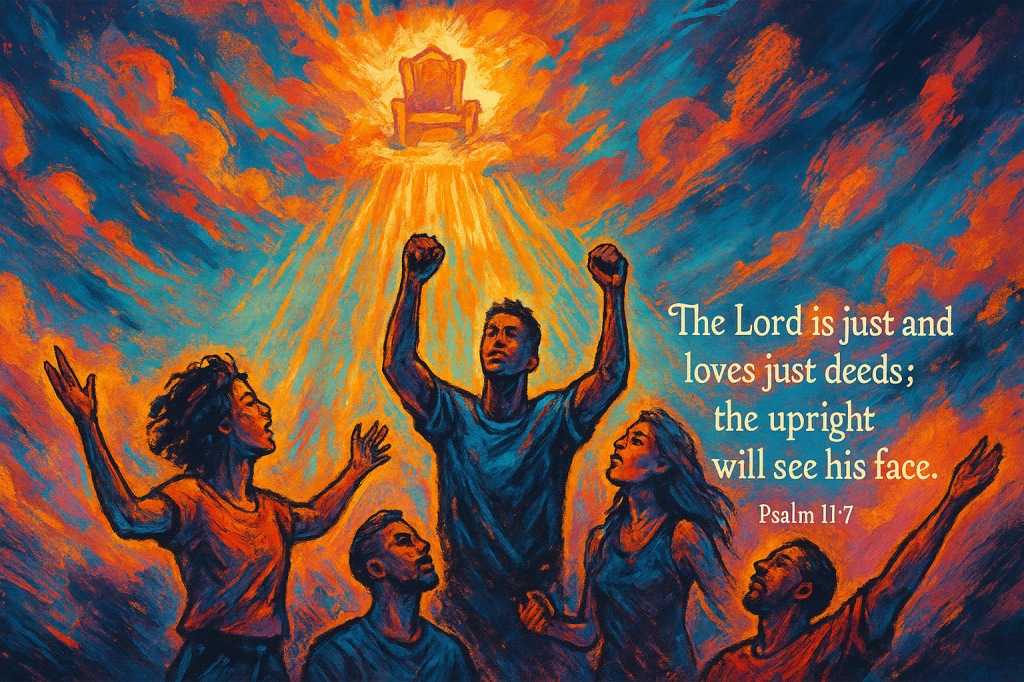
7 The Lord is just and loves just deeds;
the upright will see his face.
Detailed Exegesis
Verse 4 – “The Lord is in his holy temple; the Lord’s throne is in heaven. God’s eyes keep careful watch; they test the children of Adam.”
This verse lifts our eyes heavenward. Though chaos may reign on earth, “The Lord is in his holy temple”—a phrase that reaffirms God’s sovereign rule. The temple may refer to both the earthly sanctuary and the heavenly dwelling. His throne is not moved by earthly kings or empires. The phrase “God’s eyes keep careful watch” speaks of divine attentiveness, a reassuring truth in moments of injustice. But this vision is not passive—it “tests the children of Adam”. That is, all humanity undergoes trials that reveal the state of their hearts.
Verse 5 – “The Lord tests the righteous and the wicked, hates those who love violence.”
God’s testing is not to harm, but to refine. The righteous are examined not because they are suspected, but because they are precious—like gold in fire. At the same time, God’s justice is clear: He “hates those who love violence”. This strong language shows that the Lord’s love for justice is not neutral; evil cannot dwell with Him. In a world often indifferent to cruelty, this verse is a moral compass pointing us back to God’s heart.
Verse 7 – “The Lord is just and loves just deeds; the upright will see his face.”
This is the psalm’s radiant climax. God’s justice is not a detached quality—it is intimately connected with His love. Because He is just, He “loves just deeds”; because He is pure, the “upright will see his face.” In biblical terms, to “see the face” of God is the deepest reward—communion, blessing, and eternal life. This promise strengthens the weary and affirms that holiness will not go unnoticed. It also invites each of us into a life of moral clarity and fidelity.
Teachings of the Church
The Catechism of the Catholic Church teaches that “God is infinitely just and at the same time infinitely merciful” (CCC 211). Psalm 11 holds both truths in tension: the Lord tests the righteous (justice) and allows them to see His face (mercy). Divine justice, then, is not primarily about punishment but about purification, a concept echoed in CCC 1472, which says: “Every sin, even venial, entails an unhealthy attachment to creatures, which must be purified either here on earth, or after death in the state called Purgatory.” This purification—this testing—is not evidence of abandonment, but of divine love that wills our perfection.
St. Augustine, in his Expositions on the Psalms, wrote: “The Lord is in His holy temple… for even when He seems far away, He watches everything that passes among men.” He interprets the throne in heaven not as distance from creation, but as a vantage point of total understanding. This reflects a deep truth: we are never truly alone. Even in confusion, pain, or hidden suffering, God is present and observant. Paul understood this in Rome, and Peter came to embrace it by the Sea of Galilee when Jesus called him back to his mission.
In the larger arc of salvation history, Psalm 11 reminds us of God’s unwavering fidelity to the covenant. Throughout Israel’s exile, occupation, and hardship, this psalm would have reminded the faithful that Yahweh still reigned. Today, as the Church journeys through trials both personal and collective, we too are called to fix our eyes on His throne and persevere in justice. The saints—those who have already seen His face—encourage us to do the same, trusting that every trial has purpose and every act of righteousness will be rewarded.
Reflection
In a culture that often rewards compromise, Psalm 11 calls us to interior integrity. Are we willing to live justly even when no one sees—except God? His eyes are always upon us—not to condemn, but to purify and uplift. When circumstances feel unjust or unclear, this psalm assures us: God sees, God knows, and God will act in His time. How might the knowledge that God is watching—not with wrath but with loving justice—change the way you approach your work, your relationships, or your private thoughts?
If you’re undergoing trials today, take heart in this: being “tested” is not a punishment but a privilege. It means the Lord is forming something holy in you. Do you welcome that testing, or resist it? Let Psalm 11 be your quiet courage—a whispered anthem of confidence that even now, as you remain upright, you are preparing to one day see His face.
Holy Gospel – John 21:20–25
What Is That to You? Just Follow Me
This final passage in The Gospel of John brings us to a moment of profound intimacy and mystery between Jesus, Peter, and the beloved disciple. These verses follow Jesus’ post-resurrection appearance at the Sea of Tiberias, where He had just reinstated Peter with the triple command: “Feed my sheep” (John 21:17). Now, Peter, perhaps still unsure of his mission, turns to see John and asks Jesus: “What about him?” The Lord’s response is striking and deeply personal: “What concern is it of yours? You follow me.” This brief exchange captures the heart of today’s theme—being a faithful witness in the midst of uncertainty. In a time when comparisons and distractions are constant, Jesus calls each disciple to focus solely on Him. The Gospel of John, often described as the most theological and mystical of the four Gospels, ends not with grand miracles but with this quiet, direct invitation to individual fidelity. It is a deeply appropriate close to both the Gospel and the Easter season.
John 21:20-25
New American Bible (Revised Edition)
The Beloved Disciple. 20 Peter turned and saw the disciple following whom Jesus loved, the one who had also reclined upon his chest during the supper and had said, “Master, who is the one who will betray you?” 21 When Peter saw him, he said to Jesus, “Lord, what about him?” 22 Jesus said to him, “What if I want him to remain until I come? What concern is it of yours? You follow me.” 23 So the word spread among the brothers that that disciple would not die. But Jesus had not told him that he would not die, just “What if I want him to remain until I come? [What concern is it of yours?]”
Conclusion. 24 It is this disciple who testifies to these things and has written them, and we know that his testimony is true. 25 There are also many other things that Jesus did, but if these were to be described individually, I do not think the whole world would contain the books that would be written.
Detailed Exegesis
Verse 20 – “Peter turned and saw the disciple following whom Jesus loved, the one who had also reclined upon his chest during the supper and had said, ‘Master, who is the one who will betray you?’”
This verse reintroduces the beloved disciple, traditionally understood to be John himself. His closeness to Jesus at the Last Supper reflects a relationship of trust and spiritual intimacy. By referencing the moment when John asked about the betrayer (John 13:25), the text subtly contrasts the themes of betrayal and faithfulness that have run throughout the Passion narrative. His presence here serves as a witness, both literal and symbolic, to Jesus’ words and deeds.
Verse 21 – “When Peter saw him, he said to Jesus, ‘Lord, what about him?’”
Peter’s question is deeply human. After receiving his own mission—a mission that would lead to martyrdom—he looks to another and wonders about his fate. The Church Fathers saw in this moment the tendency of the human heart to compare callings, to seek fairness or symmetry rather than simple obedience. Peter’s question reveals lingering curiosity or insecurity about the path ahead, a distraction from the singular focus Christ asks of His disciples.
Verse 22 – “Jesus said to him, ‘What if I want him to remain until I come? What concern is it of yours? You follow me.’”
Jesus’ answer is both gentle and firm. The hypothetical—“What if I want him to remain…”—is less about John’s fate and more about Peter’s obedience. The repetition of “What concern is it of yours?” and “You follow me” makes the point unmistakable: the disciple’s task is not to control, compare, or speculate, but to follow. This command echoes the first call at the beginning of the Gospel (John 1:43), closing the narrative with the same invitation it began with: discipleship.
Verse 23 – “So the word spread among the brothers that that disciple would not die. But Jesus had not told him that he would not die, just ‘What if I want him to remain until I come? What concern is it of yours?’”
This verse addresses an early misunderstanding within the community. It shows the Evangelist’s concern for accuracy and truth, clarifying that Jesus’ words were not a prophecy but a rhetorical point. The Gospel here teaches an important lesson: even well-meaning believers can distort Christ’s words if they aren’t rooted in His true intent. The focus should remain on trust and fidelity, not speculation.
Verse 24 – “It is this disciple who testifies to these things and has written them, and we know that his testimony is true.”
The beloved disciple now explicitly identifies himself as the author of the Gospel. The testimony he offers is both personal and apostolic—it is rooted in direct experience with the Lord. The words “we know that his testimony is true” reflect the voice of the Christian community affirming the reliability and inspiration of what has been handed on. It underscores the importance of witness in the life of the Church.
Verse 25 – “There are also many other things that Jesus did, but if these were to be described individually, I do not think the whole world would contain the books that would be written.”
This final sentence is a poetic acknowledgment of the infinite mystery of Christ. No human words could exhaust His glory. It is a reminder that the written Gospel is a gateway, not a boundary—our journey with Jesus must continue beyond the text. This ending places the Gospel in our hands and hearts, inviting us to continue the story through our own faithfulness.
Teachings of the Church
The Catechism of the Catholic Church emphasizes the deeply personal nature of discipleship: “By calling his disciples to take up their cross and follow him, Jesus wishes to associate them with his own sacrifice” (CCC 618). This invitation is echoed in today’s Gospel, where Peter is asked not to speculate about John, but to carry his own cross and follow Christ. The focus is not on the outcomes or conditions of another’s life, but on the fidelity of our own response to God’s will.
St. John Henry Newman beautifully captures this personal vocation in his meditation on divine purpose: “God has created me to do Him some definite service… I have my mission—He has not created me for naught.” Jesus’ command to Peter, “You follow me,” is the echo of this same truth: each of us is uniquely called, and our only task is to be faithful to that call, not to question the path of others. The saints understood this well. St. Thérèse of Lisieux, for instance, rejoiced in being “a little flower” in God’s garden, knowing that her calling did not need to resemble the grandeur of others to be holy.
Historically, the Gospel of John was written in the latter part of the first century, during a time of theological refinement and persecution. The early Church was forming its identity and clarifying its memory of Christ. This passage is a pastoral teaching against the temptation to gossip, speculate, or compare within the community of faith. Instead, it invites believers to re-center themselves on the risen Lord, and to recognize that the mission of the Church will always involve mystery, diversity of calling, and personal surrender.
Reflection
Today’s Gospel invites us to silence the noise of comparison and refocus our eyes on Christ. Do you find yourself distracted by the paths of others—envying their blessings, questioning their calling, or assuming their journey should look like yours? Jesus responds simply: “What concern is it of yours? You follow me.” In a world of social media and constant visibility into others’ lives, these words are liberating. You are not called to live their life—you are called to live yours, faithfully, one step at a time behind the Lord.
This reading also reminds us that our faith is not about knowing every outcome, but about trusting the One who leads. Peter’s path would lead to martyrdom. John’s would lead to witness through writing. Yours may lead through unseen sacrifice, quiet service, or joyful evangelization. Can you trust that whatever your path, it is part of the divine story too large for all the books in the world to contain? Let your life become one more unwritten chapter of Christ’s love. And above all, listen to His voice, and follow.
Follow Without Fear, Witness Without Chains
Today’s readings wrap us in a gentle but firm reminder: our mission is not to have all the answers, but to remain faithful. In Acts 28, we find St. Paul in chains, yet preaching “with complete assurance and without hindrance”—proof that no earthly limitation can silence a heart aflame with the Gospel. In Psalm 11, we are reminded that the Lord sits enthroned in His holy temple, watching over the righteous and testing hearts with justice and love. And in John 21, Jesus turns Peter’s gaze away from comparison and toward discipleship with these piercing words: “What concern is it of yours? You follow me.”
Each passage speaks to a different layer of the Christian journey: proclamation in hardship, trust in divine justice, and the personal call to follow Christ amid uncertainty. Together, they call us to live with holy clarity—keeping our eyes fixed on Jesus, our hearts open to the Spirit, and our lives rooted in unwavering fidelity. There is no need to know the entire plan, only to trust the One who guides it. Whether we are chained like Paul, tested like the psalmist, or redirected like Peter, God’s invitation remains the same: Stay with Me. Walk with Me. Trust Me.
So today, let the Word settle into your soul. What is keeping you from proclaiming the Gospel with freedom? What distractions are keeping you from your unique mission? Listen again to the voice of Christ calling you: “You follow me.” Do not wait until the chains are gone or the path is clear. Begin now, wherever you are. Witness without fear. Follow without comparison. And trust that the God who sees all will lead you to His face.
Engage with Us!
We’d love to hear how today’s readings spoke to your heart. What moved you, challenged you, or gave you hope? Share your reflections in the comments and join the conversation as we grow together in faith. Whether it’s a personal insight, a prayer intention, or a question about the Scripture, your voice matters in this community.
Reflection Questions:
First Reading – Acts 28:16–20, 30–31
What “chains” in your life might God be using as a mission field? Like Paul, how can you speak the truth of the Gospel boldly, even in less-than-ideal circumstances? How does “the hope of Israel” shape the way you endure trials today?
Responsorial Psalm – Psalm 11:4–5, 7
How does the knowledge that “God’s eyes keep careful watch” impact your daily decisions? What does it mean for you personally to be “upright” before the Lord? When facing injustice or uncertainty, do you trust in God’s justice, or are you tempted to take control?
Holy Gospel – John 21:20–25
What distractions or comparisons are keeping you from fully following Christ? Can you identify moments when Jesus has gently corrected you, as He did with Peter? How can you embrace your unique calling, even when you don’t know where it will lead?
Let today’s Word inspire your heart to witness with courage, trust with confidence, and follow Jesus with your whole life. May everything you do be rooted in the love and mercy that He so patiently teaches us. Live your faith boldly—and always walk in the light of His face.
Follow us on Instagram and Facebook for more insights and reflections on living a faith-filled life.

 Holy Manna!
Leave a comment