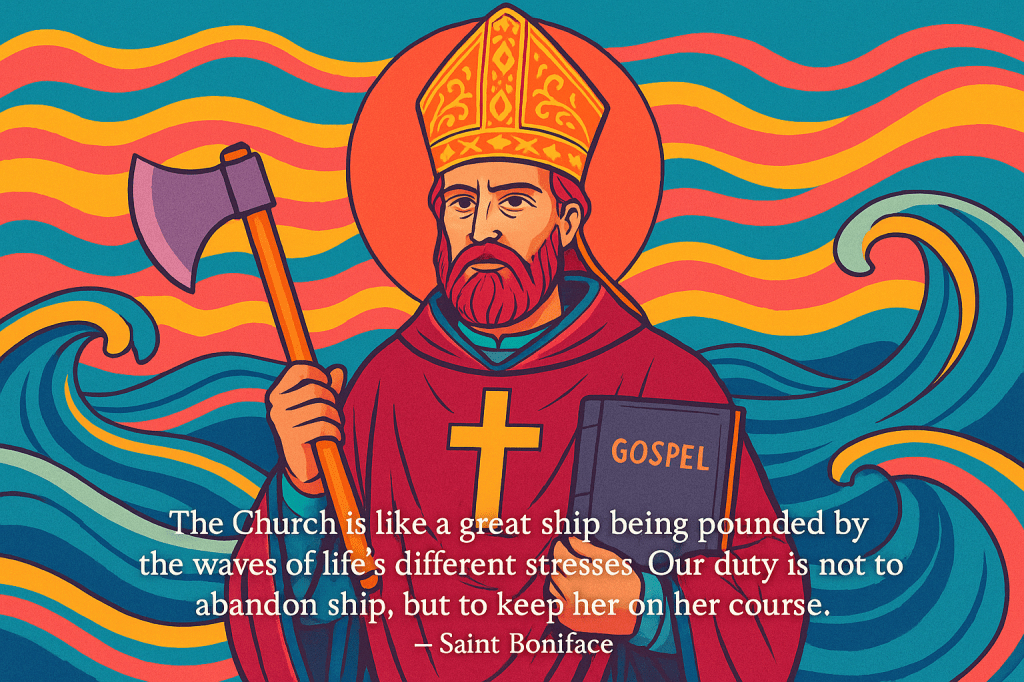
A Thunderclap in the Forest of Souls
In the rich tapestry of the Church’s missionary saints, few figures shine as brightly or as boldly as Saint Boniface. Born in Anglo-Saxon England and destined to transform the spiritual landscape of continental Europe, Boniface is best known as the Apostle to the Germans. His fearless ministry among the pagan tribes of the Frankish and Germanic regions marked a turning point in the Church’s missionary endeavors. He is the patron saint of Germany, and his legacy is carved not only into the history books but into the very identity of the Catholic Church in Europe.
Boniface was more than a zealous preacher—he was a builder, a teacher, and a reformer. He founded monasteries, reformed lax clergy, and stood like a mighty oak against both paganism and heresy. His dramatic act of chopping down the Donar Oak, sacred to the god Thor, became a symbol of Christianity’s power to uproot superstition and falsehood. And like many great saints, he sealed his mission not only with sweat and blood but ultimately with martyrdom. Boniface’s life was a symphony of obedience, courage, and unwavering trust in Christ and His Church. His feast day, celebrated on June 5, invites us to reflect on how boldness in faith can still shake the world today.
From Wessex to the Cross
Born around the year 675 in Crediton, in the Anglo-Saxon kingdom of Wessex, Boniface entered the world as Winfrid—a child destined for the Word. Raised in a devout Christian family of noble status, he was immersed in the faith from an early age. His parents recognized in him a unique thirst for knowledge and holiness, and so, at around seven years old, he was entrusted to the Benedictine monks at Exeter and later at Nursling. There, young Winfrid grew in virtue, learning grammar, Scripture, and the sacred sciences with exceptional diligence.
But beneath his scholarly excellence stirred a deeper calling. Despite his success as a monk and teacher, Winfrid yearned not for comfort or titles but for souls—especially those who had never heard the Gospel. That desire crystallized in 716, when he left the familiarity of England for the wild frontiers of Frisia. His first mission was hindered by political unrest, but far from being discouraged, he returned to England briefly and then sought the blessing of the Pope.
In 718, Pope Gregory II received him in Rome, discerned the fire of the Holy Spirit in him, and commissioned him as a missionary bishop. It was then that Winfrid was given the name Boniface, meaning “doer of good.” This new name was not merely honorary—it marked a rebirth. Now an ambassador of Christ under the authority of Peter’s successor, Boniface traveled across Germanic lands with nothing but Scripture, zeal, and unwavering trust in God.
Boniface’s missionary path led him through Hesse, Thuringia, and Bavaria. He preached, baptized, and established churches. In 732, Pope Gregory III appointed him archbishop and, later, papal legate to all of Germany. His impact cannot be overstated: he reorganized the Church, built monasteries like Fulda—which would become a spiritual powerhouse—and ensured that the faith was taught in unity with Rome. He is remembered not merely for his conversions, but for forging the very structure of the Church in lands once ruled by fear and idolatry.
The Axe and the Altar
The most legendary moment in Saint Boniface’s missionary journey came in the village of Geismar around the year 723. There, towering high in a sacred grove, stood the Donar Oak, a tree dedicated to the Norse god Thor. The pagans feared it, sacrificed beneath it, and dared not touch it. But Boniface, filled with apostolic boldness, saw it not as holy, but as a symbol of spiritual bondage.
With a crowd of pagans encircling him, Boniface lifted his axe and began to chop. He proclaimed that if Thor was real, he would strike him dead. But nothing happened—except the oak falling in pieces. The people were astonished. Not only did their god fail to defend his sacred tree, but Boniface lived, unharmed. From the timber of the fallen idol, Boniface built a chapel dedicated to Saint Peter. In one moment, he had broken centuries of fear and opened countless hearts to the truth of Christ.
Though not known for visions or healings like other saints, Boniface’s life was filled with miracles of grace. Entire villages converted. Hardened chieftains were baptized. Monasteries rose where once there were groves of idolatry. And perhaps the greatest miracle of all was the courage that burned in his heart—a courage that inspired conversions not just through words, but through radical witness. He lived out the words of Psalm 34: “I sought the Lord, and he answered me, and delivered me from all my fears.”
Trials, Triumph, and a Martyr’s Crown
Saint Boniface’s mission came at a great cost. He faced not only the dangers of wild terrain and language barriers but the even more treacherous opposition of heretical priests, lukewarm bishops, and resistant tribes. His efforts to reform the Church were not always welcomed—especially by those who had grown comfortable in corruption. Nevertheless, Boniface continued with humility and strength, always under the direction of Rome, and always grounded in prayer and penance.
As he aged, Boniface’s heart still beat with missionary fire. Even after decades of episcopal leadership, he longed for one more chance to preach Christ to those who had not heard. So in 754, nearing 80 years old, he returned to Frisia to evangelize the still-pagan region.
On June 5, near Dokkum, as he prepared to confirm new converts, he and his companions were attacked by a group of armed pagans. His attendants urged him to flee or fight. But Boniface, standing firm, took out a Gospel book and held it aloft, offering no resistance. “Cease fighting,” he reportedly said, “for the day of vengeance has come. Let us hope in God.” He was struck down, and with him more than fifty others. The sword slashed through the sacred book he held, which was later recovered—bloodstained and pierced, yet intact—a relic of his martyrdom and his testimony.
His death was not an end but a seed. As Tertullian said, “The blood of the martyrs is the seed of the Church.” Boniface’s sacrifice inspired generations of believers and missionaries. His body was taken to Fulda, where miracles soon followed.
The Mission Beyond the Grave
The death of Saint Boniface did not silence his voice. At Fulda Abbey, where his relics were enshrined, pilgrims soon came in droves. Reports of miraculous healings and divine favors began to circulate. The sick were cured. The faithful were comforted. Many who visited his tomb experienced peace, clarity, and conversion.
The very places where he preached—Geismar, Mainz, Fulda—became sacred landmarks. Fulda Abbey rose in prominence, not only as a spiritual center but as a political and cultural heart of Christian Europe. Boniface’s Gospel book, pierced by the blade that took his life, is still preserved as a symbol of both faith and victory.
To this day, churches across Europe and beyond bear his name. Pilgrimages to Fulda continue, especially in Germany, where he is honored as the founder of the Church. In an era that so often forgets its roots, Boniface stands as a reminder that one man, armed with Scripture and conviction, can transform a continent.
What Boniface Teaches Our Hearts Today
The witness of Saint Boniface is not a dusty relic of history—it is a battle cry for today’s believers. We, too, live in a world where false gods are worshiped—comfort, success, pleasure, and individualism. Like the Donar Oak, these idols loom large, daring us to confront them. Boniface reminds us that we must not be afraid.
His courage calls us to examine the idols in our own lives. Do we fear the opinions of others more than we love truth? Do we compromise faith for acceptance? Do we hide our light under a bushel when Christ calls us to be bold? These are the questions Saint Boniface raises.
Yet he does not only confront—he comforts. He shows us the power of obedience to the Church, of fidelity to the Gospel, and of love for souls. In an age of division, Boniface was a builder of unity. In an age of confusion, he was a beacon of truth.
Let us imitate him in small ways—teaching our children the faith, praying for courage in the workplace, being charitable with enemies, and loving Christ above all else. Let us say with him and Saint Paul, “I am not ashamed of the Gospel, for it is the power of God for salvation” (Romans 1:16). And when we are called to take a stand, may we lift high the Gospel, even if it costs us everything.
Engage with Us!
- What idols do you need to chop down in your own life, and what is stopping you?
- How can Saint Boniface inspire you to be more courageous in witnessing your Catholic faith?
- Are you willing to suffer discomfort or rejection in order to stand up for the Gospel, as Boniface did?
Let’s walk this journey together. Share your thoughts and stories in the comments—your testimony could be the spark someone else needs. Let’s support one another, strive for holiness, and do everything with love, just as our Lord Jesus did.
Saint Boniface, pray for us! 🌳
Follow us on Instagram and Facebook for more insights and reflections on living a faith-filled life.

 Holy Manna!
Leave a comment