Courageous Witness Rooted in Resurrection and Unity
Have you ever found yourself standing alone for something you knew was true—misunderstood, maybe even opposed—and wondered if anyone else would stand with you? Today’s readings speak directly into that fire, reminding us that we never stand alone when we witness to Christ. Through the example of St. Paul’s bold defense before the Sanhedrin, the soul’s quiet trust in Psalm 16, and Jesus’ impassioned prayer for unity in The Gospel of John, we are drawn into the heart of what it means to live as courageous disciples: rooted in the hope of the resurrection and bound together in the love of the Trinity.
To appreciate the weight of these passages, it helps to understand the historical and religious tensions behind them. In Acts 23, Paul isn’t simply defending himself before a court—he’s navigating a deep rift in Jewish belief between the Pharisees, who believed in the resurrection and spiritual realities, and the Sadducees, who did not. By identifying himself as a Pharisee and proclaiming belief in the resurrection, Paul ignites their long-standing feud, forcing a chaotic confrontation and ultimately revealing how central the resurrection is to the Christian message. Meanwhile, Jesus’ prayer in John 17 takes place just before His Passion, as He prepares His disciples—and all future believers—to endure the trials that come with bearing witness. His longing “that they may all be one” (Jn 17:21) is not just a beautiful sentiment but a battle cry for unity in the face of persecution, division, and spiritual warfare.
Together, these readings form a tapestry of encouragement. We are reminded that no matter the confusion of the courtroom or the crossfire of conflicting ideologies, God remains our refuge and our strength. As Psalm 16 proclaims with unwavering confidence: “With him at my right hand, I shall never be shaken” (Ps 16:8). The trials we face, the witness we bear, and the unity we pursue all point us toward our ultimate hope: eternal life in Christ. Are you ready to stand firm in the fire, trusting in the God who goes before you and lives within you?
First Reading – Acts 22:30; 23:6–11
When Witness Demands Wisdom
The Acts of the Apostles is often called the Gospel of the Holy Spirit because it documents the explosive growth of the early Church and the Spirit-led courage of the Apostles. Today’s passage places us in the thick of high-stakes tension in Jerusalem. Paul, once a zealous persecutor of Christians, now finds himself on trial before the very religious elite he once served. The Roman commander, confused by the uproar surrounding Paul’s arrest, convenes the Sanhedrin to uncover the real reason behind the hostility. This moment is more than a legal hearing—it is a dramatic unveiling of the Church’s core hope: the resurrection of the dead. By skillfully invoking this doctrine, Paul not only exposes the division between Pharisees and Sadducees, but re-centers the conversation on the transformative truth of Christ’s resurrection. The narrative echoes with the day’s theme—that standing firm in our witness requires courage, wisdom, and complete trust in God’s plan.
Acts 22:30; 23:6-11
New American Bible (Revised Edition)
Paul Before the Sanhedrin. 22:30 The next day, wishing to determine the truth about why he was being accused by the Jews, he freed him and ordered the chief priests and the whole Sanhedrin to convene. Then he brought Paul down and made him stand before them.
23:6 Paul was aware that some were Sadducees and some Pharisees, so he called out before the Sanhedrin, “My brothers, I am a Pharisee, the son of Pharisees; [I] am on trial for hope in the resurrection of the dead.” 7 When he said this, a dispute broke out between the Pharisees and Sadducees, and the group became divided. 8 For the Sadducees say that there is no resurrection or angels or spirits, while the Pharisees acknowledge all three. 9 A great uproar occurred, and some scribes belonging to the Pharisee party stood up and sharply argued, “We find nothing wrong with this man. Suppose a spirit or an angel has spoken to him?” 10 The dispute was so serious that the commander, afraid that Paul would be torn to pieces by them, ordered his troops to go down and rescue him from their midst and take him into the compound. 11 The following night the Lord stood by him and said, “Take courage. For just as you have borne witness to my cause in Jerusalem, so you must also bear witness in Rome.”
Detailed Exegesis
Verse 22:30 – “The next day, wishing to determine the truth about why he was being accused by the Jews, he freed him and ordered the chief priests and the whole Sanhedrin to convene. Then he brought Paul down and made him stand before them.”
The Roman commander is seeking clarity in the midst of confusion. Paul, having been arrested in Jerusalem for allegedly defiling the Temple, has already sparked riots. Roman law required a fair investigation, and so the commander calls upon the Sanhedrin—the highest Jewish court composed of both Pharisees and Sadducees. This shows how seriously Paul’s case is being taken, and how volatile the situation is. It also foreshadows a theme that will continue throughout the rest of Acts: that Paul’s fate will be determined not just by local authorities, but by how faithfully he testifies to the resurrection.
Verse 23:6 – “Paul was aware that some were Sadducees and some Pharisees, so he called out before the Sanhedrin, ‘My brothers, I am a Pharisee, the son of Pharisees; [I] am on trial for hope in the resurrection of the dead.’”
Paul’s words are not manipulative; they are truthful and strategic. He identifies with the Pharisees to highlight a crucial theological divide. The “hope in the resurrection” is not just a convenient topic—it is the very heart of Christian faith (see 1 Cor 15:14). By centering the discussion on resurrection, Paul forces his accusers to confront a doctrine that is central to both Pharisaic Judaism and the early Church, while alienating the Sadducees, who denied the afterlife altogether.
Verse 7 – “When he said this, a dispute broke out between the Pharisees and Sadducees, and the group became divided.”
This verse reveals the power of truth to stir division when it challenges deeply held ideologies. Paul’s declaration strikes a nerve. His mission was never to sow discord, but to proclaim Christ crucified and risen. Yet, division becomes inevitable when light pierces through darkness. Jesus Himself said: “Do you think that I have come to establish peace on the earth? No, I tell you, but rather division” (Luke 12:51).
Verse 8 – “For the Sadducees say that there is no resurrection or angels or spirits, while the Pharisees acknowledge all three.”
This parenthetical explanation by Luke helps Gentile readers understand the cultural-religious context. The Sadducees were the priestly aristocracy, often aligned with the temple and Roman authorities. Their denial of the supernatural—resurrection, angels, and spirits—stemmed from a strict reading of the Torah alone. The Pharisees, meanwhile, embraced a broader understanding of Scripture and tradition. Paul is effectively highlighting that Christianity emerges from the Pharisaic acknowledgment of spiritual realities, but is fulfilled in Christ.
Verse 9 – “A great uproar occurred, and some scribes belonging to the Pharisee party stood up and sharply argued, ‘We find nothing wrong with this man. Suppose a spirit or an angel has spoken to him?’”
This sudden reversal among the Pharisees shows the potential for openness when hearts are not entirely closed to the supernatural. Their defense is ironic, given Paul’s conversion on the road to Damascus involved just such a spiritual encounter. The Holy Spirit is subtly at work, softening opposition and allowing room for truth.
Verse 10 – “The dispute was so serious that the commander, afraid that Paul would be torn to pieces by them, ordered his troops to go down and rescue him from their midst and take him into the compound.”
The depth of the conflict reveals the dangerous climate Paul faced. Yet, God’s providence intervenes through the hands of pagan soldiers. Paul is saved not by theological argument but by God’s protection. This echoes Psalm 16’s confidence: “With him at my right hand, I shall never be shaken” (Ps 16:8).
Verse 11 – “The following night the Lord stood by him and said, ‘Take courage. For just as you have borne witness to my cause in Jerusalem, so you must also bear witness in Rome.’”
This is the spiritual climax of the passage. Jesus Himself appears to Paul, strengthening him for the journey ahead. The command “Take courage” echoes throughout Scripture whenever God prepares someone for a mission (see Josh 1:9). Christ’s words affirm that Paul’s current suffering is not the end but a step toward a greater witness. Rome—the heart of the empire—will hear the Gospel, just as Jesus promised.
Teachings from the Church and Tradition
The Catechism of the Catholic Church reminds us that the resurrection is the very heart of the Christian message: “The Paschal mystery has two aspects: by his death, Christ liberates us from sin; by his Resurrection, he opens for us the way to a new life” (CCC 654). St. Paul’s proclamation before the Sanhedrin is not just a clever defense—it is an embodiment of this mystery. His life, transformed by the risen Christ, is now entirely dedicated to spreading the Good News that death no longer has the final word.
St. John Chrysostom praised Paul’s courage in this moment, noting that his boldness was not rooted in human strength but in grace: “Paul did not fear the raging of his enemies, but proclaimed the resurrection boldly. He was ready to suffer anything for Christ, knowing that through death he would live eternally.” The example of the saints, many of whom died as martyrs, shows that witness to resurrection hope remains a timeless call.
Historically, this passage marks a turning point in Acts. Paul’s journey to Rome, where he will ultimately be martyred, mirrors the journey of the Gospel from Jerusalem to the ends of the earth. This missionary expansion fulfills Jesus’ words in Acts 1:8: “You will be my witnesses in Jerusalem, throughout Judea and Samaria, and to the ends of the earth.” The Church’s mission today still flows from that same Spirit-led witness.
Reflection: Living with Resurrection Boldness
What does it mean to witness to the resurrection in our daily lives? For many of us, the courtroom is replaced by social pressure, workplace scrutiny, or even tension within our families. Yet the same Spirit that filled Paul with courage dwells in us through Baptism and Confirmation. Are you willing to stand firm for your faith, even when the crowd is confused or hostile? Witnessing doesn’t always require words—it can be as simple as refusing to compromise your integrity, speaking the truth in love, or offering hope to someone in despair.
Let this reading remind you that the resurrection is not just a doctrine—it is the source of our joy, our courage, and our mission. Where is Christ asking you to take a stand this week? Ask Him to stand by your side as He did for Paul. Trust that your small acts of fidelity today may bear witness to something eternal tomorrow.
Responsorial Psalm – Psalm 16:1–2, 5, 7–11
Anchored in God Amidst the Storm
Psalm 16 is a profound declaration of trust and joy in the Lord, attributed to King David. Known as a Miktam, a term possibly indicating a “golden” or precious psalm, it is a prayer offered in the midst of uncertainty. David, surrounded by enemies and temptation, proclaims his unwavering dependence on God—not as a vague hope, but as his entire portion and inheritance. This psalm holds a central place in early Christian preaching; St. Peter quotes it in his Pentecost sermon (see Acts 2:25–28), interpreting it as a prophecy of Christ’s resurrection. Today, placed between Paul’s bold courtroom testimony and Jesus’ priestly prayer for unity, Psalm 16 becomes a bridge—a hymn of confidence for those who bear witness in a hostile world, knowing that the Lord will not abandon His faithful to the grave.
Psalm 16:1-2, 5, 7-11
New American Bible (Revised Edition)
God the Supreme Good
1 A miktam of David.
Keep me safe, O God;
in you I take refuge.
2 I say to the Lord,
you are my Lord,
you are my only good.
5 Lord, my allotted portion and my cup,
you have made my destiny secure.
7 I bless the Lord who counsels me;
even at night my heart exhorts me.
8 I keep the Lord always before me;
with him at my right hand, I shall never be shaken.
9 Therefore my heart is glad, my soul rejoices;
my body also dwells secure,
10 For you will not abandon my soul to Sheol,
nor let your devout one see the pit.
11 You will show me the path to life,
abounding joy in your presence,
the delights at your right hand forever.
Detailed Exegesis
Verse 1 – “Keep me safe, O God; in you I take refuge.”
David begins with a cry for protection, not from a place of fear, but from radical dependence. To “take refuge” in God is to entrust one’s entire being to His protection. This verse sets the tone for the entire psalm: God is not merely an aid in trouble—He is the very shelter, the secure ground of the soul.
Verse 2 – “I say to the Lord, you are my Lord, you are my only good.”
Here David confesses a truth that echoes throughout Scripture: that apart from God, there is no goodness. This mirrors what Jesus later affirms: “No one is good but God alone” (Mark 10:18). To declare that God is his “only good” is to renounce all worldly measures of value and to root one’s joy and purpose in divine communion.
Verse 5 – “Lord, my allotted portion and my cup, you have made my destiny secure.”
The imagery here is sacramental and intimate. “Portion and cup” recall the offerings of the Temple and the personal blessings of one’s inheritance. David’s trust isn’t abstract—he sees his very life, his fate, held in God’s hands. In light of today’s theme, this verse resonates deeply: even when standing before hostile powers, like Paul, one’s destiny is secure in the Lord.
Verse 7 – “I bless the Lord who counsels me; even at night my heart exhorts me.”
This verse reflects the contemplative life—David is not only guided by God externally but internally. His conscience, illuminated by grace, urges him toward righteousness even in the solitude of the night. This verse is a reminder that divine counsel is always available to the one who keeps vigil in God’s presence.
Verse 8 – “I keep the Lord always before me; with him at my right hand, I shall never be shaken.”
This is the heartbeat of trust. To “keep the Lord always before me” is a discipline of the soul: to live each moment in awareness of God’s nearness. The result is unshakeable peace. For Paul, facing divided accusers, and for us, facing spiritual or moral trials, this verse is a battle cry of steadiness and grace.
Verse 9 – “Therefore my heart is glad, my soul rejoices; my body also dwells secure,”
David’s inner joy overflows into the flesh. He sees no contradiction between spiritual delight and physical security because all of life is in God’s hands. This verse anticipates resurrection joy—the soul and body united in peace. It reinforces today’s central theme: that hope in God’s victory brings unshakable gladness even when the body is at risk.
Verse 10 – “For you will not abandon my soul to Sheol, nor let your devout one see the pit.”
This verse is one of the clearest anticipations of resurrection in the Old Testament. “Sheol” represented the realm of the dead, a place of shadow and silence. David believes he will not be left there—and early Christians saw this as a direct prophecy of Christ. Peter proclaims at Pentecost: “He foresaw and spoke of the resurrection of the Christ, that he was not abandoned to Hades, nor did his flesh see corruption” (Acts 2:31).
Verse 11 – “You will show me the path to life, abounding joy in your presence, the delights at your right hand forever.”
The psalm closes in radiant hope. The “path to life” is not merely survival but fullness of life in God. This verse speaks of eternal communion—abounding joy, divine presence, eternal delight. It is this hope that sustained Paul, that Jesus prayed for, and that all disciples are invited to live from.
Teachings from the Church and Tradition
The Catechism of the Catholic Church teaches that our ultimate happiness comes from union with God: “God alone satisfies” (CCC 1718). Psalm 16 reflects this truth with piercing clarity. David’s confidence in God as his “only good” is echoed in the Catechism’s teaching on beatitude: “The Beatitudes respond to the natural desire for happiness. This desire is of divine origin: God has placed it in the human heart” (CCC 1716). The psalm is a response to that desire, and a promise that it will be fulfilled in God.
St. Augustine, in his Confessions, echoes the cry of this psalm when he writes: “You have made us for Yourself, O Lord, and our hearts are restless until they rest in You.” Augustine sees in Psalm 16 a model of the Christian soul: searching, surrendering, and rejoicing in God’s eternal presence. The psalm’s assurance that we will not be abandoned to the grave finds its ultimate fulfillment in the resurrection of Christ, and through Him, the resurrection of the faithful.
Psalm 16 also holds liturgical significance in both Jewish and Christian worship. It was often recited during times of persecution or transition, reinforcing the truth that no matter what surrounds us, God’s presence is our stability. As Pope Benedict XVI wrote in Spe Salvi: “The one who has hope lives differently; the one who hopes has been granted the gift of a new life.” This psalm is a song of that hope.
Reflection: Dwelling Secure in God’s Presence
What voices shape your inner world when life feels uncertain? Psalm 16 invites us to silence fear and anchor our identity in God’s presence. Are you keeping the Lord always before you? This can be as practical as beginning the day in prayer, returning to God in small moments throughout the day, or ending with an Examen of how He guided you. We are called not just to believe in God’s refuge, but to live from it—especially when the ground beneath us feels unsteady.
Let today’s psalm be your shield and song. What “portion” are you clinging to that isn’t God? Lay it down. Let the words “With him at my right hand, I shall never be shaken” become your breath in the battles you face. The world may swirl with conflict, but the soul that trusts in the Lord will never be moved.
Holy Gospel – John 17:20–26
The Glory of Oneness: Christ’s Final Prayer for Us
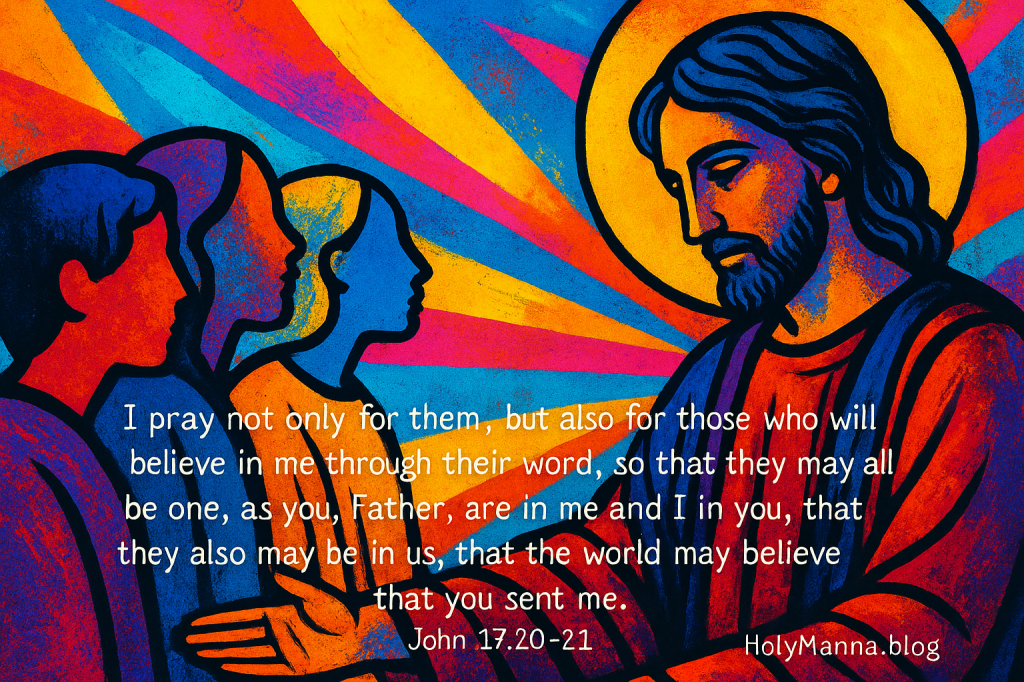
The Gospel of John offers a unique and intimate portrait of Jesus, often focusing on His divine identity and deep relational language. Nowhere is this more evident than in John 17, often called the “High Priestly Prayer.” This chapter captures Jesus’ final intercession before His Passion—a sacred moment where He lifts up not only His Apostles but also future believers, including us. Today’s passage is the climax of that prayer, where Jesus petitions the Father for unity, glory, love, and eternal communion. Set on the eve of betrayal and suffering, these words reveal the deepest desires of the Sacred Heart. The backdrop of betrayal, confusion, and impending violence ties this Gospel closely to today’s theme: standing firm in witness through unity with Christ and the hope of resurrection. Jesus is not only praying for courage in the moment—He is praying that we may be one, as He and the Father are one, so that the world might believe and be saved.
John 17:20-26
New American Bible (Revised Edition)
20 “I pray not only for them, but also for those who will believe in me through their word, 21 so that they may all be one, as you, Father, are in me and I in you, that they also may be in us, that the world may believe that you sent me. 22 And I have given them the glory you gave me, so that they may be one, as we are one, 23 I in them and you in me, that they may be brought to perfection as one, that the world may know that you sent me, and that you loved them even as you loved me. 24 Father, they are your gift to me. I wish that where I am they also may be with me, that they may see my glory that you gave me, because you loved me before the foundation of the world. 25 Righteous Father, the world also does not know you, but I know you, and they know that you sent me. 26 I made known to them your name and I will make it known, that the love with which you loved me may be in them and I in them.”
Verse 20 – “I pray not only for them, but also for those who will believe in me through their word,”
Jesus expands His intercession beyond the Twelve to every believer throughout time. This includes every generation of Christians—our families, our parishes, ourselves. He sees us even now and includes us in His prayer. This verse powerfully affirms that the mission of the Apostles was meant to bear fruit through evangelization, and we are part of that unfolding plan of salvation.
Verse 21 – “So that they may all be one, as you, Father, are in me and I in you, that they also may be in us, that the world may believe that you sent me.”
This verse expresses the central petition of Jesus’ prayer: unity. But not just unity in opinion or mission—He desires ontological unity, a mystical union modeled after the perfect communion between Father and Son. This unity is not for its own sake; it has a missional purpose: “that the world may believe”. Our unity as believers is meant to reveal Christ to the world. Division obscures His presence; unity illuminates it.
Verse 22 – “And I have given them the glory you gave me, so that they may be one, as we are one,”
Here Jesus speaks of a shared glory. This “glory” is not worldly success but the divine presence, the weight of God’s majesty and love that indwells the believer. This verse echoes 2 Corinthians 3:18: “All of us, gazing with unveiled face on the glory of the Lord, are being transformed into the same image from glory to glory.” Unity flows from being conformed to Christ’s own likeness.
Verse 23 – “I in them and you in me, that they may be brought to perfection as one, that the world may know that you sent me, and that you loved them even as you loved me.”
This is perhaps one of the most astonishing verses in the entire New Testament. Jesus prays not only that we be united, but that we know the Father’s love in the same way the Son knows it: “you loved them even as you loved me”. This verse underscores the dignity of every Christian. God’s love for us is not secondary or lesser—it is rooted in the eternal love of the Trinity.
Verse 24 – “Father, they are your gift to me. I wish that where I am they also may be with me, that they may see my glory that you gave me, because you loved me before the foundation of the world.”
Jesus expresses His longing for communion with us—not just spiritual union on earth, but eternal glory in heaven. His desire is that we behold Him in His full radiance, that we live forever in the love shared before time began. This verse reinforces the resurrection theme: that death is not the end, but the doorway to everlasting union with Christ.
Verse 25 – “Righteous Father, the world also does not know you, but I know you, and they know that you sent me.”
Here Jesus contrasts Himself and His disciples with the world. The world, in John’s Gospel, often represents those who reject divine revelation. Yet Jesus affirms that His followers do know the Father because they have received Him—the one the Father sent. This verse affirms that knowing Christ is knowing God. It also reminds us that being witnesses in the world requires intimate knowledge of the One who sends us.
Verse 26 – “I made known to them your name and I will make it known, that the love with which you loved me may be in them and I in them.”
Jesus ends His prayer with a commitment to continue revealing the Father’s name—which in biblical language means His very essence and character. The goal of this revelation is nothing less than divine indwelling: “that the love with which you loved me may be in them and I in them.” This is the very heart of Christianity—not merely behavior or belief, but becoming a dwelling place of divine love.
Teachings from the Church and Tradition
The Catechism of the Catholic Church reflects today’s Gospel when it teaches: “The unity of the Church is rooted in the unity of the Trinity: Father, Son, and Holy Spirit” (CCC 813). Jesus’ prayer for unity is not sentimental but sacramental. The Church is one because God is one. To divide the Body of Christ is to obscure the face of the Father to the world. Hence, the Church’s ecumenical mission flows from Christ’s own desire that “they may all be one.”
St. Cyprian of Carthage famously taught, “He cannot have God for his Father who does not have the Church for his mother”, emphasizing that unity with Christ is inseparable from unity with His Body. This spiritual unity must be visible and lived, not merely professed. In a world torn by division and individualism, the witness of a loving, united Church becomes the clearest proof that Christ is alive and working.
This Gospel also touches the mystical core of Christian prayer and identity. As St. Elizabeth of the Trinity wrote: “It is the Trinity dwelling in us that must be our unity and our peace.” Her insight reveals that true Christian unity does not come from human effort alone, but from our shared indwelling in the love of God. When we cultivate that interior life of union with the Trinity, we naturally become one in heart and mission with others.
Reflection: Becoming One with Christ and Each Other
How often do we reflect on the fact that Jesus prayed for us? That His final words before the Cross were not about escaping suffering, but about forming a people united in love? Do you live with a sense of being included in that prayer? It changes everything. Knowing that Christ desires unity doesn’t just call us to avoid conflict—it calls us to intentional communion. With our families. Our parishes. Our enemies.
The Gospel calls us to pray and labor for unity—not uniformity, but spiritual oneness in truth and love. Where do you need to seek reconciliation today? Is there a fractured relationship or a spirit of division in your heart? Begin there. Let Jesus’ prayer be your model: speak to the Father about those who are hardest to love. Ask to see them with the same love that exists between the Father and the Son.
Finally, remember: you are loved with the same love the Father has for Jesus. Not symbolically. Literally. What would your life look like if you truly believed this? Let His prayer become your confidence, your mission, and your peace. The world will believe when we become one in Him.
Unshaken and Undivided
Today’s readings weave together a powerful message of courage, unity, and eternal hope. From Paul’s bold stand before the Sanhedrin in Acts 23, to David’s trust-filled prayer in Psalm 16, to Jesus’ heartfelt intercession for us in John 17, we are invited into a deeper awareness of our identity as beloved witnesses to the risen Christ. In every trial, whether it is external opposition or internal division, we are reminded that God is both our refuge and our mission. “Take courage… you must also bear witness” is not just a word for Paul—it is Christ’s word for us today.
At the heart of our vocation is unity: with God, with one another, and with the Church. Jesus does not merely ask the Father that we believe in Him—He prays that we be one, as He and the Father are one. And He promises us the same love, the same glory, and the same eternal life that He shares with the Father. This unity is not something we create—it is something we receive and protect, especially when the world feels like it is tearing apart. The psalmist reminds us: “With him at my right hand, I shall never be shaken” (Psalm 16:8). That unshakable confidence comes from living fully in the love of God, rooted in resurrection hope and nourished by the sacraments.
What is God asking you to stand up for today? Where is He inviting you to step into deeper communion—with Him and with others? Let this day be a turning point. Ask the Holy Spirit for courage like Paul, for trust like David, and for unity like Jesus prayed. You are not alone. You are seen, loved, and called. Stand firm. Live unshaken. And become one.
Engage with Us!
We’d love to hear how today’s readings spoke to your heart. Your reflections inspire others and build the kind of unity Jesus prayed for. Share your thoughts in the comments below, whether it’s a personal insight, a challenge you’re facing, or a way you see God moving in your life.
Reflection Questions:
First Reading – Acts 22:30; 23:6–11
Have you ever had to speak the truth in a divided or hostile environment? What gave you strength? How can Paul’s trust in Christ’s mission for him encourage you in your current challenges?
Responsorial Psalm – Psalm 16:1–2, 5, 7–11
What does it mean to you personally to say, “You are my only good”? In moments of uncertainty, how can you return to the presence of God as your refuge?
Holy Gospel – John 17:20–26
What areas of your life are in need of deeper unity—with God, with family, or in your parish community? How does knowing that Jesus prayed specifically for you shape the way you live and pray today?
Stay rooted in the Word, anchored in the love of Christ, and united with your brothers and sisters in faith. Let everything you do be done with the courage, mercy, and self-giving love that Jesus poured out for the world. We are one Body—let us walk together, unshaken and undivided.
Follow us on Instagram and Facebook for more insights and reflections on living a faith-filled life.

 Holy Manna!
Leave a comment