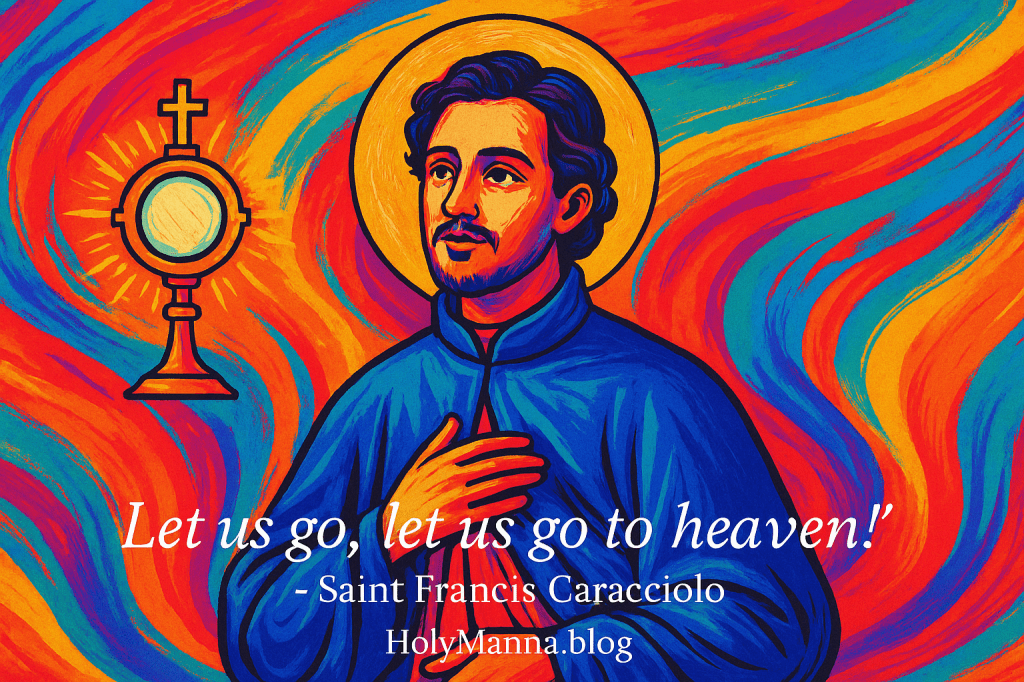
A Hidden Flame in Church History
Saint Francis Caracciolo may not be a household name like Francis of Assisi or Ignatius of Loyola, but his life was a roaring fire of love for Christ, particularly in the Eucharist. Born into nobility, yet choosing the path of humility and service, he co-founded the Clerics Regular Minor, a religious order committed to a radical life of poverty, reform, and constant Eucharistic adoration. At a time when the Church faced the aftermath of the Protestant Reformation and moral decline within its own ranks, Saint Francis offered his very life as a sacrifice to the Lord. His legacy lies not in grand papal decrees or volumes of theological works, but in a lived Gospel—a life consumed by the presence of God and overflowing in service to others. His patronage of chefs and those who nourish the body reflects a deeper truth: his entire life was spiritual nourishment for the Body of Christ.
The Journey of a Healed Heart
Born Ascanio Caracciolo on October 13, 1563, in the picturesque town of Villa Santa Maria in the Kingdom of Naples, he came from a noble lineage with strong political and social ties. Despite his aristocratic background, the young Caracciolo was not spoiled by pride or entitlement. From an early age, he demonstrated a seriousness about spiritual matters. But like many saints, it was through suffering that his divine calling was confirmed. At age 22, he contracted a severe skin disease believed to be leprosy, a diagnosis that not only threatened his health but also his future. It was during this physical and spiritual trial that he made a solemn vow: if God healed him, he would dedicate his life entirely to His service.
God heard his prayer. Ascanio was miraculously cured, and true to his word, he left behind the comforts of nobility and entered the priesthood. Ordained in 1587, he began a quiet but profound ministry of charity and devotion. In a twist of providence, a letter was mistakenly delivered to him, addressed to another Caracciolo, asking for help in founding a new religious order. Rather than dismissing the letter as an error, he discerned God’s will in the invitation. Embracing this divine coincidence, he joined forces with Venerable John Augustine Adorno and Fabrizio Caracciolo to establish the Clerics Regular Minor—a community marked by Eucharistic devotion, poverty, and missionary zeal.
He took the religious name “Francis” out of admiration for Saint Francis of Assisi, embodying the spirit of joyful poverty and radical discipleship. The new order embraced a unique charism: each house maintained perpetual adoration of the Blessed Sacrament, ensuring that Jesus was never left alone. This act wasn’t merely symbolic; it was the heart of their ministry. For Saint Francis Caracciolo, the tabernacle was not just a fixture—it was the very throne of the King.
A Priest Inflamed by God
Saint Francis Caracciolo’s life was rich in spiritual gifts, even though his miracles may not be as sensational as those of other saints. The most striking miracle was his ability to radiate holiness in a way that converted hearts and uplifted souls. People who encountered him sensed something profoundly different—his silence, his gaze, even his presence drew others toward God. He was a man who lived what he preached.
He often entered into deep states of ecstasy, especially during the Holy Sacrifice of the Mass. Witnesses noted that during the Consecration, he would sometimes appear suspended from the ground in levitation, so intensely was he united to Christ. His face would shine, transfigured by divine love. He was known to spend entire nights in adoration before the Blessed Sacrament, praying not just with words, but with tears and awe.
Perhaps most moving are the stories of how people were drawn to confession and penance simply by his presence. It was said he could read souls, guiding people with uncanny accuracy and gentleness to face their sins and return to grace. In an age riddled with spiritual lukewarmness, Saint Francis rekindled the flames of faith in every heart he touched. That, in itself, is a miracle of grace.
The Humble Crossbearer
While he was born into nobility and co-founded a thriving religious order, Saint Francis Caracciolo never sought power or prominence. In fact, he often resisted positions of leadership, preferring the hidden life of service and contemplation. Yet he was unanimously elected Superior General of the Clerics Regular Minor—a role he humbly accepted for a time before stepping down to return to simple duties.
His life was not without affliction. His health was fragile, and his intense fasting and acts of penance left his body weakened. He endured criticism from those within and outside his community who found his discipline too strict or his reforms too uncomfortable. Still, he bore all these with a serene heart, never speaking ill of others, always turning to Christ crucified for strength. In every suffering, he saw an opportunity to imitate the Passion.
In 1608, while on a missionary journey to the town of Agnone, he became gravely ill. Refusing special treatment or the comfort of his brethren, he chose to die in obscurity and simplicity—just as he had lived. His final words were recorded as: “Let us go, let us go to heaven!” A fitting farewell from one whose soul had always longed to be in the presence of the Lord. He died on June 4, 1608, at only 44 years old, offering even his death as a final act of love.
An Enduring Presence
Saint Francis Caracciolo’s death did not mark the end of his influence; in many ways, it was just the beginning. Almost immediately after his passing, reports of miraculous healings began to circulate. People afflicted with various ailments—particularly skin diseases, perhaps echoing the saint’s own past affliction—were healed after invoking his intercession or visiting his tomb. These signs were understood as divine affirmations of his sanctity.
His body, when exhumed, was found to be incorrupt—a hallmark of holiness recognized by the Church. Pilgrims began to flock to his burial site, and devotion to him spread throughout Italy, especially in Naples where his order remained active. Over the centuries, countless faithful have turned to Saint Francis for both spiritual and physical healing, and his relics have become a focal point of veneration and hope.
Canonized by Pope Pius VII in 1807, he was formally recognized as a model of priestly life and lay devotion. His commitment to Eucharistic adoration remains a legacy that continues through the Clerics Regular Minor, whose chapels still host perpetual adoration in his honor. He is also lovingly invoked by Italian cooks and chefs, a nod not only to his hometown’s culinary heritage but to his deep belief that nourishment—both physical and spiritual—is sacred when offered in love.
A Call to Eucharistic Living
In a world increasingly distracted by noise, urgency, and self-interest, the life of Saint Francis Caracciolo speaks with astonishing clarity: Put Jesus at the center—especially in the Eucharist—and everything else will fall into place. His fire for the Blessed Sacrament challenges us to ask: Do I truly believe that Christ is present in the Eucharist? Do I make time to adore Him? In his radical devotion, we see the Church’s perennial teaching lived out—not only as theology, but as love.
His humility offers a counter-witness to the hunger for recognition that often plagues even good works. By stepping away from leadership when others might have clung to it, he teaches us that service, not status, is the measure of greatness in God’s eyes. His silent nights in adoration, his tears at the altar, his gentleness in reading hearts—all point to a life hidden in Christ.
What if we spent an hour each week in adoration? What if we made a small vow to God and lived it daily, no matter the cost? What if we, like Saint Francis, lived each day with heaven in our eyes? The fire that burned in him is not extinguished. It lives on in every heart that dares to say, “Let us go, let us go to heaven!”
Engage with Us!
We’d love to hear your reflections on this fiery saint of the Eucharist. What part of his life moves you most? How do you relate to his call to humility and devotion?
Here are a few reflection questions to guide your prayer and journaling:
- How central is the Eucharist in my spiritual life? What can I do to deepen my love for Christ’s presence in the Blessed Sacrament?
- Have I made a promise to God that I need to renew or fulfill, like Saint Francis did after his healing?
- In what areas of my life am I being called to surrender control or status in favor of greater obedience to God’s will?
Let’s support each other in this journey of faith. May we, like Saint Francis Caracciolo, learn to live every day as an offering of love, consumed by the fire of Christ’s presence.
Saint Francis Caracciolo, pray for us! 🔥
Follow us on Instagram and Facebook for more insights and reflections on living a faith-filled life.

 Holy Manna!
Leave a comment