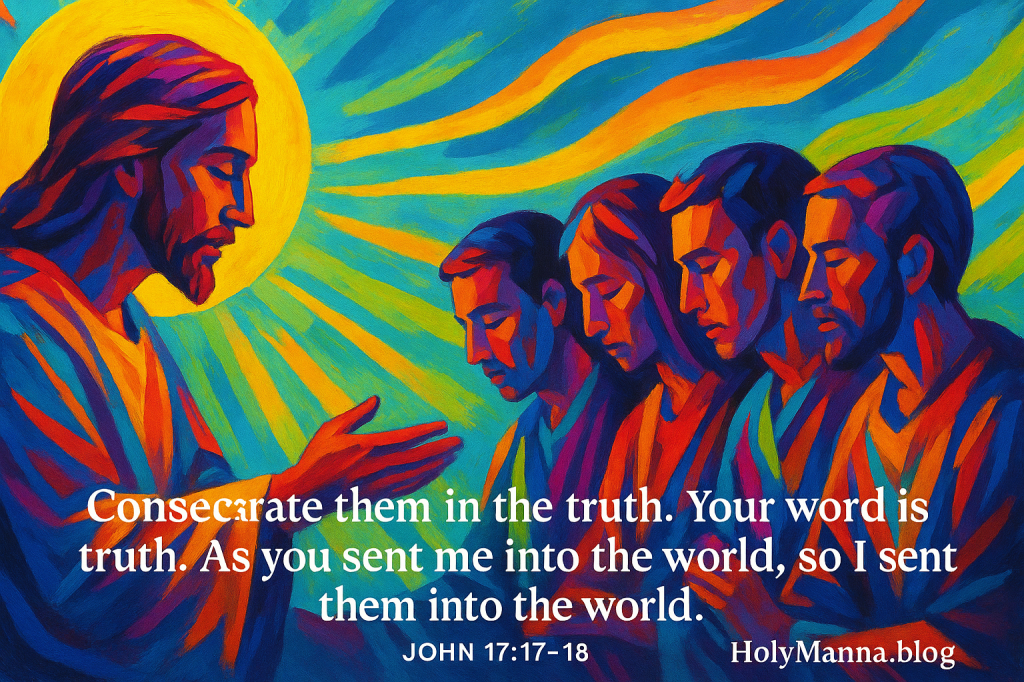
Consecrated in the Midst of Wolves
There’s a sacred weight to goodbyes—the kind that echo into eternity. In today’s readings, we are invited into two parting moments: Paul’s emotional farewell to the Ephesian elders, and Jesus’ final prayer to the Father before His Passion. Both scenes radiate urgency, love, and the solemn handing on of mission. We stand beside the apostles, listening with open hearts as they are prepared—consecrated—for a life that will not be easy, but will be holy. Do we recognize that we too have been consecrated for a mission in this world?
The early Church existed in a world hostile to the radical truth of the Gospel. In Acts 20, Paul warns that “savage wolves will come among you”—false teachers rising even from within the community. His weeping shows the deep bond between shepherd and flock, and the grave responsibility entrusted to those who lead. Likewise, in The Gospel of John, Jesus does not ask the Father to remove His disciples from the world but to protect them within it: “Consecrate them in the truth. Your word is truth”. The context is critical—this is the night before Jesus’ crucifixion. He is preparing His followers to endure hatred, division, and temptation, just as He prepared His own heart for the Cross.
Amid this spiritual battle, Psalm 68 is our anthem: a proclamation of God’s power and majesty. “Blessed be God!” cries the psalmist, lifting his voice in awe of the One who gives “power and strength to His people.” These readings, woven together, are not just a theological meditation but a prophetic call. Whether you’re a parent, a priest, a teacher, or simply someone trying to live faithfully in a chaotic world, today’s Word reminds us that the Church’s mission is not to retreat, but to stand firm—united, consecrated, and uncompromising in truth. Will you rise to the call, even when wolves draw near?
First Reading – Acts 20:28–38
Tears, Wolves, and the Cost of Shepherding
We step into an emotional and dramatic farewell in Acts 20, a book rich in missionary journeys, persecution, miracles, and the formation of the early Church. St. Paul has summoned the elders of Ephesus to Miletus, knowing this will be the last time they see his face. This moment echoes the solemn gravity of Christ’s own farewell discourse in The Gospel of John. Paul, whose missionary zeal lit up the Gentile world, now shifts from preaching to commissioning—passing the torch of spiritual vigilance and selfless service. The Church is growing, but so too are the dangers from both within and without. This passage prepares the faithful for spiritual battle, not by retreat, but through consecration to truth, charity, and endurance. It ties beautifully to today’s theme: being consecrated in a world where wolves still prowl.
Acts 20:28-38
New American Bible (Revised Edition)
28 Keep watch over yourselves and over the whole flock of which the holy Spirit has appointed you overseers, in which you tend the church of God that he acquired with his own blood. 29 I know that after my departure savage wolves will come among you, and they will not spare the flock. 30 And from your own group, men will come forward perverting the truth to draw the disciples away after them. 31 So be vigilant and remember that for three years, night and day, I unceasingly admonished each of you with tears. 32 And now I commend you to God and to that gracious word of his that can build you up and give you the inheritance among all who are consecrated. 33 I have never wanted anyone’s silver or gold or clothing. 34 You know well that these very hands have served my needs and my companions. 35 In every way I have shown you that by hard work of that sort we must help the weak, and keep in mind the words of the Lord Jesus who himself said, ‘It is more blessed to give than to receive.’”
36 When he had finished speaking he knelt down and prayed with them all. 37 They were all weeping loudly as they threw their arms around Paul and kissed him, 38 for they were deeply distressed that he had said that they would never see his face again. Then they escorted him to the ship.
Detailed Exegesis
Verse 28 – “Keep watch over yourselves and over the whole flock of which the holy Spirit has appointed you overseers, in which you tend the church of God that he acquired with his own blood.”
Paul begins with a dual call: to guard one’s own soul and the souls of others. The Greek term for “keep watch” (prosechete) implies active vigilance. These elders (or presbyteroi) are not managers, but spiritual shepherds whose mission is sacred. They are caretakers of a Church purchased by “His own blood”—a direct affirmation of the divinity of Christ and the infinite value of every member of the Church.
Verse 29 – “I know that after my departure savage wolves will come among you, and they will not spare the flock.”
Paul warns of coming threats, using the powerful image of “wolves”, which Scripture often uses to describe false prophets (see Matthew 7:15). This prophecy would soon prove true—heresies like Gnosticism, Judaizing tendencies, and doctrinal confusion plagued the early Church. His foresight is pastoral, not paranoid, showing the real cost of spiritual leadership.
Verse 30 – “And from your own group, men will come forward perverting the truth to draw the disciples away after them.”
The most dangerous distortions come from within. These men aren’t outsiders but once trusted members. Paul highlights a temptation still present in every generation: self-glorification under the guise of piety. The distortion of truth for personal gain is spiritual treason.
Verse 31 – “So be vigilant and remember that for three years, night and day, I unceasingly admonished each of you with tears.”
This is not a distant warning, but a plea born of love. Paul’s “tears” reveal a shepherd’s heart. He labored “night and day”—mirroring the relentless vigilance Christ calls for in Mark 13:33. His leadership was marked by personal sacrifice, emotion, and endurance.
Verse 32 – “And now I commend you to God and to that gracious word of his that can build you up and give you the inheritance among all who are consecrated.”
Paul entrusts them not to his own wisdom, but to “that gracious word”—the Gospel. It is the Word that builds, sanctifies, and gives kleronomía—inheritance—among the saints. This verse captures the transmission of apostolic trust to divine grace.
Verse 33 – “I have never wanted anyone’s silver or gold or clothing.”
Paul reminds them of his detachment from material gain. This counters the worldly model of leadership that seeks profit. He is, in effect, saying: I practiced what I preached. This echoes Christ’s teaching: “You received without cost; give without cost” (Matthew 10:8).
Verse 34 – “You know well that these very hands have served my needs and my companions.”
Paul labored as a tentmaker (see Acts 18:3), showing that evangelization is not incompatible with honest work. His example challenges both clericalism and laziness, illustrating that humility and service are marks of true spiritual authority.
Verse 35 – “In every way I have shown you that by hard work of that sort we must help the weak, and keep in mind the words of the Lord Jesus who himself said, ‘It is more blessed to give than to receive.’”
This verse is a treasure. Though not recorded in the Gospels, these words of Jesus were preserved orally and validated by the early Church. They encapsulate Christian discipleship. Giving is not optional; it is the path to beatitude. Helping the weak reflects the heart of the Gospel.
Verses 36–38 – “When he had finished speaking he knelt down and prayed with them all. They were all weeping loudly as they threw their arms around Paul and kissed him, for they were deeply distressed that he had said that they would never see his face again. Then they escorted him to the ship.”
This deeply human scene mirrors Christ’s own agony in Gethsemane. The elders’ “tears” reflect their love, the sacred bond of Christian community, and the weight of their coming responsibilities. Paul leaves not with fear, but with intercessory prayer—a shepherd entrusting his flock to God.
Teachings
The Catechism of the Catholic Church strongly affirms the sacred duty of pastors to guard and nourish their flock. CCC 893 teaches: “The bishop is the steward of the grace of the supreme priesthood, especially in the Eucharist which he offers personally or whose offering he assures through the priests, his co-workers. The bishop and priests sanctify the Church by their prayer and work, by the ministry of the word and of the sacraments.” Paul’s words are a living out of this vocation, pointing to the timeless role of apostolic succession.
St. John Chrysostom, himself a bishop, famously said, “The road to hell is paved with the skulls of bishops.” His bluntness is not condemnation but a sober call to vigilance for those entrusted with souls. Paul’s tearful exhortation mirrors this reality: that leadership in the Church is a weighty calling filled with temptation, sacrifice, and eternal consequence. True pastors must, like Paul, lead by example—embracing suffering and renouncing worldly ambition.
Historically, Paul’s prophecy about wolves came true quickly. The early Church battled Arianism, Pelagianism, and other doctrinal errors. It is a reminder that orthodoxy is not maintained by popularity but by courageous fidelity to “that gracious word”. The Church remains a guardian of truth, built on the blood of the Lamb and the testimony of faithful witnesses like Paul. In every age, Christ continues to raise up shepherds willing to weep, to work, and to watch.
Reflection
In our own lives, we are often called to watch over others—our children, our students, our friends, our communities. Paul’s example teaches us that spiritual leadership is not about control, but about sacrifice. Are you vigilant in guarding the faith in your home or workplace? Do you serve others out of love or obligation? These verses challenge us to check our motives and recommit to charity grounded in truth. Paul’s words—“It is more blessed to give than to receive”—are a spiritual key to daily joy. They teach us to reject the temptation of selfishness and to find Christ in the weak and weary.
If you’ve been entrusted with influence—however small—today’s reading is a commissioning. We must labor, pray, and weep when necessary for the souls in our care. Are you willing to embrace the hard work of spiritual leadership? Paul knelt and prayed with his people. When was the last time you interceded for someone by name, with tears? We are not alone in this mission. The Holy Spirit, who appointed the elders then, still appoints us now—consecrated in truth, called to serve, and blessed when we give all for Christ.
Responsorial Psalm – Psalm 68:29–30, 33–36
Majesty in the Midst of Battle
Today’s psalm is a glorious hymn of divine kingship, erupting with praise amid the trials faced by the faithful. Psalm 68 is among the most majestic and mysterious of Davidic psalms, often described as a liturgical war song—a triumphant proclamation of God’s sovereignty over creation, history, and nations. It was likely sung during great religious processions, such as the Ark of the Covenant’s ascent to Jerusalem. In this context, it exalts the God of Israel as a victorious warrior and benevolent protector. Set within today’s readings, it affirms the strength and power of the Lord who consecrates, guards, and empowers His people to remain faithful in a hostile world. Where Acts 20 and The Gospel of John present the vulnerability of the disciples amid spiritual danger, Psalm 68 anchors us in the transcendent reality that “Blessed be God!”—He remains enthroned in power.
Psalm 68:29-30, 33-36
New American Bible (Revised Edition)
29 Summon again, O God, your power,
the divine power you once showed for us,
30 From your temple on behalf of Jerusalem,
that kings may bring you tribute.
33 You kingdoms of the earth, sing to God;
chant the praises of the Lord,
Selah
34 Who rides the heights of the ancient heavens,
Who sends forth his voice as a mighty voice?
35 Confess the power of God,
whose majesty protects Israel,
whose power is in the sky.
36 Awesome is God in his holy place,
the God of Israel,
who gives power and strength to his people.
Blessed be God!
Detailed Exegesis
Verse 29 – “Summon again, O God, your power, the divine power you once showed for us.”
This is a cry for divine intervention based on remembered deliverance. The psalmist invokes the memory of God’s past acts—perhaps the Exodus or conquest of Canaan—as the basis for present hope. This is covenantal prayer at its core: God has acted before; He can act again. In times of spiritual battle, we must also learn to pray from memory, invoking the victories God has already won in our lives.
Verse 30 – “From your temple on behalf of Jerusalem, that kings may bring you tribute.”
The vision shifts to a prophetic future: kings from the nations bringing tribute to Jerusalem. This anticipates the messianic reign and foreshadows Revelation 21:24, where the nations walk by the light of the heavenly city. In ancient Israel, the Temple symbolized God’s dwelling and authority. The psalmist prays not just for Israel’s sake, but for global acknowledgment of the Lord’s dominion.
Verse 33 – “You kingdoms of the earth, sing to God; chant the praises of the Lord.”
This verse issues a universal call to worship. The covenant God of Israel is not a tribal deity but the Lord of all. Here, liturgy becomes mission. The song of the faithful is meant to echo across cultures and peoples. Singing to God becomes both an act of praise and a prophetic witness in a world that often forgets its Maker.
Verse 34 – “Who rides the heights of the ancient heavens, Who sends forth his voice as a mighty voice?”
This is awe-inspiring imagery. God is portrayed as a heavenly warrior-king riding the skies, His voice like thunder. It recalls Psalm 29—“The voice of the Lord is mighty; the voice of the Lord is majestic”—and emphasizes His authority over creation itself. The psalmist wants us to tremble and rejoice before this majesty.
Verse 35 – “Confess the power of God, whose majesty protects Israel, whose power is in the sky.”
The term “confess” here can also be rendered as “ascribe” or “recognize.” It is a call to humility. God’s protective majesty is not abstract—it’s personal. His grandeur doesn’t diminish His intimacy. In a world that idolizes human power, this verse reminds us that true protection and strength come from the heavens, not politics or weapons.
Verse 36 – “Awesome is God in his holy place, the God of Israel, who gives power and strength to his people. Blessed be God!”
The psalm crescendos in a bold declaration of God’s holiness and generosity. He is not distant or aloof but gives His strength to those who seek Him. The words “Awesome is God” speak to a reverence that borders on trembling joy. This final line is a doxology—a liturgical exclamation of blessing that should live on our lips and in our lives.
Teachings
The Catechism of the Catholic Church reflects the same theology expressed in Psalm 68: that God is the sovereign King whose majesty is not limited to heaven but is poured out for the good of His people. CCC 209 teaches: “Out of respect for the holiness of God, the people of Israel do not pronounce his name. In the reading of Sacred Scripture, the revealed name (YHWH) is replaced by the divine title ‘Lord’ (in Hebrew Adonai, in Greek Kyrios). It is under this title that the divinity of Jesus will be acclaimed: ‘Jesus is Lord.’” The God praised in Psalm 68 is the very God revealed in Christ.
St. Augustine, in his Exposition on the Psalms, writes of this psalm: “Let them sing to God, let them sing to His name; let them magnify Him that rides upon the heavens, whose name is the Lord, and exult before Him.” Augustine saw this psalm as a vision of the Church’s mission to convert the nations by song, sacrifice, and truth. It is not just a psalm of praise, but of transformation—hearing God’s voice from heaven and becoming His voice on earth.
Historically, Psalm 68 was associated with liturgical processions in ancient Israel and later Christian feasts celebrating the Ascension and Pentecost. It has also been interpreted as a Messianic psalm pointing toward Christ’s triumph over sin and death. In Ephesians 4:8, St. Paul quotes this psalm: “When He ascended on high, He led captivity captive and gave gifts to men.” This linkage highlights Christ as the true King who rides the heavens and gives gifts—power and strength—to His people through the Holy Spirit.
Reflection
In our daily battles—emotional, spiritual, and physical—we often feel small and overwhelmed. But Psalm 68 reminds us that the God who rides the heavens is still fighting for us. When was the last time you called upon God’s power with confidence? Do you remember the victories He has already won in your life? This psalm challenges us to worship with boldness, to declare His majesty even when the world mocks our faith.
Like Paul and Jesus in today’s readings, we are not promised ease, but we are promised strength. What would it look like if your prayer life reflected the majesty of God described here? Would your fears lose their grip? Would your voice rise in praise instead of complaint? Let today’s psalm remind you that to be consecrated in truth is also to be armed with heavenly power. God’s voice is still mighty, and His strength is still available. Say it aloud today—“Blessed be God!”—and let that be the anthem of your consecrated heart.
Holy Gospel – John 17:11–19
A Prayer Echoing Through Eternity
We are welcomed today into the inner sanctum of Christ’s heart—the high priestly prayer of Jesus in John 17, uttered on the eve of His Passion. This is no ordinary moment; it is the Son speaking directly to the Father in the presence of His disciples, lifting them up in an act of consecration. In Jewish tradition, high priests interceded for the people once a year in the Holy of Holies. Here, Jesus, the true and eternal High Priest, offers intercession not with incense but with His own imminent sacrifice. These verses unfold within the Upper Room discourse, part of Jesus’ final teachings before Calvary. The Church has always treasured this chapter as a sacred glimpse into the unity between the Father and the Son, and as a blueprint for the Church’s mission in the world. As we reflect on Paul’s parting words and the psalmist’s call to strength, this Gospel completes the picture: the disciples are consecrated not by escape from the world, but by remaining faithful within it, guarded by divine truth.
John 17:11-19
New American Bible (Revised Edition)
11 And now I will no longer be in the world, but they are in the world, while I am coming to you. Holy Father, keep them in your name that you have given me, so that they may be one just as we are. 12 When I was with them I protected them in your name that you gave me, and I guarded them, and none of them was lost except the son of destruction, in order that the scripture might be fulfilled. 13 But now I am coming to you. I speak this in the world so that they may share my joy completely. 14 I gave them your word, and the world hated them, because they do not belong to the world any more than I belong to the world. 15 I do not ask that you take them out of the world but that you keep them from the evil one. 16 They do not belong to the world any more than I belong to the world. 17 Consecrate them in the truth. Your word is truth. 18 As you sent me into the world, so I sent them into the world. 19 And I consecrate myself for them, so that they also may be consecrated in truth.
Detailed Exegesis
Verse 11 – “And now I will no longer be in the world, but they are in the world, while I am coming to you. Holy Father, keep them in your name that you have given me, so that they may be one just as we are.”
Jesus acknowledges His imminent departure through death, while His disciples remain behind. He entrusts them to the Father’s care, specifically asking for unity—“so that they may be one just as we are”. This divine unity is the foundation of the Church’s identity. Christ’s prayer reveals the Trinitarian goal for all believers: to live in a communion of love that reflects the life of God Himself.
Verse 12 – “When I was with them I protected them in your name that you gave me, and I guarded them, and none of them was lost except the son of destruction, in order that the scripture might be fulfilled.”
Jesus reflects on His earthly ministry as a shepherd guarding His flock. The phrase “son of destruction” refers to Judas Iscariot, whose betrayal was foreseen in Scripture (see Psalm 41:10). This verse underscores divine foreknowledge without diminishing human responsibility. Jesus has protected His own, and now hands that responsibility to the Father’s providence.
Verse 13 – “But now I am coming to you. I speak this in the world so that they may share my joy completely.”
Though the mood is somber, Jesus speaks of joy. The joy He offers is not mere emotional uplift but the complete joy found in communion with the Father—a joy rooted in love, obedience, and mission. This joy sustains disciples through trials, giving strength in persecution and peace amid chaos.
Verse 14 – “I gave them your word, and the world hated them, because they do not belong to the world any more than I belong to the world.”
To receive the Word is to be set apart. Jesus has given the disciples a new identity—one that draws the world’s hostility. “They do not belong to the world” is not a call to isolation, but a radical detachment from worldly values. The tension between belonging to Christ and living in the world is at the heart of every Christian life.
Verse 15 – “I do not ask that you take them out of the world but that you keep them from the evil one.”
Here lies the essence of consecration. Jesus doesn’t pray for escape but for protection—“keep them from the evil one”. This echoes the Lord’s Prayer (Matthew 6:13) and confirms that Christian life is warfare. We remain in the world as witnesses, not tourists. Christ’s intercession is our armor.
Verse 16 – “They do not belong to the world any more than I belong to the world.”
This repetition reinforces identity. Just as Jesus is set apart in holiness, so are His disciples. Holiness is not separation by location, but by vocation—a life lived according to the Father’s will. The world, in Johannine theology, represents that which opposes God. We are in it, but not of it.
Verse 17 – “Consecrate them in the truth. Your word is truth.”
This is the theological heart of the prayer. To be “consecrated” (Greek: hagiazo) means to be made holy, set apart for divine purpose. Truth is not merely a concept—it is Christ Himself (John 14:6), and His Word. The Church, through Scripture and Tradition, lives by this consecrating truth.
Verse 18 – “As you sent me into the world, so I sent them into the world.”
Jesus now commissions them. Their mission is not optional; it is inherited from Christ’s own. Just as the Son was sent with authority and purpose, so are the disciples sent to proclaim, heal, teach, and suffer for the Gospel. Apostolic mission is a continuation of Christ’s own.
Verse 19 – “And I consecrate myself for them, so that they also may be consecrated in truth.”
Jesus speaks of His self-offering—the Cross—as an act of consecration. He is the priest and the victim, setting Himself apart so that we too may be set apart. This verse links the Passion directly to our sanctification. His sacrifice is not abstract but deeply personal: “for them.”
Teachings
The Catechism of the Catholic Church emphasizes this Gospel’s profound teaching on consecration and mission. CCC 901 explains: “Hence the laity, dedicated as they are to Christ and anointed by the Holy Spirit, are marvelously called and prepared so that even richer fruits of the Spirit may be produced in them. For all their works, prayers, and apostolic undertakings—family and married life, daily work, relaxation of mind and body…—all of these become spiritual sacrifices acceptable to God through Jesus Christ.” This teaching reflects what Jesus prays for: consecration not by isolation, but through holiness in everyday life.
St. Thomas Aquinas, commenting on John 17, teaches that this prayer reveals Christ’s dual role as intercessor and sanctifier: “He prays not to be delivered from death, but that the disciples might be sanctified and preserved in truth. For this is the fruit of the Passion: the sanctification of the faithful.” Christ’s consecration is not just an example, but a means of grace. The holiness of the Church is born from the wounds of the Savior.
Historically, this passage has shaped Christian understanding of ecclesial unity and evangelization. The call for oneness—“that they may be one”—was echoed in Vatican II’s Unitatis Redintegratio (On Ecumenism), which states: “Christ the Lord founded one Church and one Church only… yet many Christian communions present themselves… divided in different ways from the unity Christ willed for His Church.” The Gospel of John 17 remains the foundation of ecumenical dialogue and missionary zeal.
Reflection
Jesus prayed for you the night before He died. Sit with that truth. Let it undo your fear and reorient your purpose. What would change in your life if you truly believed that Christ consecrated you for this very hour? This Gospel reminds us that holiness is not about hiding from the world but standing in it with clarity and courage, armed with the truth of God’s Word.
You have been sent. Not by accident. Not alone. Are you guarding the truth or drifting into worldly compromises? Are your prayers echoing Christ’s own? Perhaps today, renew your commitment to live as one set apart—for love, for mission, for God’s glory. Consecration is not a feeling; it’s a fact sealed by Christ’s sacrifice. Let that truth shape your speech, your habits, and your witness. And when you are weary, remember the One who prays even now at the right hand of the Father—“Keep them from the evil one.”
Set Apart, Sent Forth
Today’s Word wraps around us like a sacred mantle—a reminder that we are not ordinary people living ordinary lives. We are consecrated. Set apart. Sent into the world with the truth of God’s Word and the strength of His Spirit. From Paul’s tearful farewell in Acts 20, we learn that vigilance, self-sacrifice, and love are the marks of a true shepherd. He warns of wolves and urges the Church to hold fast to the truth with humility and generosity: “It is more blessed to give than to receive.” In Psalm 68, we’re invited to lift our eyes above the battlefield to the heavenly throne, where God reigns in power, majesty, and mercy: “Blessed be God!” And in the sacred intimacy of John 17, we hear Jesus pray for us—His disciples across time—that we may be guarded, consecrated, and unified in truth.
All three readings challenge us to embrace a deeper identity. We are not called to blend into the world, but to transform it. The Church was never meant to be passive or silent; it was meant to be a light in darkness, a voice crying out with clarity and courage, a communion of love rooted in the Father’s will. Jesus does not ask the Father to take us out of the world, but to strengthen us within it. He does not promise safety, but sanctity. He consecrates us in the very truth that the world rejects.
Are you living as one consecrated in truth? Are you seeking God’s power, standing firm in unity, and speaking the Word with boldness and love? Today, let your heart be rekindled. Pray with the passion of Paul. Praise with the confidence of the psalmist. Love with the burning clarity of Christ. You were not made for comfort—you were made for mission. Go forth, set apart, and let the world see what God can do with a heart wholly given to Him.
Engage with Us!
We’d love to hear how the Holy Spirit is moving in your heart through today’s readings. Your insights, prayers, and struggles help build up the Body of Christ. Share your reflections in the comments below and let’s walk this journey of consecration together, united in truth and love.
Reflection Questions:
First Reading – Acts 20:28–38
Who has God placed in your life to shepherd or protect spiritually? How are you watching over them with love and truth? What might be a “wolf” in your own life—something or someone drawing you away from the faith—and how can you remain vigilant in Christ’s name?
Responsorial Psalm – Psalm 68:29–30, 33–36
When was the last time you called upon God’s power with boldness and confidence? Do you praise God even when you’re in the midst of a spiritual battle? How can worship become your weapon this week?
Holy Gospel – John 17:11–19
What does it mean to you personally to be consecrated in truth? In what areas of your life are you “in the world” but called to live differently? How can you lean on Christ’s prayer for protection and mission?
Be encouraged, brothers and sisters. You are not alone. The Church is alive, and Christ is praying for you even now. Live today with intentional faith, speak the truth with mercy, serve the weak with joy, and do all things in the love of Jesus—who gave Himself for you so that you may be consecrated in Him forever.
Follow us on Instagram and Facebook for more insights and reflections on living a faith-filled life.

 Holy Manna!
Leave a comment