Finishing the Race, Entrusting the Work
There comes a moment in every disciple’s life when we are called to let go—not out of failure or fear, but in faith. Whether it’s handing off a mission, saying goodbye to a chapter of ministry, or even surrendering control of a future we cannot see, today’s readings stir our hearts to contemplate what it means to finish well. In the farewell words of both Saint Paul and Jesus, we hear the ache of parting, but also the triumph of fidelity. They have given everything—tears, trials, teachings, prayers—and now they return the work to the hands of God. What does it look like to live and leave with that kind of faith?
Set near the end of the Easter season, these Scriptures speak deeply to a Church preparing for the Ascension and Pentecost. Historically, this is a liturgical moment when the early Christian community was being formed not by the constant presence of Christ, but by His abiding Spirit. In Acts 20, Saint Paul mirrors his Master—he too is going to Jerusalem, compelled by the Holy Spirit, knowing suffering awaits. His farewell to the presbyters in Ephesus echoes Jesus’ final words to His disciples in John 17: both are deeply personal, both pour out love, and both entrust their communities to God. Meanwhile, Psalm 68 anchors the message with a reminder that God is the one who sustains the poor and carries His people, even through death.
What unites these readings is not simply the theme of departure, but the spiritual strength it takes to let go while trusting in God’s providence. Jesus prays, “I glorified you on earth by accomplishing the work that you gave me to do” (John 17:4), and Paul declares, “I consider life of no importance to me, if only I may finish my course and the ministry that I received from the Lord Jesus” (Acts 20:24). Their eyes are not on comfort, recognition, or control, but on completing the mission faithfully. Are we willing to do the same? Will we let God carry us when our strength is spent, and our role is done? Today, the Word invites us to entrust our life’s work to the One who gave it, sustained it, and will bring it to fulfillment.
First Reading – Acts 20:17–27
The Courage to Let Go
In this powerful farewell scene from the Acts of the Apostles, Saint Paul addresses the presbyters (elders) of the Church at Ephesus. This moment marks the end of his third missionary journey and serves as a moving testament to his unwavering commitment to Christ’s mission. Acts, written by Saint Luke, functions as both a historical narrative and a theological reflection on the life of the early Church, detailing how the Holy Spirit guided the apostles after Jesus’ Ascension. This speech at Miletus is unique—it is the only address in Acts delivered specifically to a Christian audience and not to nonbelievers or mixed crowds. Paul is not preaching repentance here; he is handing on a legacy of faithfulness, warning them of trials, and modeling a heart fully surrendered to the will of God. This reading aligns seamlessly with today’s theme of faithfully completing one’s mission in union with God’s will. Like Jesus in John 17, Paul is preparing to depart, entrusting the flock to God as he journeys toward a future filled with suffering—but also deep purpose.
Acts 20:17-27
New American Bible (Revised Edition)
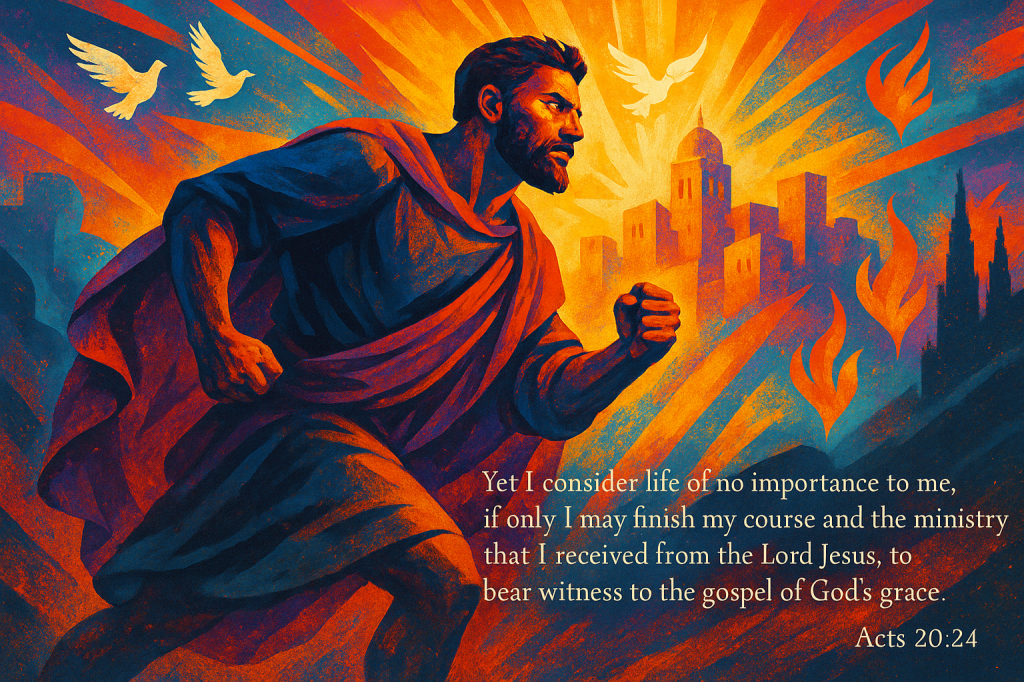
Paul’s Farewell Speech at Miletus. 17 From Miletus he had the presbyters of the church at Ephesus summoned. 18 When they came to him, he addressed them, “You know how I lived among you the whole time from the day I first came to the province of Asia. 19 I served the Lord with all humility and with the tears and trials that came to me because of the plots of the Jews, 20 and I did not at all shrink from telling you what was for your benefit, or from teaching you in public or in your homes. 21 I earnestly bore witness for both Jews and Greeks to repentance before God and to faith in our Lord Jesus. 22 But now, compelled by the Spirit, I am going to Jerusalem. What will happen to me there I do not know, 23 except that in one city after another the holy Spirit has been warning me that imprisonment and hardships await me. 24 Yet I consider life of no importance to me, if only I may finish my course and the ministry that I received from the Lord Jesus, to bear witness to the gospel of God’s grace.
25 “But now I know that none of you to whom I preached the kingdom during my travels will ever see my face again. 26 And so I solemnly declare to you this day that I am not responsible for the blood of any of you, 27 for I did not shrink from proclaiming to you the entire plan of God.
Detailed Exegesis
Verse 17 – “From Miletus he had the presbyters of the church at Ephesus summoned.”
Paul calls for the leaders of the Church at Ephesus from Miletus, bypassing Ephesus to save time, knowing he is heading toward hardship. His decision to summon only the presbyters underscores the gravity of this moment—it is a strategic, intimate farewell to those who will carry on his pastoral mission.
Verse 18 – “When they came to him, he addressed them, ‘You know how I lived among you the whole time from the day I first came to the province of Asia.’”
Paul begins by appealing to their firsthand experience of his ministry. He is not boasting, but bearing witness to a life lived in radical transparency. His credibility lies in his consistency and integrity, as he invites them to remember his way of life.
Verse 19 – “I served the Lord with all humility and with the tears and trials that came to me because of the plots of the Jews.”
This verse highlights the cost of discipleship. Paul did not lead with power, but with humility, vulnerability, and courage amid persecution. His service was marked by tears—an echo of Christ’s own weeping over Jerusalem—signifying deep compassion and suffering love.
Verse 20 – “And I did not at all shrink from telling you what was for your benefit, or from teaching you in public or in your homes.”
Paul stresses that he did not hold back the truth. Whether in the public square or in intimate domestic settings, he proclaimed the Gospel without compromise. His boldness is not arrogance, but obedience to the truth entrusted to him.
Verse 21 – “I earnestly bore witness for both Jews and Greeks to repentance before God and to faith in our Lord Jesus.”
Here we find Paul’s missionary heart: to call all people—regardless of background—to conversion and faith in Christ. Repentance and belief are the twin pillars of salvation. His message was universal, yet deeply personal.
Verse 22 – “But now, compelled by the Spirit, I am going to Jerusalem. What will happen to me there I do not know.”
This verse mirrors Jesus’ own journey to Jerusalem. Paul walks in the footsteps of the Lord, led not by certainty but by the prompting of the Holy Spirit. His trust in God’s plan outweighs his desire for safety.
Verse 23 – “Except that in one city after another the holy Spirit has been warning me that imprisonment and hardships await me.”
Paul is not naïve. He has received prophetic warnings, yet does not resist the path of suffering. His apostolic witness is deeply tied to redemptive suffering, a core theme in Christian life.
Verse 24 – “Yet I consider life of no importance to me, if only I may finish my course and the ministry that I received from the Lord Jesus, to bear witness to the gospel of God’s grace.”
This is the heart of the reading: complete abandonment to the mission. Paul does not seek comfort, reputation, or even survival—his only goal is to finish the race. This verse echoes 2 Timothy 4:7: “I have competed well; I have finished the race; I have kept the faith.”
Verse 25 – “But now I know that none of you to whom I preached the kingdom during my travels will ever see my face again.”
These words are heavy with emotion. Paul is aware this is a final goodbye. His heart is torn, but his gaze is fixed on heaven. There is no bitterness, only love and resolve.
Verse 26 – “And so I solemnly declare to you this day that I am not responsible for the blood of any of you,”
Paul takes spiritual responsibility seriously. He has proclaimed the Gospel fully, and his conscience is clear. The phrase reflects Ezekiel 33:6, where watchmen are accountable for failing to warn others.
Verse 27 – “For I did not shrink from proclaiming to you the entire plan of God.”
Paul has no regrets. He preached the full counsel of God—not selective truths, not watered-down messages. This bold integrity is what he leaves behind as his inheritance.
Teachings of the Church and the Saints
The Catechism of the Catholic Church teaches that “the duty of Christians to take part in the life of the Church impels them to act as witnesses of the Gospel and of the obligations that flow from it” (CCC 2472). Paul’s unwavering witness—even in the face of suffering and rejection—perfectly illustrates this call. His heart was consumed not by ambition, but by the burning desire to see Christ glorified and souls saved. He embodies the missionary zeal that the Church asks of all her children, especially those entrusted with pastoral responsibility.
CCC 852 affirms that “the Holy Spirit is the principal agent of the whole of the Church’s mission”, a truth clearly evident in Paul’s discernment. He is not following his own plan, but is compelled by the Spirit to go to Jerusalem. This surrender, even to a path of suffering, recalls the words of Christ in the Garden of Gethsemane: “Not my will, but yours be done” (Luke 22:42). Paul’s life demonstrates how the Spirit animates and strengthens us for even the hardest missions—when we yield completely.
Saint John Chrysostom reflected on this passage with deep admiration, saying, “I am moved not so much by his miracles, but by his endurance, his afflictions, his humility.” This legacy continues to inspire the Church. Missionaries, martyrs, and confessors throughout history have looked to Paul as the model of holy perseverance. Even today, his words resonate with all who seek to serve the Church: preach boldly, love deeply, and let go in faith.
Reflection
Paul’s farewell is not just a touching historical moment—it’s a mirror for our own mission. Are we living with the same integrity and urgency? Are we proclaiming the truth with courage, even when it costs us? Paul’s humility, tears, and fearless preaching challenge us to evaluate our own discipleship. Maybe we’re being called to forgive someone, to speak a hard truth in love, or to take a step of faith without knowing what lies ahead. What mission has God entrusted to you—and are you finishing it faithfully?
We are not called to be perfect or to understand every step of the journey. Like Paul, we are called to be faithful. To finish our course. To surrender control and trust that God, who began the good work in us, will bring it to completion. Ask the Holy Spirit today: Where do I need to be bold? Where do I need to let go? And then, entrust your mission—whatever it is—to the One who called you.
Responsorial Psalm – Psalm 68:10–11, 20–21
The God Who Carries Us
Psalm 68 is a triumphal hymn celebrating God’s victorious power, care for the weak, and active presence among His people. Traditionally attributed to King David, this psalm reflects a liturgical procession of the Ark of the Covenant, symbolizing God’s dwelling with Israel. Yet it is more than a song of national triumph; it is a deep theological proclamation of God’s fatherhood, provision, and salvation. Today’s selected verses highlight God’s mercy toward the poor and His power to rescue from death, anchoring the central theme of finishing our mission with trust in divine providence. Just as Saint Paul moves forward “compelled by the Spirit” and Jesus entrusts His disciples to the Father, this psalm reminds us that it is God—not our strength—who sustains and saves.
Psalm 68:10-11, 20-21
New American Bible (Revised Edition)
10 You poured abundant rains, God,
your inheritance was weak and you repaired it.
11 Your creatures dwelt in it;
you will establish it in your goodness for the poor, O God.
20 Blessed be the Lord day by day,
God, our salvation, who carries us.
Selah
21 Our God is a God who saves;
escape from death is the Lord God’s.
Detailed Exegesis
Verse 10 – “You poured abundant rains, God, your inheritance was weak and you repaired it.”
This verse speaks of divine generosity. The “abundant rains” symbolize both physical sustenance and spiritual grace. Israel, described as God’s “inheritance,” is portrayed as weak or worn out—yet God restores her. In the spiritual life, God often allows us to reach the point of dryness so that His outpouring is unmistakably His. It reflects what Saint Paul also knew: that grace is sufficient in our weakness (2 Corinthians 12:9).
Verse 11 – “Your creatures dwelt in it; you will establish it in your goodness for the poor, O God.”
This verse reflects God’s protective and nurturing nature. The poor—often seen in Scripture as those most open to God’s gifts—are given a secure dwelling. The verb “establish” suggests permanence, reminding us that God’s blessings are not fleeting. It is He who builds and secures the dwelling for His people, just as He establishes the Church through the Spirit.
Verse 20 – “Blessed be the Lord day by day, God, our salvation, who carries us.”
This declaration of praise points to the intimate daily care of the Lord. He is not a distant Savior but one who “carries us”—language that evokes both tenderness and strength. It echoes Deuteronomy 1:31, where God is said to have carried Israel “as a father carries his child.” This verse beautifully complements Paul’s willingness to suffer, for he knows who holds him.
Verse 21 – “Our God is a God who saves; escape from death is the Lord God’s.”
This final verse is the crescendo of hope. Salvation belongs to God alone. The phrase “escape from death” is especially fitting as we near the Ascension and Pentecost—moments where Jesus, having conquered death, promises His Spirit to lead the Church. In Christ, this psalm is fulfilled eternally. It reinforces Jesus’ words in John 17:2: “so that he may give eternal life to all you gave him.”
Teachings
The Catechism of the Catholic Church teaches that “God reveals his fatherly omnipotence by the way he takes care of our needs” (CCC 270). Psalm 68 makes this abundantly clear. God’s greatness is not just in His cosmic power but in His closeness—He provides rain for the weary, a home for the poor, and daily sustenance for His people. The very fact that He “carries us” is a tender sign of His fatherhood, which we receive most fully in Christ.
The Church Fathers saw in this psalm a prophecy of Christ’s victory. Saint Augustine interpreted the rain as the doctrine of the apostles, and the dwelling place as the Church. He writes, “In this house shall the poor dwell; not those wanting in gold, but in pride… Let the poor in spirit dwell here.” This ties directly into Jesus’ teaching in Matthew 5:3: “Blessed are the poor in spirit, for theirs is the kingdom of heaven.” The “poor” are those who recognize their total dependence on God.
Historically, this psalm has been sung in liturgies during times of great need, especially in early Christian communities facing persecution. The affirmation that “escape from death is the Lord God’s” served as both a cry of hope and a statement of defiance against worldly powers. Just as Paul went forward despite threats of imprisonment, and Jesus embraced His Cross, the psalmist assures us: God saves. Not sometimes. Always.
Reflection
How often do we forget that God carries us each day? In a world that celebrates self-reliance and productivity, this psalm invites us to rest in the arms of divine love. What would happen if we let ourselves be weak before God, allowing Him to repair us, feed us, and defend us? Begin each day by blessing the Lord “day by day”, recognizing that even your breath is sustained by Him. Let His Word rain upon your soul. And when trials come—as they did for Paul, and even for Jesus—remember this: “Our God is a God who saves.”
Holy Gospel – John 17:1–11
The Prayer That Holds Us
As Jesus prepares to enter His Passion, He turns His eyes to heaven and lifts His voice in what the Church has long revered as the High Priestly Prayer. Found only in The Gospel of John, chapter 17 reveals the deepest desires of Christ’s Sacred Heart: to glorify the Father, to complete the mission He was given, and to intercede for His disciples. This passage comes at the conclusion of the Last Supper discourse, just before Jesus crosses the Kidron Valley to the Garden of Gethsemane. Theologically, this moment is rich—it is Jesus stepping into His role as the eternal High Priest (cf. Hebrews 7:24–25), interceding for those the Father has entrusted to Him. The Gospel reading aligns beautifully with today’s theme of faithful mission and divine entrustment. Like Saint Paul in Acts 20, Jesus speaks not with fear but with clarity and love, entrusting His mission—and His people—to the Father.
John 17:1-11
New American Bible (Revised Edition)
The Prayer of Jesus. 1 When Jesus had said this, he raised his eyes to heaven and said, “Father, the hour has come. Give glory to your son, so that your son may glorify you, 2 just as you gave him authority over all people, so that he may give eternal life to all you gave him. 3 Now this is eternal life, that they should know you, the only true God, and the one whom you sent, Jesus Christ. 4 I glorified you on earth by accomplishing the work that you gave me to do. 5 Now glorify me, Father, with you, with the glory that I had with you before the world began.
6 “I revealed your name to those whom you gave me out of the world. They belonged to you, and you gave them to me, and they have kept your word. 7 Now they know that everything you gave me is from you, 8 because the words you gave to me I have given to them, and they accepted them and truly understood that I came from you, and they have believed that you sent me. 9 I pray for them. I do not pray for the world but for the ones you have given me, because they are yours, 10 and everything of mine is yours and everything of yours is mine, and I have been glorified in them. 11 And now I will no longer be in the world, but they are in the world, while I am coming to you. Holy Father, keep them in your name that you have given me, so that they may be one just as we are.
Detailed Exegesis
Verse 1 – “When Jesus had said this, he raised his eyes to heaven and said, ‘Father, the hour has come. Give glory to your son, so that your son may glorify you,’”
Jesus’ act of lifting His eyes expresses His intimacy and unity with the Father. “The hour” refers to His Passion, the culmination of His earthly mission. His request for glory is not selfish—it is the glorification of love through the Cross. In this moment, Jesus redefines glory as sacrificial love.
Verse 2 – “Just as you gave him authority over all people, so that he may give eternal life to all you gave him.”
This verse emphasizes Jesus’ divine authority, given by the Father. His mission is not domination but gift—eternal life offered to those who belong to God. The Greek word for “authority” (exousia) also implies a divine commission. Christ’s authority exists solely for the purpose of giving life.
Verse 3 – “Now this is eternal life, that they should know you, the only true God, and the one whom you sent, Jesus Christ.”
Jesus defines eternal life not as mere endless existence, but as relationship—knowing the Father and the Son. The word “know” (ginosko) implies intimate, experiential knowledge. This is the essence of discipleship: communion with the Trinity.
Verse 4 – “I glorified you on earth by accomplishing the work that you gave me to do.”
Jesus proclaims the fulfillment of His earthly mission. His entire life, from Incarnation to ministry, was directed toward glorifying the Father. The Greek word for “accomplishing” (teleioō) echoes His final words on the Cross: “It is finished” (John 19:30).
Verse 5 – “Now glorify me, Father, with you, with the glory that I had with you before the world began.”
Here Jesus speaks of His divine pre-existence. This verse is a profound assertion of His divinity, recalling John 1:1: “In the beginning was the Word, and the Word was with God, and the Word was God.” The glory He asks to return to is the eternal communion of the Trinity.
Verse 6 – “I revealed your name to those whom you gave me out of the world. They belonged to you, and you gave them to me, and they have kept your word.”
To reveal God’s name is to reveal His identity. In biblical terms, the “name” encompasses essence and presence. Jesus has manifested the Father’s love, truth, and holiness. Those who “kept His word” have responded with obedience and faith.
Verse 7 – “Now they know that everything you gave me is from you,”
The disciples have come to understand that Jesus’ authority and teaching originate in the Father. This recognition is crucial for the Church’s foundation. Their belief affirms the unity of Father and Son.
Verse 8 – “Because the words you gave to me I have given to them, and they accepted them and truly understood that I came from you, and they have believed that you sent me.”
Jesus emphasizes the transmission of divine truth. The disciples’ belief is not merely intellectual; it is relational and revelatory. Their faith is the fruit of God’s Word, spoken through Christ and accepted in their hearts.
Verse 9 – “I pray for them. I do not pray for the world but for the ones you have given me, because they are yours,”
Jesus begins His intercession for the disciples. “The world” in John often refers to the realm of sin and rejection. Jesus’ prayer is focused on those who are His own, those entrusted to Him by the Father.
Verse 10 – “And everything of mine is yours and everything of yours is mine, and I have been glorified in them.”
This verse reveals the perfect communion between Father and Son. Jesus sees His glory reflected in the lives of His disciples. Their response of faith and love becomes a mirror of divine life.
Verse 11 – “And now I will no longer be in the world, but they are in the world, while I am coming to you. Holy Father, keep them in your name that you have given me, so that they may be one just as we are.”
This is the heart of Jesus’ intercession: that the Father would protect and unify the disciples in His name. The prayer for unity—“that they may be one just as we are”—is both intimate and eschatological. The Church’s mission is to reflect the unity of the Trinity.
Teachings
The Catechism of the Catholic Church teaches that “Jesus’ prayer, the longest transmitted by the Gospel, embraces the whole economy of creation and salvation, as well as his death and Resurrection” (CCC 2758). In this high priestly prayer, we see the full spectrum of Christ’s mission—eternal love poured out through obedience and suffering. His intercession is ongoing; He continues to pray for us from the right hand of the Father (CCC 2741), drawing us into the unity of the divine family.
Saint Thomas Aquinas, commenting on John 17, writes, “Christ’s prayer manifests the perfection of charity, for it proceeds from love and tends to the unity of the Church.” For Aquinas, this passage shows the inner logic of salvation: to glorify God is to love, and to love is to unite. Jesus prays not for isolation but for communion—for His disciples to remain in the world, yet not be consumed by it, and to be united in truth and love.
The early Church Fathers also saw John 17 as the priestly act that parallels the Jewish high priest’s intercession on Yom Kippur. Jesus, however, is both priest and victim. His prayer becomes the foundation for the Church’s own liturgical prayer and mission. The unity He prays for is not uniformity, but Trinitarian harmony: many persons bound together in one divine life. This prayer anticipates Pentecost, when the Holy Spirit will make that unity a living reality.
Reflection
What does it mean that Jesus prayed for you? Not just once, but eternally. What would change in your life if you lived knowing you are the fruit of His prayer? This Gospel calls us to live in confidence and gratitude. We are not alone. Christ intercedes for us, and the Father keeps us in His name. But it also calls us to mission. If Jesus is glorified in us, as He said, then we are meant to reflect His love, His truth, His unity. Are you guarding His Word as something entrusted to you, or letting it fade amid worldly distractions?
To live John 17 is to live with purpose: to know the Father, to accept the mission, and to entrust everything—successes, fears, and relationships—to the One who sent us. Today, pause and pray slowly through this Gospel. Picture Jesus speaking these words over your life. Then ask: Where in my life is God calling me to deeper unity with Him and with others? Let this prayer hold you. Let it send you. Let it change everything.
Held, Sent, and Carried
Today’s readings offer us a sacred glimpse into the hearts of two great men of God—Saint Paul and Jesus Himself—at the threshold of departure. Each speaks not with fear or self-pity, but with clarity, love, and deep trust in the Father. In Acts 20, Paul’s farewell to the Ephesians is a model of pastoral courage and humble integrity: “I consider life of no importance to me, if only I may finish my course and the ministry that I received from the Lord Jesus”. In John 17, Jesus lifts His eyes to heaven, entrusting His disciples to the Father with a love so profound that it still reverberates through time: “Holy Father, keep them in your name… that they may be one just as we are”. And Psalm 68 sings of a God who not only saves but “carries us”—day by day, moment by moment.
Together, these readings remind us that the Christian life is a mission given, a race to be run, and a prayer constantly lifted. We are not sent alone; we are held in the prayer of Christ, carried by the mercy of the Father, and filled with the Spirit who strengthens us to proclaim the Gospel in word and in witness. Are you willing to live a life that glorifies God above all else? Are you ready to let go of control and let the Spirit lead you where you may not want to go, but where grace abounds?
Let today be a fresh yes. Say yes to finishing the course God has set for you. Say yes to being sanctified in truth. Say yes to being one with Christ, even in your weakness. And most of all, say yes to being carried—because the God who sends you is also the God who holds you. How will you glorify Him today?
Engage with Us!
We’d love to hear how today’s Word has spoken to your heart. Share your thoughts, questions, and prayers in the comments below—your reflection may be the encouragement someone else needs today. Take a moment to pause, pray, and ponder the following questions as you let these readings sink deeper into your life.
First Reading – Acts 20:17–27
What part of Saint Paul’s farewell speech resonates most with your current spiritual journey? Is there a mission or responsibility God is asking you to finish with greater courage or humility? How can you live with the same single-hearted focus on proclaiming “the entire plan of God”?
Responsorial Psalm – Psalm 68:10–11, 20–21
Where in your life do you most need to let God “carry you” today? How do you experience God’s daily goodness, especially in times of weakness or dryness? Are you creating space each day to bless the Lord and recognize His saving work in your life?
Holy Gospel – John 17:1–11
What does it mean to you that Jesus prayed for you personally? How can you grow in unity with others—especially within your family, parish, or community? Are there areas in your life where you need to entrust yourself more deeply to the Father’s name?
May you go forth today renewed in purpose, steadied by grace, and confident in the One who saves. Walk your path with faith, let your words bear witness to truth, and do everything with the love and mercy Jesus taught us. You are held, you are sent, and you are never alone.
Follow us on Instagram and Facebook for more insights and reflections on living a faith-filled life.

 Holy Manna!
Leave a comment