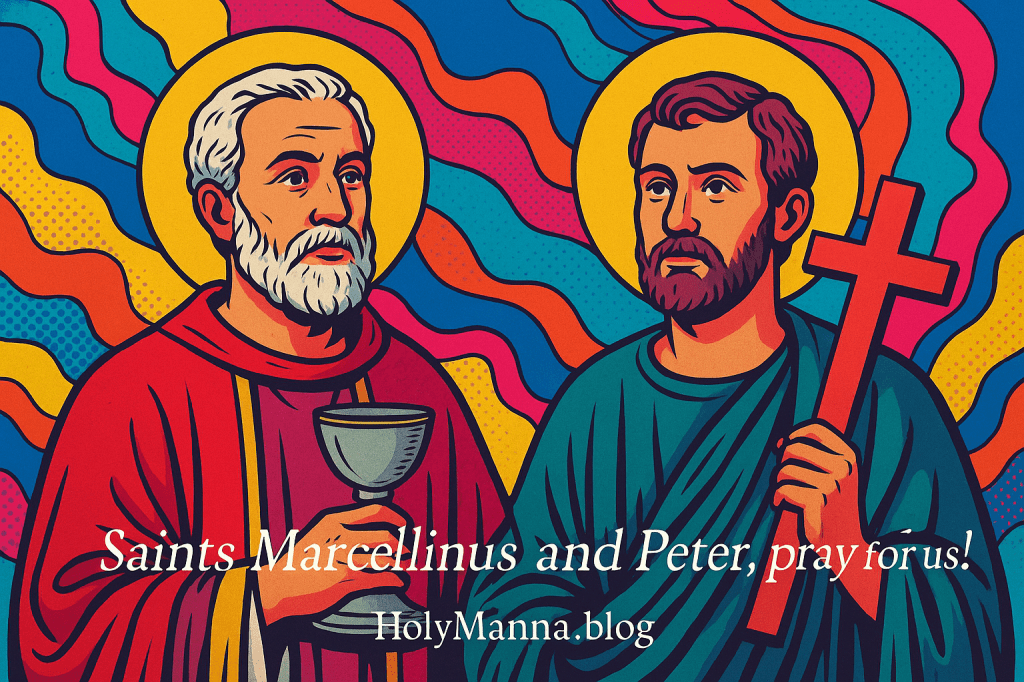
Echoes in the Eucharist
“They conquered him by the blood of the Lamb and by the word of their testimony; love for life did not deter them from death.” — Revelation 12:11
Every time we attend Mass and hear the sacred names of the early martyrs in the Eucharistic Prayer, two lesser-known yet eternally celebrated names appear: Marcellinus and Peter. These holy men—one a priest and the other an exorcist—stand among giants like Saints Lawrence, Chrysogonus, and Cyprian. But unlike those more widely known, their stories are largely hidden in the mists of early Church memory. They lived during the ferocious persecution of Christians under Emperor Diocletian in the early 4th century, and their legacy has survived not through eloquent writings or powerful sermons, but through the enduring strength of their witness and the reverence with which the early Church remembered them.
It is no accident that they are invoked in the Roman Canon. Though we know little about their earthly lives, their inclusion in the most ancient Eucharistic prayer speaks volumes. The Church saw something holy, something sacred in their faith—a light powerful enough to endure through centuries of darkness. These saints are a reminder that even the quietest witnesses can shake the gates of hell.
Rome’s Courageous Shepherds
Saint Marcellinus was a priest, likely ordained in the heart of Rome. Saint Peter was an exorcist, a rare and specific role in the early Church assigned to those called to confront spiritual darkness with authority and prayer. We are not told the details of their families or whether they were born into Christian households, but we do know that they ministered at a time when the Church in Rome was constantly under threat. To serve Christ in this context was to live on the edge of death.
Under the rule of Emperor Diocletian, Christianity was declared illegal, and believers were routinely arrested, tortured, and executed. In this climate, Marcellinus and Peter served the Church not in hiding, but in boldness. Their faith was not theoretical—it was forged in the crucible of persecution. According to Pope Damasus I, who grew up hearing their story from the very man who executed them, these two saints were arrested precisely because they would not stop preaching Christ. Even in prison, they continued their ministry, converting fellow inmates, praying with the condemned, and offering the Sacraments in defiance of imperial law.
Their example paints a picture of radical fidelity. They were men of deep prayer, fierce courage, and immense charity. They are most known not for any miracles or speeches, but for the way they quietly lived and died for the Eucharist, for Confession, and for the conversion of souls.
Invisible Light
While no dramatic physical miracles are recorded from the lives of Saints Marcellinus and Peter, their entire ministry in prison was a miracle of grace. It is said that Peter, as an exorcist, freed many from the grip of demonic possession. These exorcisms were not simply symbolic; they were spiritual battles, marked by prayer, fasting, and the authority of Christ. In the ancient Church, an exorcist’s role was not casual—it was a calling into combat with darkness itself.
Meanwhile, Marcellinus continued to offer the Holy Sacrifice of the Mass under threat of death. His presence brought Christ into the jail cells, and many of the imprisoned—some violent, some lost, some pagan—came to believe in Jesus through his example and preaching. The miracle here is the radical transformation of hardened hearts, the grace of faith flourishing in the most unlikely soil. These are not miracles easily seen, but they are miracles that echo eternity.
Just as Jesus told Nicodemus, “The wind blows where it wills, and you hear the sound of it, but you do not know where it comes from or where it goes” (John 3:8), so the Spirit worked silently through these men to bring the Kingdom into the shadows.
The Forest of Faith
One of the most poignant aspects of their story is the manner of their martyrdom. The Roman authorities, aware of the veneration martyrs often received from fellow Christians, wanted to erase Marcellinus and Peter from memory. They brought them into a remote forest outside of Rome, executed them in secret, and buried them in an unmarked grave.
This act of suppression, however, was overturned by divine providence. The man who executed them—perhaps disturbed in conscience or converted by the witness he saw—later revealed the location of their bodies. A devout Christian woman named Lucilla, with great courage, retrieved their remains and had them laid to rest with dignity in the Catacombs of St. Tiburtius on the Via Labicana. That location would soon become a sacred site of pilgrimage, prayer, and miracle.
Their martyrdom reveals the absolute trust they placed in Christ. There were no crowds watching. No glory. No famous last words recorded. Only the quiet, heroic surrender of their lives to the God they loved. In a world where we often seek applause and recognition, Marcellinus and Peter show us the power of dying to self in silence.
Their final act on earth was not one of triumph in the world’s eyes, but in the eyes of heaven, they received the victor’s crown promised by Christ: “Be faithful unto death, and I will give you the crown of life” (Revelation 2:10).
From Bones to Blessings
After their martyrdom, stories of miraculous healings and conversions began to circulate at their tomb. The early Christians believed, as we do today, that the bodies of martyrs are precious—temples of the Holy Spirit that continue to radiate grace. The veneration of their relics became widespread, and their intercession was sought for deliverance from illness, spiritual affliction, and despair.
When Charlemagne came to power centuries later, he had their relics transferred to Seligenstadt in Germany, where a magnificent basilica was built in their honor. Pilgrims from all over Europe came to visit the site, and reports of miracles continued for generations.
These posthumous miracles are a testament to the communion of saints. Saints Marcellinus and Peter, though long departed from earthly life, continue to be powerful intercessors in the Church, channels of God’s mercy and love. The Catechism reminds us: “Being more closely united to Christ, those who dwell in heaven fix the whole Church more firmly in holiness…” (CCC 956). Their legacy is not buried—it is alive in every Eucharist where their names are spoken, in every heart that finds courage because of their example.
Silent Witnesses, Eternal Echoes
What does the story of Saints Marcellinus and Peter mean for us today? In a culture that constantly pushes us to advertise our achievements, to seek approval, and to build platforms, their lives whisper a different truth: Holiness doesn’t need an audience. Faith doesn’t require fame. Love doesn’t need applause.
These men lived in a time when faith could cost you everything—and it did. They remind us that Christianity is not about comfort. It is about surrender, about living for Someone greater than ourselves, and about offering every moment—whether in freedom or persecution—as worship to God.
How many of us today fear proclaiming our faith in the workplace, in our families, or on social media? How many of us shrink back from spiritual battle because it’s inconvenient or unpopular? Saints Marcellinus and Peter would tell us: Stand firm. Speak truth. Love courageously. And if no one sees, God sees.
Their witness encourages us to treasure the sacraments, to prepare our hearts regularly in Confession, and to receive Jesus in the Eucharist with reverence and awe. It reminds us that even in the darkest prison, God is at work. Even in silence, our faith speaks volumes.
Let us imitate their bold humility. Let us serve with devotion. Let us never forget that the blood of the martyrs are the seeds of the Church, and we are called to be fertile ground for that seed to bear fruit in our lives.
Engage with Us!
Let the courage of Saints Marcellinus and Peter stir something in your heart. Let their hidden lives inspire you to live boldly—even if unnoticed—knowing that heaven sees and rejoices.
Reflection Questions:
- How am I being called to witness to my faith in quiet or hidden ways today?
- Have I taken the sacraments—especially Reconciliation and the Eucharist—for granted?
- Would I be willing to suffer for my faith, even if no one knew my sacrifice but God?
Please share your thoughts, prayers, or personal reflections in the comments below. Let’s support one another in our journey to heaven, and remember to do everything with love—as our Lord Jesus Christ did.
Saints Marcellinus and Peter, pray for us!🩸
Follow us on Instagram and Facebook for more insights and reflections on living a faith-filled life.

 Holy Manna!
Leave a comment