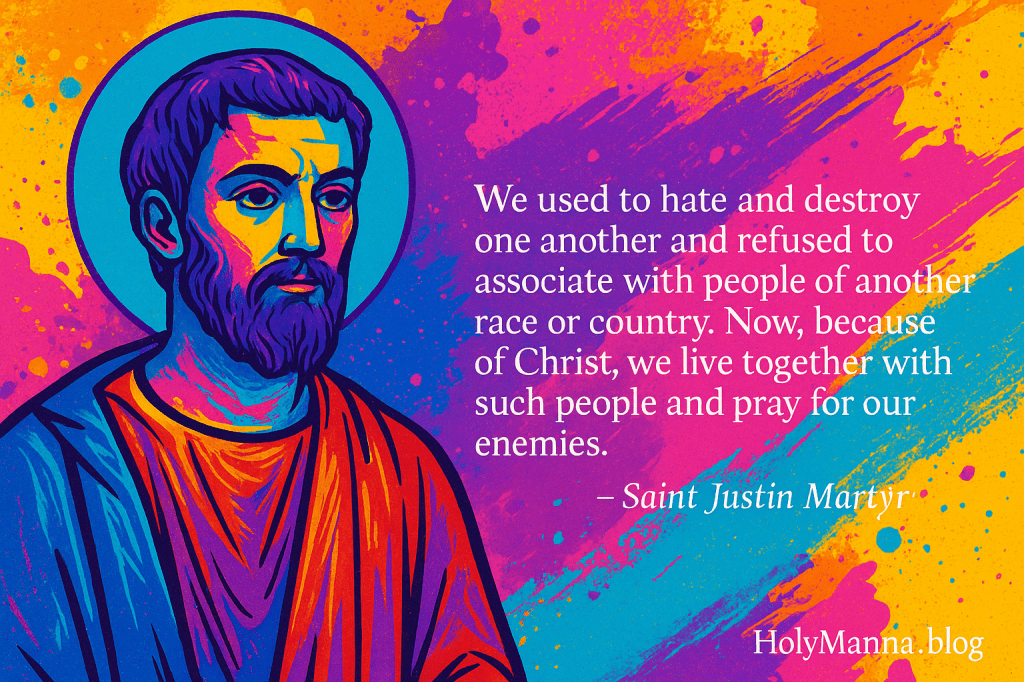
A Mind on Fire
In the roaring heart of the Roman Empire, where emperors ruled and philosophers debated in marble forums, one man stood at the crossroads of reason and revelation. His name was Justin, a man of immense intellect and burning conviction, now honored as Saint Justin Martyr. Living during the second century, when Christians were still considered a strange and often dangerous sect, Justin dared to speak publicly and passionately about the crucified and risen Christ—not just as a personal Savior, but as the ultimate fulfillment of all human philosophy.
He is remembered not for working miracles or founding monasteries, but for something rarer: bridging the ancient world of Greek reason with the new world of Christian faith. Justin’s writings—First Apology, Second Apology, and Dialogue with Trypho—are some of the earliest and most articulate defenses of the Christian faith ever penned. In a world steeped in idolatry and pagan worship, he dared to proclaim the Gospel in the emperor’s court, arguing that Christianity was not only reasonable but true. His legacy is a powerful reminder that truth is not something to be hidden—it is something to be proclaimed, even at great cost.
The Catechism of the Catholic Church holds such witnesses in the highest esteem: “The martyrs are the supreme witnesses to the truth of the faith: they bear witness even unto death” (CCC 2473). Saint Justin did exactly that—witnessing to the Truth with both his words and his blood.
The Restless Heart
Born around 100 A.D. in Flavia Neapolis, a Roman town in the region of Samaria (modern-day Nablus), Justin was raised in a pagan Greek family. His parents provided him with an excellent education in classical philosophy, and Justin, eager to find meaning in life, dove headfirst into the teachings of Stoics, Aristotelians, Pythagoreans, and finally Platonists. Each school offered some insight, some whisper of the divine, but none could satisfy the deep longing of his soul. His heart, like that of Saint Augustine centuries later, was restless.
One day, during a walk by the sea, Justin encountered an old man who spoke to him not in abstract terms, but with a quiet certainty about the prophets and the Messiah. This mysterious Christian figure pointed him toward the Scriptures and challenged the limitations of human reason without divine revelation. This conversation became the turning point in Justin’s life. Reflecting on that encounter, Justin later wrote: “I found this philosophy alone to be safe and profitable.”
From that moment forward, Justin devoted himself to the study of Christianity, embracing it not as a rejection of reason but as its perfect fulfillment. He moved to Rome, where he began teaching the faith as the “true philosophy,” opening a Christian school where seekers could find what he had found—truth, beauty, and eternal life in Jesus Christ. He saw Christ as the Logos, the Divine Word, in whom all truth is found—a notion that resonated deeply with his Greek audience.
His work as a teacher, writer, and apologist not only strengthened the early Church but gave it intellectual credibility in the eyes of skeptics. Justin became a bold and compassionate witness, defending the faith with clarity, humility, and courage. His dialogues with Jewish thinkers and pagan philosophers revealed the depth of his love for souls and his conviction that all people, if shown the truth of Christ, could be transformed.
The Silent Wonder
Unlike many saints who dazzled the world with healings, visions, or supernatural gifts, Saint Justin Martyr never performed a recorded miracle. And yet, his life was nothing short of miraculous. In a society intoxicated by spectacle and entertainment, Justin’s miracle was his mind—formed by the Spirit, sharpened by study, and surrendered to Christ. His miracle was the clarity with which he explained the mysteries of faith to a skeptical world.
Justin’s boldness in proclaiming Christianity as the “true philosophy” in the heart of the Empire was revolutionary. He demonstrated that the Christian faith is not a blind leap but a reasoned response to God’s revelation. He offered the intellectual elite of Rome a way to see Christ not as a mythological figure, but as the Logos—the Divine Reason behind all existence, mentioned in The Gospel of John and foreshadowed in Greek philosophy.
He taught that all truth, wherever it is found, is a reflection of the truth in Christ. “Whatever things were rightly said among all men are the property of us Christians,” he boldly declared. For Justin, Christ was not just a Jewish teacher—He was the light shining in every culture, the fulfillment of every noble thought. His ability to express Christian doctrine in philosophical terms opened the doors for many to embrace the faith.
And so, while no wonders of healing or levitation are attributed to him, Justin’s witness to truth is itself a marvel of grace. His life challenges us to ask: Do we see faith and reason as friends? Do we let our minds be sanctified by the Spirit?
Crowned in Blood
Justin’s relentless proclamation of the truth eventually led him into conflict with those in power. Around 165 A.D., during the reign of Emperor Marcus Aurelius, Justin was arrested with six of his students and brought before Rusticus, the Roman Prefect. In the preserved court transcripts, we see a man unshaken by threats or fear.
Rusticus asked, “Do you suppose, then, that you will ascend into heaven to receive some recompense?” Justin replied: “I do not suppose it, but I know and am fully persuaded of it.” When commanded to sacrifice to the Roman gods, he responded with clarity and courage: “No one who is rightly minded turns from true belief to false.”
Refusing to renounce Christ, Justin and his companions were scourged and then beheaded. Their blood joined the blood of the martyrs that would become the seed of the Church. His fearless testimony before a pagan judge became a final and eternal chapter in the story he had spent his life writing with words—now sealed in red.
The Catechism affirms: “Martyrdom is the supreme witness given to the truth of the faith: it means bearing witness even unto death” (CCC 2473). Justin, the philosopher who found Truth incarnate, now stood face to face with that Truth, radiant in glory.
The Legacy of Light
Although there are no documented physical miracles after Justin’s death, his influence echoes through the centuries like a bell that never stops ringing. His writings, especially his First Apology, are among the earliest and clearest explanations of the structure of the Mass. He describes the readings, the homily, the prayers, the kiss of peace, the consecration, and the reception of the Eucharist—giving us a glimpse into second-century Christian worship that is still recognizable today.
His description is a reminder that what we do every Sunday is not a modern invention but an ancient inheritance. When we participate in the liturgy, we join Justin and the early Christians in a timeless act of love and communion with God.
Veneration of his relics began shortly after his martyrdom. Originally buried on the Via Tiburtina in Rome, his remains became a source of inspiration for Christians across the empire. Churches and chapels were built in his honor, especially in Italy and France. His feast day, celebrated on June 1, invites the faithful to remember that love for truth sometimes leads to suffering—but always leads to glory.
Justin’s intellectual courage paved the way for generations of Christian thinkers—from Augustine to Aquinas, from John Henry Newman to Pope Benedict XVI. He remains a patron for all who seek to unite faith and reason, courage and compassion, truth and love.
The Pen and the Sword
Saint Justin Martyr’s life offers a compelling blueprint for how to live as a disciple in a world that doesn’t always understand or welcome the Gospel. He teaches us that faith and reason are not enemies, but allies. That the Church is not afraid of questions, because Christ is the answer. That the life of the mind can—and must—be in service to the life of the soul.
In an age of confusion, distraction, and relativism, Justin’s clarity and conviction are a guiding light. He didn’t hide his faith, compartmentalize it, or water it down. He embraced it, studied it, explained it, and lived it—unto death. His courage calls us to examine our own witness: Are we prepared to explain why we believe? Are we willing to suffer for what we know to be true?
Practical ways to follow in Justin’s footsteps include committing to regular study of Scripture and the Catechism, engaging in respectful dialogue with those of other beliefs, attending the Mass with renewed reverence, and staying firm in our convictions even when it costs us popularity, comfort, or approval.
Let Saint Justin Martyr’s example stir your soul to deeper commitment. May his words and witness echo in our hearts as we strive to become lovers of truth, defenders of the faith, and children of the light.
Engage with Us!
How has Saint Justin Martyr inspired you? Have you ever been challenged for your beliefs? What role does reason play in your journey of faith?
Here are three reflection questions to ponder and share in the comments:
- How can you grow in both intellectual formation and spiritual devotion in your Catholic faith?
- When was the last time you explained your faith to someone? What helped or hindered you?
- What fears hold you back from living boldly like Justin? How can you surrender those to God?
Let’s support each other in this journey of faith. May we, like Saint Justin Martyr, always seek the truth, speak it with courage, and do everything with love—as our Lord Jesus did.
Saint Justin Martyr, pray for us! 📜
Follow us on Instagram and Facebook for more insights and reflections on living a faith-filled life.

 Holy Manna!
Leave a comment