Living in the Glory, Unity, and Mercy of Christ
There are moments in the liturgical year when the readings converge like streams into a single river, carrying us deeper into the mystery of Christ. Today is one of those days. From the martyrdom of Saint Stephen in Acts, to the triumphant vision of the Lamb in Revelation, to the tender prayer of Jesus in The Gospel of John, we are swept into a divine current that invites us to behold the glory of Christ, remain united in His love, and long for His return. What does it mean to see the glory of Jesus and live as people who await His coming? The Church gives us today’s readings to ponder that very question—not just with our minds, but with our hearts and lives.
Historically, today’s liturgy falls near the end of the Easter season, just before Pentecost. This is no accident. The Church, like the early disciples, waits in expectant hope for the Holy Spirit. In Acts 7, we see Stephen, the Church’s first martyr, “filled with the Holy Spirit,” courageously gazing into heaven and proclaiming his vision of the risen Christ. His death echoes Jesus’ own Passion: forgiving his persecutors and surrendering his spirit. Meanwhile, Revelation 22 offers the Church’s final cry of longing: “Amen! Come, Lord Jesus!” This eschatological yearning is not fear-filled, but love-filled—directed toward the One who is “the Alpha and the Omega, the first and the last” (Rev 22:13). And in John 17, Jesus prays not only for His apostles but for us—His future disciples—that we may share in His divine glory and unity.
At the heart of today’s readings is a deep invitation: to become a people who witness to Christ’s glory, live in His unity, and thirst for His return. Stephen saw the glory of God and was unafraid to die for love of Jesus. The psalmist rejoices in the kingship of the Lord, whose justice is unshakable and whose majesty puts false idols to shame. Jesus, in His final discourse, speaks of a communion so profound that it mirrors the inner life of the Trinity itself: “that they may all be one, just as You, Father, are in Me and I in You” (John 17:21). Do our lives reflect that same communion? Do we forgive like Stephen, hope like the bride in Revelation, and love like Christ? Today’s Word invites us to lift our eyes, like Stephen, and see the heavens opened—then live with that same vision in our hearts.
First Reading – Acts 7:55–60
The Glory That Costs Everything
The first reading plunges us into the climactic scene of Saint Stephen’s martyrdom—an event that forever shaped the early Church. Taken from the Acts of the Apostles, a book written by Saint Luke to chronicle the mission of the Apostles after Christ’s Ascension, this passage reveals the cost of witnessing to the Risen Christ in a hostile world. Stephen is the Church’s first martyr, and his death is not merely tragic—it is gloriously conformed to that of Christ. We meet him at the end of a powerful speech given before the Sanhedrin, in which he laid out the history of salvation and accused Israel’s leaders of resisting the Holy Spirit. His fearless proclamation and heavenly vision ignited fury among his accusers. This scene not only illustrates the spiritual power of testimony (martyria) but ties directly into today’s theme: beholding Christ’s glory, bearing witness in the Spirit, and forgiving in divine love. Stephen’s gaze into heaven and his Christlike death form a living icon of Christian hope and unity.
Acts 7:55-60
New American Bible (Revised Edition)
55 But he, filled with the holy Spirit, looked up intently to heaven and saw the glory of God and Jesus standing at the right hand of God, 56 and he said, “Behold, I see the heavens opened and the Son of Man standing at the right hand of God.” 57 But they cried out in a loud voice, covered their ears, and rushed upon him together. 58 They threw him out of the city, and began to stone him. The witnesses laid down their cloaks at the feet of a young man named Saul. 59 As they were stoning Stephen, he called out, “Lord Jesus, receive my spirit.” 60 Then he fell to his knees and cried out in a loud voice, “Lord, do not hold this sin against them”; and when he said this, he fell asleep.
Detailed Exegesis
Verse 55 – “But he, filled with the holy Spirit, looked up intently to heaven and saw the glory of God and Jesus standing at the right hand of God”
Stephen is described as “filled with the Holy Spirit,” a detail that emphasizes his complete surrender to divine guidance. His vision into heaven mirrors the mystical experiences of the prophets, particularly Ezekiel and Daniel. Seeing Jesus “standing at the right hand of God” breaks with the usual depiction of Christ seated—here, Jesus rises in honor of His faithful witness. This divine endorsement is central: Stephen sees not just glory but a welcoming Christ, standing in intercession and affirmation.
Verse 56 – “and he said, ‘Behold, I see the heavens opened and the Son of Man standing at the right hand of God.’”
Stephen gives voice to his vision. The title “Son of Man” alludes to Daniel 7:13, a messianic figure who reigns with divine authority. This is the only time in Acts this title is used—underscoring Stephen’s deep alignment with Jesus’ own identity and mission. His words echo Jesus before the Sanhedrin in Mark 14:62, fulfilling the pattern of prophetic witness met with rejection.
Verse 57 – “But they cried out in a loud voice, covered their ears, and rushed upon him together.”
This verse highlights the irrational fury and spiritual blindness of the mob. Their actions—“cried out,”, “covered their ears,” and “rushed”—mirror the persecution faced by the prophets before Stephen. They cannot bear to hear truth. The covering of ears is especially poignant: they refuse to listen, just as Israel had rejected the prophets before.
Verse 58 – “They threw him out of the city, and began to stone him. The witnesses laid down their cloaks at the feet of a young man named Saul.”
Stephen is expelled from the city, a gesture echoing the fate of Jesus, who was crucified outside Jerusalem. The laying down of cloaks signals a formal execution and introduces Saul—later Paul—whose presence here is chilling yet ironic. The future Apostle to the Gentiles first appears as a persecutor, standing over the scene of martyrdom.
Verse 59 – “As they were stoning Stephen, he called out, ‘Lord Jesus, receive my spirit.’”
Stephen’s final words mirror those of Jesus on the Cross (Luke 23:46). Calling upon Jesus to “receive my spirit” is an act of ultimate trust and surrender. This line affirms Christ’s divinity: Stephen prays to Him directly, recognizing Him as the One who receives the souls of the faithful.
Verse 60 – “Then he fell to his knees and cried out in a loud voice, ‘Lord, do not hold this sin against them’; and when he said this, he fell asleep.”
This final act of mercy is breathtaking. Stephen imitates Christ’s words from the Cross (Luke 23:34) in forgiving his murderers. His kneeling signifies reverence, while the phrase “fell asleep” reflects early Christian language for death, affirming belief in the resurrection. His martyrdom is not defeat—it is witness, forgiveness, and union with Christ.
Teachings from the Church
Stephen’s witness is echoed in the Catechism of the Catholic Church: “Martyrdom is the supreme witness given to the truth of the faith: it means bearing witness even unto death” (CCC 2473). The Church has always venerated martyrs as those most conformed to Christ, whose blood becomes the seed of new Christians. Saint Augustine wrote, “The martyrs were bound, scourged, racked, burnt, rent, butchered—and they multiplied.” This was not because of fanaticism, but because of love: love for Christ who is glorified in their suffering. Saint Thomas More, a later martyr, reflected Stephen’s spirit when he said, “I die the king’s faithful servant, but God’s first.” Their courage flows from the Holy Spirit.
Moreover, Saint Stephen’s death becomes a catalyst for conversion. Saul’s presence in this scene is not incidental. Tradition holds that the seed of Stephen’s forgiveness pierced Saul’s heart, planting the grace that would blossom into Paul’s transformation. The Church Fathers saw this as divine providence: that one martyr’s prayer helped raise up the Church’s greatest missionary. This connects directly to Christ’s prayer in John 17—that future believers, like Saul, would come to know Him through the testimony of the faithful.
Historically, Stephen’s martyrdom also marked a turning point: the Church was scattered from Jerusalem but not silenced. In fact, the persecution of Christians became the means by which the Gospel spread to Samaria and beyond (Acts 8:1). Suffering, in God’s providence, becomes a vehicle of expansion and grace. As Tertullian wrote, “The blood of the martyrs is the seed of the Church.”
Reflection for Daily Life
How often are we willing to speak truth even when it costs us comfort or reputation? Stephen’s death asks each of us: Do I truly believe in the glory of Christ? Do I forgive as He forgave? Perhaps we are not called to shed blood, but we are called to die to self. Every act of truth-telling in love, every choice to forgive rather than retaliate, every prayer uttered in suffering, becomes a small martyrdom. In our workplaces, relationships, and even social media, we can reflect Stephen’s courage. Where in your life is Jesus inviting you to look up—to lift your gaze above fear and hostility, and see His glory? And can you, like Stephen, trust that your witness—however quiet or small—may be the very seed that leads someone else to salvation?
Responsorial Psalm – Psalm 97:1–2, 6–7, 9
The Reign of the Risen King
The Responsorial Psalm bursts forth with triumphant joy: “The Lord is king; let the earth rejoice”. Psalm 97 is part of the royal psalms, a collection that celebrates the kingship of the Lord over all creation. It is believed to have been sung during temple worship, possibly on high feast days when Israel commemorated God’s sovereignty, His covenant, and His divine justice. In this psalm, we encounter God not only as Creator but as enthroned Judge and Redeemer—whose power humbles false gods and draws all nations to behold His glory. Placed alongside today’s First Reading, where Stephen sees Jesus standing in heavenly glory, and the Gospel, where Jesus prays for unity among believers, this psalm reminds us that Christ’s reign is not merely symbolic. It is real, cosmic, and final. His throne is justice, His glory unmatched, and His name above every name.
Psalm 97:1-2, 6-7, 9
New American Bible (Revised Edition)
The Divine Ruler of All
1 The Lord is king; let the earth rejoice;
let the many islands be glad.
2 Cloud and darkness surround him;
justice and right are the foundation of his throne.
6 The heavens proclaim his justice;
all peoples see his glory.
7 All who serve idols are put to shame,
who glory in worthless things;
all gods bow down before him.
9 For you, Lord, are the Most High over all the earth,
exalted far above all gods.
Detailed Exegesis
Verse 1 – “The Lord is king; let the earth rejoice; let the many islands be glad.”
This opening verse proclaims a universal truth: the Lord reigns not just over Israel but over the entire earth. The mention of “many islands” is a poetic way to include distant nations and peoples—those considered far off geographically or spiritually. All creation is summoned into joy because the Lord is enthroned, not as a tyrant, but as a just and merciful King.
Verse 2 – “Cloud and darkness surround him; justice and right are the foundation of his throne.”
The imagery of “cloud and darkness” recalls the theophanies of the Old Testament, such as God’s presence on Mount Sinai (Exodus 19:16–18). These signs evoke mystery and awe—God is not fully graspable, yet His moral foundation is clear: “justice and right”. This connects with the vision of Jesus in Acts 7, standing in divine authority, and with the Revelation passage where judgment is linked to righteousness.
Verse 6 – “The heavens proclaim his justice; all peoples see his glory.”
This verse moves from mystery to manifestation. The heavens—God’s creation—announce His justice like a herald. In line with Psalm 19 and Romans 1:20, creation becomes a visible testimony to divine truth. In Stephen’s martyrdom, the heavens open, and God’s glory is made visible through the witness of a faithful servant.
Verse 7 – “All who serve idols are put to shame, who glory in worthless things; all gods bow down before him.”
This verse is a call to abandon false worship. In the ancient world, idols were physical statues, but today they can be anything that takes the place of God in our lives—wealth, power, pleasure, or self. The psalmist declares that these are “worthless things”, and before the true God, even the so-called “gods” must bow. This affirms Christ’s supremacy over all—He is not one option among many but the only Lord and Judge.
Verse 9 – “For you, Lord, are the Most High over all the earth, exalted far above all gods.”
The final verse affirms the psalm’s theme with majesty: the Lord is “the Most High”—a title denoting ultimate authority. His exaltation “far above all gods” mirrors the New Testament proclamation of Christ’s lordship. As Philippians 2:9 declares, “God greatly exalted him and bestowed on him the name that is above every name”. Psalm 97 finds its ultimate fulfillment in the risen and glorified Jesus, standing at the right hand of the Father.
Teachings from the Church
The Catechism of the Catholic Church teaches that the glory of God is revealed through creation and the Word: “The world was made for the glory of God. St. Bonaventure explains that God created all things ‘not to increase his glory, but to show it forth and to communicate it’” (CCC 293). The psalm reflects this glory: creation sings of it, justice embodies it, and the nations are summoned to behold it. Saint Irenaeus adds, “The glory of God is man fully alive; and the life of man is the vision of God”. Stephen’s martyrdom is such a vision made visible—a human being, fully alive in Christ, beholding divine glory even in death.
This psalm also condemns idolatry—a theme deeply rooted in the prophetic tradition. The prophets consistently warned Israel against turning to false gods, but the issue is not ancient history. As CCC 2113 reminds us, “Idolatry consists in divinizing what is not God… it is a perverse inclination that remains a constant temptation”. In a culture saturated with distractions and false ideologies, the call to worship God alone remains urgent. Psalm 97 brings this into sharp relief: only the Lord reigns; only His justice brings peace.
Finally, the psalm prepares us liturgically and eschatologically. In the Liturgy, we proclaim the Lord’s kingship now, even as we await its full unveiling. The Second Coming, referenced in Revelation 22, will be the moment when the heavens and the earth truly rejoice in fullness. As Saint Augustine wrote, “He who made you is more beautiful than all the beauties of the earth”. The psalm calls us to lift our eyes, hearts, and allegiance to Him who reigns forever.
Reflection for Daily Life
Do we live as if Christ is truly King of our hearts, our homes, our desires? This psalm invites us to celebrate, but also to examine. What idols do I still serve? What “worthless things” am I tempted to glorify? The joy of the Lord’s kingship should not only bring us comfort but conversion. In prayer, we can ask: Lord, reign in every part of my life. Let me rejoice in You, trust Your justice, and proclaim Your glory to all the earth. When we see with eyes of faith like Stephen, and praise with lips of truth like the psalmist, we truly become citizens of the kingdom that shall never pass away.
Second Reading – Revelation 22:12–14, 16–17, 20
The Cry of the Bride: Come, Lord Jesus
As the Easter season draws to a close and Pentecost approaches, the Church turns our hearts to the final chapter of the Bible: Revelation 22. These verses are among the most powerful and poetic in all of Scripture. They form part of the conclusion to the visions granted to Saint John on the island of Patmos—a persecuted Church’s sacred glimpse into God’s cosmic plan. Written in a time of tribulation, Revelation offers more than apocalyptic symbolism; it is a message of unwavering hope for those who suffer for Christ. This reading focuses our gaze on the return of Jesus, His final justice, and the invitation to receive the gift of life-giving water. In today’s liturgy, this passage complements the martyrdom of Stephen, the psalm’s royal proclamation, and Jesus’ priestly prayer. Each reading lifts our eyes to the heavens and roots our hearts in the promise: “I am coming soon.”
Revelation 22:12-14, 16-17, 20
New American Bible (Revised Edition)
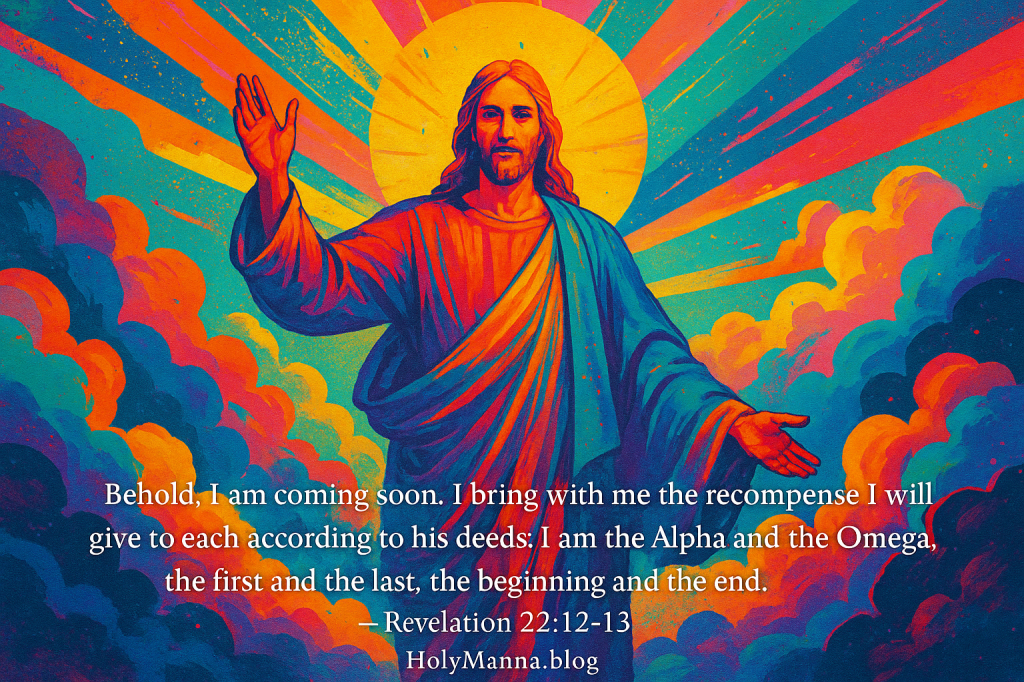
12 “Behold, I am coming soon. I bring with me the recompense I will give to each according to his deeds. 13 I am the Alpha and the Omega, the first and the last, the beginning and the end.”
14 Blessed are they who wash their robes so as to have the right to the tree of life and enter the city through its gates.
16 “I, Jesus, sent my angel to give you this testimony for the churches. I am the root and offspring of David, the bright morning star.”
17 The Spirit and the bride say, “Come.” Let the hearer say, “Come.” Let the one who thirsts come forward, and the one who wants it receive the gift of life-giving water.
20 The one who gives this testimony says, “Yes, I am coming soon.” Amen! Come, Lord Jesus!
Detailed Exegesis
Verse 12 – “Behold, I am coming soon. I bring with me the recompense I will give to each according to his deeds.”
Jesus speaks with urgency and authority. The word “Behold” demands our attention—it is both a comfort and a warning. The “recompense” refers to divine judgment: God’s justice will be perfectly executed according to our deeds. This echoes Romans 2:6, which affirms that “He will repay everyone according to his works.” While salvation is a gift, our response to grace—our deeds—matters eternally.
Verse 13 – “I am the Alpha and the Omega, the first and the last, the beginning and the end.”
This Trinitarian title reveals Christ’s divinity and timeless sovereignty. As “Alpha and Omega”, He encompasses all of history and existence. He is not a part of creation; He is Lord over it. This connects with the psalm’s proclamation of God’s exalted reign and affirms that the Jesus Stephen saw standing at God’s right hand is indeed the eternal One.
Verse 14 – “Blessed are they who wash their robes so as to have the right to the tree of life and enter the city through its gates.”
This verse recalls the imagery of Eden and the new Jerusalem. To “wash their robes” is to be cleansed by the blood of the Lamb (see Revelation 7:14). Those who do so are not merely forgiven—they are welcomed. The “tree of life” lost in Genesis is restored, and entry into the city signifies full communion with God. This is the hope for all faithful witnesses, including Stephen.
Verse 16 – “I, Jesus, sent my angel to give you this testimony for the churches. I am the root and offspring of David, the bright morning star.”
Here, Jesus personally affirms His identity and mission. By calling Himself “the root and offspring of David”, He bridges Old Testament prophecy with New Covenant fulfillment. He is both source and heir. As the “bright morning star”, He brings light after darkness—a powerful image of resurrection, hope, and new beginnings.
Verse 17 – “The Spirit and the bride say, ‘Come.’ Let the hearer say, ‘Come.’ Let the one who thirsts come forward, and the one who wants it receive the gift of life-giving water.”
This verse is profoundly liturgical and sacramental. The Church—“the bride”—joined with the Holy Spirit, cries out for the Lord’s return. It is both a prayer and an invitation. The phrase “life-giving water” evokes baptism, the Eucharist, and the promise of eternal satisfaction in Christ. It is open to “the one who thirsts”—a call to every heart that longs for more.
Verse 20 – “The one who gives this testimony says, ‘Yes, I am coming soon.’ Amen! Come, Lord Jesus!”
The final promise and the final prayer. Jesus reaffirms His imminent return, and the Church responds with love and longing. The Greek phrase “Maranatha”—Come, Lord—is not a fear-filled plea but a declaration of hope. It is the Church’s heartbeat as we await our Bridegroom.
Teachings from the Church
The Catechism of the Catholic Church speaks directly to the longing expressed in this reading: “Since the Ascension, Christ’s coming in glory has been imminent, even though ‘it is not for you to know times or seasons which the Father has fixed by his own authority.’ This eschatological coming could be accomplished at any moment…” (CCC 673). The Church lives in a state of watchful hope, not anxious dread. This expectation is meant to shape how we live: as a people who trust in God’s justice and yearn for His return.
In connection with baptism and eternal life, the Catechism also states: “By Baptism the Christian participates in the grace of Christ’s death and resurrection. Baptism signifies and actually brings about death to sin and entry into the life of the Most Holy Trinity” (CCC 1277). The image of the “life-giving water” offered to those who thirst points to the sacramental life of the Church, which prepares us for entrance into the heavenly city. Our robes are washed, not by our own merit, but by God’s mercy flowing through the sacraments.
Saint Ambrose, commenting on the end of Revelation, wrote: “He who says ‘Come’ loves, and he who loves, longs for union. Let us desire the presence of Christ, not delay it”. This deeply resonates with Stephen’s vision and Jesus’ priestly prayer in John 17. The saints teach us that holiness is not just obedience—it is longing. Heaven is not a reward; it is a wedding feast, and we are the beloved bride.
Reflection for Daily Life
Do I live each day as if Jesus could return today? The Second Reading gently but urgently invites us to prepare—not through fear, but through love. The longing of the Spirit and the bride is the longing of a Church in love with her Savior. Do I thirst for the living water Christ offers? If our robes have grown stained through sin, now is the time to wash them in confession and renewal. If our lives have been consumed by lesser pursuits, now is the moment to lift our eyes to the One who is “the beginning and the end.”
In practical terms, this reading encourages a heart of readiness and hope. Begin and end each day with the words: Come, Lord Jesus. Let them sanctify our schedules, interrupt our distractions, and purify our desires. Let them give us the courage to witness like Stephen, the joy to praise like the psalmist, and the unity for which Jesus prayed. The Bridegroom is coming. Are we waiting with oil in our lamps, robes washed, and hearts burning with desire to see His face?
Holy Gospel – John 17:20–26
The Prayer of Glory and Unity
In today’s Gospel from John 17, we are drawn into the very heart of Jesus’ love for His Church. This passage comes from what is known as the High Priestly Prayer, spoken by Jesus just before His Passion. In it, Christ lifts His eyes to heaven and intercedes not only for His disciples, but for all who would come to believe in Him through their word—including us. Set within the rich context of the Last Supper, these words are deeply intimate and eternally significant. They reveal Jesus’ deepest desires: that we may be united, glorified in Him, and filled with divine love. This prayer is a living echo of Stephen’s vision and Revelation’s final longing. It draws the whole Church into a communion that is not merely human or symbolic, but rooted in the very life of the Trinity. As Jesus prepares to lay down His life, He does not pray for escape—but for union.
John 17:20-26
New American Standard Bible
20 “I am not asking on behalf of these alone, but also for those who believe in Me through their word, 21 that they may all be one; just as You, Father, are in Me and I in You, that they also may be in Us, so that the world may believe that You sent Me.
Disciples’ Future Glory
22 The glory which You have given Me I also have given to them, so that they may be one, just as We are one; 23 I in them and You in Me, that they may be perfected in unity, so that the world may know that You sent Me, and You loved them, just as You loved Me. 24 Father, I desire that they also, whom You have given Me, be with Me where I am, so that they may see My glory which You have given Me, for You loved Me before the foundation of the world.
25 “Righteous Father, although the world has not known You, yet I have known You; and these have known that You sent Me; 26 and I have made Your name known to them, and will make it known, so that the love with which You loved Me may be in them, and I in them.”
Detailed Exegesis
Verse 20 – “I am not asking on behalf of these alone, but also for those who believe in Me through their word.”
Jesus widens the scope of His intercession. He has been praying for His apostles, but now includes all future believers. His prayer spans generations, cultures, and nations. We are directly included in this verse—those who believe because of the apostolic witness passed down through Scripture, Tradition, and the sacraments.
Verse 21 – “That they may all be one; just as You, Father, are in Me and I in You, that they also may be in Us, so that the world may believe that You sent Me.”
Unity is not optional—it is essential to Christian witness. Jesus desires that believers reflect the perfect unity of the Trinity. This spiritual communion is evangelistic in nature: “so that the world may believe”. Disunity among Christians, then, is not merely tragic—it obstructs the world’s ability to recognize the divine mission of Christ.
Verse 22 – “The glory which You have given Me I also have given to them, so that they may be one, just as We are one.”
Here, Jesus speaks of shared glory. This is not earthly honor, but the divine radiance that flows from love and obedience. The glory Christ receives from the Father He gives to us—not for individual exaltation, but for unity. Our unity is meant to reflect the eternal communion of the Father and the Son.
Verse 23 – “I in them and You in Me, that they may be perfected in unity, so that the world may know that You sent Me, and You loved them, just as You loved Me.”
This verse reveals the full depth of Christ’s desire. He wants His disciples to be “perfected in unity”, not simply for their own sake, but for the salvation of others. The world will come to know God’s love through the unity of His people. Most astonishingly, Jesus declares that the Father loves us “just as You loved Me”—a statement of immeasurable worth.
Verse 24 – “Father, I desire that they also, whom You have given Me, be with Me where I am, so that they may see My glory which You have given Me, for You loved Me before the foundation of the world.”
Jesus longs for us to be with Him in heaven. This verse shows His deep yearning for our eternal communion. To “see My glory” is to participate in the Beatific Vision—the fullness of joy in beholding God. The love between the Father and Son precedes creation; our destiny is to share in that eternal love.
Verse 25 – “Righteous Father, although the world has not known You, yet I have known You; and these have known that You sent Me.”
Jesus contrasts the ignorance of the world with the knowledge of the faithful. The “Righteous Father” is the One who sent the Son—not as an idea or example, but as Savior. Jesus affirms that His disciples, though not perfect, have come to know this truth.
Verse 26 – “And I have made Your name known to them, and will make it known, so that the love with which You loved Me may be in them, and I in them.”
This final verse brings the prayer to a climax. Jesus reveals the divine name—the inner reality of God—to His followers, and continues to do so. His goal is love: “so that the love with which You loved Me may be in them”. The indwelling of Jesus in His disciples is the crowning gift of salvation.
Teachings from the Church
The Catechism of the Catholic Church teaches that Christian unity is a reflection of Trinitarian love: “The desire to recover the unity of all Christians is a gift of Christ and a call of the Holy Spirit” (CCC 820). The unity Jesus prays for is not uniformity but communion. As the Church, we are many parts but one body, called to live in such harmony that it reveals the mystery of God Himself.
Saint John Paul II emphasized the missionary nature of unity: “The credibility of the Christian message would be much greater if Christians could overcome their divisions” (Ut Unum Sint 98). In a fragmented world, the Church’s unity is a prophetic sign. Jesus’ prayer challenges us to examine how we foster or fracture this unity in our parishes, families, and relationships.
Moreover, CCC 260 teaches that this prayer of Jesus is an invitation into divine intimacy: “The ultimate end of the whole divine economy is the entry of God’s creatures into the perfect unity of the Blessed Trinity. But even now we are called to be a dwelling for the Most Holy Trinity: ‘If a man loves me… we will come to him, and make our home with him.’” This is not poetic metaphor—it is theological reality. Christ desires to dwell within us, just as He dwells in the Father.
Reflection for Daily Life
Do I live as one who is deeply loved by the Father, just as He loves the Son? This Gospel reading invites us to live not in isolation, but in communion—with God and one another. Where do I resist unity in my life? Are there people I need to forgive, or relationships that need healing? The unity Jesus prays for is not sentimental—it is sacrificial. It demands humility, reconciliation, and love that perseveres.
Each day, we can respond to this prayer by becoming a channel of Christ’s presence to others. Begin with prayer: Lord, make me one with You and with those You have placed in my life. Seek opportunities to build bridges, to reconcile, and to affirm others in truth and love. The world desperately needs to see the Church united—not just institutionally, but spiritually and relationally. Will others come to believe in Jesus through my life? Will they see the love of the Father in me? Jesus is still praying for us. Let us join our hearts to His and become the answer to His own prayer.
Come, See His Glory—Then Live It
Today’s readings draw us into the heart of Christian faith—a vision of glory, a prayer for unity, and a hope that endures through suffering. Saint Stephen, filled with the Holy Spirit, lifts his eyes and sees the heavens opened: “Behold, I see the heavens opened and the Son of Man standing at the right hand of God” (Acts 7:56). In his dying breath, he forgives his persecutors and surrenders his spirit to Jesus. His martyrdom becomes not only a witness to truth but a mirror of Christ’s love. In Psalm 97, we echo Stephen’s vision with joyful acclamation: “The heavens proclaim his justice; all peoples see his glory”. We are reminded that no idol, no darkness, no lie can overshadow the radiant reign of our King.
From the heights of heaven, the Book of Revelation speaks directly to our waiting hearts: “Behold, I am coming soon” (Rev 22:12). This is not just a future event—it is a present invitation. Jesus is near. He is coming with justice, with mercy, with the reward of eternal life for those who have washed their robes in His blood. The Church, united with the Spirit, cries out: “Come!” Not in fear, but in longing. Not in dread, but in love. And finally, in the Gospel of John 17, we hear the Son praying for us: “That they may all be one… so that the world may believe that You sent Me” (John 17:21). This is the heart of Jesus—beating with love, glowing with glory, and desiring communion with us.
Will you live today with your eyes lifted toward heaven? Will you be the answer to Jesus’ prayer for unity? Will you thirst for the life-giving water He offers? The call is clear: fix your gaze on Christ, let His love transform your heart, and bear witness to the world—not in words alone, but through mercy, forgiveness, and unshakable hope. Let your life echo Stephen’s courage, the psalmist’s praise, the bride’s longing, and the Savior’s love. Come, Lord Jesus. And until You do, make us ready to see Your glory—and live it here and now.
Engage with Us!
We’d love to hear how today’s readings have spoken to your heart. Whether it was Stephen’s bold witness, the psalm’s celebration of God’s reign, the Church’s longing in Revelation, or Jesus’ prayer for unity in John—your reflections matter. Share your thoughts in the comments below and join us in growing as a community of faith, hope, and love.
Reflection Questions:
First Reading – Acts 7:55–60
What part of Stephen’s martyrdom resonates most deeply with you? Have you ever faced rejection or hostility for speaking the truth in love? How did you respond?
Can you imagine yourself forgiving like Stephen did? What would help you grow in that grace?
Responsorial Psalm – Psalm 97
What “idols” in your life do you feel called to surrender so Christ can reign fully in your heart? How can you proclaim God’s glory in the ordinary parts of your day? Where do you find joy in the truth that “The Lord is king”?
Second Reading – Revelation 22:12–14, 16–17, 20
What does it mean for you personally to say, “Come, Lord Jesus”? Do you feel spiritually thirsty right now? What “life-giving water” is Jesus inviting you to receive? How can you live in joyful expectation of Christ’s return?
Holy Gospel – John 17:20–26
Where in your life is God calling you to build unity and deeper communion? Do you believe the Father loves you as He loves His Son? How might that truth change the way you live and love? How can you help others see Jesus through your words, actions, and relationships?
Let today’s Word take root in your soul. Let it inspire you to live courageously, love deeply, and forgive generously. May your life be a prayer of praise, a witness to unity, and a longing for Jesus to reign in every heart. And as you go forward, do everything with the love and mercy that He has poured out for us. You are not alone. You are loved. You are part of His glorious plan.
Follow us on Instagram and Facebook for more insights and reflections on living a faith-filled life.

 Holy Manna!
Leave a comment