When God Comes Close
Have you ever felt so overwhelmed with joy that your heart could do nothing but sing? That’s the kind of joy we’re invited into today—a joy that doesn’t just bubble up from circumstances but flows from the presence of the living God in our midst. Today’s readings draw us into the intimate reality of a God who draws near, who acts mightily, and who delights in His people. This is not a distant deity watching from afar, but a Savior who rejoices over us with singing, who fills our empty places, and who comes hidden in the womb of a humble virgin.
The thread of joyful salvation runs through all three readings. In Zephaniah 3:14–18, the prophet calls Zion to rejoice because the Lord has removed judgment and dwells among them as a victorious King. In Isaiah 12:2–6, the response echoes this joy with poetic exultation: “God indeed is my salvation; I am confident and unafraid”. These Old Testament voices prepared Israel for a day when God’s presence would no longer be limited to the temple or veiled in cloud and fire—but would walk among them, speak with them, and even be carried in a mother’s womb. And in Luke 1:39–56, that promise is fulfilled. Mary, the new Ark of the Covenant, visits Elizabeth, and even the unborn John leaps in recognition. The Magnificat becomes the Church’s hymn of ultimate reversal: the lowly are lifted up, and God’s mercy rains down from generation to generation.
Culturally, this moment in salvation history represents the threshold between Israel’s long waiting and the dawn of the Messiah’s arrival. Religiously, it fulfills centuries of covenant promises made to Abraham, David, and the prophets. Historically, it stirs a revolution of the heart—not with swords or power, but with mercy and maternal joy. As we prepare to meditate on each passage, let us ask ourselves: Do we recognize the Lord in our midst? Are we still waiting for something, or are we rejoicing in what has already come? Today’s readings do not merely tell us about God—they invite us to welcome Him with song.
First Reading – Zephaniah 3:14–18
The God Who Rejoices With Us
The Book of Zephaniah is a short yet thunderous prophecy from a time of deep spiritual decay in Judah, likely during the reign of King Josiah (late 7th century BC). Zephaniah opens with fiery judgments against Jerusalem’s idolatry and injustice, yet ends with a radiant promise of restoration. Today’s passage comes from this final crescendo of hope. After warning of the Day of the Lord—a time of reckoning and purification—Zephaniah now unveils a vision of renewal, where God’s justice gives way to joy. This sets the stage for a radically intimate portrait of divine love: not only does God dwell with His people, but He sings over them. In the context of today’s theme—Joyful Salvation in the Midst of God’s Presence—this reading is a prophetic foretaste of the Gospel encounter between Mary and Elizabeth. The joy in Mary’s womb is the same joy announced centuries earlier by Zephaniah: “The Lord, your God, is in your midst, a mighty savior”.
Zephaniah 3:14-18
New American Bible (Revised Edition)
14 Shout for joy, daughter Zion!
sing joyfully, Israel!
Be glad and exult with all your heart,
daughter Jerusalem!
15 The Lord has removed the judgment against you,
he has turned away your enemies;
The King of Israel, the Lord, is in your midst,
you have no further misfortune to fear.
16 On that day, it shall be said to Jerusalem:
Do not fear, Zion,
do not be discouraged!
17 The Lord, your God, is in your midst,
a mighty savior,
Who will rejoice over you with gladness,
and renew you in his love,
Who will sing joyfully because of you,
18 as on festival days.
I will remove disaster from among you,
so that no one may recount your disgrace.
Detailed Exegesis
Verse 14 – “Shout for joy, daughter Zion! sing joyfully, Israel! Be glad and exult with all your heart, daughter Jerusalem!”
This jubilant call to “daughter Zion” and “Israel” uses covenantal language to address God’s people as His beloved. The Hebrew word for “shout” connotes a cry of victory or deliverance. Zephaniah invites the whole nation to rejoice not in temporary blessing, but in the presence of the Lord Himself. This anticipates the angel’s greeting to Mary—“Rejoice, full of grace” (Luke 1:28)—linking Israel’s joy to Mary’s.
Verse 15 – “The Lord has removed the judgment against you, he has turned away your enemies; The King of Israel, the Lord, is in your midst, you have no further misfortune to fear.”
Here we witness a divine reversal: judgment is lifted, enemies are repelled, and fear is cast out. “The King of Israel” is a messianic title, but here it is applied directly to the Lord Himself, prefiguring the Incarnation. This language calls to mind John 1:14: “The Word became flesh and made his dwelling among us”. In Mary’s womb, this prophecy finds flesh.
Verse 16 – “On that day, it shall be said to Jerusalem: Do not fear, Zion, do not be discouraged!”
The phrase “on that day” echoes prophetic literature’s description of God’s decisive intervention. Fear and discouragement, common in exile and spiritual desolation, are banished by divine presence. This reminds us of Gabriel’s words to Mary: “Do not be afraid, Mary” (Luke 1:30). When God acts, fear gives way to faith.
Verse 17 – “The Lord, your God, is in your midst, a mighty savior, Who will rejoice over you with gladness, and renew you in his love, Who will sing joyfully because of you,”
This is one of the most tender images in all of Scripture. God not only saves—He sings. His joy over His people is likened to that of a bridegroom, echoing Isaiah 62:5: “As a bridegroom rejoices in his bride, so shall your God rejoice in you”. This mutual joy between Creator and creature is made incarnate in the Magnificat—Mary’s song answering God’s delight with her own.
Verse 18 – “as on festival days. I will remove disaster from among you, so that no one may recount your disgrace.”
This verse offers consolation to the ashamed and broken. Israel’s disgrace, born from infidelity and suffering, will be erased in the joy of the Lord’s saving action. The festival image evokes Passover and other feasts of remembrance and liberation—now renewed in the person of Christ, whose very presence among us is our deliverance.
Teachings of the Church
The Catechism of the Catholic Church teaches that “the Word became flesh to be our model of holiness” (CCC 459), and this reading shows us the shape of that holiness: God’s joy in us is not abstract—it is embodied, relational, and transformative. The Lord’s singing over His people shows a divine tenderness echoed in the Sacred Heart of Jesus, who said: “As the Father has loved me, so have I loved you. Remain in my love” (John 15:9). Zephaniah’s prophecy thus invites us into the heart of Trinitarian joy, not as spectators, but as beloved participants.
Saint Augustine reflects this when he writes, “To fall in love with God is the greatest romance, to seek Him the greatest adventure, to find Him the greatest human achievement”. Zephaniah’s vision isn’t just about corporate restoration—it’s personal. Each soul is called to be a daughter Zion, a sanctuary where God rejoices. Similarly, Saint Thérèse of Lisieux writes, “Jesus does not demand great actions from us, but simply surrender and gratitude”. Today’s reading calls us to live in this posture of joyful surrender.
Historically, this prophecy gave hope to a nation surrounded by invading empires and plagued by internal corruption. Today, in an age of confusion and weariness, its relevance is renewed. The Church, too, is called to be a joyful witness in the midst of trial, echoing the joy of the One who dwells within her. As Pope Francis reminds us, “The joy of the Gospel fills the hearts and lives of all who encounter Jesus” (Evangelii Gaudium, 1).
Reflection
How might your life change if you truly believed that God rejoices over you? What would happen if you lived as if He were singing over you right now? So often we carry shame, discouragement, or a sense of abandonment. But this passage reminds us that our identity is not in our disgrace, but in divine delight. Let us be people who shout, sing, and rejoice—not because life is easy, but because God is near. Today, take time to sit in silence and picture the Lord singing over you. What do you hear? What song does He want to write in your heart?
Responsorial Psalm – Isaiah 12:2–6
Drawing Joy from the Wells of Salvation
Nestled within the prophecies of Isaiah, chapter 12 serves as a hymn of thanksgiving that bursts forth after the pronouncement of God’s judgment and mercy in earlier chapters. It is a psalm in poetic form, marking a transition from divine wrath to divine restoration. Written during a time of political upheaval and moral decay in Israel, Isaiah 12 captures the heart of a redeemed people rejoicing in God’s faithfulness. While technically part of a prophetic book, this song functions as a liturgical response—making it fitting as today’s Responsorial Psalm. It mirrors Zephaniah 3’s theme of God’s saving presence and prefigures the joy of Mary and Elizabeth in Luke 1. Together, they weave a tapestry of salvation history that pulses with exultation, proclaiming that the Holy One of Israel dwells among His people—not just in temples, but in hearts.
Isaiah 12:2-6
New American Bible (Revised Edition)
2 God indeed is my salvation;
I am confident and unafraid.
For the Lord is my strength and my might,
and he has been my salvation.
3 With joy you will draw water
from the fountains of salvation,
4 And you will say on that day:
give thanks to the Lord, acclaim his name;
Among the nations make known his deeds,
proclaim how exalted is his name.
5 Sing praise to the Lord for he has done glorious things;
let this be known throughout all the earth.
6 Shout with exultation, City of Zion,
for great in your midst
is the Holy One of Israel!
Detailed Exegesis
Verse 2 – “God indeed is my salvation; I am confident and unafraid. For the Lord is my strength and my might, and he has been my salvation.”
This verse echoes Exodus 15:2, the song of Moses after the crossing of the Red Sea. Here, Isaiah transforms the collective memory of deliverance into personal affirmation. “God indeed is my salvation” moves salvation from abstract theology into intimate relationship. The repetition—“strength,” “might,” “salvation”—is a crescendo of trust. Fear dissolves when we rest in the strength of the Lord, not in ourselves. As Mary declares, “My spirit rejoices in God my savior” (Luke 1:47), we are reminded that true peace flows from divine presence.
Verse 3 – “With joy you will draw water from the fountains of salvation,”
In the arid lands of Israel, water was more than a need—it was life itself. To draw from “fountains of salvation” is to access divine grace with joy, as one quenches thirst after a long drought. The early Church Fathers saw this as a reference to Baptism. Saint Cyril of Jerusalem wrote, “He who comes down into the water is not drowned, but brought back to life” (Catechetical Lectures, 3.4). This joy, rooted in sacramental renewal, echoes Mary’s joyful fiat and the Spirit’s living waters that stirred Elizabeth and John.
Verse 4 – “And you will say on that day: give thanks to the Lord, acclaim his name; Among the nations make known his deeds, proclaim how exalted is his name.”
Thanksgiving is never silent. Isaiah envisions a people whose gratitude spills out into the world. This verse introduces mission: to “make known his deeds among the nations” is to evangelize. In Mary’s Magnificat, we hear this same impulse: “He has done great things for me… from age to age” (Luke 1:49–50). Praise naturally overflows into proclamation.
Verse 5 – “Sing praise to the Lord for he has done glorious things; let this be known throughout all the earth.”
The glory of God’s deeds demands a global stage. This is not private religion—it is cosmic rejoicing. The early Church understood this as the calling of the Church to make disciples of all nations. When we sing praise in Mass, we unite with this universal praise. Saint Augustine taught, “To sing is to pray twice”, highlighting that praise shapes not just sound, but the soul.
Verse 6 – “Shout with exultation, City of Zion, for great in your midst is the Holy One of Israel!”
This verse echoes the climax of Zephaniah 3, reaffirming that the joy of God’s people flows from His “presence”. The “Holy One of Israel” now dwells “in your midst”—not on Sinai, not just in the Ark, but in your very city, your life. Mary fulfills this cry, carrying the Holy One within her womb to the hill country of Judah. The joy of God’s nearness becomes incarnate, personal, and transformative.
Teachings of the Church
The Catechism of the Catholic Church teaches that “the desire for God is written in the human heart” (CCC 27), and this Psalm shows what happens when that desire is fulfilled. Isaiah sings from a place of longing now met with joy. The fountain imagery recalls the sacraments, particularly Baptism and the Eucharist, which draw us into Christ’s life. As the Catechism states, “The Eucharist is the source and summit of the Christian life” (CCC 1324), the very fountain from which we draw salvation.
Saint Athanasius wrote, “He became what we are so that He might make us what He is” (On the Incarnation). That exchange of divine presence is what Isaiah 12 celebrates. Through Christ’s coming, we are no longer distant from God; He is our strength, our song, our salvation. This is why Mary could magnify the Lord, and why we too must sing aloud. We are not spectators—we are sharers in the divine life, participants in the joy of heaven breaking into earth.
Historically, this hymn would have been a prophetic declaration of hope during a time of national vulnerability. Politically and spiritually, Judah was teetering. But Isaiah dared to see beyond the present, to a day when God’s glory would reach the ends of the earth. Today, in our own turbulent world, we are called to be that prophetic voice, to carry joy not as a feeling, but as a witness. As Saint Paul reminds us: “Rejoice in the Lord always. I shall say it again: rejoice!” (Philippians 4:4).
Reflection
Do you draw daily from the wells of salvation, or are you trying to quench your thirst elsewhere? This psalm reminds us that joy is not optional for the Christian—it is essential. But this joy does not come from comfort or ease. It comes from presence. Are you aware that God is in your midst today? How might you proclaim His deeds to someone else this week? Take time today to thank God aloud for something He has done in your life, and let that thanksgiving become your song.
Holy Gospel – Luke 1:39–56
The Dance of Joy in the Presence of the Lord
The Gospel according to Luke is rich in narrative, detail, and theological depth. Written by the beloved physician and companion of Saint Paul, Luke’s Gospel emphasizes God’s mercy, the dignity of women, the work of the Holy Spirit, and the fulfillment of Old Testament prophecy. Today’s passage, Luke 1:39–56, captures the awe-filled encounter between Mary and Elizabeth and introduces one of the Church’s most cherished prayers: the Magnificat. This scene is more than a family reunion—it is a profound revelation of God’s nearness. Mary, newly pregnant with the Son of God, becomes the first tabernacle of the New Covenant. Her visit to Elizabeth is a living fulfillment of Zephaniah 3 and Isaiah 12, where God’s presence in the midst of His people overflows into joy and proclamation. The unborn John leaps, Elizabeth proclaims, and Mary magnifies the Lord—this is salvation history breaking into human history.
Luke 1:39-56
New American Bible (Revised Edition)
Mary Visits Elizabeth. 39 During those days Mary set out and traveled to the hill country in haste to a town of Judah, 40 where she entered the house of Zechariah and greeted Elizabeth. 41 When Elizabeth heard Mary’s greeting, the infant leaped in her womb, and Elizabeth, filled with the holy Spirit, 42 cried out in a loud voice and said, “Most blessed are you among women, and blessed is the fruit of your womb. 43 And how does this happen to me, that the mother of my Lord should come to me? 44 For at the moment the sound of your greeting reached my ears, the infant in my womb leaped for joy. 45 Blessed are you who believed that what was spoken to you by the Lord would be fulfilled.”
The Canticle of Mary. 46 And Mary said:
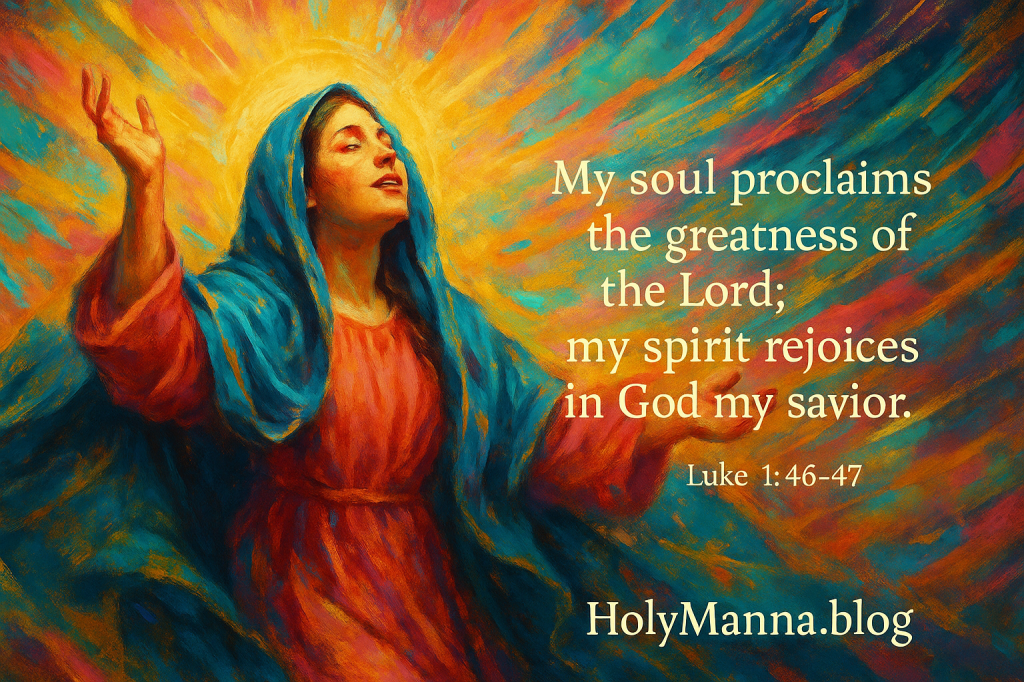
“My soul proclaims the greatness of the Lord;
47 my spirit rejoices in God my savior.
48 For he has looked upon his handmaid’s lowliness;
behold, from now on will all ages call me blessed.
49 The Mighty One has done great things for me,
and holy is his name.
50 His mercy is from age to age
to those who fear him.
51 He has shown might with his arm,
dispersed the arrogant of mind and heart.
52 He has thrown down the rulers from their thrones
but lifted up the lowly.
53 The hungry he has filled with good things;
the rich he has sent away empty.
54 He has helped Israel his servant,
remembering his mercy,
55 according to his promise to our fathers,
to Abraham and to his descendants forever.”
56 Mary remained with her about three months and then returned to her home.
Detailed Exegesis
Verse 39 – “During those days Mary set out and traveled to the hill country in haste to a town of Judah,”
Mary’s journey reflects both obedience and joy. The hill country recalls the region of Jerusalem, where God’s presence had historically dwelt in the Ark. Her “haste” suggests urgency not from fear, but from the overflow of grace. She carries within her the Word made flesh, and like David bringing the Ark to Jerusalem (2 Samuel 6:2), she brings God to Elizabeth.
Verse 40 – “where she entered the house of Zechariah and greeted Elizabeth.”
Mary’s greeting is more than a polite formality—it becomes a conduit for the Holy Spirit. The meeting of these two women bridges the Old and New Covenants: Elizabeth represents the promise to Israel; Mary carries the fulfillment. This moment becomes a sacred liturgy of encounter.
Verse 41 – “When Elizabeth heard Mary’s greeting, the infant leaped in her womb, and Elizabeth, filled with the holy Spirit,”
The unborn John leaps—literally “dances”—in the presence of Jesus. The Holy Spirit fills Elizabeth, highlighting Luke’s emphasis on divine inspiration. This is the first recognition of Christ’s presence by another human being, even in the womb. It is also a strong affirmation of the sanctity and spiritual life of the unborn.
Verse 42 – “cried out in a loud voice and said, ‘Most blessed are you among women, and blessed is the fruit of your womb.’”
Elizabeth’s words, now part of the Hail Mary, come from divine revelation, not just human affection. Her declaration affirms Mary’s role in salvation history and honors the child she bears. To be “blessed among women” recalls the honor given to Jael and Judith—women who delivered Israel—but Mary’s mission is far greater.
Verse 43 – “And how does this happen to me, that the mother of my Lord should come to me?”
This question is filled with humility and awe. Elizabeth recognizes Mary not just as cousin, but as “the mother of my Lord”—a clear affirmation of Jesus’ divinity. In the Greek, “Kyrios” refers to God. This anticipates the Church’s Marian doctrine and affirms Mary’s unique vocation.
Verse 44 – “For at the moment the sound of your greeting reached my ears, the infant in my womb leaped for joy.”
Joy is the fruit of divine presence. John’s leap is not merely physical—it is prophetic. Even in utero, he begins his mission as the forerunner of Christ. This verse also reminds us that spiritual realities transcend age or awareness—God’s grace touches even the unborn.
Verse 45 – “Blessed are you who believed that what was spoken to you by the Lord would be fulfilled.”
Faith is Mary’s distinguishing mark. Elizabeth praises Mary’s belief—not just in God’s power, but in His personal promise. This connects back to Abraham, who “believed, hoping against hope” (Romans 4:18). Mary becomes the model disciple, the one who hears and believes.
Verse 46 – “And Mary said: ‘My soul proclaims the greatness of the Lord;”
The Magnificat begins as Mary responds not with self-glorification, but with worship. Her soul magnifies God, reflecting His light like a holy lens. This echoes 1 Samuel 2—Hannah’s song—and places Mary in continuity with the faithful women of Israel.
Verse 47 – “my spirit rejoices in God my savior.”
Mary acknowledges her need for salvation, affirming her humility. Her joy is not rooted in circumstance, but in the character of God. She rejoices not in herself, but in Him who lifts the lowly.
Verse 48 – “For he has looked upon his handmaid’s lowliness; behold, from now on will all ages call me blessed.”
God exalts the humble. Mary’s “lowliness” reflects not shame, but spiritual poverty—complete dependence on God. Her blessedness is not prideful recognition, but the fruit of divine favor. This verse supports the Church’s ongoing veneration of Mary through all generations.
Verse 49 – “The Mighty One has done great things for me, and holy is his name.”
God’s actions define Mary’s identity. Holiness belongs to His name, and might to His deeds. She becomes the first evangelist, proclaiming the greatness of God with her whole being.
Verse 50 – “His mercy is from age to age to those who fear him.”
This line widens the lens to all who live in reverent awe of God. Mercy, the hesed of God, is not a passing feeling but a covenant reality. Mary understands herself as a participant in this eternal mercy.
Verse 51 – “He has shown might with his arm, dispersed the arrogant of mind and heart.”
God’s might disrupts human pride. The “arm” is biblical imagery for decisive action—God intervenes to defend the humble and dismantle the proud. Mary sees God’s justice as both personal and cosmic.
Verse 52 – “He has thrown down the rulers from their thrones but lifted up the lowly.”
This great reversal lies at the heart of the Gospel. God’s Kingdom inverts worldly power. This line echoes Zephaniah’s prophecy of God lifting His people and resonates with Christ’s Beatitudes.
Verse 53 – “The hungry he has filled with good things; the rich he has sent away empty.”
Spiritual hunger draws God’s favor. Mary does not romanticize poverty, but reveals that openness to God—not wealth—determines one’s share in the Kingdom. The Eucharist fulfills this longing for the Bread of Life.
Verse 54 – “He has helped Israel his servant, remembering his mercy,”
God is not forgetful. His covenant with Israel is alive in Mary’s womb. This verse affirms the continuity of the Old and New Testaments, showing that Jesus is the fulfillment of divine promises.
Verse 55 – “according to his promise to our fathers, to Abraham and to his descendants forever.”
Mary’s song ends in covenant memory. She places herself within God’s story, recognizing that what He began with Abraham finds fulfillment in her Son. This line roots the Incarnation in salvation history.
Verse 56 – “Mary remained with her about three months and then returned to her home.”
Mary’s stay shows the fruit of her visit: love made visible in presence. She serves Elizabeth with humility and then returns quietly, carrying within her the mystery of the world’s salvation.
Teachings of the Church
The Catechism of the Catholic Church affirms Mary’s unique role in salvation history, stating: “By her complete adherence to the Father’s will… the Virgin Mary is the Church’s model of faith and charity” (CCC 967). Her Magnificat is not just a personal hymn—it is the voice of the Church praising God for His saving work. As CCC 2619 teaches, “The prayer of Mary is revealed to us at the dawning of the fullness of time. Before the incarnation of the Son of God, and before the outpouring of the Holy Spirit, her prayer cooperates in a unique way with the Father’s plan of loving kindness.”
Saint Ambrose writes: “Mary’s soul was so filled with God that she bore Him not only in her womb but in every thought and action”. Her journey to Elizabeth was an act of radical charity and theological proclamation. As the Ark of the New Covenant, she brings Christ to others and causes joy to erupt. Her presence becomes a sanctifying presence, not by her own merit, but by the One she bears.
The Council of Ephesus (AD 431) proclaimed Mary as Theotokos, “God-bearer,” a title implicit in Elizabeth’s greeting: “the mother of my Lord”. This doctrinal declaration guards the truth of the Incarnation and affirms the unity of Christ’s divine and human natures. Mary’s “yes” enabled this mystery to unfold. Her song remains the anthem of every soul who surrenders to God’s will and magnifies His name.
Reflection
Do you recognize the presence of Christ when He comes to you through others? Mary’s visit to Elizabeth reminds us that God often arrives wrapped in humility, in the ordinary, and through those we least expect. Are you carrying Christ to others in joy? We are all called to be bearers of the Word—whether in a conversation, an act of mercy, or a silent prayer. Like Mary, let our souls magnify the Lord. What would it look like to live your life as a Magnificat? Take time today to pray the Magnificat slowly. Let Mary’s words become your own. Let her joy become yours. Let her humility reshape your heart. And in all things, rejoice—for the Mighty One has done great things for you.
Heaven Rejoices, So Should We
Today’s readings invite us into a holy symphony of joy—a joy born not from perfect circumstances, but from the overwhelming reality that God is in our midst. From Zephaniah’s prophetic declaration that the Lord sings over His people, to Isaiah’s fountains of salvation drawn with joy, and finally to the sacred encounter between Mary and Elizabeth in Luke, we are immersed in the song of salvation. God is not far off. He comes close. He dwells within us, and He delights in us.
Each reading reveals the heart of the Father, who does not merely tolerate His people but rejoices in them. He removes shame, casts out fear, fills the hungry, and lifts up the lowly. In Mary, we see the model of one who receives God with humility and immediately brings Him to others. Her Magnificat is the natural outpouring of a soul that knows it is loved and chosen. This is our calling too—not just to know about God, but to carry Him, to proclaim Him, and to rejoice in Him.
What song is your soul singing today? Do you believe that the Lord rejoices over you? Let your heart be awakened by these readings. Let your fears be quieted by the presence of the Mighty One. And let your life become a living Magnificat—a praise-filled witness that announces to the world: “The Holy One of Israel is great in our midst”. Today, rejoice. Let heaven’s joy become your own.
Engage with Us!
We’d love to hear how today’s readings moved your heart. What stood out to you? What did you feel God whispering to your soul through His Word? Share your reflections in the comments below—we’re walking this journey of faith together, and your insight may be exactly what someone else needs to hear today!
Reflection Questions:
First Reading – Zephaniah 3:14–18
Do you believe God delights in you and sings over you? What fears or discouragements is God asking you to release today so that He can renew you in His love?
Responsorial Psalm – Isaiah 12:2–6
From which “wells” are you drawing your strength each day—are they rooted in God’s salvation? How can you proclaim God’s goodness to someone in your life this week?
Holy Gospel – Luke 1:39–56
What part of Mary’s Magnificat speaks most deeply to your current spiritual journey? Like Mary, how are you being called to carry Christ to others with joyful urgency?
Let’s go forward filled with the joy of the Lord, remembering that we are not alone—He is with us, He rejoices over us, and He invites us to live as witnesses of His mercy and love. Whatever you do today, let it be done with the compassion, humility, and radiant joy that Jesus taught us.
Follow us on Instagram and Facebook for more insights and reflections on living a faith-filled life.

 Holy Manna!
Leave a comment