Heaven’s Warrior
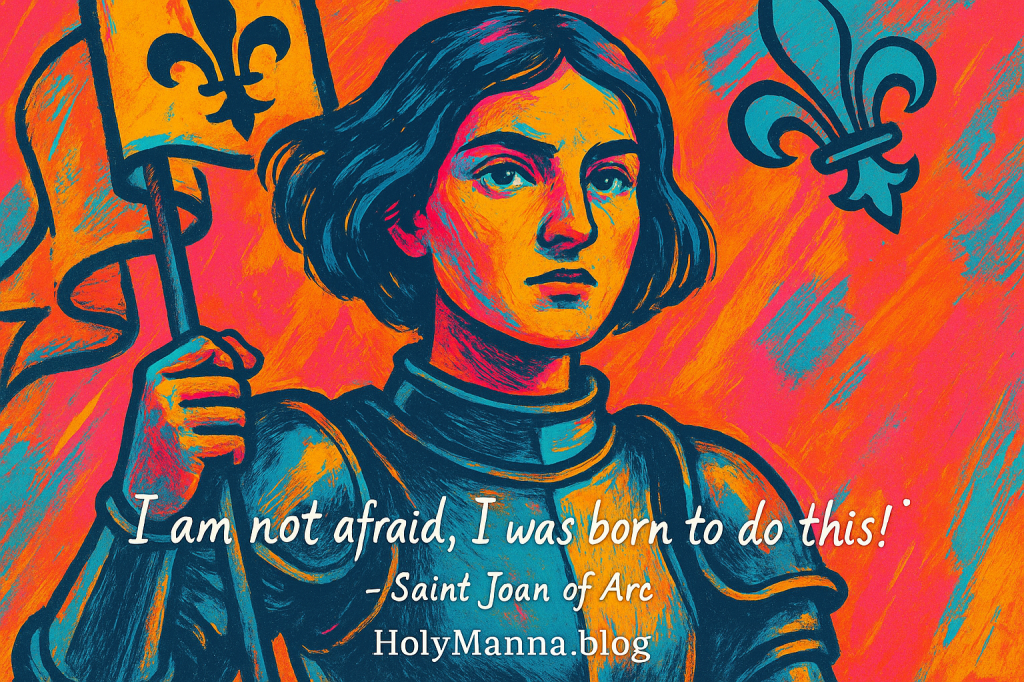
“I am not afraid, I was born to do this!”
With these thunderous words, Saint Joan of Arc declared not only her mission but her very identity. She is one of the most unique and awe-inspiring figures in the communion of saints—unlettered yet divinely wise, young yet spiritually mature, female yet a leader of armies in a male-dominated world. The Church reveres her not just for her military victories but for her heroic virtue, obedience to God, and unshakable purity. She is the patroness of France, soldiers, captives, and those who are ridiculed for their faith. Her story is not simply a historical account of war and politics, but a holy epic—a sacred drama in which Heaven reached down and found, in the fields of Domrémy, a peasant girl whose “yes” would echo through centuries.
Joan’s greatness does not rest in battlefield strategy or political power, but in her singular focus on God’s will. When Heaven called, she responded. When men mocked, she persevered. When the flames rose, she whispered the sweetest name—“Jesus.” In a world that teaches us to seek power and prestige, Joan reminds us that sanctity is found in obedience, sacrifice, and faith.
The Maid of Domrémy
Joan of Arc was born around the feast of the Epiphany, on January 6, 1412, in the humble village of Domrémy in northeastern France. Her parents, Jacques and Isabelle d’Arc, were poor but devout farmers who instilled in their daughter a deep love for the Church and reverence for the sacraments. From a young age, Joan stood out among her peers—not for wealth or brilliance, but for her intense devotion. She attended daily Mass whenever possible, spent hours in prayer, and was known to give alms to the poor even from her family’s limited means. Her deep interior life blossomed in silence and simplicity.
At the age of 13, everything changed. While in her father’s garden, Joan received her first mystical vision. Appearing before her was Saint Michael the Archangel, flanked by Saint Catherine of Alexandria and Saint Margaret of Antioch. These heavenly voices would appear to her regularly for years, revealing God’s will for her life. Their divine message was both clear and astounding: she was to help deliver France from English occupation and ensure the coronation of Charles VII as rightful king.
Joan, uneducated and female in a world where neither was deemed fit for leadership, resisted at first. But grace prevailed. “You must go to the Dauphin,” her voices said. And she obeyed. Trusting that God would provide the strength she lacked, she made her way—through enemy territory and political scorn—to gain an audience with the future king. There, in a private moment known only to the two of them, she confirmed a secret known only to Charles, which led to her gaining his trust.
Joan would go on to lead French troops to several crucial victories, most notably the lifting of the siege of Orléans in 1429. Her presence inspired courage in the soldiers, and her unwavering faith acted as a shield far greater than steel. She was nicknamed La Pucelle d’Orléans—the Maid of Orléans—and became a symbol of divine hope for a war-torn nation. But her mission was never about military conquest. It was about fidelity to God’s voice, and about the restoration of rightful order through divine providence.
Heaven’s Hand on the Battlefield
Though Joan of Arc never performed miracles in the traditional sense, her entire life was steeped in the miraculous. Her success in war, without any military training, confounded experts. Her survival in countless dangerous situations seemed to defy natural law. The hand of God was evident to both friend and foe.
One of the most striking moments occurred during the siege of Orléans. Joan was shot through the shoulder with an English arrow. While her comrades feared the worst, she asked only for the arrow to be removed, prayed, and reentered the battlefield by evening. Such resilience, combined with her insistence on moral reform among her troops, drew reverence. She forbade blasphemy, required her soldiers to go to confession, and insisted that prostitutes be removed from military camps—under penalty of banishment. Her camp was marked not by debauchery but by devotion. She had a banner, not a sword, which she carried into battle—a white standard bearing the names Jesus and Mary.
She also displayed extraordinary discernment and prophetic knowledge. She once predicted a defeat at Paris if the troops did not wait, and her warning came true. Her voices, she said, gave her strength and insight that confounded even learned theologians. Those who encountered her in these moments often came away convinced of her divine calling. She did not seek glory, riches, or fame—only the fulfillment of God’s will.
A Crown of Thorns
After Charles VII was crowned in Reims—thanks largely to Joan’s guidance—political winds began to shift. Joan had fulfilled her mission, but she had become a threat to the established powers, even within the French court. In 1430, she was captured by the Burgundians and sold to the English. Her imprisonment marked the beginning of one of the most tragic and unjust trials in Church history.
Though the trial was cloaked in ecclesiastical form, it was a farce from the beginning. Joan was imprisoned in a secular English military prison, guarded by men rather than nuns—an unusual and dangerous arrangement for a young woman who had vowed perpetual virginity. She was interrogated for months by hostile clergy, led by Bishop Pierre Cauchon, who sought to condemn her for political gain. They accused her of heresy, witchcraft, and most famously, for wearing male clothing.
Joan stood firm, always appealing to her Lord. When they mocked her, she replied with humility. When they tried to trip her up theologically, she answered with profound wisdom. When asked if she was in a state of grace—a trap question—she replied, “If I am not, may God put me there; and if I am, may God so keep me.” Her responses stunned her inquisitors and revealed a soul intimately united with God.
Eventually, under threat of torture and execution, Joan signed a recantation. But shortly after, she returned to wearing male clothing, likely to protect herself from abuse. This was used as a pretext to condemn her. On May 30, 1431, at the age of 19, she was led to the stake in Rouen. She asked for a cross to be held before her and cried out the name “Jesus” again and again until the flames consumed her.
Witnesses reported that her heart remained intact and unburnt. Even her enemies were shaken. One English soldier, upon seeing her die, exclaimed, “We are lost! We have burned a saint!”
Twenty-five years later, Pope Callixtus III opened a retrial. After extensive testimonies, Joan was declared innocent and a martyr. Her canonization in 1920 recognized what Heaven had declared all along.
A Legacy Set Aflame by God
Though her life was short, Joan of Arc’s influence did not end at the stake. Since her death, countless miracles and conversions have been attributed to her intercession. Pilgrims who visit Domrémy or Rouen testify to deep spiritual renewal. Devotion to her has flourished across the globe—not only in France but among all who seek courage in adversity.
Her relics—what little remained—were dispersed or lost. But her legacy has proven more indestructible than bone or ash. She has appeared in visions to the faithful, inspired writers like Mark Twain and Charles Péguy, and even became the subject of liturgical prayers. In The Catechism of the Catholic Church, she is held up as a model of the sensus fidei—the deep intuition of the faithful that transcends theological education (cf. CCC 91).
Saint Thérèse of Lisieux, another beloved French saint, regarded Joan as her spiritual sister and even portrayed her in a play she wrote. To this day, the Church invokes Joan as a protector of the innocent, a defender of truth, and a champion of divine mission in the face of worldly opposition.
Flame of Faith
What does Saint Joan of Arc offer us today? She reminds us that the call of God does not conform to the expectations of the world. God calls whom He wills, regardless of age, education, or background. He speaks to the humble, and through their faith, moves mountains.
Joan’s life challenges us to listen. Are we attentive to the whispers of God in our daily routines? Her purity in the midst of immorality encourages us to pursue holiness with tenacity. Do we guard our hearts and bodies with the reverence they deserve? Her forgiveness of enemies, even those who murdered her, invites us to radical mercy. Can we extend grace where the world demands revenge?
The armor Joan wore was not made of iron, but of prayer, obedience, and trust. Her victories were not hers, but God’s. May we take up our own spiritual armor and walk boldly into the battles God calls us to fight—armed not with swords, but with love, faith, and the name of Jesus on our lips.
Engage with Us!
We’d love to hear your reflections and insights! Share your thoughts in the comments below and join us in growing together in faith.
Reflection Questions:
- Have you ever felt called to do something outside your comfort zone? How did you respond?
- What does courage in faith look like in your life today?
- How can you, like Saint Joan, listen more attentively to the voice of God?
Let us walk with the saints, learn from their example, and support one another on this journey. May we do everything with love, as Christ has taught us, and fearlessly follow His voice—wherever it leads.
Saint Joan of Arc, pray for us!⚜️
Follow us on Instagram and Facebook for more insights and reflections on living a faith-filled life.

 Holy Manna!
Leave a comment